.png)
What is visual search? A guide for 2026


TL;DR:
Visual search is transforming online discovery by analyzing images instead of keywords, leading to significant increases in e-commerce conversions. Major platforms process billions of searches monthly, emphasizing the importance of high-quality, well-structured visual assets for optimal AI ranking. Businesses must optimise their images proactively to stay competitive in this evolving digital landscape.
Google Lens now processes over 20 billion image searches every single month, and 4 billion of those have direct shopping intent. That one figure tells you everything about where discovery is heading. Visual search, the ability to use an image rather than typed words to find information or products online, has moved from novelty to commercial infrastructure in the space of a few years. This guide explains what visual search is, how it works under the hood, why it matters for e-commerce and marketing, and what you can do right now to stay ahead of it.
Table of Contents
Key takeaways
Point | Details |
Visual search uses AI, not keywords | AI analyses pixels and patterns rather than typed words to return relevant results. |
Scale is already enormous | Google Lens handles 20 billion monthly searches; Pinterest processes 80 billion, half with commercial intent. |
Conversion impact is measurable | Retailers using visual search report a 38% uplift in conversions versus traditional text search. |
Image quality is now a ranking factor | AI ranks images by visual composition and user behaviour, not just metadata or captions. |
Marketers need to act now | Optimising visual assets for AI perception is becoming as important as keyword strategy. |
What is visual search and how does it work?
Visual search is a technology that lets users submit an image, a photo, a screenshot, or a camera feed as their search query instead of typing words. The system analyses that image and returns results based on what it sees: objects, colours, shapes, styles, and context. Think of it as giving the internet the ability to see, rather than just read.
Under the surface, how does visual search work? It starts with a process called feature extraction. An AI model converts the submitted image into a high-dimensional mathematical representation called a feature vector. This vector captures everything distinctive about the image: the curve of a chair leg, the weave pattern of a fabric, the dominant colour palette of a room. The system then compares that vector against millions of indexed images to find the closest matches.
The key building blocks of modern visual search include:
Convolutional neural networks (CNNs) that scan images in layers, detecting edges first, then shapes, then complex objects
Labelled training data that teaches the model what a “sofa” or a “Chelsea boot” actually looks like across thousands of variations
Similarity scoring that ranks results by how closely their feature vectors match the query image
Natural language processing (NLP) layered on top so that text context, where available, refines the results further
The most widely used visual search engines today include Google Lens, Bing Visual Search, and Pinterest Lens. Each applies these principles slightly differently, but all rely on the same core AI architecture.
Pro Tip: High-quality images are not just for aesthetics. The sharper and better-composed your product photography, the more accurately AI can extract features and surface your content in visual search results.
Visual search for e-commerce: applications and impact
If you sell products online, visual search is arguably the single most consequential technology shift happening in discovery right now. The global visual search market is valued at $5.68 billion, with retail and e-commerce accounting for 29% of that revenue. Those numbers reflect a genuine change in how people find things to buy.

The clearest use case is product discovery when a shopper cannot describe what they want. Someone spots a lamp in a television programme, a pair of trainers on a stranger, or a tile pattern in a café. They cannot type an accurate description because they do not know the product name, the brand, or the right vocabulary. Visual search cuts through that barrier completely. They photograph it, and the engine finds it.
Search method | Conversion rate uplift | Purchase likelihood |
Traditional text search | Baseline | Baseline |
Visual search | +38% for retailers | 37% more likely to buy |
Retailers using visual search report a 38% rise in conversions, and users are 37% more likely to complete a purchase compared to those using text search alone. Those are not marginal gains.
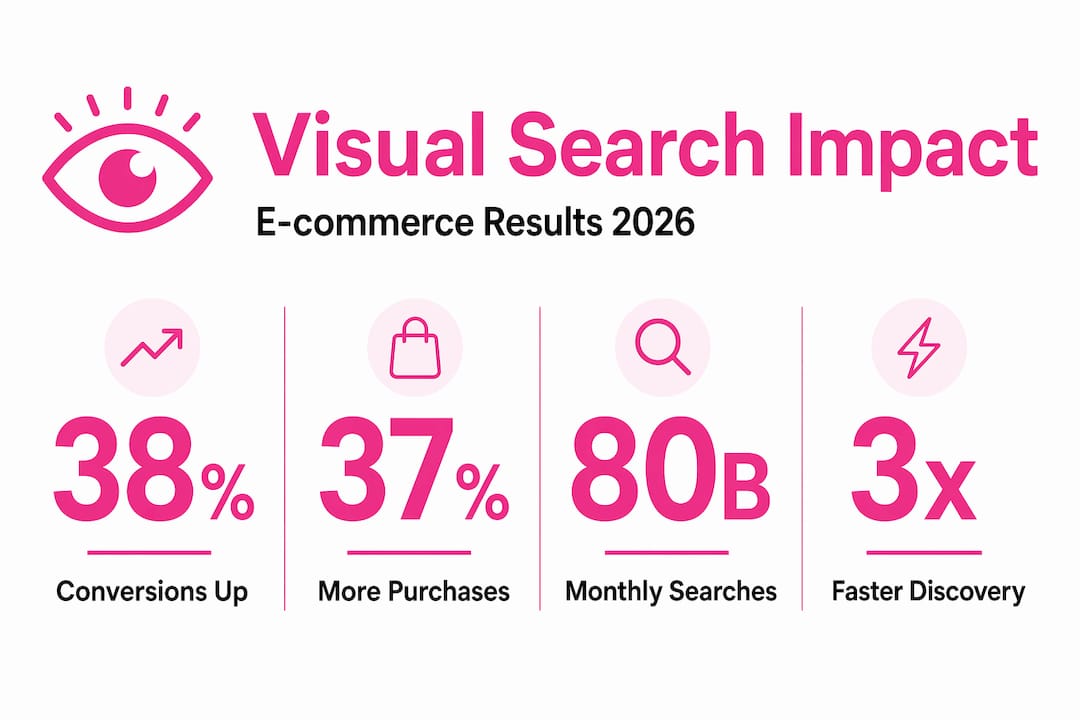
Beyond exact product matching, visual search technology examples show something even more interesting commercially. Because AI uses feature vectors to surface complementary items rather than just identical matches, a search for a grey linen sofa might return cushions, rugs, and side tables that share the same aesthetic. That behaviour increases average order values, not just individual product sales.
Pinterest demonstrates the commercial scale possible here. The platform handles 80 billion monthly visual searches, with approximately half carrying commercial intent, generating $1.01 billion in revenue in Q1 2026 alone. Pinterest is, at its core, a visual search engine that monetises discovery.
Pro Tip: Do not just optimise your product images for human eyes. Structure your visual assets with clear backgrounds, strong contrast, and consistent styling so AI systems can extract features cleanly and rank your products accurately.
AI and multimodal models: the next frontier
The capabilities driving visual search have advanced considerably beyond simple image matching. Modern systems use what are called multimodal AI models, meaning they process images and text together as a unified input rather than as separate signals. This allows them to understand context, not just content.
One of the most significant recent developments is what Google calls the fan-out technique. When you submit a photo of a living room, older systems would attempt to identify one dominant object and search for that. Google’s AI now simultaneously identifies multiple objects within the same image: the sofa, the rug, the lamp, the coffee table. It runs parallel searches for each and then synthesises those results into a cohesive, contextual response rather than a fragmented list.
This multi-object reasoning is why visual search evolved from returning isolated results to providing exploratory, room-level or outfit-level suggestions. The shift is meaningful for users because it maps to how people actually think about style and purchasing decisions.
Here is what the current generation of AI-powered visual search engines does that earlier versions simply could not:
Recognise multiple objects in a single frame and query them simultaneously
Combine visual data with the surrounding text on a webpage to refine intent
Assess the emotional or stylistic tone of an image (minimalist, maximalist, vintage) and match that to indexed content
Learn from user engagement signals so that images people click on and buy from rank higher over time
That last point matters enormously for SEO. Image composition quality now outweighs traditional metadata like captions and alt text in AI-driven content ranking. A beautifully composed photograph of a product, in the right context, on a page with strong engagement signals, will outrank a cluttered image with perfectly optimised metadata. The rules of the game have genuinely shifted.
Leveraging visual search for marketing and SEO
Understanding what visual search is only gets you so far. The more pressing question for marketers and e-commerce operators is what to do about it. The answer starts with treating your visual assets as a search channel in their own right.
Traditional SEO focuses on keywords, backlinks, and page authority. Visual SEO builds on top of that with a different layer of signals: image clarity, composition, subject isolation, lighting, and the behavioural data your images generate. AI ranks images based on these visual elements and user behaviour patterns, so the quality of what you publish matters more than the text surrounding it.
Practical steps for aligning your content with visual search:
Photograph products on clean, neutral backgrounds so AI can isolate the subject clearly and extract accurate feature vectors
Maintain consistent visual style across your catalogue so that AI systems can group and contextualise your products as a coherent range
Use high resolution images at multiple angles because AI models are trained on varied perspectives and reward depth of visual information
Optimise for speed and mobile because visual search queries happen predominantly on smartphones and a slow-loading image is an invisible image
Structure your image SEO strategy to include alt text, structured data, and descriptive file names alongside the visual quality improvements
Visual search also shortens the sales funnel in a way that text search rarely achieves. When a user finds your exact product through a camera query, purchase intent is already at its peak. They saw the thing, they want the thing, and your visual search optimisation put your product in front of them at that precise moment. Combining this with the broader digital marketing trends shaping e-commerce gives you a layered competitive advantage.
The benefits of visual search for businesses are specific and measurable: higher conversion rates, increased average order values through complementary product discovery, reduced search abandonment because users no longer need to find the right words, and stronger engagement with your visual content across platforms.
My perspective on where visual search is actually heading
I have been watching search technology evolve for over two decades, and visual search is one of the few developments that I think is genuinely misunderstood by the majority of marketers. Most people treat it as a sophisticated reverse image lookup. A clever party trick. It is not.
What I find compelling, and a little urgent, is that visual search is fundamentally an intent signal. When someone points a camera at a product, the ambiguity that kills text search is gone. There is no keyword mismatch, no typo, no semantic gap between what they mean and what they typed. The intent is crystal clear, and visual search bridges that keyword gap in a way that no amount of long-tail keyword research can replicate.
What I have learned from working with e-commerce brands is that the businesses who are slow to optimise their visual content are going to feel it. Not gradually, but in a step-change as AI-powered discovery reaches mainstream adoption. The brands that invested in image quality and structured data two years before it mattered for text SEO are the ones who dominated rankings. The same pattern is playing out now with visual assets.
The one pitfall I see constantly is marketers focusing on the platform rather than the asset. They ask “should we be on Google Lens or Pinterest?” when the real question is “are our images good enough for AI to understand and rank?” Get the assets right. The platforms will find them.
— Darren
Ready to get your visual presence working harder?
Visual search is already reshaping how shoppers find and buy products. If your image assets are not optimised for AI-driven discovery, you are leaving measurable revenue on the table.

At Iwanttobeseen, we specialise in helping e-commerce brands build the kind of digital visibility that actually converts. Our team understands how image optimisation feeds into AI-driven search ranking, and how that connects to your wider SEO and paid media performance. Whether you are starting from scratch or auditing an existing catalogue, we can help you build a visual strategy that AI systems reward. Explore how our SEO services can improve your discoverability across both traditional and visual search, and get your products in front of the right people at exactly the right moment.
FAQ
What is visual search in simple terms?
Visual search lets you use an image instead of typed words to find information or products online. AI analyses the image and returns the most visually and contextually relevant results.
How does visual search differ from text search?
Text search relies on keywords, while visual search analyses pixels, shapes, colours, and patterns to understand a query. Visual search removes the need to describe what you are looking for in words.
Which platforms use visual search technology?
Google Lens, Pinterest Lens, and Bing Visual Search are the most widely used visual search engines. Google Lens alone processes over 20 billion image searches per month, with 4 billion linked to shopping intent.
Does visual search actually improve e-commerce conversion rates?
Yes. Retailers that implement visual search report a 38% increase in conversions, and users are 37% more likely to complete a purchase compared to those using traditional text search.
How can businesses optimise for visual search?
Focus on image quality over metadata. AI ranks content by visual composition, clarity, contrast, and user engagement. Clean backgrounds, high resolution, and consistent product photography are the most impactful starting points.
Recommended
Comments