.png)
What is user generated content in 2026?


TL;DR:
User generated content includes unpaid photos, reviews, and social posts created by genuine customers, enhancing trust and conversions. Its strategic use on product pages and with authentic, compliant content drives significant business results and brand credibility. Effective UGC management requires consent, transparency, moderation, and ongoing performance measurement to maximize its impact.
Most marketers assume user generated content means a blurry photo tagged on Instagram or a rambling product review. That framing costs businesses real money. In reality, understanding what is user generated content, and deploying it deliberately, is one of the most potent tools available to brands right now. UGC is created by unpaid contributors and spans photos, videos, reviews, social posts, and survey responses. It is organic, peer-endorsed, and trusted in ways that polished brand advertising simply cannot replicate. This guide cuts through the noise and gives you a clear, strategic picture of what UGC is, why it works, and how to use it well.
Table of Contents
Key takeaways
Point | Details |
UGC is unpaid and authentic | Content created voluntarily by real customers carries far greater credibility than brand-produced material. |
Conversions rise sharply with UGC | Pages featuring UGC see 6.73x higher conversions than pages without it, according to Emplifi Q1 2026 data. |
Trust demands transparency | Undisclosed paid content and AI-generated reviews actively repel consumers and damage brand credibility. |
Legal compliance is non-negotiable | Solicited or compensated UGC requires clear disclosure under FTC guidelines, regardless of platform. |
Product pages are the priority | UGC delivers its biggest commercial impact on product and landing pages, not just social feeds. |
What user generated content actually is
The definition of user generated content is straightforward: it is any content created by people who are not on your payroll, made available for public consumption. Google categorises UGC as content submitted by users including video, podcasts, and social media posts. That scope is broader than most business owners realise.
The types of user generated content worth understanding fall into several distinct categories:
Content type | Common platforms | Format |
Product reviews and ratings | Amazon, Trustpilot, Google | Text, star rating |
Social media posts | Instagram, TikTok, X | Image, short-form video |
Q&A and forum discussions | Reddit, Quora, brand websites | Text threads |
Unboxing and demo videos | YouTube, TikTok | Long and short-form video |
Survey responses | Brand checkouts, email campaigns | Structured data |
Customer photos | Brand hashtag feeds, product pages | Image, carousel |
The critical distinction is between UGC and branded content or paid endorsements. Squarespace describes unpaid UGC as content users share without compensation, reflecting genuine interest. Once payment or free product enters the equation, the content shifts into a different legal and strategic category. That distinction shapes everything from how you collect it to how you display it.
Why the benefits of user generated content are so significant
The commercial case for UGC is not a matter of opinion. It is a matter of data, and the 2026 numbers are striking.
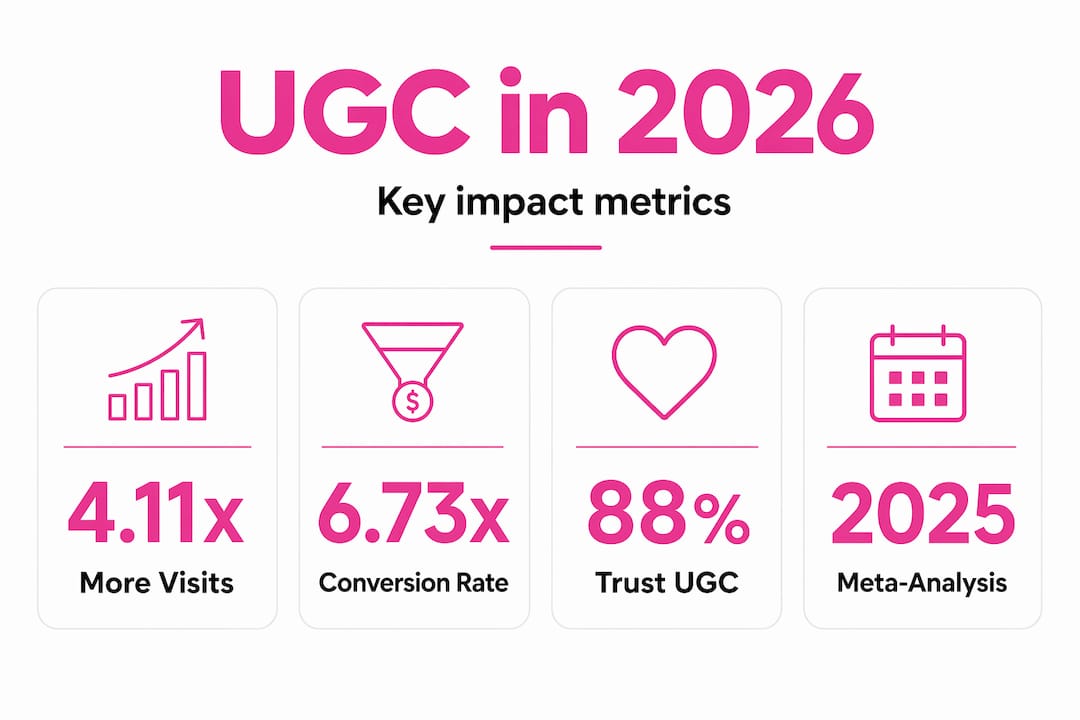
Pages featuring UGC show 4.11x higher visits and 6.73x higher conversions than those without. Short-form video and carousels are performing best. These are not marginal gains. They represent the difference between a product page that converts browsers into buyers and one that does not.
Beyond raw conversion data, the benefits of user generated content include:
Trust signals at scale. UGC functions as organic peer endorsement. It feels less salesy than advertising because it is. Consumers know the difference.
Content volume without production costs. Every customer photo, review, or tagged post is content your team did not have to brief, shoot, or edit.
SEO value through fresh content. Search engines reward pages that are regularly updated with relevant, original text. Reviews and Q&A threads do exactly that.
Organic reach amplification. When a customer posts about your brand, their audience sees it. You gain exposure you did not pay for.
Deeper engagement metrics. Visitors who interact with UGC on product pages spend longer on site and show stronger purchase intent, as measured by the engagement and traffic data that smart eCommerce operators track closely.
The importance of user generated content becomes clearest when you compare it to paid advertising. A well-placed customer video on a product page does more persuasive work than a brand-produced banner ad because the viewer understands intuitively that no one is being paid to say something nice.
Risks and challenges you cannot afford to ignore
UGC is not a set-and-forget strategy. There are real pitfalls, and underestimating them is how brands damage the trust they are trying to build.

The biggest risk is inauthenticity. Consumers are sharper than ever at detecting manufactured enthusiasm. 88% of consumers oppose AI-generated reviews and actively seek genuine, firsthand experiences. If your UGC strategy leans on AI-written testimonials or suspiciously uniform five-star reviews, consumers will notice. When they do, the reputational damage outweighs whatever short-term uplift you gained.
A meta-analysis of 128 studies published in 2025 confirms that UGC only works when digital trust conditions are met. Misrepresented or aggressively filtered content erodes the very trust you are trying to build. Showing only glowing reviews while burying legitimate criticism is counterproductive. Consumers see curated perfection as a red flag.
Legal compliance adds another layer of complexity. Marketers must disclose material connections under FTC Endorsement Guides whenever there is any material relationship between the brand and the content creator. That includes free products, discounts, or payment. The disclosure must be clear and conspicuous, not buried in a hashtag pile or a caption footnote. Failure to comply risks regulatory action and, more immediately, public trust.
Practical risks to manage include:
Fake or incentivised reviews that distort your average rating and breach platform terms
Inappropriate or off-brand content submitted through hashtag campaigns
Privacy violations when using customer images without explicit permission
Brand safety issues when UGC appears alongside third-party content you cannot control
Pro Tip: Set up a moderation workflow before you launch any UGC campaign. Define what content you will feature, what you will remove, and what you will leave without engaging. Publish your moderation policy publicly. Transparency in how you handle content is itself a trust signal.
How to leverage user generated content effectively
Knowing the importance of user generated content is one thing. Building a strategy around it is another. Here is a practical framework for doing it properly.
1. Decide whether you are curating organic UGC or soliciting it. Organic curation means monitoring brand mentions, hashtags, and review platforms, then requesting permission to republish content. Solicited UGC means actively asking customers to create content, sometimes with incentives. Both operational modes have compliance implications that must be factored in from the start.
2. Prioritise your product and landing pages. UGC delivers its biggest impact on product and landing pages, where shoppers are actively deciding whether to buy. Place customer photos, video reviews, and star ratings where they are most visible at decision time.
3. Choose the right formats for each platform. Short-form video and carousel posts outperform static images across most social platforms in 2026. For product pages, a mix of written reviews with photos converts better than either alone.
4. Use moderation to maintain credibility, not to manufacture perfection. Research shows that moderation preserving authentic details, including constructive criticism, builds more trust than only showcasing five-star content. Feature reviews that mention both strengths and genuine product nuances.
5. Always secure rights before republishing. A direct message asking for permission, with a clear description of how you intend to use the content, protects you legally and often delights the creator. It also signals respect for your community.
6. Integrate UGC into your wider content marketing. Customer stories and testimonials belong not just on product pages but in email campaigns, paid social ads, and case studies. Your eCommerce content strategy should treat UGC as a standing content source, not a one-off campaign tactic.
7. Build community touchpoints that generate UGC naturally. Post-purchase emails, loyalty programmes, branded hashtag campaigns, and Q&A sections on product pages all create low-friction opportunities for customers to contribute content.
Measuring UGC impact and refining your approach
Is user generated content effective? Only if you measure it. Deploying UGC without tracking performance is how brands waste the opportunity.
The key metrics to watch are:
Metric | What it tells you |
Conversion rate on UGC pages vs. non-UGC pages | Direct commercial impact of content placement |
Time on page | Whether UGC is keeping visitors engaged |
Organic search traffic | Whether fresh UGC is improving search visibility |
Review sentiment trend | Whether product quality and brand perception are improving |
Social reach from UGC posts | Organic amplification beyond your own audience |
AI-powered tools can now surface relevant UGC at scale, flagging content by sentiment, keyword, and engagement level. This matters because manually monitoring brand mentions across platforms is not sustainable once volume grows. The right tools make it possible to maintain quality moderation without a large team.
The single most common mistake brands make is optimising for review volume rather than review quality. A hundred thin, generic reviews do far less persuasive work than twenty detailed, specific ones. Prioritise depth of content over quantity. Consumers seeking information before purchase respond to specificity. Vague praise does not move them.
The content marketing ideas that perform best in eCommerce are almost always those rooted in genuine customer experience. UGC is the most direct expression of that experience.
My take on UGC after 25 years in eCommerce
I have watched brands chase volume with UGC and then wonder why it is not moving the needle. Here is what I have learned: the number of reviews you have matters far less than whether those reviews feel real.
In my experience, the brands that get UGC right treat it as a relationship, not a content pipeline. They respond to reviews, feature real customers by name, and show the occasional imperfect piece of content precisely because doing so signals confidence. Hiding anything less than perfect tells consumers you are curating a fiction.
I have also seen legal compliance treated as an afterthought, and it always catches up with brands eventually. The FTC rules around disclosure are not difficult to follow. They just require you to take them seriously from day one. Authenticity and compliance are not in tension. They reinforce each other.
What has shifted most clearly in recent years is that UGC has moved from something nice to have to something structurally necessary. Consumers in 2026 actively distrust brands that rely entirely on their own voice. They want to hear from people like them. If your marketing does not include that, you are at a genuine disadvantage. Not theoretically. Practically.
— Darren
Grow your brand with a smarter content strategy
If you have read this far, you already understand that UGC is not a passive benefit. It requires deliberate strategy, the right tools, and the discipline to manage it properly over time.

At Iwanttobeseen, we have spent over 25 years scaling eCommerce brands, and we know how to build content ecosystems where UGC works alongside SEO, social, and paid media rather than in isolation. Whether you need help with review management to protect and build your brand’s credibility, or a full digital marketing strategy that puts UGC at the centre of your growth plan, we are ready to help. Get in touch and let us show you what a properly integrated UGC approach looks like in practice.
FAQ
What is user generated content?
User generated content is any content created by unpaid contributors for public consumption, including photos, videos, reviews, social posts, and survey responses. It differs from brand-produced content because it originates from genuine customer experience rather than a marketing brief.
Is user generated content effective for eCommerce brands?
Yes. According to Emplifi Q1 2026 data, pages featuring UGC see 4.11x more visits and 6.73x higher conversions than pages without it. Product and landing pages see the greatest commercial benefit.
What are the main types of user generated content?
The main types include product reviews, customer photos, unboxing videos, social media posts, Q&A threads, and survey responses. Short-form video and carousels are the highest-performing formats in 2026.
Do brands need permission to use customer content?
Yes. Using customer images or videos without explicit permission creates legal and reputational risk. Always request rights directly before republishing any piece of customer-created content.
How do I stay compliant when using UGC in marketing?
Any UGC that involves payment, free products, or other material incentives must carry a clear and conspicuous disclosure under FTC Endorsement Guides. Organic, unpaid UGC carries no disclosure requirement, but rights to republish must still be obtained.
Recommended
Comments