.png)
Social media launch strategy for UK ecommerce brands


TL;DR:
A structured social media launch strategy is essential to build momentum, engagement, and sales for ecommerce brands.
Effective pre-launch preparation includes audience research, platform selection, content batching, and clear goal setting to ensure a polished rollout.
Launching a product on social media without a clear social media launch strategy is like opening a shop and forgetting to unlock the door. You might have an excellent product, polished visuals, and a competitive price, yet without a structured plan, your posts disappear into an algorithm with no momentum behind them. Launching in phases rather than posting randomly is what separates the brands that break through from those that post twice and go quiet. This guide gives UK and Irish ecommerce owners a step-by-step framework to build real visibility, real engagement, and real sales from day one.
Table of Contents
Preparing your social media launch
Before you write a single caption or record a single Reel, the groundwork determines everything. Brands that skip preparation end up improvising during launch week, which is precisely the moment you need to be focused on engagement, not scrambling to create content.
Start with audience research. Know where your ideal customers spend time, what language they use, what problems they have, and what type of content they share. Use platform analytics, community groups, and competitor comment sections to gather insight. This is not optional desktop research. It informs every creative decision you make.
Platform selection matters more than most brands realise. You cannot launch effectively on Instagram, TikTok, Pinterest, Facebook, LinkedIn, and X simultaneously. Pick two or three platforms where your target audience is genuinely active, and build depth there rather than spreading your effort thin. For most UK consumer ecommerce brands, Instagram and TikTok are the primary starting point. B2B or trade-facing brands may favour LinkedIn.
Key preparation steps
Define your brand voice, visual identity, and core messaging before creating any assets
Claim your brand handles on every major platform, even ones you are not yet using, to prevent squatting
Set clear objectives and brand positioning separately from your posting plan to avoid rework and confusion
Research two or three direct competitors and audit their social presence for gaps you can exploit
Identify your content pillars, the three to four recurring themes your brand will own on social media
Once strategy is locked, move to content production. Create 20 to 30 pieces of content before launch week so you are never building assets while simultaneously managing engagement. This is one of the most overlooked elements of planning social media launches, and it is the difference between a brand that looks polished under pressure and one that visibly falls apart.
Preparation task | Why it matters | When to complete |
Audience and competitor research | Informs every creative decision | 4 to 6 weeks before launch |
Platform selection | Focuses effort and budget | 4 weeks before launch |
Brand handle claiming | Protects brand consistency | As early as possible |
Content batch creation (20 to 30 pieces) | Frees you to engage during launch | 1 to 2 weeks before launch |
Strategy vs plan separation | Reduces rework, improves clarity | 3 to 4 weeks before launch |
Pro Tip: Build your ecommerce content strategy around content pillars before scripting individual posts. It keeps every piece connected to a broader brand narrative rather than feeling like random posts.
Executing a phased social media launch plan
A well-structured social media launch plan does not start on launch day. It starts weeks before, using a deliberate sequence to build anticipation, warm up the algorithm, and give your audience a reason to pay attention. A phased approach, covering pre-launch, teaser, launch day, and post-launch momentum, is what creates ongoing engagement rather than a one-day spike that flatlines.
The five-phase launch sequence
Awareness phase (2 to 4 weeks before launch): Introduce your brand story, founder journey, and the problem your product solves. No product reveal yet. Build intrigue.
Teaser phase (1 to 2 weeks before launch): Share cryptic hints, partial product visuals, and countdowns. Encourage followers to guess, tag friends, and share.
Launch day: Publish a content calendar with varied posts timed across morning, midday, and evening. Mix a product reveal post, a behind-the-scenes piece, a social proof asset, and a clear call to action.
Post-launch engagement (days 2 to 7): Answer questions, share user-generated content, post FAQs, and sustain the conversation. Use a 7-day content plan mixing brand story, educational posts, proof, and soft calls to action.
Community building (weeks 2 to 4 post-launch): Shift from broadcasting to conversations. Feature customers, share results, and introduce secondary products or offers.
The single most underrated part of any social media engagement strategy is response speed. Respond to every comment, DM, and mention within the first 48 hours of launch. This is not about being polite. It signals to the algorithm that your content is generating meaningful interaction, which expands reach dramatically.
Launch day content checklist
Hero product reveal post with strong visual and clear benefit statement
Behind-the-scenes story content showing the team or the process
Social proof post using early testimonials, press mentions, or pre-order reviews
Educational post addressing the primary customer problem your product solves
Evening engagement post encouraging interaction, such as a poll or question
Launch phase | Content type | Primary goal |
Pre-launch | Brand story, problem framing | Build audience and awareness |
Teaser | Cryptic hints, countdowns | Generate curiosity and shares |
Launch day | Product reveal, proof, CTA | Drive traffic and conversions |
Post-launch (days 2 to 7) | FAQs, UGC, follow-up | Sustain engagement and trust |
Community phase | Customer features, dialogues | Build loyalty and repeat visits |
Pro Tip: Schedule your ecommerce marketing posts in advance using a scheduling tool, but leave 20% of your capacity free for reactive, in-the-moment content during launch week. Real-time engagement posts consistently outperform pre-scheduled content in reach.
Optimising paid social ads during your launch
Organic content builds community; paid ads build reach at scale. An effective launch on social media combines both, and the paid component needs its own plan, not a last-minute budget boost when organic posts underperform.

Start by tying every ad objective to a specific launch goal. Awareness campaigns, traffic campaigns, and conversion campaigns behave very differently and should not be run interchangeably. Know which stage of the funnel each ad set targets before you spend a single pound.
Understanding Meta’s learning phase is non-negotiable. Meta ads require approximately 50 optimisation events per ad set per week to exit the learning phase and begin delivering results reliably. If your target cost per acquisition is £35 and you are running one ad set, you need a minimum weekly budget of roughly £1,750 for that ad set to function properly. Underfunding ad sets is one of the most common and costly mistakes ecommerce brands make during launches.
Paid ads launch framework
Start with ad set budget optimisation (ABO) to test three to five different creative hooks independently
Run tests for a minimum of five to seven days without changing variables, changing creative and budget simultaneously corrupts your data
Identify winning creatives based on cost per click, click-through rate, and conversion rate
Move winners into a campaign budget optimisation (CBO) structure for scaling
Set pre-defined kill criteria before launch, for example any ad set with 1,000 impressions and zero clicks gets paused immediately
Budget ladder: Increase spend in increments of 20% maximum every three to five days to avoid triggering a new learning phase
Creative testing: Test one variable at a time, hook, visual, or offer, never all three at once
Audience layering: Start broad and let Meta optimise, over-targeting during launch limits the algorithm’s ability to find your buyers
Frequency monitoring: If frequency exceeds 3.5 within the first week, refresh creatives immediately to prevent audience fatigue
Pro Tip: Set up your Facebook ads structure before your content is finalised. Waiting until the last moment to configure pixel events, ad accounts, and payment methods costs you the first critical days of your launch window.
Ensuring compliance and influencer collaboration during your launch
Influencer marketing remains one of the most effective launch amplification tools for ecommerce brands in the UK and Ireland. But it carries real legal obligations that many smaller brands overlook until it is too late.
The Financial Conduct Authority has fined influencers for issuing unauthorised financial promotions in the UK. While this most directly affects financial products, the precedent signals how seriously UK regulators treat undisclosed or misleading promotional content. Any paid or gifted partnership must be clearly labelled as an advertisement.
“Brands that do not establish written agreements with influencers before launch are one post away from a compliance crisis. The influencer’s mistake becomes your brand’s problem.”
Influencer collaboration checklist
Choose micro-influencers with 5,000 to 50,000 followers in your specific niche; their audiences convert at a higher rate than mega-influencers for most ecommerce products
Put formal agreements in writing, covering content approval rights, disclosure requirements, posting schedules, and compliance responsibilities
Brief every influencer on the ASA guidelines for disclosure, specifically that “#ad” must be visible without clicking “more”
Monitor published content within 24 hours of going live and request corrections immediately if disclosure is missing or misleading
Avoid any language that resembles a guaranteed return, financial benefit, or investment opportunity in any promotional copy
Pro Tip: Start your influencer outreach at least four to six weeks before launch. Influencers with engaged audiences book up quickly, and rushing this process leads to misaligned partnerships that damage brand credibility rather than build it.
Measuring and maintaining momentum after your launch
The week after launch is when most ecommerce brands lose the plot. The announcement has gone out, a few sales have come in, and the posting frequency drops off. This is precisely the wrong moment to ease off.
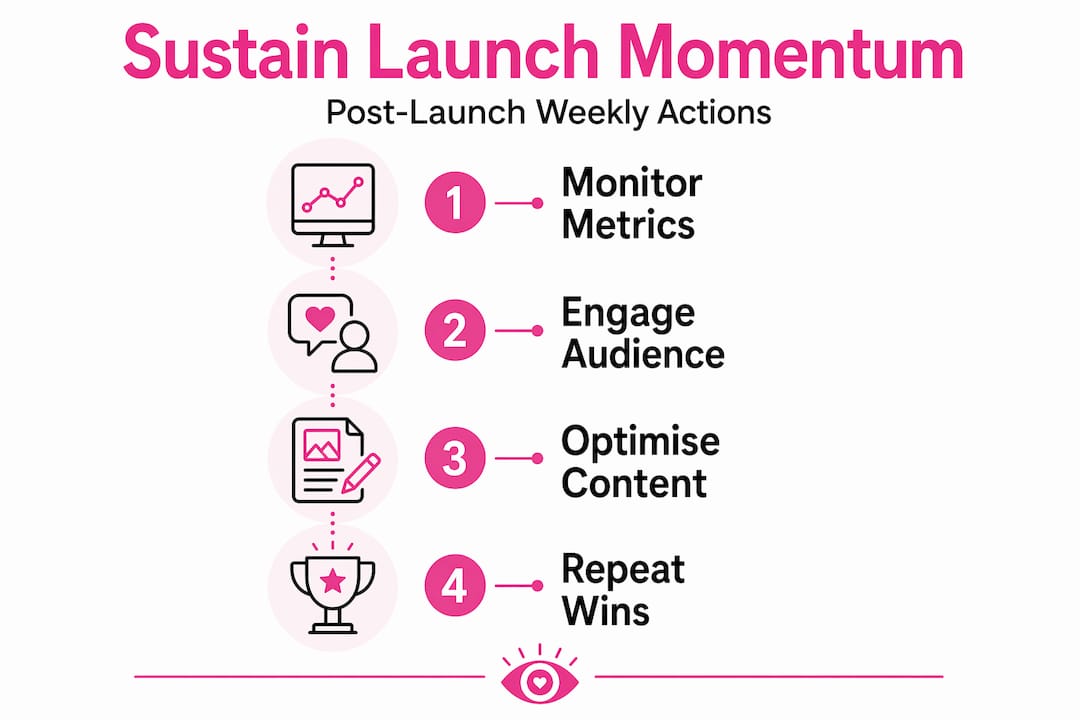
Post-launch content should target measurable business outcomes, not vanity metrics like follower counts or likes. Engagement rate, website traffic quality, add-to-cart rate, and conversion actions are the numbers that tell you whether your social media campaign strategy is working.
Post-launch measurement framework
Day 7 review: Assess follower growth, engagement rate per post, link clicks, and any direct sales attributed to social. Identify your two best-performing content types.
Day 30 review: Analyse website traffic from social channels in Google Analytics. Look at bounce rate, session duration, and goal completions. Identify the content that drove the highest-quality traffic.
Ongoing cadence: Use your findings to build a posting schedule that reflects what your audience actually engages with rather than what you assumed they would like.
Sustaining momentum: practical actions
Repurpose your top five performing posts into blog articles, email newsletters, or short-form videos to extend their shelf life
Introduce a recurring weekly content format, such as a tips post every Tuesday or a customer spotlight every Friday, to build habitual audience behaviour
Actively request reviews and user-generated content from early buyers and feature them regularly
Keep your content marketing strategy updated monthly based on platform analytics, not gut feel
Respond to every comment within 24 hours as standard practice, not just during launch week
Rethinking social media launches: common mistakes and expert lessons
Here is the uncomfortable truth we see repeatedly when working with ecommerce brands: most launches fail not because of bad products, but because of poor sequencing.
Many brands treat a launch as a single announcement rather than a momentum-building process that unfolds over weeks. They post once, get underwhelming results, and conclude that “social media does not work for us.” What they actually experienced was the predictable outcome of skipping the phases that create context, curiosity, and trust before asking for a sale.
The other mistake we see constantly is platform sprawl. A founder decides they need to be on Instagram, TikTok, Facebook, Pinterest, and LinkedIn because their competitors are. They spread their content team impossibly thin, post irregularly on every platform, and build a shallow community on none of them. One platform done brilliantly beats five platforms done poorly, every single time.
Launching on social media also exposes a structural weakness many ecommerce businesses share: no one owns engagement. Content gets scheduled, but when comments and DMs arrive during launch week, they sit unanswered for days. Assign a named person whose sole responsibility during launch week is responding to every interaction. That one change in how you approach your launch can double your follower conversion rate.
Finally, resist the urge to change your campaign mid-flight because early numbers look underwhelming. The learning phase on paid ads and the early days of organic growth both require patience. Define your budget thresholds, your kill criteria, and your review schedule before launch. Stick to them. Reactive changes made from anxiety rarely improve results and often reset the progress you have already made.
How iwanttobeseen supports your social media launch journey
Planning and executing a social media launch strategy takes time, expertise, and a level of coordination that most ecommerce teams find genuinely difficult to manage alone. Getting the phasing right, the paid ads structured correctly, and the compliance in order while also running a business is a lot to hold together.

At iwanttobeseen, we work exclusively with ecommerce brands in the UK and Ireland to plan and execute launches that actually convert. Our approach combines content strategy, influencer outreach, paid social management, and SEO into a single integrated plan built around your goals. With over 25 years of experience scaling our own and our clients’ ecommerce brands, we know where launches go wrong and how to prevent it. If you have a product launch coming up and want a team that has done this many times before, get in touch early. The earlier we build the strategy together, the better your results will be.
Frequently asked questions
What social media platforms should UK ecommerce businesses focus on for a launch?
Focus on two or three platforms where your target customers are most active. For consumer products, Instagram and TikTok are typically the strongest starting point, while B2B brands tend to see better results on LinkedIn. As platform selection guidance confirms, you cannot launch effectively across seven platforms simultaneously.
How many pieces of content should I prepare before my social media launch?
Prepare between 20 and 30 pieces of content before your launch week begins. This ensures you can maintain a consistent posting schedule without splitting your focus between content creation and engagement at the most critical moment. Batch-producing content in advance is one of the highest-impact preparation steps you can take.
What is the best way to handle engagement during launch week?
Respond to every comment, direct message, and mention within the first 48 hours. Prompt engagement tells the algorithm your content is generating meaningful interaction, which expands organic reach and improves follower conversion significantly.
What budget should I allocate for Facebook ads during my product launch?
Budget enough to generate approximately 50 optimisation events per ad set per week. Meta’s learning phase requirements mean that for a £40 target cost per acquisition, you need roughly £2,000 per ad set weekly to achieve stable, optimised delivery.
How can I ensure compliant influencer marketing for my UK ecommerce launch?
Always label paid and gifted content clearly as an advertisement, obtain written agreements with influencers before any content is published, and monitor all posts within 24 hours of going live. The FCA has fined influencers for non-compliant promotions, and the responsibility for compliance ultimately sits with the brand.
Recommended
Comments