.png)
Performance Max: your guide to e-commerce ad success


TL;DR:
Performance Max is a goal-based Google Ads campaign type that uses AI to optimize bids and ad delivery across multiple channels from a single structure. It replaces granular keyword control with asset and audience signals, empowering automation while allowing key strategic controls to remain with the marketer. Successful implementation depends on high-quality tracking, rich creatives, accurate audience signals, and ongoing data-driven optimization.
Running separate Google Ads campaigns across Search, Display, Shopping, and YouTube while manually juggling bids and budgets is exhausting. You invest significant time and budget, yet attribution remains murky and you rarely feel certain which channels are actually driving sales. Performance Max changes the entire equation. This article explains what Performance Max is, how its AI-driven engine operates, how it compares to traditional campaign types, and what you need to do right now to implement it effectively in your e-commerce business.
Table of Contents
Key Takeaways
Point | Details |
Unified ad automation | Performance Max centralises multi-channel ad delivery and optimisation using Google AI. |
Inputs drive outcomes | Your conversion goals, tracking, and creative assets determine campaign effectiveness. |
Not just keywords | Performance Max works with assets and audience signals, not traditional search keywords. |
Ongoing optimisation | Regular reporting and audits are essential to ensure your ad budget drives real results. |
What is Performance Max and how does it work?
Performance Max, often called PMax, is one of the most significant shifts in Google Ads since automated bidding was introduced. Google Ads Performance Max is a goal-based campaign type that uses Google AI to optimise bids, budget, and ad delivery across multiple Google channels from a single campaign. That single sentence carries enormous implications for how you allocate your time, budget, and creative resources.
Instead of building separate campaigns for each channel, you create one Performance Max campaign and Google’s AI does the heavy lifting of deciding where, when, and to whom your ads appear. The channels covered include YouTube, Search, Display, Discover, Gmail, and Maps. That is the full breadth of Google’s advertising inventory, all managed through a single campaign structure.
Mechanically, Performance Max is built around assets and signals rather than keyword targeting, where advertiser-provided creatives and customer or audience signals guide AI-driven ad generation and placement selection. This is a fundamental departure from how most e-commerce managers have historically structured their Google Ads activity. Rather than telling Google exactly which keyword triggers your ad, you provide the raw materials and the AI works out the optimal combination.
Here is what those inputs look like in practice:
Assets: Headlines, descriptions, images, logos, and videos that Google assembles into ads
Audience signals: Customer match lists, website visitor data, in-market segments, and custom intent audiences
Conversion goals: The specific actions you want Google to optimise towards, such as purchases, add-to-cart events, or lead submissions
Final URLs: The landing pages users reach after clicking
The role of AI in advertising is shifting rapidly, and Performance Max is the clearest example of Google placing AI at the centre of campaign management rather than at the edges. The AI in marketing transformation underway means marketers who understand how to work with these systems will consistently outperform those who resist or misunderstand them.
Google channel | Ad format served |
Search | Responsive search ads |
YouTube | Video ads (skippable and bumper) |
Display | Banner and responsive display ads |
Discover | Native image and carousel ads |
Gmail | Sponsored email promotions |
Maps | Local inventory and location ads |
“Performance Max is not a magic button. It is a highly capable AI system that performs in direct proportion to the quality and relevance of what you feed into it.”
How Performance Max compares to traditional Google Ads campaigns
With a grasp of how Performance Max works, it is essential to see how it fits alongside the Google Ads campaigns you may already use.
Performance Max is best understood as an asset-and-signal-driven, AI-optimised campaign type that trades off granular query-by-query control for automation across multiple Google channels. For e-commerce managers who have invested years mastering keyword match types, negative keyword lists, and manual bid adjustments, this trade-off can feel uncomfortable at first.
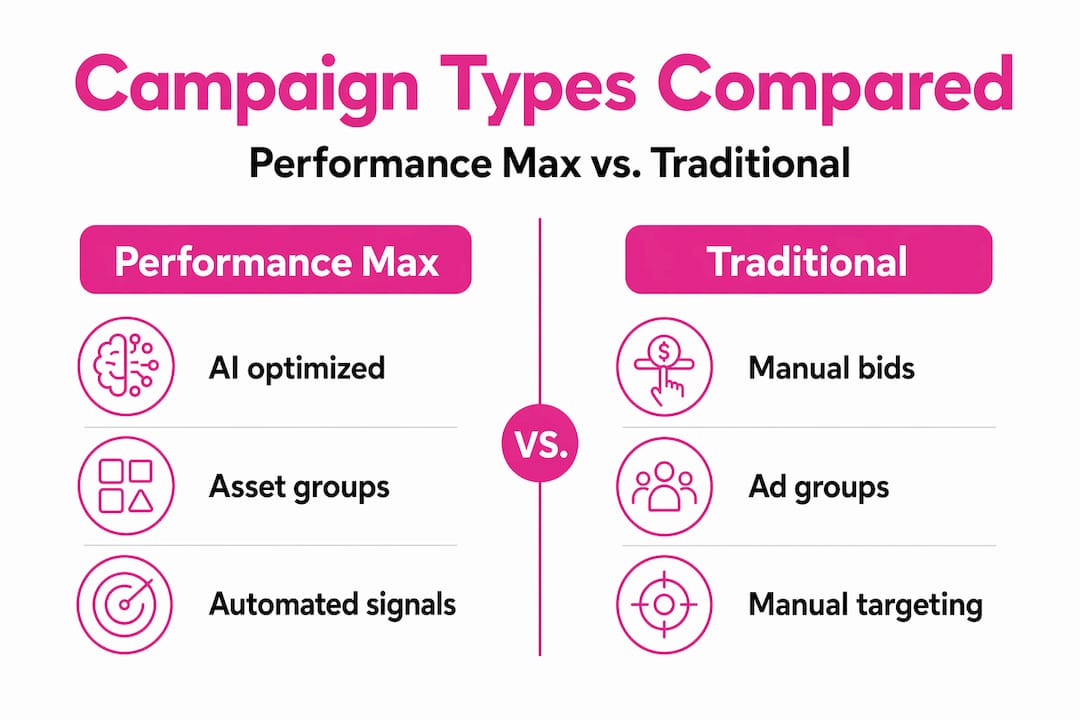
The important thing to recognise is that Performance Max can complement keyword-based Search campaigns and reach Google’s full inventory in a single campaign. The word complement is critical here. Google explicitly positions Performance Max as an addition to your existing strategy, not a wholesale replacement.
Here is a direct comparison to clarify the key differences:
Feature | Performance Max | Traditional campaigns |
Targeting method | Assets and audience signals | Keywords, audiences, placements |
Channel coverage | All Google channels | Single channel per campaign |
Bid management | Fully automated | Manual or automated |
Creative assembly | AI-generated from assets | Manually assembled |
Query-level control | Limited | Full |
Audience control | Signal-based guidance | Direct audience selection |
Reporting granularity | Aggregated with insights | Keyword and placement level |
What do you retain control over? Quite a lot, actually:
Your overall campaign budget and target return on ad spend (ROAS) or target cost per acquisition (CPA)
The conversion goals and how they are weighted
The quality and variety of creative assets you provide
The audience signals you supply to guide the AI
URL exclusions and brand safety settings
Product feed quality for Shopping-based inventory
What you give up is the ability to say “only show my ad when someone searches this exact phrase on desktop.” For many e-commerce managers, that level of micro-control felt reassuring but rarely translated into better performance at scale. The AI marketing strategies that are working right now lean into automation rather than fighting it.
Pro Tip: Keep your existing branded Search campaigns running alongside Performance Max. Branded keywords in a traditional Search campaign protect your brand terms at efficient costs and prevent PMax from consuming budget on queries you could win cheaply elsewhere.
Key factors for successful Performance Max implementation
Having compared campaign types, let us turn to the essential ingredients for getting Performance Max set up effectively in your e-commerce operation.

Performance Max performance depends heavily on tracking quality, conversion goal selection, and campaign inputs, because PMax optimises to whatever you provide. This is the single most important principle to internalise before you launch. If your conversion tracking is broken, firing on the wrong events, or counting returns as sales, the AI will optimise towards those flawed signals and your results will reflect that garbage-in, garbage-out reality.
Here is a structured approach to getting the foundations right:
Audit your conversion tracking first. Before touching campaign settings, verify that your purchase events fire reliably, are de-duplicated, and pass accurate revenue values. Use conversion tracking in eCommerce best practices to confirm your tagging is solid.
Define your primary conversion goal clearly. For most e-commerce businesses, this should be completed purchases with transaction values passed. Avoid optimising towards micro-conversions like page views or time on site as the primary goal, as the AI will pursue volume over value.
Build rich asset groups. Google recommends providing at least five headlines, five descriptions, at least five images in multiple formats (square, landscape, and portrait), your logo, and ideally at least one video. The more relevant variety you supply, the more combinations the AI can test.
Supply strong audience signals. Upload your customer purchase list, your email subscriber list, and create custom intent segments based on your top-performing search terms. These signals do not restrict who sees your ads, but they act as a starting point that accelerates the learning phase.
Set a realistic budget and give the AI time to learn. Performance Max typically requires a learning period of two to four weeks. Avoid making significant bid or budget changes during this period. Treat it as an investment in data collection rather than a channel delivering immediate perfection.
Use listing groups thoughtfully for Shopping inventory. If you have a product feed, segment your listing groups by product category, margin, or performance. This gives you more strategic control over where budget flows within your campaign.
Review and refresh assets regularly. Low-performing assets drag down overall campaign quality. Google’s asset reporting flags underperforming creatives so you can swap them out and test new combinations.
Common mistakes to avoid include launching with a single asset group covering your entire product catalogue, setting an unrealistically low target ROAS that restricts spending, and failing to exclude irrelevant URLs from ad serving. Managing budgets alongside social media ads as part of a holistic paid media strategy also helps you allocate spend intelligently across channels.
Pro Tip: If you have seasonal products or promotions, create separate asset groups with dedicated creatives and audience signals for each. This prevents your evergreen messaging from diluting time-sensitive campaign performance.
Unlocking insights: Reporting and interpreting Performance Max results
After your campaign is live, it is crucial to understand how Performance Max measures up, especially given its automated, often opaque approach.
As an e-commerce manager, you should set up reporting and audits to compensate for the ‘black box’ nature: channel performance, audience insights, and other diagnostics help validate that spend is going where you intend. The black box criticism of Performance Max is fair to a degree, but Google has steadily expanded the reporting options available to address this.
Here is what you can currently access and how to use each insight effectively:
Asset performance ratings: Each creative asset receives a rating of “Low,” “Good,” or “Best.” Replace “Low” assets with fresh alternatives to improve overall ad quality scores.
Audience insights: This report shows which audience segments your conversions are coming from, helping you refine your signals and identify new customer profiles you may not have targeted manually.
Channel performance breakdown: While not as granular as separate channel campaigns, you can see conversion and spend data broken down by channel, giving you a broad view of where the AI is allocating budget.
Search terms insights: A themed search category report shows the types of queries your ads are matching against. This does not show individual search terms, but it reveals intent clusters and helps you assess relevance.
Placement exclusions: Review where your Display and YouTube ads are appearing. You can and should exclude irrelevant placements or low-quality app categories that consume budget without delivering results.
Diagnostics tab: This highlights configuration issues such as asset disapprovals, tracking problems, or policy concerns that may be limiting your campaign’s reach.
Your eCommerce advertising guide strategy should include a weekly review of asset performance and a monthly deeper audit of channel allocation and audience insights. Set up a custom report in Google Ads that tracks your target ROAS, conversion value, cost per conversion, and impression share by channel. This gives you a consistent framework for identifying drift early rather than discovering problems weeks after they start affecting your return on investment.
One often-overlooked diagnostic is comparing your Performance Max attribution to your analytics data. If Google Ads reports significantly more conversions than your analytics platform, investigate whether your campaign is cannibalising organic search or other paid channels through last-click inflation.
Why understanding Performance Max’s AI matters more than ever
Here is the uncomfortable truth that most guides on Performance Max will not tell you. The e-commerce managers who struggle most with this campaign type are not the ones who lack technical skills. They are the ones who still think their job is to control the machine rather than to direct it.
We have spent over 25 years running e-commerce brands and managing paid media for clients across the UK and Ireland. The shift that Performance Max demands is a genuine mindset change. You are no longer a hands-on operator adjusting bids and match types. You are a strategic pilot, setting the destination, fuelling the aircraft with quality data and creative assets, and monitoring the flight path rather than flying manually.
The AI’s evolving role in advertising does not diminish the marketer’s value. It raises the stakes on what you bring to the table. When the AI handles placement and bidding, your competitive advantage moves upstream: to the quality of your audience data, the persuasiveness of your creative assets, the precision of your conversion signals, and your ability to diagnose what the reporting is actually telling you.
Set-and-forget is the single most dangerous approach to Performance Max. We see it repeatedly. A campaign launches, initial results look promising because the AI scoops up easy conversions from branded and retargeting audiences, and the manager relaxes. Six weeks later, acquisition costs have crept upward, the campaign is serving heavily on low-intent Display placements, and no one has refreshed a creative asset since launch. The AI is not underperforming. It is doing exactly what it was told, with inputs that have grown stale.
The marketers who thrive with Performance Max treat it like a high-performance team member rather than a vending machine. They feed it excellent creative regularly. They improve their data quality obsessively. They audit the outputs consistently. And they know when to intervene versus when to give the algorithm space to work.
Accelerate your e-commerce advertising strategy
You now understand the mechanics, the strategic positioning, and the practical requirements for making Performance Max work for your e-commerce business. Knowing the theory is one thing. Getting it right in practice, with real budgets and real products, is where specialist experience makes a measurable difference.

At iwanttobeseen.online, we have spent over 25 years scaling e-commerce brands through SEO, PPC, AI-driven strategies, and social media. Our team helps e-commerce marketing managers across the UK and Ireland build Performance Max campaigns that are grounded in solid tracking, powered by compelling creative, and continuously optimised for return on investment. Whether you are launching your first PMax campaign or troubleshooting one that is not delivering, we can help you move from uncertainty to measurable growth. Explore our PPC and advertising services and take the next step with a team that has done this at scale.
Frequently asked questions
Does Performance Max replace Search or Shopping campaigns?
No. Performance Max complements keyword-based Search campaigns and reaches Google’s full inventory from a single campaign, but running both in parallel is often the stronger strategic approach.
What assets do I need for a successful Performance Max campaign?
You need high-quality headlines, descriptions, images, logos, and ideally video, alongside detailed audience signals. Advertiser-provided asset inputs and audience signals including customer data are what guide the AI towards strong performance.
How does Performance Max know which conversions to optimise for?
It optimises based on the conversion events and goals you configure in your tracking setup. Tracking quality and conversion goal selection are the most critical factors in determining what results the AI pursues.
How can I see where my Performance Max budget is being spent?
Use Google Ads’ reporting tools to review channel performance, audience insights, and asset results. Setting up regular reporting and audits is essential to validate that spend allocation aligns with your business priorities and goals.
Recommended
Comments