.png)
What is user engagement and how to boost it in UK e-commerce


Most e-commerce marketers in the UK and Ireland believe user engagement simply means conversion rate. This narrow view misses the bigger picture. True engagement encompasses every meaningful interaction a visitor has with your online store, from browsing product pages to adding items to their basket, returning for repeat visits, and recommending your brand to others. Understanding this broader definition is crucial because engaged customers deliver far greater lifetime value than one-time buyers. This article clarifies what user engagement actually means, why it matters more than traditional metrics for UK e-commerce profitability, and provides actionable strategies to enhance it.
Table of Contents
Key takeaways
Point | Details |
Engagement extends beyond conversions | Active interactions include page views, session duration, basket additions, and repeat visits that predict long-term value. |
UK benchmarks reveal opportunities | Average engagement rate is 64% whilst conversion sits near 3%, showing huge potential to nurture engaged visitors. |
Retention drives profitability | A 5% retention increase boosts profits by 25-95%, making engagement metrics more valuable than acquisition-focused vanity metrics. |
Personalisation maximises customer lifetime value | Tailored experiences using machine learning techniques increase relevance, satisfaction, and repeat purchases. |
Advanced metrics reveal true performance | Tracking POAS and CLV instead of ROAS provides accurate profitability insights for sustainable growth. |
Understanding user engagement in e-commerce
User engagement in e-commerce represents the sum of active visitor interactions like page views, time spent browsing, basket additions, and completed purchases. It measures how deeply visitors connect with your store, not just whether they buy. This distinction matters because engaged visitors who do not convert immediately often return to purchase later, recommend your brand, or provide valuable feedback.
The engagement rate formula divides engaged sessions by total sessions. An engaged session typically includes at least two page views, lasts over ten seconds, or results in a conversion event. For UK e-commerce businesses, understanding these behavioural indicators helps identify which visitors show genuine interest versus those who bounce quickly.
Current UK benchmarks provide context for evaluating your performance. The table below shows typical metrics for British online retailers:
Metric | UK Average | What It Means |
Engagement Rate | 63.86% | Percentage of sessions with meaningful interaction |
Conversion Rate | 2.9% | Percentage of sessions ending in purchase |
Add-to-Cart Rate | 8-12% | Visitors who add products to basket |
These figures reveal a critical insight. Whilst nearly two-thirds of visitors engage with UK e-commerce sites, fewer than 3% convert during that session. This gap represents enormous opportunity. Those engaged but unconverted visitors are prime candidates for remarketing, email nurturing, and loyalty programmes.
Engagement metrics differ fundamentally from conversion metrics. Conversion measures a single outcome: did the visitor buy? Engagement captures the entire journey: which pages did they view, how long did they stay, did they interact with product filters, did they watch videos, did they save items for later? These signals predict future purchase behaviour far better than a single conversion event.
Common ecommerce marketing metrics for measuring engagement include:
Session duration: total time spent browsing during one visit
Pages per session: number of pages viewed before leaving
Add-to-cart rate: percentage of visitors adding products to basket
Repeat visit frequency: how often customers return within a timeframe
Bounce rate: percentage of single-page sessions with no interaction
Product video views: engagement with multimedia content
Wishlist additions: intent signals for future purchases
Tracking these indicators alongside conversion rates gives you a complete picture of customer behaviour. You can identify which product categories generate the most engagement, which traffic sources deliver the most engaged visitors, and which page elements keep people browsing longer. This granular understanding enables targeted improvements that boost both engagement and eventual conversions.
Why user engagement matters more than traditional conversion metrics
Traditional metrics like ROAS and impression counts tell an incomplete story. ROAS overlooks margins, lifetime value, and customer retention, focusing narrowly on immediate return from ad spend. A campaign might show strong ROAS whilst attracting one-time bargain hunters who never return. Another campaign might show weaker ROAS whilst building a loyal customer base that generates profit for years.
Engagement metrics like session quality, repeat visit rate, and time to second purchase better predict long-term revenue. They reveal which customers will become valuable assets versus which represent fleeting transactions. This distinction becomes crucial when you consider acquisition costs in the competitive UK market, where paid search and social advertising expenses continue rising.

The profit impact of retention demonstrates why engagement deserves priority. Research shows a 5% retention increase boosts profits by 25-95%, with repeat customers spending 67% more than new ones. These figures reflect several compounding advantages. Retained customers cost nothing to acquire, understand your products better, trust your brand more, and often buy higher-margin items.
Consider the economics. Acquiring a new customer in the UK e-commerce space typically costs five to seven times more than retaining an existing one. If your customer acquisition cost sits at £45 and your average order value is £75, you need that customer to make at least one repeat purchase to achieve meaningful profitability after accounting for product costs, fulfilment, and overheads.
Focusing on engagement metrics rather than vanity metrics transforms how you allocate marketing budget. Instead of chasing expensive new traffic, you invest in experiences that keep existing customers coming back, dramatically improving unit economics and sustainable growth.
This shift requires rethinking success indicators. Traditional dashboards highlight impressions, clicks, and immediate conversions. Engagement-focused dashboards prioritise metrics like:
Customer lifetime value trends over quarterly cohorts
Repeat purchase rate by acquisition channel
Average time between first and second purchase
Engagement score progression for individual customers
Net promoter score and referral rates
These indicators reveal whether your marketing builds lasting relationships or simply generates transactional one-offs. They guide strategic decisions about which products to promote, which customer segments to nurture, and where to invest in building customer loyalty rather than just chasing the next sale.
The distinction becomes especially important for UK and Ireland e-commerce brands competing against international giants. You cannot outspend Amazon on acquisition, but you can out-engage them by delivering personalised experiences, building community, and creating reasons for customers to choose you repeatedly despite slightly higher prices or longer delivery times.
Nuances and strategies for enhancing user engagement in UK e-commerce
Effective engagement strategies recognise that different products require different interaction types. High-involvement products like furniture or electronics benefit from information interaction: detailed specifications, comparison tools, expert reviews, and educational content. Customers researching these purchases want comprehensive data to justify their decision.
Low-involvement products like everyday groceries or basic clothing accessories respond better to relationship interaction: loyalty rewards, personalised recommendations, convenient reordering, and community engagement. Customers buying these items prioritise convenience and familiarity over exhaustive research. Tailoring your engagement approach to product involvement level increases relevance and response.
Digital nudging offers powerful conversion tools but carries risks. Techniques like countdown timers, scarcity messages, and social proof notifications can boost immediate purchases. However, aggressive nudging affects trust and privacy perceptions, potentially damaging long-term engagement. Customers who feel manipulated rarely become loyal advocates.
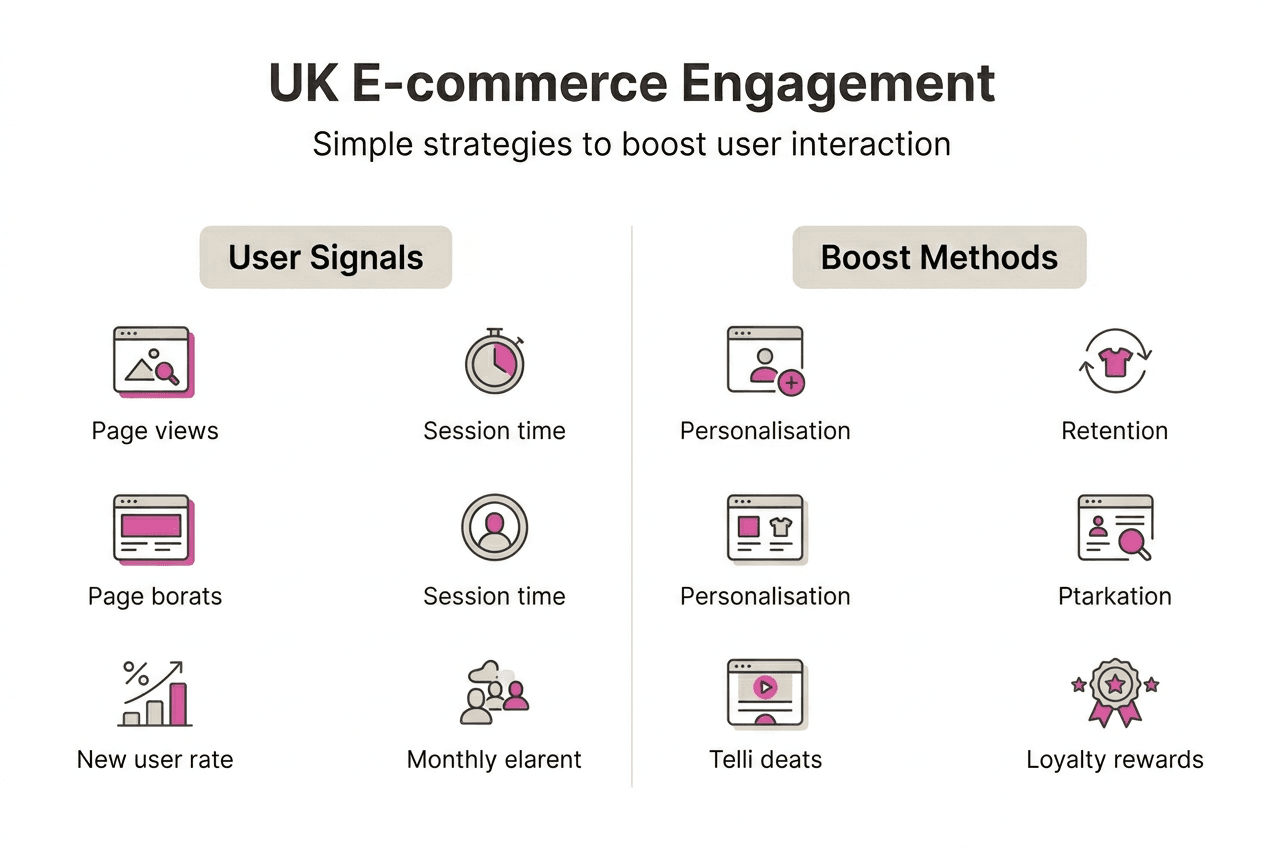
Practical strategies for enhancing engagement in UK e-commerce combine personalisation, loyalty integration, and behavioural insights:
Implement dynamic personalisation using browsing history, purchase patterns, and demographic data to customise product recommendations, email content, and homepage layouts for individual visitors.
Integrate loyalty programmes with machine learning techniques that predict which rewards will motivate specific customer segments, maximising programme effectiveness whilst controlling costs.
Deploy behavioural analytics to identify micro-moments where targeted engagement drives macro results, such as sending personalised emails exactly when customers typically reorder consumables.
Create interactive content like quizzes, configurators, or style guides that educate whilst gathering preference data to improve future personalisation and product development.
Build community features such as reviews, user-generated content galleries, or forums that transform passive shoppers into active participants who feel invested in your brand success.
These strategies align with broader ecommerce marketing objectives focused on sustainable growth rather than short-term sales spikes. They require upfront investment in technology and content but deliver compounding returns as engaged customers generate repeat purchases, referrals, and valuable feedback.
Pro Tip: Test nudging techniques carefully with small customer segments before broad deployment. Monitor not just conversion lift but also return rates, customer service contacts, and repeat purchase behaviour to ensure short-term gains do not damage long-term relationships. The most effective nudges feel helpful rather than manipulative, such as reminding customers about items left in their basket rather than creating false urgency.
Implementing eCRM retention strategies amplifies these engagement efforts by coordinating touchpoints across email, SMS, push notifications, and on-site experiences. Customers receive consistent, relevant messages that acknowledge their individual journey rather than generic broadcasts that ignore their history with your brand.
The key is balancing automation with authenticity. Personalisation algorithms should enhance human connection, not replace it. Customers can distinguish between genuinely helpful recommendations based on their preferences and obviously automated upsells based on crude purchase history matching. Invest in quality data, sophisticated segmentation, and thoughtful messaging that respects customer intelligence.
Handling edge cases: cart abandonment, returns, and tracking true profitability
UK e-commerce faces specific challenges that complicate engagement measurement. Returns cost £27 billion annually, with 11% of customers responsible for most returns. Cart abandonment rates spike when customers browse clearance sections or shop via smartphone, creating misleading signals about genuine purchase intent versus casual browsing.
These edge cases require nuanced interpretation. A customer who adds clearance items to their basket but never checks out may simply be window shopping, not indicating serious interest. A smartphone user who abandons their cart after viewing detailed product specifications might complete the purchase later on desktop. Treating all abandoned carts equally wastes remarketing budget on visitors who were never close to buying.
Advanced profitability metrics address these complications better than conventional approaches. The table below compares three measurement frameworks:
Metric | What It Measures | Key Advantage | Main Limitation |
ROAS | Revenue per pound of ad spend | Simple to calculate and understand | Ignores margins, lifetime value, and retention |
POAS | Profit per pound of ad spend | Accounts for product costs and margins | Requires accurate cost data and attribution |
CLV | Total profit from customer relationship | Reveals true long-term value | Complex to calculate and predict accurately |
Tracking POAS and CLV instead of ROAS transforms decision making. A campaign attracting high-value customers who make repeat purchases at full price might show modest ROAS but excellent POAS and CLV. Another campaign driving bargain hunters to clearance items might show strong ROAS but poor POAS and CLV. Optimising for the wrong metric leads to the wrong strategic choices.
Factors influencing cart abandonment and returns in the UK market include:
Mobile checkout friction from complex forms and payment processes
Unexpected delivery costs or long shipping timeframes revealed late in checkout
Unclear product information leading to purchases that do not meet expectations
Bracketing behaviour where customers order multiple sizes or colours intending to return most
Comparison shopping where baskets serve as wishlists rather than purchase intent
Payment security concerns, especially for unfamiliar brands
Addressing these factors requires cart abandonment reduction strategies tailored to root causes. Generic abandoned cart emails recover some sales but miss opportunities to fix underlying problems. Better approaches include streamlining mobile checkout, displaying total costs earlier, improving product photography and descriptions, and implementing virtual try-on tools that reduce bracketing.
Pro Tip: Segment abandoned carts by behaviour signals before deploying recovery campaigns. Customers who abandoned after viewing shipping costs need different messaging than those who abandoned whilst comparison shopping or those who abandoned due to payment issues. Targeted recovery emails based on abandonment reason convert at significantly higher rates than generic reminders.
The returns challenge requires similar nuance. Serial returners who exploit generous policies damage profitability and should be managed differently than occasional returners experiencing genuine product issues. Predictive analytics can identify high-risk return patterns, enabling interventions like requiring upfront payment for serial returners or offering virtual consultations to reduce fit issues.
Balancing customer experience with profitability means accepting some returns as the cost of doing business whilst implementing guardrails against abuse. Transparency about return policies, clear product information, and proactive customer service reduce unnecessary returns without creating friction that damages engagement.
Boost your e-commerce user engagement with tailored solutions
Transforming user engagement from a vague concept into a measurable driver of growth requires expertise, tools, and sustained effort. The strategies outlined above work best when customised to your specific products, customers, and competitive position within the UK and Ireland markets.

We specialise in helping e-commerce brands implement engagement strategies that deliver measurable improvements in retention, customer lifetime value, and profitability. Our approach combines 25 years of experience scaling successful e-commerce brands with cutting-edge AI, SEO, social media, and PPC capabilities. Whether you need help implementing personalisation, optimising your loyalty programme, or tracking advanced profitability metrics, we provide the expertise and support to achieve your ecommerce marketing solutions goals. Visit our homepage to explore how we can help you build deeper customer relationships that drive sustainable growth.
Frequently asked questions
What metrics best indicate strong user engagement in e-commerce?
Strong engagement shows through session duration exceeding two minutes, multiple page views per visit, high add-to-cart rates, and frequent repeat visits within short timeframes. Advocacy signals like reviews, social shares, and referrals indicate exceptional engagement. Long-term KPIs such as customer lifetime value and retention rate reveal whether engagement translates into profitable relationships. Track these indicators together rather than relying on any single metric.
How can UK e-commerce brands reduce cart abandonment effectively?
Optimise mobile checkout by minimising form fields, offering guest checkout, and integrating digital wallets like Apple Pay. Display total costs including delivery early in the shopping journey to avoid surprise at checkout. Use targeted recovery campaigns based on abandonment reason rather than generic reminders. Segment users by behaviour to offer personalised incentives only when necessary, preserving margins whilst recovering genuinely interested shoppers.
What role does personalisation play in boosting user engagement?
Personalisation increases relevance by showing customers products, content, and offers matched to their preferences and behaviour. This relevance drives satisfaction, repeat visits, and higher customer lifetime value. Machine learning integration enables sophisticated personalisation at scale, analysing thousands of data points to predict what individual customers want next. Effective personalisation feels helpful rather than intrusive, respecting privacy whilst delivering genuine value. Brands achieving this balance see dramatic improvements in marketing objectives related to retention and profitability.
Which long-term KPIs should marketers prioritise in 2026?
Focus on repeat interaction rate, customer lifetime value, advocacy signals like net promoter score, and time to second purchase. These metrics reveal sustainable engagement and future sales potential better than traditional conversion rates or ROAS. Track cohort retention curves to understand how engagement evolves over customer lifecycles. Monitor engagement score progression for individual customers to identify at-risk relationships before they churn. These forward-looking indicators enable proactive strategies that build lasting competitive advantages.
Recommended
Comments