.png)
What is price optimisation: boost e-commerce profits in 2026


Many e-commerce business owners believe pricing is a fixed process, something you set once and revisit only during seasonal sales. This misconception costs businesses thousands in lost revenue every year. Price optimisation challenges this outdated thinking by using data-driven strategies to find the sweet spot where prices attract buyers and maximise profits. In 2026, UK and Ireland e-commerce businesses are leveraging advanced techniques like dynamic pricing and AI-powered tools to outcompete rivals and enhance profitability. This guide explains what price optimisation truly is, how it works, and the practical strategies you can implement to transform your pricing approach and drive sustainable growth.
Table of Contents
Key takeaways
Point | Details |
Price optimisation balances profit and appeal | Data-driven strategies help you find prices that attract customers whilst maximising revenue. |
Dynamic pricing adapts in real time | Prices adjust automatically based on inventory levels, demand spikes, and competitor movements. |
AI reduces manual pricing effort by 80% | Machine learning algorithms predict optimal prices and eliminate time-consuming manual adjustments. |
Consumer trust requires careful pricing | Whilst 68% feel exploited by dynamic pricing, transparent strategies maintain brand credibility. |
UK and Ireland markets benefit from tailored approaches | Regional tax considerations and market-specific tactics enhance competitive advantage. |
Understanding price optimisation and its core concepts
Price optimisation represents a fundamental shift from traditional pricing approaches. Rather than setting prices based on gut feeling or simple cost-plus formulas, optimisation uses data and smart strategies to identify the sweet spot where prices attract buyers and maximise profits. This approach transforms pricing from a static exercise into a dynamic, strategic tool that responds to market conditions, customer behaviour, and competitive pressures.
At its core, price optimisation relies on several key concepts that work together to enhance profitability. Dynamic pricing adjusts your prices based on real-time factors like inventory levels, demand fluctuations, or competitor moves. Charm pricing leverages psychological triggers by setting prices at £9.99 instead of £10, creating the perception of better value. Tiered pricing offers customers multiple options at different price points, encouraging them to choose higher-value packages whilst feeling in control of their decision.
Understanding customer behaviour forms the foundation of effective price optimisation. You need to know how price-sensitive your audience is, what value they perceive in your products, and how they compare your offerings to competitors. This knowledge allows you to set prices that resonate with your target market whilst maintaining healthy profit margins. The relationship between predictive marketing and e-commerce becomes crucial here, as predictive analytics help forecast how customers will respond to different pricing scenarios.
The strategic nature of pricing cannot be overstated. Every price point sends a signal to your customers about quality, exclusivity, and value. Consider these essential principles:
Pricing reflects your brand positioning and market strategy
Costs provide a floor, but customer value perception sets the ceiling
Competitor prices offer reference points but shouldn’t dictate your strategy
Regular testing and adjustment improve results over time
Transparency builds trust even when prices fluctuate
Successful price optimisation requires balancing multiple factors simultaneously. You must understand your costs thoroughly to ensure profitability, monitor competitors to remain competitive, and analyse customer data to maximise conversion rates. This balancing act becomes easier with the right tools and frameworks, but it demands ongoing attention and refinement.
“Pricing is not just about numbers on a product page. It’s a strategic tool that communicates value, positions your brand, and directly impacts your bottom line. The businesses that treat pricing as flexible and data-driven consistently outperform those stuck in static pricing models.”
The shift towards optimisation thinking transforms how you approach every pricing decision. Instead of asking “What should we charge?”, you begin asking “What price maximises our profitability whilst maintaining customer satisfaction and competitive positioning?” This subtle but powerful reframing opens up new possibilities for revenue growth and market expansion.
How dynamic and AI-driven pricing reshape e-commerce profitability
Dynamic pricing has revolutionised how e-commerce businesses approach profitability by enabling real-time price adjustments. Prices adapt based on factors like inventory levels, demand spikes, or competitor moves, ensuring you capture maximum value from every transaction. This approach moves beyond the limitations of static pricing, allowing your business to respond instantly to market conditions and customer behaviour patterns.

Artificial intelligence amplifies dynamic pricing capabilities by introducing predictive analytics and automation. UK fashion retailer Oh Polly partnered with 7Learnings to deploy machine learning algorithms that predict pricing impact and reduce manual labour by 80%. These AI-powered systems analyse vast datasets including historical sales, competitor pricing, seasonal trends, and customer segments to recommend optimal prices for every product in your catalogue.
The benefits of AI-driven pricing extend far beyond time savings. Faster decision-making allows you to capitalise on fleeting opportunities like sudden demand spikes or competitor stock-outs. Better margins result from precise pricing that captures willingness to pay without leaving money on the table. Manual effort reduction frees your team to focus on strategic initiatives rather than spreadsheet updates. Together, these advantages create a compounding effect that significantly enhances overall profitability.
Implementing AI dynamic pricing requires a structured approach to ensure success. Follow these steps to deploy effective pricing automation:
Collect comprehensive data from sales history, competitor monitoring, customer behaviour, and market trends to build a robust foundation for AI analysis.
Simulate different pricing scenarios using your AI platform to understand potential impacts before making live changes to your pricing structure.
Deploy automated pricing rules that align with your business objectives, whether maximising revenue, clearing inventory, or maintaining market share.
Monitor performance metrics continuously to identify what’s working and where adjustments are needed for optimal results.
Refine algorithms based on real-world outcomes, feeding learnings back into the system to improve accuracy and effectiveness over time.
The integration of AI tools for e-commerce extends beyond pricing into inventory management, customer service, and marketing personalisation. When these systems work together, they create a powerful ecosystem that drives sales growth whilst reducing operational complexity. Your pricing strategy becomes part of a larger AI-driven approach to business optimisation.
Pro Tip: Conduct regular A/B tests comparing your AI-recommended prices against alternative pricing strategies to validate performance and identify opportunities for algorithm refinement. This evidence-based approach ensures your pricing remains optimised as market conditions evolve.
The transformation enabled by dynamic and AI-driven pricing represents a competitive advantage that compounds over time. Early adopters in the UK and Ireland markets are already seeing substantial benefits, whilst businesses clinging to manual, static pricing struggle to keep pace. The technology continues advancing rapidly, with platforms like 7Learnings introducing new capabilities that further enhance precision and automation.
Balancing consumer trust and pricing agility: challenges and nuances
Whilst dynamic pricing offers substantial benefits, it introduces significant challenges around consumer trust and brand perception. Research shows 68% of consumers feel taken advantage of when brands use dynamic pricing, highlighting the delicate balance required between pricing agility and customer relationships. This perception stems from experiences with airlines and ride-sharing services where prices fluctuate dramatically, creating frustration and eroding trust.
The trust factor becomes even more critical when you consider that 80% of consumers believe brands with consistent pricing are more trustworthy. This statistic reveals a fundamental tension in modern e-commerce: the technology enables sophisticated price optimisation, but customers often prefer predictability and stability. Resolving this tension requires thoughtful strategy rather than abandoning dynamic pricing altogether.
Successful businesses navigate this challenge by implementing dynamic pricing in ways that feel fair and transparent to customers. You can maintain pricing agility whilst preserving trust through several key strategies:
Communicate the reasons behind price changes clearly, such as limited inventory or seasonal demand patterns
Limit the frequency and magnitude of price fluctuations to avoid shocking customers with dramatic swings
Offer price match guarantees or loyalty programmes that protect regular customers from feeling exploited
Use dynamic pricing primarily for clearance, new releases, or genuinely scarce items where customers expect variability
Maintain stable pricing on core products that define your brand and customer relationships
The frequency of promotions also impacts consumer trust and long-term profitability. Constant discounting trains customers to wait for sales, diminishing the perceived value of your regular prices. This creates a downward spiral where you need ever-deeper discounts to generate the same response. Strategic price optimisation focuses on finding the right regular price rather than relying on promotional cycles to drive sales.
Your approach to pricing transparency shapes how customers perceive your brand. Some businesses openly explain their dynamic pricing algorithms, positioning them as fair systems that benefit both parties. Others maintain the illusion of static pricing whilst making subtle adjustments behind the scenes. Neither approach is inherently superior, but your choice must align with your brand values and customer expectations.
“Trust is the currency of modern e-commerce. You can have the most sophisticated pricing algorithms in the world, but if customers feel manipulated or exploited, they’ll take their business elsewhere. The key is using pricing technology to create genuine value, not just extract maximum revenue from every transaction.”
The relationship between pricing strategy and boosting online sales extends beyond the price itself to encompass the entire customer experience. Fair, transparent pricing contributes to positive brand perception, customer loyalty, and word-of-mouth recommendations. These intangible benefits often outweigh the short-term revenue gains from aggressive dynamic pricing.
Finding the right balance requires ongoing monitoring and adjustment. Track customer sentiment through reviews, social media, and direct feedback to gauge how your pricing strategies are perceived. If you notice increasing complaints about price unfairness or inconsistency, dial back the aggressiveness of your dynamic pricing rules. The goal is sustainable profitability, not maximising revenue from a single transaction at the cost of future business.
Practical pricing optimisation techniques and strategies for e-commerce in the UK and Ireland
Moving from theory to practice, several proven techniques can immediately enhance your pricing effectiveness. Charm pricing remains one of the most reliable psychological tactics, where pricing at £9.99 instead of £10 creates the perception of significantly better value despite the minimal actual difference. This technique works because customers process prices from left to right, anchoring on the first digit they see.
Tiered pricing offers another powerful approach by presenting customers with multiple options at different price points. This strategy encourages higher-value purchases by making mid-tier options appear reasonable compared to premium alternatives, whilst the entry-level tier attracts price-sensitive customers who might otherwise not purchase at all. The key is structuring your tiers to guide customers towards your preferred option through strategic feature differentiation and pricing gaps.
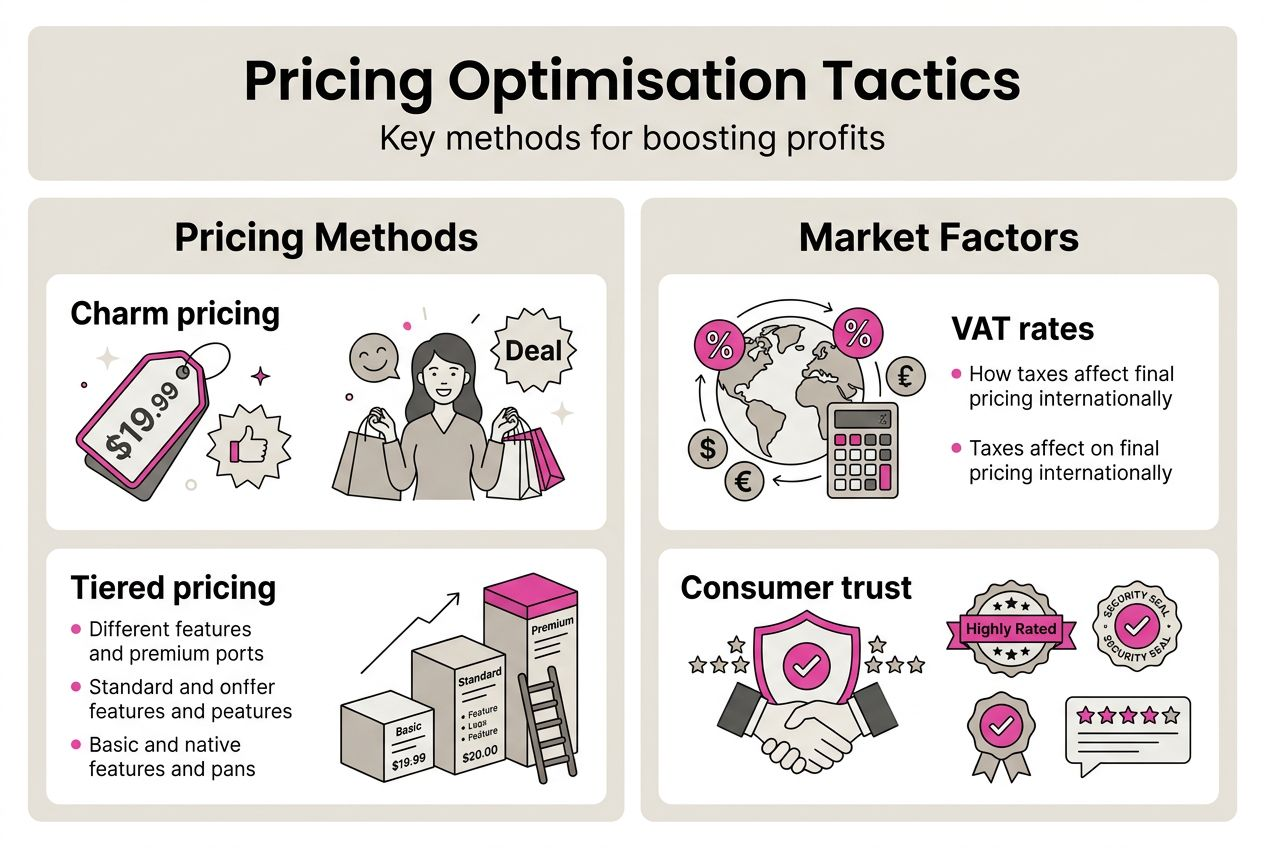
Different pricing tactics deliver varying benefits depending on your specific context and objectives. This comparison helps you select the right approach:
Tactic | Best for | Expected benefit | Implementation complexity |
Charm pricing | Impulse purchases, competitive categories | 5-10% conversion lift | Low |
Tiered pricing | SaaS, subscriptions, service packages | 15-25% average order value increase | Medium |
Dynamic pricing | High-turnover inventory, seasonal products | 10-20% margin improvement | High |
Bundle pricing | Complementary products, clearance items | 20-30% units per transaction increase | Low |
Penetration pricing | New market entry, customer acquisition | Rapid market share growth | Medium |
Category-specific pricing strategies deliver superior results compared to one-size-fits-all approaches. Research indicates retailers should calibrate pricing tactics by category rather than applying uniform strategies across their entire catalogue. Fashion items respond well to frequent seasonal adjustments, electronics benefit from competitive price matching, and consumables perform best with subscription or bulk pricing models.
The UK and Ireland markets present unique considerations that influence pricing strategy. VAT rates differ between the two countries, with the UK at 20% and Ireland at 23% for most goods. Currency fluctuations between pounds and euros affect cross-border pricing decisions. Regional preferences and purchasing power variations across different areas require localised pricing approaches for optimal results.
Pro Tip: When setting prices for UK and Ireland markets, calculate your net profit after VAT rather than focusing solely on gross margins. This ensures you maintain profitability targets whilst remaining competitive on customer-facing prices that include tax.
Implementing these techniques requires systematic testing and measurement. Start with a small subset of products to validate each approach before rolling it out across your entire catalogue. Track key metrics including conversion rate, average order value, profit margin, and customer lifetime value to assess true impact. Some tactics may boost short-term sales whilst harming long-term customer relationships, so comprehensive measurement is essential.
Your marketing objectives should align closely with your pricing strategy to create a cohesive customer experience. If you’re positioning as a premium brand, charm pricing might undermine that perception. If customer acquisition is your primary goal, penetration pricing supports that objective better than margin maximisation. Strategic alignment across all business functions amplifies the effectiveness of each individual tactic.
The practical application of pricing optimisation extends beyond selecting techniques to encompass operational execution. You need systems for monitoring competitor prices, tracking inventory levels, analysing customer segments, and implementing price changes efficiently. Many businesses underestimate the operational requirements of sophisticated pricing strategies, leading to inconsistent execution that undermines potential benefits.
Explore services to optimise your e-commerce pricing today
Transforming your pricing strategy from static to optimised requires expertise, technology, and ongoing refinement. We specialise in helping UK and Ireland e-commerce businesses implement data-driven pricing strategies that enhance profitability whilst maintaining customer trust. Our team brings over 25 years of experience scaling successful e-commerce brands, combining deep knowledge of pricing psychology with cutting-edge AI and analytics tools.

Whether you’re looking to implement dynamic pricing, leverage AI-powered price optimisation, or develop category-specific strategies tailored to your market, we provide the guidance and support you need. Our comprehensive approach integrates pricing with broader marketing objectives, ensuring every element of your strategy works together to drive sustainable growth. Discover how our e-commerce optimisation solutions can transform your pricing approach and unlock new profit potential in 2026.
Frequently asked questions
What is price optimisation in e-commerce?
Price optimisation uses data analytics and strategic methods to identify prices that maximise profitability whilst remaining attractive to customers. It balances multiple factors including costs, competitor pricing, customer behaviour, and market conditions to find the optimal price point for each product.
How does dynamic pricing differ from regular pricing?
Dynamic pricing adjusts prices automatically based on real-time factors like inventory levels, demand patterns, and competitor movements, whereas regular pricing remains static until manually changed. This enables businesses to capture more value during high-demand periods and clear inventory more efficiently during slow periods.
Will dynamic pricing damage customer trust?
Dynamic pricing can erode trust if implemented aggressively or without transparency, but thoughtful approaches that limit frequency, communicate clearly, and maintain fairness can preserve customer relationships. The key is using dynamic pricing strategically rather than maximising every transaction at the expense of long-term loyalty.
What pricing tactics work best for UK e-commerce businesses?
Charm pricing, tiered pricing, and category-specific strategies deliver strong results for UK businesses, with effectiveness varying by product type and target market. Fashion retailers benefit from seasonal dynamic pricing, whilst subscription businesses see better results from tiered packages that encourage premium selections.
How do I account for VAT when optimising prices?
Calculate your target profit margin after VAT deduction to ensure prices remain profitable whilst appearing competitive to customers who see VAT-inclusive prices. UK businesses should factor in the 20% VAT rate when setting prices, whilst those serving Irish customers must account for the 23% rate.
Can small e-commerce businesses benefit from AI pricing tools?
AI pricing platforms now offer accessible options for businesses of all sizes, with some providers offering tiered pricing based on catalogue size and transaction volume. Even basic AI tools can deliver significant time savings and margin improvements compared to manual pricing approaches, making them worthwhile investments for growing businesses.
Recommended
Comments