.png)
How to create lead magnets that boost UK ecommerce sales


Many UK and Irish ecommerce marketers attract traffic but struggle to convert visitors into quality leads. Generic offers fail to engage properly, leaving potential revenue on the table. This guide shows you how to craft targeted lead magnets that improve lead quality, nurture prospects effectively, and drive measurable conversion improvements for your online store.
Table of Contents
Key takeaways
Point | Details |
Lead magnets improve lead quality | Addressing specific audience needs increases conversion rates and email list growth by 20% or more. |
Format and landing page optimisation matter | Choosing the right format and designing compelling landing pages drives measurable results. |
Promotion accelerates conversions | Strategic distribution across social media, PPC, and email delivers results within 2 to 4 weeks. |
Avoid common mistakes | Neglecting updates, poor targeting, and skipping A/B testing can cost you 20% in conversions. |
ROI exceeds expectations | Effective lead magnets often return five times the initial marketing investment. |
Understanding lead magnets and their value
A lead magnet is a valuable offer exchanged for contact details, designed to attract potential customers and grow your email list. Examples include discount codes, ebooks, exclusive content, checklists, and free trials. Each format serves a specific purpose in your marketing funnel.
Effective lead magnets deliver high ROI for ecommerce businesses by attracting higher quality prospects rather than casual browsers. They enable targeted follow-up campaigns, personalised messaging, and nurture sequences that convert leads into paying customers. In competitive UK and Irish markets, a well-crafted lead magnet differentiates your brand and builds trust before the purchase.
Quality matters more than quantity. A smaller list of engaged subscribers outperforms a large list of uninterested contacts. Lead magnets filter prospects by requiring a small commitment, ensuring those who opt in genuinely want what you offer. This self-selection improves email engagement rates and reduces unsubscribe rates.
Key benefits include:
Growing email lists with qualified prospects who match your ideal customer profile
Enabling personalised marketing campaigns based on subscriber interests and behaviours
Building authority and trust through valuable educational content
Reducing customer acquisition costs compared to cold outreach methods
Creating opportunities for upselling and cross-selling to engaged audiences
Understanding ecommerce marketing best practices helps you integrate lead magnets into a broader strategy. The Shopify UK lead magnet guide offers additional format ideas and examples from successful brands.
Prerequisites: know your audience and tools you need
Before creating any lead magnet, research your target audience thoroughly. Understanding pain points, desires, and buying behaviours ensures your offer resonates. Segment your audience by demographics, purchase history, browsing behaviour, and engagement levels to create tailored magnets for each group.

Conduct surveys, analyse customer feedback, and review support tickets to identify common challenges. Monitor social media conversations and competitor offerings to spot gaps in the market. This research informs both the format and content of your lead magnet, making it genuinely valuable rather than generic.
AI and design tools reduce creation time significantly whilst maintaining professional quality. Generative AI helps draft ebook content, create quiz questions, and personalise email sequences. Design platforms like Canva or Designrr.io enable non-designers to produce polished PDFs, infographics, and templates quickly. Hello Bar and similar tools capture leads without complex coding.
Essential tools include:
Email marketing platforms with landing page builders and automation capabilities
Design software for creating visually appealing downloadable assets
Analytics tools to track conversion rates and lead quality metrics
AI writing assistants to accelerate content creation and optimisation
A/B testing tools to compare different offers and landing page variations
Investing in AI marketing strategies for ecommerce accelerates production whilst reducing costs. The best lead magnet tools streamline creation, capture, and nurture processes, allowing you to launch campaigns faster.
Pro Tip: Start with one well-researched lead magnet for your primary customer segment before expanding to other audiences. Depth beats breadth in early stages.
Core steps to create effective lead magnets
Creating effective lead magnets follows a systematic process that maximises conversions.
Choose your format based on audience readiness and preferences. Common formats include checklists, cheat sheets, ebooks, free trials, webinars, templates, and interactive tools, each suited to different buyer stages. Checklists work well for quick wins, whilst ebooks build authority with detailed information. Match format to where prospects are in their buying journey.
Create concise, problem-solving content that delivers immediate value. Focus on one specific challenge rather than covering everything broadly. Make content actionable with clear steps, templates, or frameworks. Avoid unnecessary length; prospects want quick wins, not overwhelming information.
Design landing pages with clear headlines and compelling calls-to-action. Your headline should communicate the benefit in five seconds or less. Include social proof, testimonials, or statistics to build credibility. Keep forms short, asking only for essential information like name and email.
Implement a lead magnet funnel to nurture and convert leads systematically. Lead magnet funnels increase sales conversions by 20% by guiding prospects through awareness, consideration, and decision stages. Automate follow-up emails that provide additional value whilst introducing your products naturally.
Test and optimise continuously using data from analytics and user feedback. Compare different headlines, form lengths, and content formats through A/B testing. Monitor metrics like conversion rate, email open rate, and eventual purchase rate to assess lead quality.
Format | Best For | Average Conversion Rate |
Checklist | Quick wins, early awareness | 15-25% |
Ebook | Building authority, mid-funnel | 10-20% |
Discount code | Ready-to-buy prospects | 20-35% |
Webinar | High-value products, nurturing | 8-15% |
Free trial | Software/subscription models | 12-22% |
Understanding landing page optimisation principles improves conversion rates significantly. Apply conversion funnel optimization strategies to nurture leads effectively. Review Salesforce lead magnet formats for detailed examples from successful campaigns.
Pro Tip: Use urgency ethically by offering limited-time bonuses or exclusive content for early subscribers, but never create false scarcity that damages trust.
Promotion and distribution strategies
Creating a brilliant lead magnet means nothing if nobody sees it. Strategic promotion across multiple channels maximises reach and conversion potential.
Promote through social media platforms where your audience actively engages. Share snippets, testimonials, and behind-the-scenes content to build interest. Use paid social ads to target specific demographics and retarget website visitors who haven’t converted yet. Organic posts build awareness, whilst paid campaigns accelerate results.
Google Ads places your offer in front of high-intent searchers actively looking for solutions. Target keywords related to the problem your lead magnet solves. Display remarketing keeps your offer visible to previous site visitors across the web.
Email marketing to existing subscribers introduces new lead magnets and encourages sharing. Segment your list to promote relevant offers based on past behaviour and interests. Incentivise referrals by offering bonuses when subscribers share your lead magnet with colleagues.
Key promotion channels include:
Social media organic posts and paid advertising campaigns
Search engine marketing targeting solution-focused keywords
Email campaigns to existing subscribers and customers
Website pop-ups and embedded forms on high-traffic pages
Partnerships with complementary brands for co-marketing opportunities
Allocate budget strategically between paid and organic channels based on your goals and resources. Track lead capture and performance using analytics tools to identify top-performing channels. Lead magnets typically deliver results within 2 to 4 weeks depending on traffic volume and promotion effort.
PPC for UK ecommerce accelerates lead magnet visibility amongst high-intent audiences. Review Salesforce on promotion strategies for channel-specific tactics and budget allocation frameworks.
Common mistakes and how to fix them
Even experienced marketers make avoidable errors that reduce lead magnet effectiveness.
Failing to update content causes audience fatigue and reduces perceived value. Refresh statistics, examples, and design annually at minimum. Outdated information damages credibility and reduces conversion rates as prospects question whether you understand current market conditions.
Skipping A/B testing misses easy conversion gains. Neglecting updates and testing costs UK ecommerce marketers up to 20% in conversions. Test headlines, form placement, button colours, and content length systematically. Small improvements compound over time.
Generic offers reduce lead quality because they attract casual browsers rather than qualified prospects. Tailor content to specific segments within your audience. A discount code attracts different prospects than an educational ebook, so match offers to buyer intent.
Common errors to avoid:
Creating overly complex content that overwhelms rather than helps prospects
Asking for too much information in opt-in forms, creating friction
Underpromoting quality magnets, resulting in low traffic and poor results
Ignoring mobile optimisation when most traffic comes from smartphones
Delivering lead magnets slowly rather than instantly after opt-in
Review ecommerce marketing pitfalls to avoid broader strategic errors. Learn from common lead magnet mistakes documented across industries and markets.
Pro Tip: Set calendar reminders to review and refresh your lead magnets quarterly, ensuring content stays current and relevant to your audience’s evolving needs.
Expected results and benchmarks
Understanding realistic expectations helps you assess performance and adjust strategy appropriately.
Results typically appear within 2 to 4 weeks after launch, influenced by traffic volume and promotional intensity. High-traffic sites see results faster, whilst newer stores require longer runway periods. Don’t judge performance too early; allow sufficient time for data collection.
Email list growth accelerates by 20% or more after launching effective lead magnets. Quality matters more than quantity, so monitor engagement rates alongside list size. Subscribers acquired through targeted magnets show higher open rates and purchase intent than those from generic opt-ins.
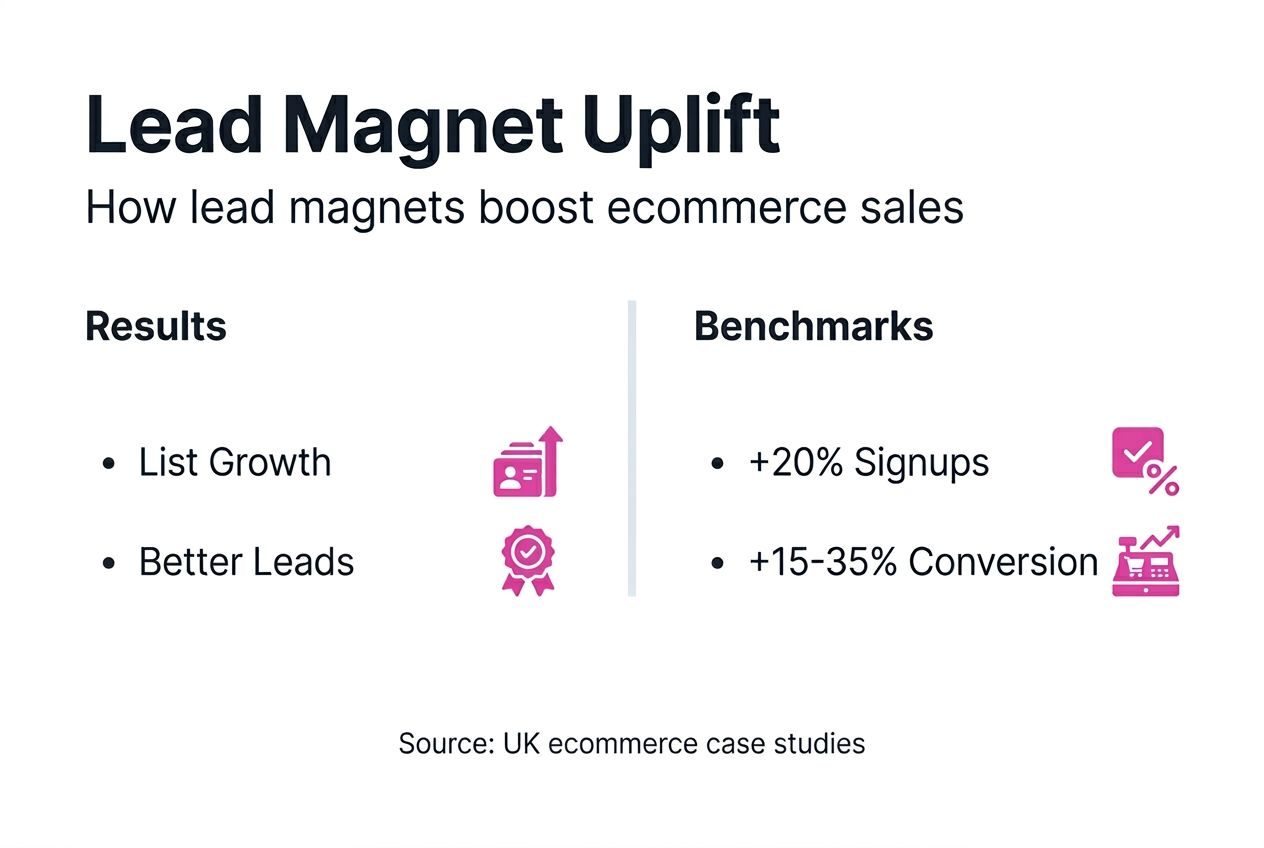
Conversion rate uplifts generally range from 15% to 35% depending on offer relevance and landing page quality. Top performers optimise continuously, testing variations and refining targeting to push rates higher over time.
Metric | Baseline | After Lead Magnet | Improvement |
Email list growth rate | 50 subscribers/month | 60-70 subscribers/month | 20-40% increase |
Landing page conversion | 2-5% | 8-15% | 3-5x improvement |
Email open rate | 15-20% | 25-35% | 50-75% increase |
Lead-to-customer rate | 5-8% | 10-15% | 2x improvement |
Marketing ROI | 2:1 | 5:1 or higher | 2.5x increase |
ROI often exceeds five times initial marketing spend when lead magnets integrate into broader nurture campaigns. Track lifetime value of acquired leads, not just immediate conversions. Quality leads generate revenue over months and years through repeat purchases and referrals.
Review ecommerce sales benchmarks to contextualise your performance against industry standards. Consult lead magnet results benchmarks for detailed performance data across formats and industries.
Ready to boost your ecommerce lead generation?
Creating effective lead magnets requires strategy, execution, and continuous optimisation. If you need expert support to develop tailored lead magnets for your UK or Irish ecommerce business, we can help.

Our team specialises in digital marketing for ecommerce brands, combining SEO, AI, social media, and PPC strategies to drive measurable growth. With over 25 years scaling successful ecommerce brands, we understand what works in competitive markets. We’ll help you create lead magnets that attract quality prospects, optimise your sales funnel, and accelerate revenue growth. Visit iwanttobeseen.online to explore how we can transform your lead generation results.
FAQ
What is a lead magnet and why is it important for ecommerce?
A lead magnet is a valuable offer you provide in exchange for a prospect’s contact details, typically an email address. It’s crucial for ecommerce because it builds a qualified email list of potential customers who’ve shown genuine interest in solving problems related to your products. This enables personalised marketing campaigns and nurture sequences that convert prospects into buyers.
How long does it take to see results from a lead magnet?
Results usually appear between 2 and 4 weeks after launching your lead magnet campaign. Timeline depends on factors like existing traffic volume, promotional effort invested, and how well your offer matches audience needs. High-traffic stores with strong promotion see results faster than newer businesses building momentum.
What are the best lead magnet formats for ecommerce marketers?
Effective formats include checklists, cheat sheets, ebooks, free trials, webinars, and templates, each serving different buyer stages. Checklists and discount codes suit prospects ready to purchase quickly. Ebooks and webinars work better for building authority and nurturing warm leads over time. Match format to where your audience sits in their buying journey.
How do I avoid common lead magnet mistakes?
Regular updates, audience-specific offers, and systematic testing improve conversions by up to 20% compared to neglecting these practices. Refresh content annually to maintain relevance. Tailor magnets to specific audience segments rather than creating generic offers. Test headlines, forms, and content variations continuously to identify what resonates best with your prospects.
Recommended
Comments