.png)
What is keyword mapping: complete SEO guide for ecommerce


Selecting keywords isn’t enough for ecommerce SEO success. Many managers believe keyword research alone drives rankings, but keyword mapping organises concepts strategically to improve visibility and eliminate internal competition. This guide explains what keyword mapping is, how it’s evolved beyond isolated keywords, and why it’s essential for your ecommerce site’s search performance in 2026.
Table of Contents
Key takeaways
Point | Details |
Strategic alignment | Keyword mapping links target keywords to specific URLs, organising content and boosting SEO performance |
Concept-driven approach | Modern mapping focuses on concepts rather than isolated keywords, improving relevance and user intent matching |
Prevents cannibalisation | Proper mapping stops internal pages competing for the same keywords, strengthening overall rankings |
Ecommerce advantages | Aligning keywords with product and category pages creates clearer site structure and better customer journeys |
AEO benefits | Implementing keyword mapping supports both traditional SEO and answer engine optimisation for voice search |
Understanding what keyword mapping is and why it matters
Keyword mapping aligns target keywords with specific URLs to organise content, prevent internal competition, and maximise search visibility. Think of it as assigning each page on your ecommerce site a clear purpose and focus. Without this organisation, multiple pages might target identical keywords, creating internal battles that dilute your ranking potential.
Keyword cannibalisation occurs when several pages compete for the same search terms. Google struggles to determine which page deserves top ranking, often showing less relevant pages or splitting authority between them. Mapping resolves this by designating one authoritative page per keyword concept, concentrating your SEO power where it matters most.
For ecommerce sites, the benefits transform both technical performance and customer experience:
Clearer site architecture helps search engines understand product relationships and category hierarchies
Customers find relevant products faster through intuitive navigation aligned with their search intent
Rankings improve as each page targets distinct, relevant keywords without internal conflict
Content creation becomes more strategic when you know which concepts need coverage
“Keyword mapping is the strategic process of aligning target keywords with specific URLs to organise content, prevent internal competition, and maximise search visibility.” — AudienceKey
Understanding how to research SEO keywords provides the foundation, but mapping transforms that research into actionable site structure. If you’re new to optimisation, review SEO basics for ecommerce to grasp how mapping fits within broader strategy.
Pro Tip: Start with your top-performing pages and map backwards. Identify which keywords already drive traffic, then optimise those pages specifically for those terms whilst assigning related variations to supporting content.
How keyword mapping has evolved: from keywords to concepts
Modern keyword mapping focuses less on individual keywords and more on the concepts they represent. Google’s algorithms now understand synonyms, related terms, and user intent behind searches. Optimising for “running trainers,” “jogging shoes,” and “athletic footwear” separately wastes effort when Google recognises these as the same concept.

This shift towards semantic understanding means your mapping strategy must think conceptually. Rather than creating separate pages for every keyword variation, organise content around core topics that naturally include related terms. A comprehensive category page about running shoes can rank for dozens of related searches without keyword stuffing.
Semantic search revolutionised how search engines interpret queries. They analyse context, user location, search history, and query relationships to deliver relevant results. Your keyword mapping should mirror this by grouping semantically related terms under unified concepts. Learn more about semantic search for ecommerce SEO to understand these connections.
Concept-based mapping delivers several competitive advantages:
Future-proofs your strategy as search algorithms become more sophisticated at understanding intent
Reduces content duplication by consolidating similar topics under comprehensive resources
Improves answer engine optimisation by providing clear, authoritative pages for specific concepts
Supports natural language queries from voice search and conversational AI assistants
Answer engines like ChatGPT, Perplexity, and Google’s AI Overviews prioritise content organised around clear concepts. When your keyword map reflects topical authority rather than keyword density, you’re positioned for both traditional search and emerging AI-powered discovery.
Pro Tip: Build topic clusters by mapping a pillar page to a core concept, then create supporting content for related subtopics. Link these pages together to signal topical authority to search engines whilst providing comprehensive coverage for users.
Practical framework: mapping keywords effectively for your ecommerce site
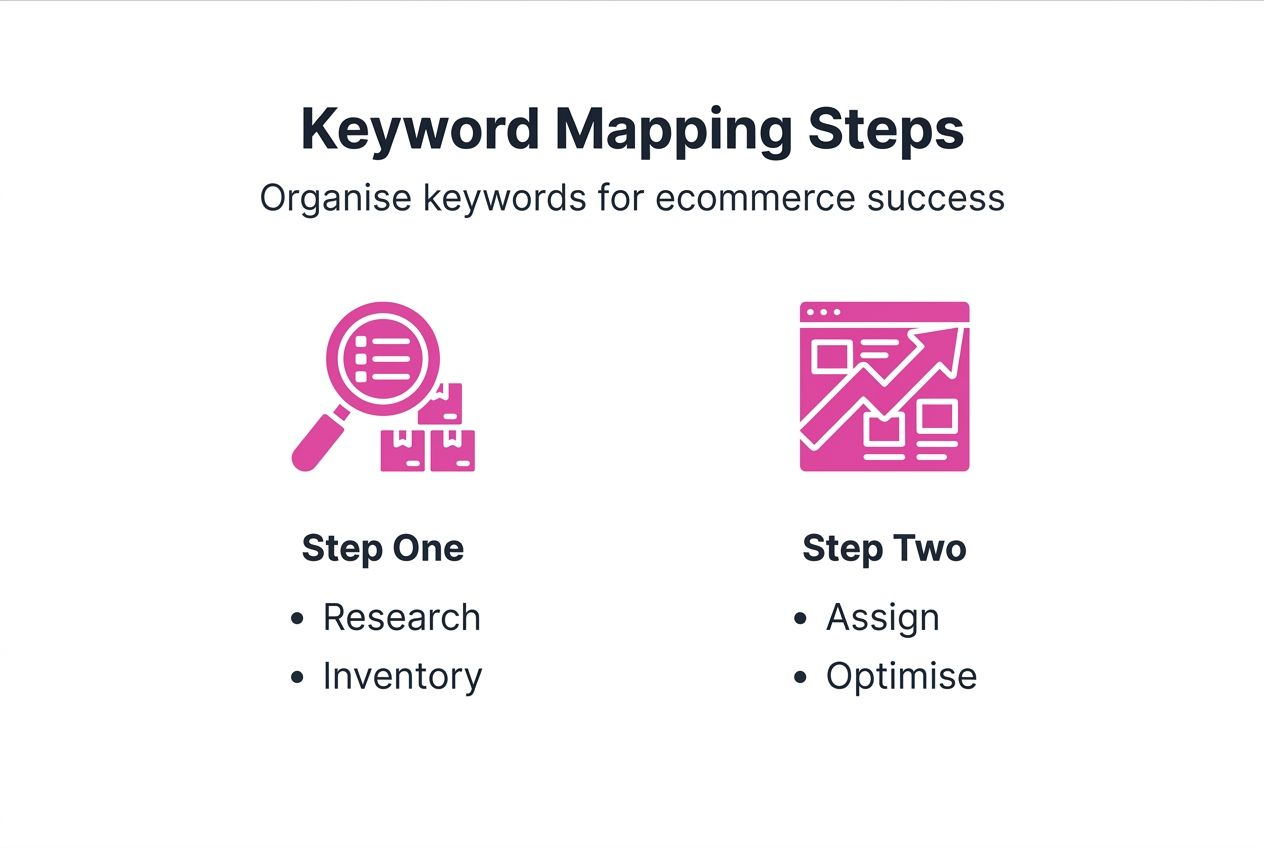
Implementing keyword mapping requires systematic organisation. Aligning keywords with specific URLs maximises both SEO and AEO performance by clarifying the core concepts important to your pages and overall site structure. Follow this framework to build your map:
Conduct comprehensive keyword research using tools like Google Keyword Planner, Ahrefs, or SEMrush to identify relevant terms your audience searches. Prioritise keywords by search volume, competition, and commercial intent.
Create a complete URL inventory listing every page on your site, including category pages, product pages, blog posts, and informational content. Export this from your sitemap or crawl tools.
Group keywords by concept rather than exact matches. Cluster related terms that share search intent and could logically appear on the same page without forcing repetition.
Assign primary and secondary keywords to each URL based on relevance and search intent. Your homepage might target brand terms, category pages target product types, and blog posts address informational queries.
Identify gaps and opportunities where valuable concepts lack dedicated pages. Create new content to fill these gaps and capture untapped traffic.
Document your map in a spreadsheet with columns for URL, primary keyword, secondary keywords, concept, search volume, and optimisation status. This becomes your strategic reference.
Optimise existing pages by updating title tags, meta descriptions, headings, and content to align with mapped keywords whilst maintaining natural language.
Monitor and refine regularly by tracking rankings, identifying new keyword opportunities, and adjusting assignments as your site and market evolve.
Approach | Focus | Best For | Limitations |
Keyword-focused | Individual exact match terms | Small sites with distinct products | Misses semantic relationships, creates duplication |
Concept-focused | Topical clusters and intent | Growing ecommerce sites | Requires deeper analysis and content planning |
Hybrid | Mix of exact match and concepts | Established sites with varied content | More complex to maintain and track |
Explore essential SEO tools for ecommerce to streamline your mapping process. Quality tools automate keyword clustering, identify cannibalisation, and track ranking changes across your map.
Revisit keyword research methods quarterly to discover emerging search trends and adjust your map accordingly. Consumer language evolves, new products launch, and seasonal patterns shift search behaviour throughout the year.
Pro Tip: Use conditional formatting in your mapping spreadsheet to highlight pages with multiple primary keywords (potential cannibalisation) or high-value keywords without assigned URLs (missed opportunities). Visual cues make strategic decisions faster.
Avoiding common keyword mapping mistakes and maximising value
Even experienced marketers stumble with keyword mapping implementation. Recognising these pitfalls helps you build more effective strategies from the start.
Common mistakes that undermine mapping efforts include:
Ignoring internal keyword competition by assigning identical keywords to multiple pages without clear differentiation
Relying on outdated keyword data instead of refreshing research quarterly to capture changing search behaviour
Neglecting site structure and URL hierarchy, making it difficult for search engines to understand page relationships
Mapping keywords mechanically without considering user intent or the customer journey stage each page serves
Focusing exclusively on high-volume keywords whilst missing valuable long-tail opportunities with stronger purchase intent
Failing to coordinate keyword mapping with content creation, leading to gaps in coverage or redundant content
Keyword mapping has evolved into organising the concepts that matter most to your target audience. This perspective shift prevents the biggest mistake: treating mapping as a one-time technical task rather than ongoing strategic planning.
“Keyword mapping has evolved into an exercise in organising the concepts that matter most to your target audience.” — AudienceKey
To maximise value from your keyword map, integrate it throughout your SEO workflow. Reference it when planning new content, prioritising technical optimisations, and evaluating which pages deserve link building investment. Your map becomes the strategic foundation connecting all optimisation activities.
Regularly audit your map against actual performance data. Pages ranking for unintended keywords signal opportunities to refine targeting or create new content. Pages failing to rank for assigned keywords need content improvements, technical fixes, or authority building through links.
Understand why investing in SEO delivers compounding returns as your keyword map matures. Each refinement strengthens site architecture, improves user experience, and builds topical authority that benefits all related pages.
Pro Tip: Set calendar reminders to review your keyword map monthly for quick wins and quarterly for strategic updates. Brief, regular attention prevents mapping drift and keeps your strategy aligned with business priorities and market changes.
Optimise your ecommerce SEO with expert guidance
Implementing keyword mapping transforms ecommerce SEO performance, but execution requires expertise, time, and ongoing refinement. If you’re ready to eliminate internal competition and organise your site around concepts that drive revenue, professional support accelerates results whilst avoiding costly mistakes.

Our team specialises in ecommerce SEO strategies backed by 25 years scaling successful online brands. We’ve mapped thousands of keywords across diverse product catalogues, creating clear site architectures that rank consistently and convert visitors into customers. Explore our ecommerce SEO services to discover how strategic keyword mapping fits within comprehensive optimisation programmes tailored to UK and Ireland markets.
FAQ
What is keyword mapping in SEO?
Keyword mapping is the strategic process of assigning specific target keywords to individual URLs on your website. This creates organised site architecture where each page focuses on distinct concepts, preventing internal competition and clarifying which content serves which search queries.
Why is keyword mapping important for ecommerce sites?
Mapping prevents keyword cannibalisation where multiple product or category pages compete for identical search terms, weakening your overall rankings. It helps customers find relevant products through logical site navigation aligned with their search intent. Proper mapping concentrates your SEO authority, boosting organic traffic and conversions.
How do I create a keyword map for my website?
Start with comprehensive keyword research to identify relevant search terms your audience uses. Inventory all your URLs, then group keywords by concept and assign them to the most relevant pages. Use spreadsheets or SEO tools to document your map, then regularly audit and refine assignments based on performance data and emerging opportunities.
Can keyword mapping improve answer engine optimisation?
Yes, mapping concepts to specific URLs improves content clarity for answer engines like ChatGPT and Google’s AI Overviews. Clear topical organisation helps these systems identify authoritative sources for specific queries. This supports better visibility in voice search results, featured snippets, and conversational AI responses that increasingly drive ecommerce discovery.
Recommended
Comments