.png)
What is voice commerce and how it boosts sales in 2026
- Darren Burns
- Mar 11
- 7 min read


Voice commerce isn’t just another way to search for products online. It’s a complete purchase workflow powered by AI that lets customers browse, select, and buy using nothing but their voice. While many e-commerce businesses think voice technology stops at simple search queries, the reality is far more transformative. This guide explains what voice commerce actually is, the AI technology behind it, measurable benefits for your business, market growth projections for 2026, and practical considerations for UK and Ireland retailers ready to adopt this channel.
Table of Contents
Key takeaways
| Point | Details | |-------|---------|| | Voice commerce definition | Shopping using voice commands via smart devices, completing entire purchase workflows beyond simple search. | | AI technology stack | Combines automatic speech recognition, natural language processing, intent analysis, and conversational AI to enable transactions. | | Business benefits | Increases average order values by 35%, speeds up shopping, reduces cart abandonment, and improves customer engagement. | | Market growth | Global voice commerce market projected to reach $147.9 billion by 2030, with 20% compound annual growth rate. | | Implementation challenges | Managing latency under 600ms, supporting concurrent users, and building trust between discovery and checkout stages. |
What is voice commerce and how does it work?
Voice commerce enables customers to shop using spoken commands through smart speakers, smartphones, and other voice-enabled devices. Unlike basic voice search that simply returns product results, voice commerce completes the entire shopping journey through conversation. Voice commerce relies on voice-enabled devices connected to software solutions powered by natural language processing (NLP) technologies that understand intent and execute actions.
The technology stack combines several AI systems working together. Voice input is captured by smart speakers or devices and converted to text through automatic speech recognition algorithms. Natural language processing then analyses the text to understand what the customer wants. AI decision engines determine appropriate responses, pulling product data, checking inventory, and processing transactions. Finally, the system generates voice or text responses that feel natural and conversational.
Here’s how a typical voice commerce interaction flows:
Customer speaks a command like “order more nappies for my toddler”
Device captures audio and transcribes it to text
NLP algorithms analyse intent and extract key information
AI systems check order history, current stock, and pricing
System confirms details verbally and processes the transaction
Customer receives voice confirmation and order summary
The difference between voice search and voice commerce becomes clear in execution. Voice search stops at showing results. Voice commerce handles the complete workflow including product selection, basket management, payment processing, and order confirmation. This integration with backend systems and AI in e-commerce platforms makes true hands-free shopping possible.
Pro Tip: Voice commerce works best for repeat purchases and familiar products where customers already know what they want, eliminating the need to browse screens.
The business and customer benefits of voice commerce
Voice commerce AI is changing how people shop online, making buying faster and more natural. Customers can place orders while cooking, driving, or caring for children without touching a device. This convenience eliminates typing errors and reduces friction in the purchase process. Speech is faster than typing, allowing customers to add multiple items quickly using natural language.

The impact on business metrics can be substantial. Bugaboo increased average order value by 35% and add-to-cart rate by 20% after implementing voice AI. Voice assistants can suggest complementary products during conversations, driving upsells naturally without feeling pushy. When customers ask questions about products, immediate voice responses prevent the hesitation that often leads to cart abandonment.
Key benefits for UK and Ireland e-commerce businesses include:
Faster checkout processes that reduce drop-off rates during purchase
Higher conversion rates through conversational product recommendations
Improved accessibility for customers with visual impairments or mobility challenges
Reduced customer service costs by automating routine queries and reorders
Enhanced brand differentiation in competitive markets
For customers, voice commerce delivers tangible advantages. They receive instant answers to product questions without navigating multiple pages. Voice interfaces remember preferences and purchase history, creating personalised shopping experiences. Multitasking becomes effortless when you can shop while doing other activities. The technology also frees up human customer service agents to handle complex queries requiring empathy and judgement, similar to benefits seen with chatbot marketing in e-commerce.
Pro Tip: Start with voice commerce for high-frequency, low-complexity products like consumables and household essentials where customers have established preferences.
Market trends and the growth outlook for voice commerce
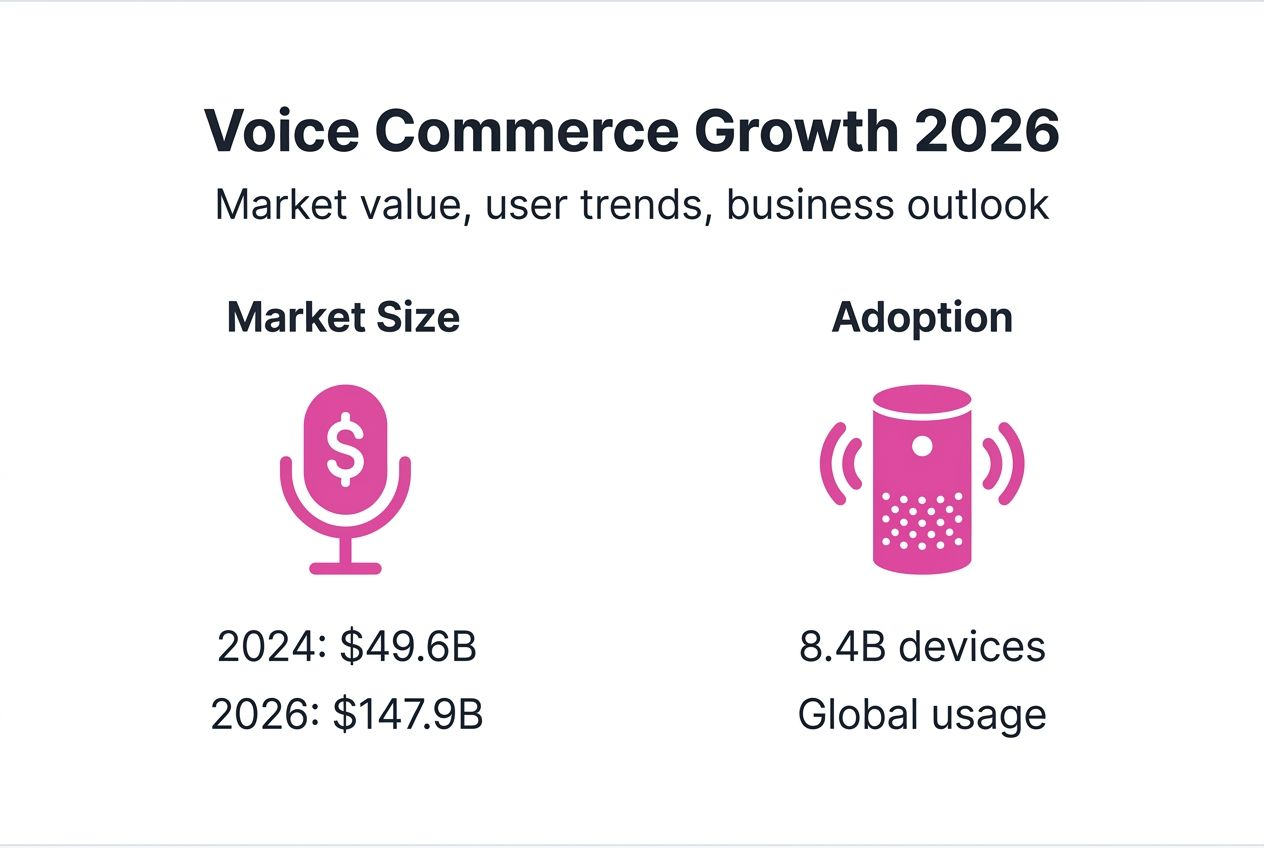
Voice assistant adoption has reached critical mass globally. 8.4 billion digital voice assistant units were active worldwide in 2024, creating an enormous potential customer base for voice commerce. Smart speakers sit in kitchens, bedrooms, and living rooms across the UK and Ireland, with voice assistants built into most modern smartphones. This device penetration creates natural touchpoints for shopping throughout the day.
The global voice commerce market was valued at US$49.6 billion in 2024 and is projected to reach US$147.9 billion by 2030 with 20% CAGR. This represents a tripling of market value in just six years, signalling rapid mainstream adoption. Personal care products and consumer electronics show particularly strong growth rates as customers become comfortable making purchases by voice.
Year | Market Value | Growth Rate |
2024 | $49.6 billion | baseline |
2026 | $71.5 billion | 20% CAGR |
2028 | $103.0 billion | 20% CAGR |
2030 | $147.9 billion | 20% CAGR |
Consumer behaviour shifts explain this growth trajectory. Younger demographics especially expect voice interfaces across digital experiences. The convenience factor drives repeat usage once customers experience successful voice transactions. Trust in AI systems grows as speech recognition accuracy improves and security measures strengthen.
“Voice commerce represents the natural evolution of shopping interfaces, removing screens as barriers between customer intent and purchase completion.”
For UK and Ireland e-commerce businesses, these trends create both opportunity and urgency. Early adopters gain competitive advantages and learn to optimise voice experiences before markets saturate. The technology aligns with broader digital marketing trends in e-commerce emphasising personalisation and convenience. Businesses that delay risk falling behind as voice commerce becomes standard rather than novel.
Challenges and best practices when implementing voice commerce
While voice commerce offers significant benefits, implementation requires careful attention to technical and experiential factors. In voice systems, latency above 600ms harms user experience; concurrency limitations cause many production failures. Customers expect conversational systems to respond as quickly as humans, ideally within 300 milliseconds. Delays break the natural flow and cause frustration.
Concurrency presents another common pitfall. Demo voice systems often work perfectly with one user but struggle when dozens or hundreds of customers use them simultaneously. Production environments require infrastructure that scales to handle peak demand without degrading response times. Voice AI systems consume more computing resources than text-based chatbots, requiring robust backend architecture.
Trust issues frequently emerge between product discovery and checkout completion. Customers comfortable asking voice assistants about products hesitate to authorise purchases verbally. Security concerns about voice authentication and payment processing create friction. Many implementations succeed at conversational product browsing but fail to close transactions, similar to challenges in voice search optimisation for e-commerce.
Challenge | Impact | Mitigation Strategy |
High latency | Breaks conversational flow, frustrates users | Optimise infrastructure, use edge computing, implement response caching |
Concurrency limits | System fails during peak traffic periods | Load test rigorously, design for horizontal scaling, monitor performance |
Trust barriers | Customers abandon before purchase completion | Multi-factor authentication, order confirmations, gradual trust building |
Accent recognition | Excludes customers with regional accents | Train models on diverse speech data, offer fallback text options |
Best practices for smooth implementation include:
Design voice flows that allow interruptions and clarifications naturally
Provide visual confirmation on companion screens when available
Start with simple, high-confidence use cases before expanding
Monitor actual latency and concurrency metrics in production
Train voice models specifically on your product catalogue and terminology
Pro Tip: Test your voice commerce system with real customers who have diverse accents and speaking styles, not just internal team members, to identify recognition issues early.
How to start with voice commerce for your e-commerce store
Voice commerce represents a significant opportunity for UK and Ireland e-commerce businesses ready to enhance customer experiences and drive sales growth. The technology has matured beyond experimental stages into proven implementations delivering measurable results. Starting doesn’t require complete platform overhauls. Many businesses begin with specific use cases like reordering consumables or answering product questions before expanding to full transactional capabilities.

Our team specialises in helping e-commerce businesses integrate AI technologies including voice commerce solutions that align with your specific product catalogue and customer base. With over 25 years scaling successful e-commerce brands, we understand the technical requirements and customer experience factors that determine success. Whether you’re exploring voice commerce for the first time or looking to optimise existing implementations, we can guide you through strategy, platform selection, and deployment.
FAQ
What devices support voice commerce?
Smart speakers like Amazon Echo and Google Nest are the most common voice commerce platforms. Smartphones with Siri, Google Assistant, or Alexa also enable voice shopping. Many smart TVs, car systems, and wearable devices now include voice assistants capable of handling commerce transactions.
How does voice commerce improve customer engagement?
Voice commerce lets customers shop using natural speech, reducing friction and eliminating typing errors that cause frustration. Immediate responses to questions prevent the delays that often lead to cart abandonment. Personalised recommendations delivered conversationally feel more helpful than intrusive, increasing customer satisfaction and loyalty.
Are there risks with using voice commerce for big-ticket items?
Voice shopping is mostly limited to repeat grocery orders, not complex or big-ticket purchases, where UX and trust issues exist. Customers typically want to see detailed specifications, compare options visually, and carefully review purchases before committing to expensive items. Voice commerce works best for familiar products and routine reorders where decision complexity is low.
How can businesses ensure smooth voice commerce experiences?
Maintain system latency under 600ms to preserve conversational flow and prevent customer frustration. Design infrastructure to support multiple concurrent users, especially during peak shopping periods. Allow customers to interrupt and clarify naturally rather than forcing rigid command structures. Test extensively with diverse accents and speaking styles before full launch.
What products sell best through voice commerce?
Consumable goods like groceries, household supplies, and personal care items perform strongest in voice commerce. Products customers purchase repeatedly benefit from the convenience of voice reordering. Simple, well-known items without complex variants or specifications convert better than products requiring detailed visual comparison or customisation.
Recommended
Comments