.png)
What Is a Landing Page? Boosting eCommerce Sales


Every Ecommerce entrepreneur in the United Kingdom and Ireland knows the challenge of turning website visitors into paying customers. In a competitive online marketplace, a carefully crafted landing page can make all the difference by eliminating distractions and guiding buyers towards a single action. Discover how a focused approach to landing page design offers a strategic advantage, driving more conversions and building customer engagement where it matters most.
Table of Contents
Key Takeaways
Point | Details |
Effective Landing Pages | A well-designed landing page can significantly increase conversion rates by focusing on specific actions. |
Types of Landing Pages | Different types, such as Lead Capture and Sales Pages, cater to distinct marketing goals and target customer journeys. |
Essential Elements | High-converting landing pages must include clear CTAs, engaging imagery, and trust indicators to guide prospective buyers. |
Common Mistakes | Avoid overwhelming navigation, slow loading times, and unclear value propositions to improve user experience and conversion potential. |
Landing pages explained for eCommerce owners
A landing page is a targeted web page designed specifically to convert visitors into customers or leads. Unlike standard website pages with multiple navigation options, landing pages focus exclusively on encouraging a single, specific action from potential buyers. When crafted effectively, these pages can dramatically improve your online sales conversion rates.
Landing pages serve multiple critical purposes for eCommerce businesses:
Capture visitor attention immediately
Eliminate distracting website elements
Present a clear, compelling value proposition
Guide visitors towards a specific conversion goal
Track marketing campaign performance
These specialised pages are typically created for specific marketing campaigns, designed with minimal navigation to keep potential customers focused on taking action. For eCommerce owners, this means creating a streamlined experience that reduces friction in the purchasing journey.
Typically, an effective landing page includes several key components:
Attention-grabbing headline
Clear product or offer description
High-quality product imagery
Compelling call-to-action (CTA) button
Social proof elements like testimonials
Simplified contact or purchase form
Conversion tracking is another crucial aspect of landing pages. By designing pages that are laser-focused on specific goals, eCommerce businesses can measure exactly how well their marketing efforts are performing and make data-driven improvements.

Pro tip: Create unique landing pages for different marketing channels to maximise conversion potential and improve campaign tracking accuracy.
Types of landing pages and their purposes
E-commerce businesses utilise several distinct landing page types, each designed to achieve specific marketing objectives. Different landing page categories serve unique purposes in guiding potential customers through the purchasing journey, from initial interest to final conversion.
The primary landing page types include:
Lead Capture Pages: Collect user contact information for future marketing
Click-Through Pages: Encourage users to proceed to a specific offer
Squeeze Pages: Request minimal user details through compact forms
Product Launch Pages: Showcase new products with compelling descriptions
Sales Pages: Direct users towards making an immediate purchase
Reference landing pages provide detailed information about products or services, helping potential customers understand value propositions before making purchasing decisions. These pages typically include comprehensive product descriptions, feature breakdowns, and comparative insights.
Here is a comparison of the most common e-commerce landing page types and their strategic business focus:
Landing Page Type | Main Objective | Typical Use Case |
Lead Capture | Gather user contact information | Newsletter signup |
Click-Through | Move users to an offer or checkout | Paid ad campaign destination |
Squeeze | Request minimal details via a form | Free guide or resource download |
Product Launch | Showcase new items and benefits | Announce new product line |
Sales | Drive immediate purchase | Flash sale or special promotion |
Transactional landing pages are more action-oriented, designed to persuade visitors to complete a specific transaction. They often feature streamlined forms, clear pricing information, and prominent call-to-action buttons that minimise potential barriers to conversion.
A well-designed landing page can increase conversion rates by up to 300% compared to generic website pages.
Marketing teams typically select landing page types based on specific campaign goals, target audience characteristics, and desired user actions. Understanding these nuanced differences allows e-commerce businesses to create more targeted, effective marketing strategies.
Pro tip: Continuously A/B test different landing page designs to identify which formats and elements generate the highest conversion rates for your specific audience.
Essential elements for high-converting pages
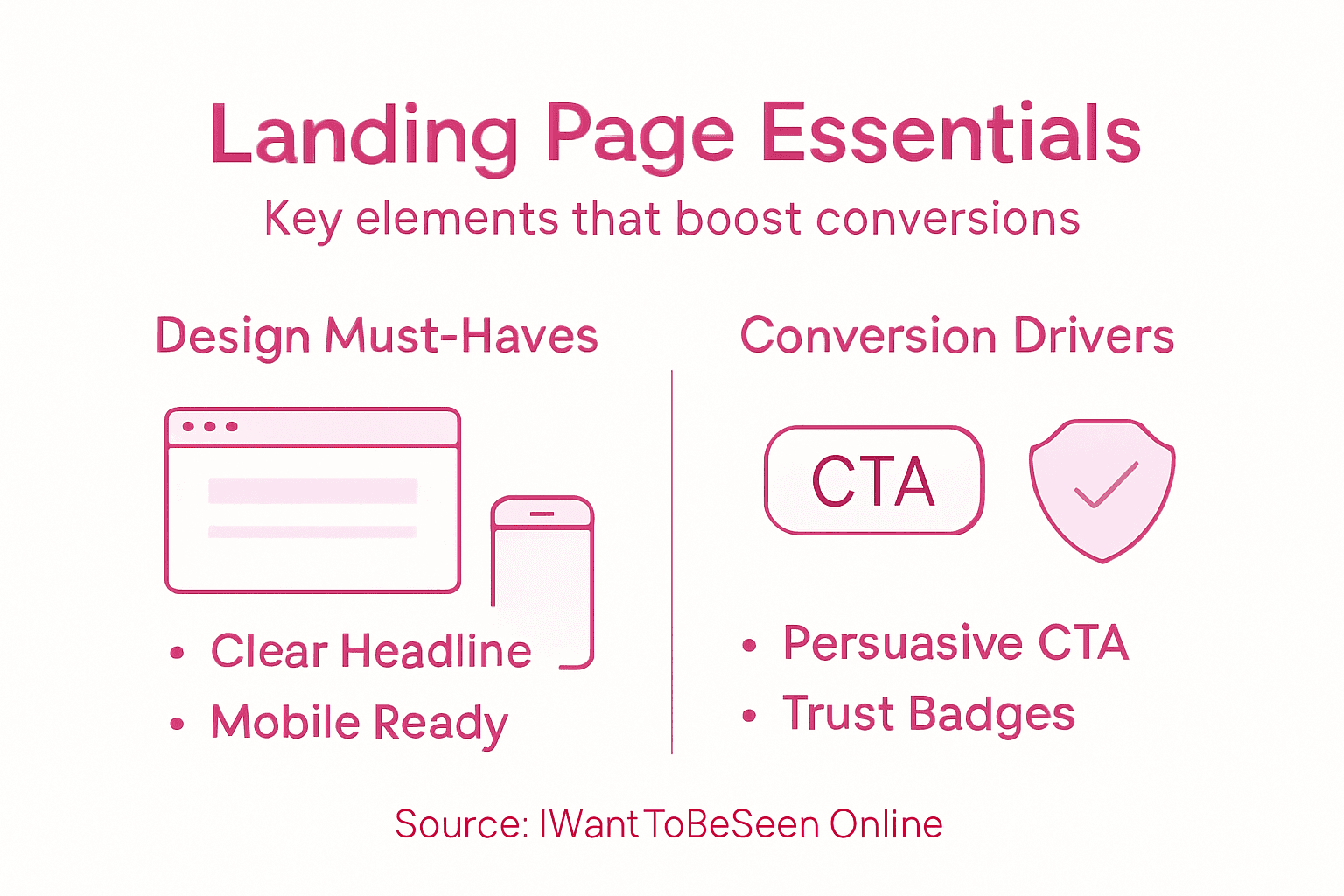
Creating a high-converting landing page requires careful attention to specific design and content elements that guide visitors towards conversion. The most successful e-commerce landing pages combine strategic visual design with compelling, user-focused content that addresses potential customer needs and motivations.
The critical components of a high-converting landing page include:
Clear and Compelling Headline: Immediately communicate unique value proposition
Engaging Product Imagery: High-quality, professional visuals that showcase products
Concise Value Description: Explain benefits quickly and directly
Prominent Call-to-Action (CTA): Visually striking button with action-oriented text
Trust Indicators: Customer testimonials, security badges, guarantees
Social proof plays a crucial role in converting visitors. Effective landing pages incorporate elements that build credibility, such as customer reviews, industry certifications, and performance statistics. These trust signals help overcome potential customer hesitations and reduce perceived purchasing risks.
Reducing friction in the conversion process can increase landing page effectiveness by up to 50%.
Mobile responsiveness is no longer optional but essential. With over 60% of e-commerce traffic coming from mobile devices, landing pages must provide seamless experiences across all screen sizes. This means intuitive navigation, fast-loading images, and forms that are easy to complete on smaller devices.
Pro tip: Implement heatmap tracking to understand exactly how users interact with your landing page and continuously refine your design based on real user behaviour.
Key conversion strategies and optimisation tips
E-commerce businesses can dramatically improve landing page performance by implementing targeted conversion strategies. These strategic approaches focus on understanding user behaviour, reducing friction, and creating compelling pathways that guide potential customers towards making a purchase.
Key conversion optimisation strategies include:
Simplify Navigation: Remove unnecessary menu items
Streamline Forms: Minimise required fields
Use Persuasive Copywriting: Address customer pain points directly
Implement Clear CTAs: Create visually striking, action-oriented buttons
Personalise User Experience: Tailor content to specific audience segments
Analytics-driven optimization is crucial for continuous improvement. By tracking user interactions, businesses can identify potential barriers in the conversion funnel and make data-informed refinements. Heat mapping, click tracking, and user session recordings provide invaluable insights into how visitors interact with landing pages.
Reducing form fields from 4 to 3 can increase conversion rates by up to 50%.
Psychological triggers play a significant role in conversion optimization. Elements like scarcity indicators, social proof, and trust badges can significantly influence purchasing decisions. Implementing these strategically can help overcome customer hesitations and create a sense of urgency.
Pro tip: Conduct regular A/B testing on different landing page elements, focusing on one variable at a time to accurately measure its impact on conversion rates.
Common mistakes and how to avoid them
E-commerce landing pages often fall victim to critical design and strategic errors that dramatically reduce conversion potential. Identifying and addressing common mistakes can significantly improve user experience and sales performance.
Most frequent landing page mistakes include:
Overwhelming Navigation: Too many menu options distracting visitors
Unclear Value Proposition: Failing to communicate product benefits immediately
Complex Form Designs: Requesting excessive customer information
Slow Page Loading: Performance issues that frustrate potential buyers
Weak Call-to-Action: Ineffective or buried conversion buttons
Technical performance plays a crucial role in landing page success. Slow-loading pages can increase bounce rates by up to 53%, meaning businesses lose potential customers before they even see the full offering. Mobile responsiveness is particularly critical, with over 60% of online shopping now occurring on mobile devices.
A one-second delay in page load time can reduce conversions by 7%.
Below is a summary of the most frequent landing page mistakes and their potential impact on e-commerce performance:
Mistake | Possible Negative Outcome | Business Impact |
Overwhelming navigation | Increased visitor drop-off rate | Fewer conversions |
Unclear value proposition | Confused users, low engagement | Reduced sales opportunities |
Slow page loading | High bounce rate, frustrated visitors | Loss of potential customers |
Weak call-to-action | Low response to offers | Missed sales and sign-ups |
Lack of trust signals | Visitor scepticism, hesitation | Lower conversion rates |
Psychological barriers can also undermine landing page effectiveness. Lack of trust signals, such as customer testimonials, security badges, and transparent policies, can create unconscious resistance. Potential buyers need reassurance that their transaction is safe and the product will deliver promised value.
Pro tip: Conduct quarterly comprehensive audits of your landing pages, systematically testing each element and gathering user feedback to identify and eliminate conversion barriers.
Joining the eCommerce Club for support
Professional support networks can be transformative for e-commerce entrepreneurs seeking to accelerate their online business growth. Digital marketing communities offer crucial resources for businesses looking to navigate the complex landscape of online sales and marketing strategies.
The key benefits of joining an e-commerce support club include:
Access to expert mentorship
Networking with fellow entrepreneurs
Structured learning opportunities
Peer-to-peer knowledge sharing
Exclusive industry insights and trends
Membership levels typically range from free entry-level access to premium tiers with more comprehensive support. Beginners can benefit from foundational resources, while advanced members might receive personalised coaching, advanced marketing tools, and direct consulting opportunities.
Professional communities can reduce the learning curve by up to 60% for new e-commerce entrepreneurs.
Selecting the right e-commerce club requires careful consideration of your specific business needs, growth stage, and learning objectives. Look for communities that offer practical, actionable guidance, current digital marketing strategies, and a supportive environment that encourages continuous learning and adaptation.
Pro tip: Research multiple e-commerce clubs, attend free webinars or introductory sessions, and evaluate their community culture and resources before committing to a membership.
Transform Your Landing Pages into Conversion Powerhouses
The article highlights common challenges you face with landing pages such as unclear value propositions, overwhelming navigation and slow page loading that dramatically reduce your conversion rates. If you are struggling to create landing pages that truly capture attention and drive sales, you are not alone. Achieving high-converting, targeted landing pages with compelling calls-to-action and seamless user experience takes specialised knowledge and experience.
At IWantToBeSeen Online, we understand the emotional frustration of losing potential customers due to poorly optimised landing pages. With over 25 years of experience scaling multiple successful e-commerce brands and offering expert digital marketing services in SEO, AI, Social Media and PPC, we are perfectly positioned to help you overcome these hurdles. Utilise our proven strategies and technical expertise to dramatically boost your online sales through expertly crafted landing pages that engage visitors and maximise conversions.
Ready to unlock the full potential of your e-commerce marketing efforts and convert more visitors into loyal customers right now?

Discover customised digital marketing solutions designed specifically for eCommerce at IWantToBeSeen Online. Visit our landing page today and take the first step towards increasing your sales performance with confidence.
Frequently Asked Questions
What is the purpose of a landing page in eCommerce?
A landing page is specifically designed to convert visitors into customers or leads by focusing on a single, clear action while eliminating distractions found on standard website pages.
What are the essential elements of a high-converting landing page?
Key components include a clear headline, engaging product imagery, a concise value description, a prominent call-to-action, and trust indicators like customer testimonials or security badges.
How can I track the performance of my landing page?
Utilise conversion tracking tools to measure how well your landing page meets its goals. Metrics like bounce rates, form completion rates, and click-through rates can provide insights into performance and areas for improvement.
What types of landing pages are most effective for eCommerce?
Common types include lead capture pages, click-through pages, squeeze pages, product launch pages, and sales pages, each tailored to achieve specific marketing objectives.
Recommended
Comments