.png)
Return on Ad Spend: Maximising eCommerce Profits


Every British or Irish eCommerce owner knows the frustration of watching ad budgets disappear without clear proof of success. Understanding where your money truly goes is more than just good book keeping, it is key to smarter decision making. By mastering Return on Ad Spend as a distinct advertising metric, you can cut through common misconceptions and pinpoint exactly how much revenue each pound of ad spend generates for your business.
Table of Contents
Key Takeaways
Point | Details |
Understanding ROAS | ROAS measures the revenue generated for every pound spent on advertising, specifically focusing on advertising efficiency. A ROAS above 1:1 indicates profitability, with a target of around 4:1 for most eCommerce businesses. |
Misinterpretation Risks | Many businesses mistakenly treat ROAS as a comprehensive profit metric, overlooking costs like product or operational expenses. It should be used alongside other metrics like Customer Acquisition Cost and Net Profit Margin for a complete financial analysis. |
Benchmark Contextualisation | ROAS benchmarks vary across industries, with some sectors requiring higher returns. Understanding these contextual differences is vital for assessing advertising effectiveness appropriately. |
Continuous Optimisation | Improving ROAS requires ongoing analysis and strategic optimisation in audience targeting and creative development, supported by advanced analytics and conversion tracking. This multifaceted approach can lead to higher advertising efficiency and greater returns. |
Return on Ad Spend Defined and Debunked
Return on Ad Spend (ROAS) represents a critical performance metric for eCommerce businesses seeking to understand their advertising efficiency. At its core, ROAS measures the revenue generated for every pound spent on advertising, providing a clear snapshot of campaign profitability. Unlike generic return on investment (ROI) calculations, ROAS zeroes in specifically on advertising expenditure and its direct revenue outcomes.
The fundamental ROAS calculation is straightforward: total revenue generated from an advertising campaign divided by the total advertising spend. For instance, if you invest £1,000 in digital advertising and generate £4,000 in sales, your ROAS would be 4:1 - a robust performance indicator in the digital marketing landscape. Crucially, a ROAS above 1:1 signals that your advertising generates more revenue than its cost, with most eCommerce businesses targeting a benchmark of 4:1 or higher.
Misconceptions about ROAS frequently emerge, particularly around its interpretation. Some entrepreneurs mistakenly view ROAS as a comprehensive profit metric, overlooking essential factors like product cost, operational expenses, and profit margins. While a high ROAS suggests effective advertising, it does not automatically guarantee overall business profitability. Successful eCommerce operators recognise ROAS as one component of a broader financial analysis, using it alongside metrics like customer acquisition cost, lifetime value, and net profit margins.
Here’s a useful summary comparing ROAS with other key eCommerce metrics:
Metric | Focus Area | Measures | Typical Use Case |
ROAS | Advertising efficiency | Revenue per £1 ad spend | Optimising marketing campaigns |
Customer Acquisition Cost (CAC) | Customer outreach | Cost to acquire one customer | Budget allocation decisions |
Customer Lifetime Value (CLV) | Long-term profit potential | Total value per customer | Strategic growth planning |
Net Profit Margin | Overall profitability | Profit after all expenses | Business health assessment |
Pro tip: Develop a holistic view of your advertising performance by tracking ROAS alongside other critical financial indicators to ensure comprehensive business insights.
How the ROAS Formula Works in Practice
Calculating Return on Ad Spend requires a systematic approach that goes beyond simple arithmetic. At its core, the ROAS formula demands precise tracking of all advertising expenditures and the corresponding revenue generated. Total ad spend encompasses more than just media placement costs, including agency fees, creative production expenses, platform charges, and any additional marketing-related investments directly tied to the campaign.
To demonstrate the practical application, consider a digital marketing campaign where you invest £5,000 across multiple channels. Calculating advertising effectiveness involves meticulously tracking the revenue directly attributable to these advertising efforts. If this campaign generates £25,000 in sales, the ROAS calculation becomes straightforward: £25,000 divided by £5,000, resulting in a 5:1 ROAS. This means for every pound spent on advertising, the business generates £5 in revenue.

Professional eCommerce operators understand that raw ROAS numbers require nuanced interpretation. A high ROAS doesn’t automatically translate to profitability, as it doesn’t account for product costs, operational expenses, or profit margins. Savvy marketers use ROAS as a comparative tool across different advertising channels, identifying which platforms and strategies deliver the most efficient revenue generation. By comparing ROAS across Google Ads, social media campaigns, and email marketing, businesses can strategically allocate their advertising budgets to maximise financial performance.
Pro tip: Create a standardised tracking spreadsheet that captures all advertising expenses and directly attributable revenue to simplify your ROAS calculations and provide consistent performance insights.
Interpreting ROAS Benchmarks for eCommerce
Understanding ROAS benchmarks requires a nuanced approach that goes beyond simple numerical comparisons. Different eCommerce sectors demonstrate varying performance expectations, making it critical to contextualise your advertising efficiency within your specific industry landscape. Benchmark thresholds fluctuate across product categories, with some niches tolerating lower returns while others demand exceptionally high performance metrics.
Interpreting advertising performance metrics reveals that most eCommerce businesses aim for a 4:1 ROAS as a robust standard. This means generating £4 in revenue for every £1 spent on advertising. However, this benchmark isn’t universal. Luxury product retailers might require higher returns to offset production costs, while high-volume, low-margin businesses might operate successfully with lower ROAS figures.
Sophisticated eCommerce operators recognise that ROAS benchmarks represent more than isolated numbers. They incorporate additional context such as customer lifetime value, repeat purchase rates, and long-term brand building potential. A seemingly lower ROAS might be acceptable if it attracts high-quality customers with significant future purchasing potential. Conversely, a high ROAS could mask underlying issues like narrow market reach or unsustainable marketing strategies.
Pro tip: Develop comparative ROAS tracking across different marketing channels and product lines to identify your most efficient revenue generation strategies.
Common ROAS Pitfalls and Misconceptions
Many eCommerce businesses fall into dangerous traps when interpreting Return on Ad Spend, mistaking raw numbers for comprehensive performance insights. Advertising efficiency requires more than surface-level calculations, demanding a sophisticated understanding of complex marketing dynamics. Superficial ROAS interpretations can lead to misguided strategic decisions that ultimately undermine business growth.
Predictive accuracy challenges reveal that simply calculating a high ROAS does not guarantee sustainable marketing success. A common misconception is treating ROAS as a standalone metric, overlooking critical factors like customer acquisition costs, lifetime value, and broader marketing performance indicators. Some businesses celebrate a 5:1 ROAS without recognising that the underlying campaign might attract low-quality customers with minimal repeat purchase potential.
Sophisticated marketers understand that ROAS represents just one piece of a complex financial puzzle. Potential pitfalls include misinterpreting short-term gains as long-term strategy, failing to account for indirect marketing benefits, and neglecting the nuanced differences between revenue generation and genuine profitability. A holistic approach requires integrating ROAS with comprehensive performance metrics, understanding the contextual limitations of advertising spend analysis, and maintaining flexibility in strategic interpretation.
Pro tip: Develop a multi-dimensional performance dashboard that tracks ROAS alongside customer lifetime value, repeat purchase rates, and acquisition costs to gain a more comprehensive understanding of marketing effectiveness.
Strategies to Improve Return on Ad Spend
Improving Return on Ad Spend requires a multifaceted approach that goes beyond simplistic advertising tactics. Strategic optimisation demands a comprehensive understanding of audience targeting, creative development, and continuous performance analysis. Successful eCommerce businesses recognise that ROAS improvement is an ongoing process of refinement and precision.
Advanced advertising performance strategies reveal critical techniques for enhancing marketing efficiency. Key approaches include granular audience segmentation, implementing sophisticated conversion tracking, and developing highly targeted ad creatives that resonate with specific customer personas. Businesses should focus on creating laser-focused campaigns that speak directly to distinct customer segments, avoiding broad, generic messaging that fails to generate meaningful engagement.
Technical infrastructure plays a crucial role in ROAS optimization. This involves implementing advanced attribution models that accurately track customer journeys across multiple touchpoints, leveraging cross-device tracking, and integrating sophisticated analytics tools. Successful marketers continuously test and iterate their approaches, using data-driven insights to make incremental improvements. This might involve A/B testing ad variations, refining landing page designs, and constantly adjusting bidding strategies to maximise advertising efficiency.
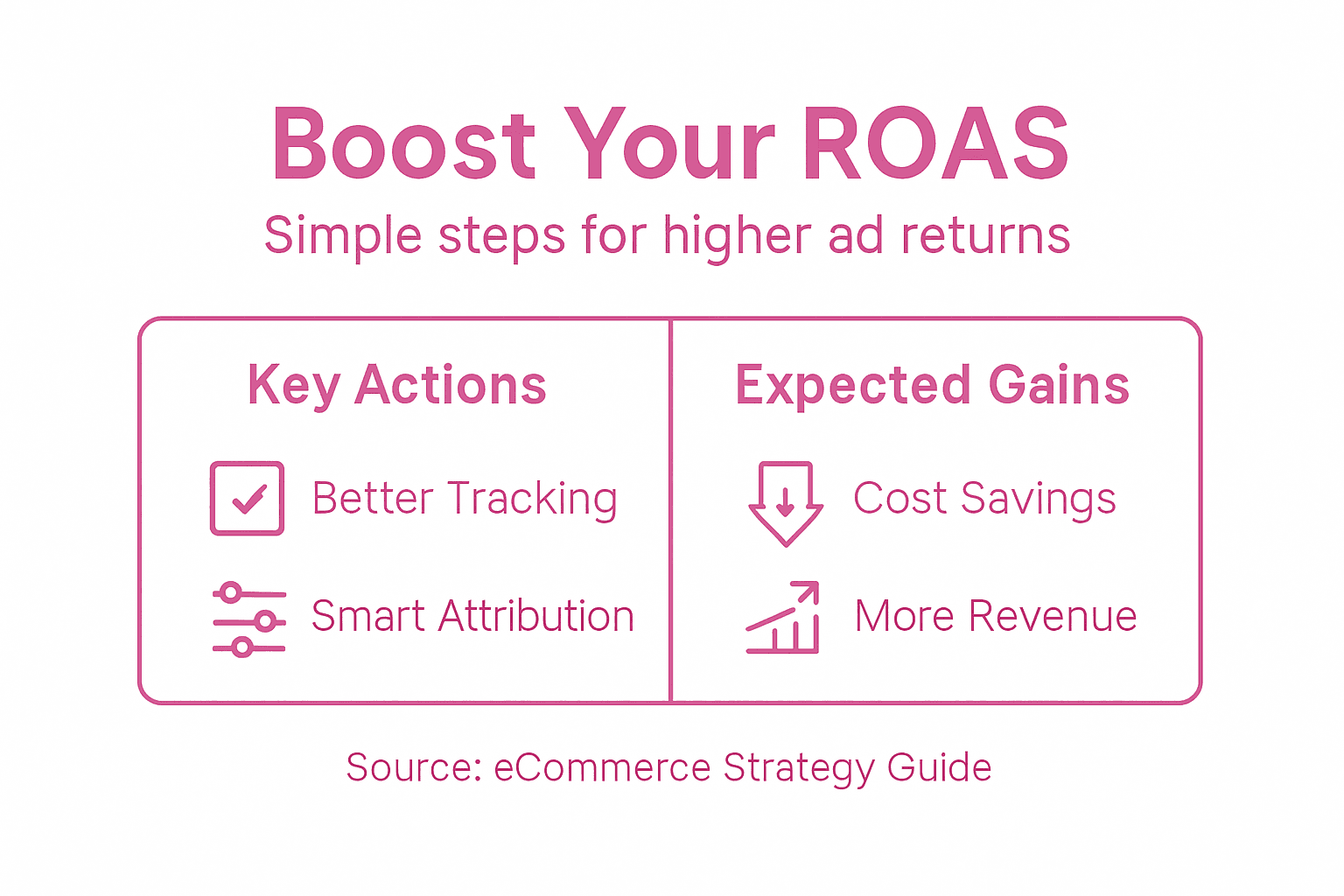
The following table highlights practical strategies to improve ROAS and their potential impact:
Strategy | Description | Expected Benefit |
Audience segmentation | Targeting distinct customer groups | Higher relevance, better returns |
Conversion tracking | Monitoring actions leading to sales | Improved attribution accuracy |
Creative optimisation | Tailoring ad content to audience | Increased engagement |
Advanced analytics implementation | Using data-driven insights | Faster, informed adjustments |
Pro tip: Develop a systematic approach to campaign tracking by creating a comprehensive dashboard that monitors ROAS in real-time, allowing for immediate strategic adjustments and continuous performance optimization.
Maximise Your Return on Ad Spend with Expert Digital Marketing Solutions
Achieving a strong Return on Ad Spend is a common challenge for eCommerce businesses aiming to transform advertising costs into real profits. This article highlights the crucial need for precise tracking, audience targeting, and strategic campaign optimisation to overcome pitfalls and improve advertising efficiency. If you want to move beyond guesswork and prevent wasted budget on unproductive ads, it is time to leverage professional support.

At IWantToBeSeen Online, we specialise in crafting tailored digital marketing strategies that focus on SEO, AI, Social Media, and PPC specifically for eCommerce brands. With over 25 years of hands-on experience scaling successful eCommerce businesses, we understand how to refine your ROAS by combining creative optimisation with advanced analytics. Don’t let short-term ROAS figures mislead your growth potential. Start tracking the right metrics today with our help and achieve the sustainable, profitable advertising results your brand deserves. Visit our website now to take the first step towards maximising your marketing returns and business success.
Frequently Asked Questions
What is Return on Ad Spend (ROAS)?
Return on Ad Spend (ROAS) is a key performance metric used to measure the revenue generated for every pound spent on advertising. It helps businesses assess the efficiency and profitability of their advertising campaigns.
How is ROAS calculated?
ROAS is calculated by dividing the total revenue generated from an advertising campaign by the total advertising spend. For example, if you spend £1,000 on advertising and generate £4,000 in sales, your ROAS would be 4:1.
Why is a high ROAS not always indicative of overall profitability?
A high ROAS indicates effective advertising, but it doesn’t account for product costs, operational expenses, or profit margins. Therefore, businesses should consider ROAS alongside other financial metrics like customer acquisition cost and net profit margin for a complete view of profitability.
How can I improve my ROAS?
To improve ROAS, focus on strategies such as audience segmentation, conversion tracking, and creative optimisation. Implement advanced analytics to track performance, refine marketing strategies based on data, and continuously test and adjust campaigns for better results.
Recommended
Ecommerce Advertising Guide: Boost Sales with Expert Strategy
Ecommerce Advertising Guide: Boost Sales with Expert Strategy
How to Optimize Website Conversions for eCommerce Success – Lind Creative
Mastering SEM Techniques to Drive Digital Growth - Bamsh Digital Marketing
Mastering Conversion Rate Optimization: Strategies for Online Success
Comments