.png)
Boost customer retention for e-commerce loyalty and growth


TL;DR:
Customer retention delivers higher value with lower marketing costs compared to acquisition.
Emotional connection and shared values build long-term customer loyalty more effectively than discounts.
Practical strategies include personalized follow-up, proactive support, simple loyalty programs, and seamless returns.
Retaining one existing customer consistently delivers more value than acquiring several new ones, yet most UK and Irish e-commerce businesses still pour the lion’s share of their budgets into paid acquisition. As ecommerce expert Martin Newman puts it, prioritising post-purchase strategies over ads is the smarter long-term play. This article cuts through the noise to give you a clear understanding of what customer retention actually means, how to measure it properly, what drives it, and which strategies work best for e-commerce brands operating in the UK and Ireland right now.
Table of Contents
Key Takeaways
Point | Details |
Retention beats acquisition | Retaining existing customers delivers better long-term growth than acquiring new ones. |
Track the right metrics | Critical numbers like LTV:CAC and cohort analysis reveal true retention performance. |
Prioritise brand values | Loyalty grows when customers see shared values, not just special offers. |
Favour experiential rewards | Exclusive experiences and meaningful engagement outperform discounts in creating loyal repeat buyers. |
Take practical action | Proactive service, community building, and personalisation drive retention—start with these strategies. |
What is customer retention and why does it matter?
Customer retention is simply your ability to keep existing customers coming back and making repeat purchases over time. It sounds straightforward, but in practice most e-commerce brands treat it as an afterthought once the initial sale is done. That is a costly mistake.
When a customer returns, your marketing cost for that sale is dramatically lower. You have already paid to acquire them. Every subsequent purchase they make improves your profit margins, raises their lifetime value (LTV), and reduces your dependency on expensive paid media. Retained customers also tend to spend more per order over time, and they are far more likely to recommend your brand to others, giving you free word-of-mouth growth.
“Retention outperforms acquisition long-term. Brands that prioritise post-purchase strategies over ads will build more sustainable, profitable businesses.” — Martin Newman, ecommerce customer experience expert.
Here is where most UK e-commerce owners trip up. The excitement of a new customer notification, a fresh Google Ads conversion, or a surge in traffic creates a feel-good feedback loop. Retention is quieter and slower, but its compounding effect on revenue is far more powerful. Understanding customer lifecycle marketing is the first step towards making that compounding effect work in your favour.
Common challenges e-commerce brands face with retention include:
Lack of post-purchase communication beyond transactional order updates
No loyalty mechanism to incentivise a second or third purchase
Generic, one-size-fits-all emails that fail to engage returning shoppers
Poor returns experiences that destroy trust after the first purchase
No measurement in place to even know how well retention is performing
If any of these feel familiar, you are not alone. The good news is that each one is fixable without a massive budget.
Key metrics to measure customer retention success
Before you can improve retention, you need to know where you stand. Guessing is not a strategy. These are the four metrics every UK e-commerce owner should be tracking, and what healthy benchmarks look like.
Repeat purchase rate — The percentage of customers who buy more than once. Calculate it by dividing repeat customers by total customers, then multiplying by 100. A rate above 25% for a consumer goods e-commerce brand is a solid starting point.
Customer churn rate — The percentage of customers who do not return after their first purchase. High churn is a red flag that your post-purchase experience needs attention.
LTV:CAC ratio — Lifetime value compared to customer acquisition cost. This tells you how much you earn from a customer relative to what it cost you to win them. A ratio above 3:1 is the benchmark for a healthy, sustainable e-commerce business.
Time-to-second purchase — How long it takes a customer to buy again after their first order. Shorter times signal a strong post-purchase experience and a compelling reason to return.
Metric | How to calculate | Healthy benchmark |
Repeat purchase rate | Repeat customers ÷ total customers × 100 | 25%+ for most sectors |
Churn rate | Lost customers ÷ total customers at start × 100 | Below 30% annually |
LTV:CAC ratio | Customer LTV ÷ cost to acquire one customer | 3:1 or higher |
Time-to-second purchase | Average days between order 1 and order 2 | Sector-dependent; track trends |
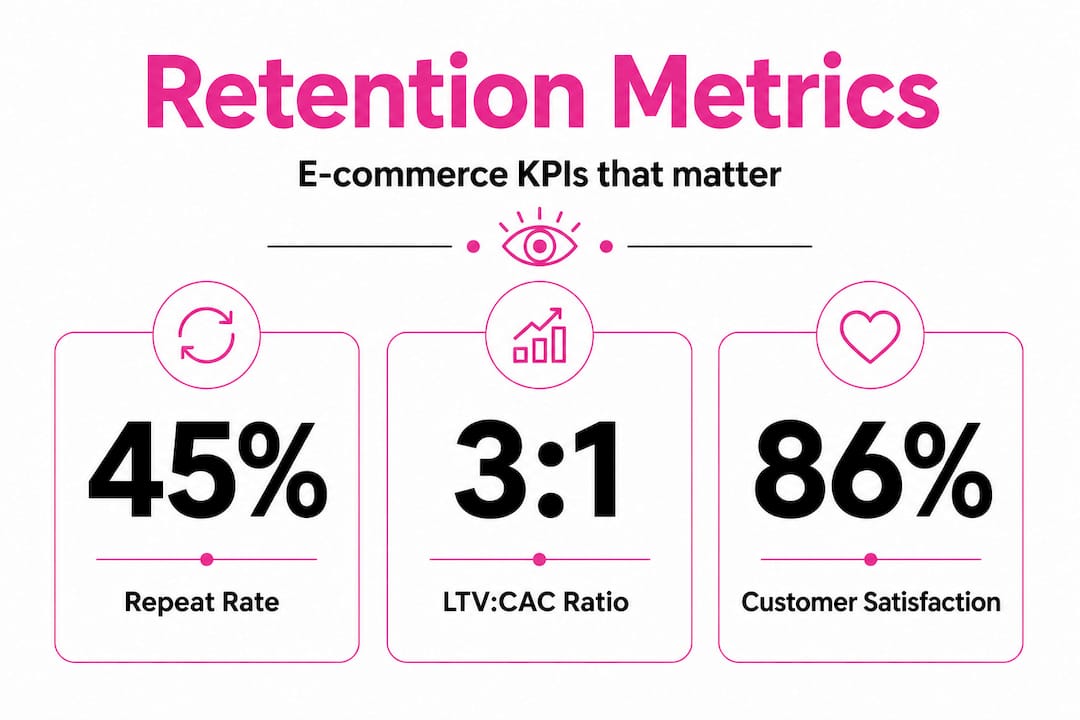
One thing worth noting: aggregate retention rates can be misleading. A brand with a 40% overall retention rate might think it is performing well, but if a newer cohort of customers acquired last winter has a 15% repeat rate, you have a serious problem hiding inside the average. Cohort analysis strips away that disguise by grouping customers by when they first purchased, letting you see exactly how each group behaves over time.
Pro Tip: Set up a monthly cohort report in your analytics platform or even a simple spreadsheet. Track the repeat purchase rate for customers acquired each quarter and compare cohorts side by side. You will spot shifts in retention performance months before they show up in your overall revenue numbers. You can link this directly to campaigns, seasons, or product changes, making it one of the most powerful tools in your essential marketing metrics toolkit.
What drives customer retention in e-commerce?
Most e-commerce brands assume the answer is price. Run a sale, offer a discount code in a win-back email, or give loyalty points that convert to money off. These tactics work in the short term, but they quietly erode your margins and train customers to wait for a deal before buying again.
The real drivers of retention are emotional, not transactional. Connection and shared values with your brand consistently outperform discounts when it comes to long-term loyalty. Customers who feel aligned with what your brand stands for, who feel seen and understood by their shopping experience, are far less likely to defect when a competitor offers a lower price.
Approach | Impact on loyalty | Impact on margin | Long-term sustainability |
Discount-led retention | Short-term uplift | Negative | Low |
Cashback and points schemes | Moderate, transactional | Neutral to negative | Medium |
VIP and experiential rewards | High, emotional | Neutral to positive | High |
Values-based brand connection | Very high, deep loyalty | Positive | Very high |
The shift from transactional to experiential loyalty is not just a theory. Brands that invest in building e-commerce brand loyalty through storytelling, community, and meaningful customer experiences consistently see higher LTV and lower churn than those competing on price alone.
Experiential retention tactics worth adopting include:
VIP early access to new products for top customers, making them feel valued before anyone else
Personalised content that reflects a customer’s purchase history and stated preferences
Behind-the-scenes brand storytelling that brings your values and people to life
Community spaces such as private groups, forums, or events where customers connect with each other
Surprise and delight moments such as a handwritten note, an unexpected gift, or a birthday discount that feels personal rather than automated
Effective customer experience management is what underpins all of these. When customers feel the brand genuinely cares about them beyond the transaction, retention becomes almost effortless.

Pro Tip: Weave your brand values and origin story into every post-purchase touchpoint. Your confirmation email, packaging insert, and first follow-up message are all opportunities to remind a customer why they chose you over anyone else. Done well, this creates an emotional anchor that no competitor discount can easily break.
Best practices: Customer retention strategies that work
Theory is useful, but you need practical steps you can implement this week. Here are five proven strategies specifically relevant for UK and Irish e-commerce businesses in 2026.
Personalised post-purchase outreach. Send a tailored follow-up email or SMS within 48 hours of delivery. Ask how the product is performing, offer usage tips, or suggest a complementary product based on what they bought. This alone dramatically reduces the time-to-second purchase.
Proactive customer support. UK shoppers respond strongly to brands that anticipate problems rather than simply reacting to complaints. If a delivery is running late, tell the customer before they have to ask. If a product recall or issue arises, communicate immediately. Proactive service builds an enormous amount of trust quickly.
A simple, rewarding loyalty scheme. You do not need a complex points platform to start. Even a straightforward stamp card style reward, whether digital or physical, gives customers a reason to return. Cashback schemes have become particularly popular in the UK amid ongoing cost-of-living pressures, and they tend to feel more tangible than points.
Seamless, no-friction returns. A poor returns experience is one of the fastest ways to lose a customer forever. UK consumers have come to expect free, easy returns as a baseline. Make your policy generous, your process simple, and follow up after a return to understand what went wrong. A well-handled return can actually convert a dissatisfied customer into a loyal one.
Community building around your niche. Whether it is a Facebook group, a newsletter with genuinely useful content, or a seasonal event, giving customers a space to connect with each other and with your brand extends the relationship far beyond individual purchases. Behavioural targeting for loyalty lets you personalise this community experience based on how customers actually interact with your brand.
None of these strategies require massive technology investments. A well-crafted email sequence, a clearly communicated returns policy, and a genuine effort to know your customers go a very long way. Start with one and build from there.
Pro Tip: The fastest route to a repeat purchase is not another discount. It is a moment of unexpected value after the first sale. A personal thank-you, a useful tip, or an early preview of something new costs almost nothing and creates a memory that advertising rarely achieves.
The hard truth about customer retention in e-commerce
Here is what most retention content will not tell you. Chasing retention through a relentless cycle of discount codes and automated win-back emails is not a loyalty strategy. It is a symptom of not having one.
We have spent over 25 years scaling e-commerce brands, and the pattern is consistent. Businesses that struggle with retention are usually the ones treating their customers as transactions rather than relationships. They pour budget into acquisition, run a discount when customers go quiet, and call that a retention strategy. It is not. It is expensive and it is fragile.
The brands that genuinely retain customers build something more durable. They create an emotional connection through consistent values, honest communication, and experiences that feel human rather than automated. As Martin Newman consistently argues, loyalty rooted in connection and values outperforms price-led loyalty every single time, especially when markets tighten and competitors undercut.
The uncomfortable truth is that real retention takes longer to build than a flash sale takes to set up. But the results are far more durable. A customer who believes in your brand will stay through a price increase, forgive an occasional mistake, and bring others with them. A customer who only stays for the discount will leave the moment someone else offers ten percent more off.
If you want a deep-dive on brand loyalty and how to build it properly, we have covered the full framework. True e-commerce loyalty is a long game, and it rewards the businesses willing to play it seriously.
Take the next step: Unlock your retention strategy with expert support
Understanding retention is one thing. Building a strategy that actually moves your metrics is another.

At I Want To Be Seen, we have spent over 25 years helping e-commerce brands across the UK and Ireland turn one-time buyers into loyal, high-value customers. From SEO and content that attracts the right audience, to AI-driven personalisation and social media strategies that deepen engagement, our team knows what it takes to grow retention alongside revenue. If you are ready to move beyond guesswork and build a retention engine that compounds over time, explore our e-commerce marketing services and let us help you build something that lasts.
Frequently asked questions
How can I calculate my customer retention rate in e-commerce?
Divide the number of customers making repeat purchases by the total number of customers within a set period, then multiply by 100. Tracking repeat purchases through cohort analysis gives you a far more actionable view than a single overall percentage.
What is a good LTV:CAC ratio for my online shop?
A healthy target is at least 3:1, meaning each customer’s lifetime value should be around three times what you spent to acquire them. LTV:CAC above 3:1 signals that your e-commerce model is sustainable and scalable.
Are discounts still an effective customer retention tactic?
Relying on discounts can erode your margins and teach customers to wait for offers rather than buy at full price. Experiential rewards and genuine brand connection now deliver stronger, more profitable retention results.
What are simple ways to improve retention as a small e-commerce business?
Focus on personalised post-purchase communication, proactive customer support, a simple loyalty scheme, and a frictionless returns process. Proactive service amid cost pressures is particularly effective for UK and Irish shoppers and does not require expensive technology to implement.
Recommended
Comments