.png)
Audience segmentation strategies to boost e-commerce conversions


TL;DR:
Audience segmentation divides customers into meaningful groups, enabling personalized marketing that boosts engagement and conversions.
Using demographic, behavioral, psychographic, and geographic data layers, brands can craft targeted messages that resonate and drive measurable results.
Most e-commerce marketers know their customers are not all the same, yet many still send identical emails, run uniform paid ads, and present the same homepage to every visitor. The result is predictable: average open rates, disappointing click-throughs, and conversion figures that never quite reach their potential. Audience segmentation is the process of dividing your customer base into smaller groups based on shared characteristics, whether demographic, behavioural, psychographic, or geographic, to enable personalised marketing that actually resonates. This guide breaks down every major segmentation type, shows you real-world applications for UK and Irish e-commerce brands, and gives you a clear roadmap to implement a strategy that measurably improves results.
Table of Contents
Key Takeaways
Point | Details |
Personalised campaigns work | Segmenting your audience enables tailored marketing that drives more engagement and sales. |
Data-driven approach wins | Accurate customer data and regular updates are essential for effective segmentation. |
Start simple, refine often | Begin with basic segments and regularly refine them as your audience and business evolve. |
E-commerce sees rapid uplift | Targeted segmentation can quickly increase conversion rates and customer loyalty for UK and Irish e-commerce brands. |
Understanding audience segmentation
Generic marketing wastes budget. When you show the same ad to a 22-year-old student in Dublin and a 45-year-old professional in Edinburgh, you are almost certainly irrelevant to one of them. That irrelevance costs money and erodes trust with the audience you could have converted.
Audience segmentation solves this by splitting your customer base into meaningful, actionable groups. Once you understand who each group is, what they want, and how they behave, you can craft messages that speak directly to their specific needs. The result is marketing that feels personal rather than broadcast.
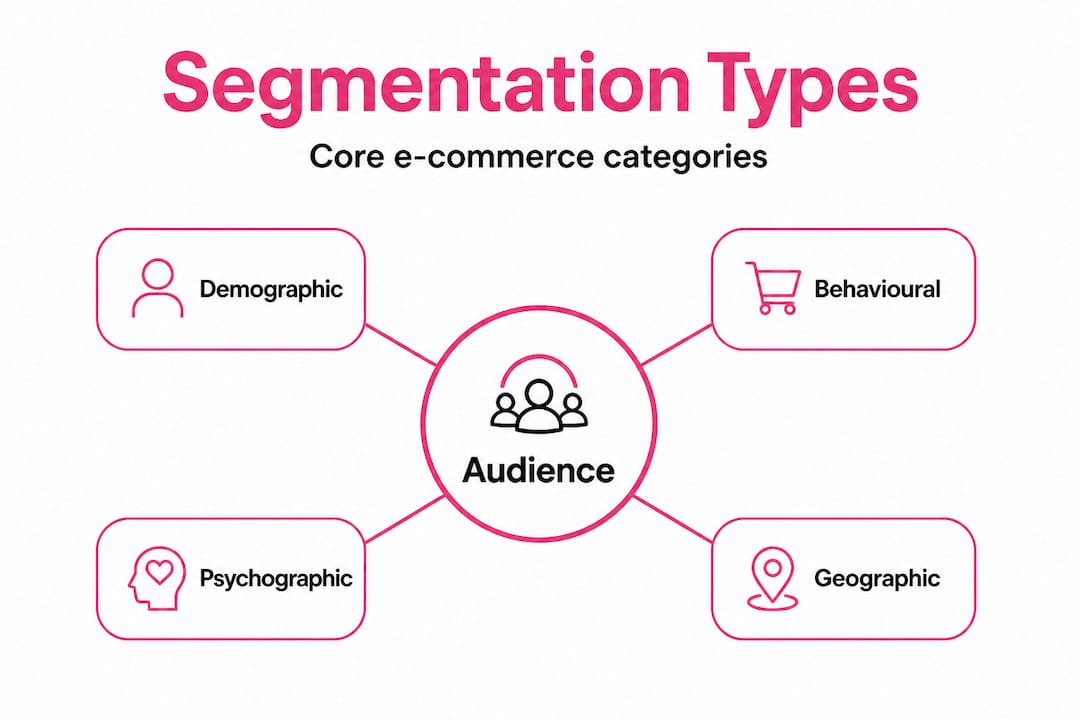
For customer segmentation in e-commerce, the four core variables marketers work with are:
Demographic: Age, gender, income level, occupation, household size
Behavioural: Purchase history, browsing patterns, basket abandonment, loyalty status
Psychographic: Interests, values, lifestyle choices, motivations
Geographic: Country, county or region, urban versus rural location
“The power of segmentation lies not in how many groups you create, but in how precisely each group’s needs differ from the next, and how well your messaging reflects that difference.”
Each variable tells a different story about your customer. Demographic data tells you who they are. Behavioural data tells you what they do. Psychographic data tells you why they do it. Geographic data tells you where they are and, often, what context shapes their buying decisions. Used together, these variables create a rich picture that makes personalised marketing genuinely effective.
Major types of audience segmentation explained
Understanding the theory is only valuable when you can apply it practically. Here is how each segmentation type plays out in a live e-commerce environment, particularly for UK and Irish retailers.
Segmentation type | Key variables | Practical e-commerce example |
Demographic | Age, gender, income | Promote luxury products to high-income customers aged 35+ |
Behavioural | Purchase frequency, loyalty tier | Reward repeat buyers with early access to new stock |
Psychographic | Values, lifestyle, interests | Target eco-conscious shoppers with sustainable product ranges |
Geographic | Country, region, urban/rural | Promote rain gear to customers in the West of Ireland or Scottish Highlands |
Demographic segmentation is often the starting point because it is the easiest data to collect. Age and gender, for example, directly influence product preferences and price sensitivity. An Irish fashion retailer selling both budget and premium lines might use income-based demographic data to ensure the right range appears in the right paid social campaigns. It is a blunt instrument on its own, but a crucial foundation.

Behavioural segmentation is where e-commerce brands often find the biggest wins. Audience segmentation hinges on demographics, behaviour, psychographics, and geography, but behaviour is uniquely powerful because it reflects actual intent rather than assumed characteristics. A customer who has purchased three times in six months is fundamentally different from someone who browsed once and left. Treating them identically wastes the loyalty of the first and fails to re-engage the second.
Psychographic segmentation requires more sophisticated data collection, typically through surveys, reviews, and social listening, but it produces some of the most powerful creative targeting. Consider a UK outdoor equipment retailer: demographic data might identify customers aged 25 to 40, but psychographic data reveals that this group is motivated by adventure, environmental responsibility, and community. That insight completely changes the tone, visuals, and messaging of a campaign.
Geographic segmentation is often underused by British and Irish e-commerce marketers, despite being highly accessible. Shoppers in rural Wales may face longer delivery windows and respond better to messaging that emphasises reliability. Customers in central London may prioritise same-day delivery and sustainability credentials. Regional cultural differences across Ireland, particularly between urban Dublin and rural Connacht, also influence buying decisions in ways that a single national campaign simply cannot address.
Pro Tip: Do not silo your segmentation types. The most effective campaigns layer two or three variables together. A behavioural segment of lapsed customers, filtered by geographic location and layered with a psychographic interest in sustainability, creates a far more targetable and responsive audience than any single dimension alone.
You can explore how layering these variables translates into real outcomes through market segmentation success case studies that show exactly where the biggest conversion lifts occur.
How segmentation transforms e-commerce campaigns
The difference between a segmented and an unsegmented campaign is measurable, often dramatically so. Personalised marketing consistently delivers higher open rates, improved click-through rates, and better conversion figures across every channel. Segmentation enables personalised marketing, increasing marketing ROI and conversion rates in ways that generic approaches simply cannot match.
Here is a concrete example. Consider a mid-sized UK home goods retailer running a spring campaign. Without segmentation, they send a single email to their entire list of 80,000 subscribers promoting outdoor furniture. Result: a 14% open rate and a 1.8% conversion rate.
The following year, they segment the same list using behavioural and geographic data:
Segment | Message focus | Open rate | Conversion rate |
Previous outdoor buyers, South England | Premium garden sets, lifestyle imagery | 28% | 4.1% |
Lapsed buyers, all regions | Re-engagement offer with 15% discount | 22% | 3.0% |
First-time buyers, urban areas | Compact balcony furniture, small-space solutions | 25% | 3.6% |
High-value loyalty customers | Early access to new collection | 34% | 5.2% |
The numbers speak for themselves. Each segment received a message that was relevant to their specific context, and every metric improved significantly. The audience insights for growth that drive these decisions come directly from data you already hold in your CRM, email platform, and analytics tools.
The step-by-step benefits of running segmented campaigns are tangible:
Better targeting accuracy means your ad spend reaches people who are predisposed to convert, not just those who fit a loose demographic profile.
Reduced wasted spend comes from excluding irrelevant audiences from paid campaigns, which directly lowers cost per acquisition.
Higher customer lifetime value develops naturally when customers consistently receive relevant offers, because they trust your brand to understand their needs.
Improved retention results from post-purchase segmentation, where buyers receive tailored follow-up rather than the same onboarding email sequence every first-time customer gets.
Richer data over time compounds each benefit, because every segmented campaign produces cleaner insights into what each audience type responds to.
For email specifically, segmenting email lists is one of the most immediate and cost-effective improvements a UK or Irish e-commerce marketer can make, with very little additional technical complexity required.
Building and executing your segmentation strategy
Knowing why segmentation works is one thing. Actually building a segmentation strategy that runs consistently and improves over time is another. Here is a practical roadmap to follow, regardless of whether you are starting from scratch or refining an existing approach.
Audit your existing data. Pull together every data source you have: CRM records, purchase history, website analytics, email engagement metrics, and any survey responses. You may already have more segmentation-ready data than you realise. Effective segmentation relies on accurate data about your customer base’s attributes and behaviours, so spend time cleaning and deduplicating before you begin.
Define your segmentation criteria. Choose the variables that are most relevant to your business model. A subscription box company may prioritise behavioural data like churn risk and renewal patterns. A fashion retailer may lean more heavily on demographic and psychographic data. Do not try to segment everything at once. Start with two or three variables that align closely with your current campaign goals.
Build your initial segments. Create your first set of audience groups within your email platform, CRM, or paid media tool. Keep these manageable. Four to six segments is a practical starting point. Avoid the temptation to create twenty highly granular micro-segments immediately, because you will struggle to produce meaningful differentiated content for each one.
Develop tailored messaging for each segment. This is where most of the creative work happens. Each segment needs its own subject lines, body copy, imagery, and calls to action that reflect its specific characteristics and motivations. Even small differences in tone or offer relevance can produce significant uplift in results.
Test, measure, and refine. Run your segmented campaigns and compare results against your previous benchmarks. Use A/B testing within segments to optimise individual elements. Revisit your segment definitions every quarter to account for shifts in customer behaviour, seasonality, or changes in your product range.
Automate where possible. Once your segments are performing consistently, consider automating the triggers that move customers between segments. A customer who completes their third purchase, for example, should automatically graduate to your loyalty segment without requiring manual intervention. Practical guidance on automated email segmentation can help you set this up efficiently.
The most common pitfalls are over-segmentation (creating so many tiny groups that you cannot produce relevant content for each one) and letting segments go stale. Customer behaviour evolves, and a segment that was accurate twelve months ago may no longer reflect your actual customer base. Review regularly. See further e-commerce email tips for maintaining list health alongside segmentation hygiene.
Pro Tip: Build a simple segmentation review calendar into your marketing schedule. Set a recurring quarterly task to check whether your segment definitions still match the data. A segment labelled “lapsed customers” should be reviewed to ensure the time threshold still makes sense for your purchasing cycle.
A fresh perspective on audience segmentation for e-commerce
Here is something most segmentation guides will not tell you: the majority of e-commerce brands that adopt audience segmentation do so by copying a competitor’s framework or following a generic template, and then wonder why the results are mediocre.
The issue is not the segmentation itself. It is that they are segmenting around assumptions rather than evidence. They create a “young, value-conscious shopper” segment because it sounds logical, not because they have actually interrogated their data to see whether this group genuinely behaves differently from others in their database. When the underlying assumption is flawed, the entire campaign strategy built on top of it is flawed too.
From our own experience scaling e-commerce brands, the campaigns that consistently outperform are built on segments discovered through data rather than segments imposed onto data. There is a significant difference. Discovered segments emerge when you analyse purchase patterns, session behaviour, and engagement history and allow genuine clusters to reveal themselves. Imposed segments are the demographic boxes you create before looking at the data because they feel intuitive.
The other thing that separates high-performing segmentation strategies from average ones is iteration speed. In 2026, customer behaviour shifts faster than it ever has. Seasonal trends, economic pressures, and cultural moments can reshape buying patterns within weeks. A rigid segmentation framework reviewed annually simply cannot keep pace. The brands getting the best results are those treating their segments as living, evolving entities, updating definitions as new signals emerge, and acting on that intelligence in near-real time.
We have seen this clearly across case studies in segmentation where the brands achieving standout results were those willing to discard a segment that had stopped performing rather than defending it because it had always been part of their model.
The most effective mindset shift is to think of audience segmentation not as a project you complete but as a capability you build. The infrastructure, the data habits, the creative process, all of it compounds over time and becomes a genuine competitive advantage that is very difficult for a competitor to replicate.
Supercharge your segmentation strategy with professional support
Building a segmentation strategy that delivers consistent, measurable ROI takes the right combination of data infrastructure, creative execution, and ongoing refinement. Many UK and Irish e-commerce teams have the ambition but lack the time or specialist expertise to make it fully operational.

At I Want To Be Seen, we have spent over 25 years building and scaling e-commerce brands, both our own and our clients’. We understand that audience segmentation is not a standalone tactic but a thread that runs through SEO, PPC, social media, and email marketing simultaneously. Our team can audit your current audience data, identify the segmentation opportunities you are missing, and build a tailored strategy designed around your specific customer base and commercial goals. If you are ready to move beyond generic targeting and start seeing the kind of conversion lifts that segmentation genuinely delivers, we would welcome the conversation.
Frequently asked questions
How often should I update my audience segments?
Update your audience segments at least quarterly, or sooner if you notice significant shifts in customer behaviour or changes in your product range. Accurate, up-to-date data is the foundation of any effective segmentation strategy, so stale segments will actively undermine your campaign performance.
Which is the most important type of audience segmentation for e-commerce?
Behavioural segmentation is typically the most impactful for e-commerce because it reflects what customers actually do rather than who they theoretically are. That said, segmentation across all four types produces better results than relying on any single variable.
Is audience segmentation only for large e-commerce businesses?
Absolutely not. Businesses of any size benefit from segmentation because it makes every pound of marketing spend more efficient. Personalised marketing increases ROI regardless of the scale at which you operate, and many email platforms make basic segmentation accessible even on small budgets.
Can segmentation help with email marketing results?
Yes, consistently and significantly. Segmented email campaigns produce higher open rates, better click-through rates, and stronger conversion figures compared to batch-and-blast sends. Personalised, segmented campaigns are one of the most cost-effective improvements an e-commerce marketer can make to their email programme.
Recommended
Comments