.png)
Why Use PPC: Driving E-commerce Growth in 2026


Running an online shop in the United Kingdom or Ireland often brings fast questions about how to attract more buyers without wasting money. Yet, sorting through advertising options can feel confusing if you are new to Pay-Per-Click and digital marketing. By breaking down core PPC concepts and campaign strategies, you can discover precise targeting methods and actionable steps that help turn clicks into real sales for your e-commerce business.
Table of Contents
Key Takeaways
Point | Details |
PPC Advertising Model | Businesses pay each time their advertisement is clicked, allowing precise targeting and measurable results. |
Successful PPC Strategy | Key components include keyword selection, compelling ad copy, landing page optimisation, and budget management. |
Types of PPC Campaigns | E-commerce businesses can leverage various campaign types such as search network ads, shopping ads, and remarketing campaigns. |
Common Pitfalls | Avoid issues like keyword mismanagement and neglecting landing pages by conducting thorough research and regular audits. |
What Is PPC? Core Concepts Explained
Pay-Per-Click (PPC) is a powerful digital advertising model where businesses pay a fee each time their online advertisement receives a click. Unlike traditional advertising, digital marketing strategies allow precise targeting and measurable results.
In essence, PPC operates through an auction-based system where advertisers bid on specific keywords relevant to their target audience. When users search using those keywords, the advertisers’ ads appear in prominent positions on search engine results pages or across digital advertising networks.
Key components of a successful PPC strategy include:
Keyword Selection: Identifying precise search terms potential customers use
Ad Copywriting: Creating compelling messages that drive clicks
Landing Page Optimisation: Ensuring seamless user experience after clicking
Budget Management: Controlling spending while maximising return on investment
The digital advertising landscape has evolved dramatically, with PPC now covering multiple objectives beyond direct sales. Modern PPC campaigns can target:
Bottom-of-funnel conversions (direct purchases)
Mid-funnel lead generation
Top-of-funnel brand awareness
PPC is no longer just about immediate sales, but a sophisticated tool for comprehensive digital marketing strategies.
Pro tip: Start with smaller budgets and experiment with different keyword combinations to understand your most effective targeting approach.
Types of PPC Campaigns for E-commerce
Pay-Per-Click (PPC) advertising offers e-commerce businesses multiple strategic campaign types to drive targeted traffic and boost online sales. E-commerce marketing strategies encompass several distinct approaches designed to reach potential customers at different stages of their purchasing journey.
The most common PPC campaign types for online retailers include:
Search Network Ads: Text-based advertisements appearing in search engine results when users seek specific products
Shopping Ads: Visual product listings displaying images, prices, and merchant details directly in search results
Display Network Ads: Graphic advertisements shown across websites and apps targeting users based on interests and browsing history
Remarketing Campaigns: Targeted ads shown to users who have previously visited your online store
Social Media Ads: Promotional content distributed across platforms like Facebook, Instagram, and Pinterest
Each campaign type serves unique objectives within the e-commerce marketing funnel:
Attracting new potential customers
Reconnecting with previous website visitors
Promoting specific product collections
Driving immediate sales
Successful e-commerce PPC campaigns require a nuanced understanding of audience targeting and compelling ad creative.
Pro tip: Implement cross-channel tracking to understand how different PPC campaign types interact and contribute to your overall conversion strategy.
How Modern PPC Advertising Works
Pay-Per-Click (PPC) advertising has transformed dramatically with technological advancements, becoming a sophisticated digital marketing approach. Digital marketing strategies now leverage advanced algorithms and machine learning to optimise advertising performance.
The modern PPC ecosystem operates through a complex auction-based system where advertisers compete for digital advertising space. Key components of this sophisticated process include:
Keyword Bidding: Advertisers place monetary bids on specific search terms
Audience Targeting: Precise demographic and behavioural selection mechanisms
Ad Placement Algorithms: Dynamic systems determining ad visibility and positioning
Performance Tracking: Real-time metrics measuring ad effectiveness
Automated Optimization: Machine learning adjusting campaign parameters automatically
Modern PPC platforms offer increasingly intelligent features that streamline advertising efforts:
Automated bid management
Predictive audience targeting
Cross-platform campaign integration
Instantaneous performance analytics
Successful PPC campaigns now require a nuanced understanding of technological capabilities and strategic implementation.
Pro tip: Regularly audit your PPC campaign settings to ensure machine learning algorithms are aligned with your specific business objectives.

Key Benefits: Sales, Data, and Brand Growth
Pay-Per-Click (PPC) advertising delivers multiple strategic advantages for e-commerce businesses seeking comprehensive growth. Marketing objectives enable companies to achieve precise, measurable outcomes across critical business dimensions.
The primary benefits of PPC advertising can be categorised into three fundamental areas:
Direct Sales Growth: Immediate revenue generation through targeted advertising
Advanced Customer Insights: Deep understanding of audience behaviour and preferences
Brand Visibility Enhancement: Increased digital presence and market recognition
Competitive Intelligence: Real-time understanding of market dynamics
Cost-Effective Marketing: Predictable, controlled advertising expenditure
Detailed strategic benefits include:
Accelerated sales conversion rates
Precision audience targeting
Measurable return on investment
Rapid market penetration
Dynamic campaign adaptability
PPC represents more than an advertising channel - it’s a sophisticated growth acceleration platform for modern e-commerce businesses.
Pro tip: Implement granular tracking mechanisms to transform PPC data into actionable strategic insights for continuous business improvement.
Costs, Risks, and PPC vs. Organic SEO
Understanding the financial implications and strategic trade-offs between Pay-Per-Click (PPC) and organic Search Engine Optimisation (SEO) is crucial for e-commerce businesses. Digital marketing strategies require careful analysis of costs, potential returns, and long-term growth objectives.
The key differences between PPC and organic SEO can be categorised across several critical dimensions:
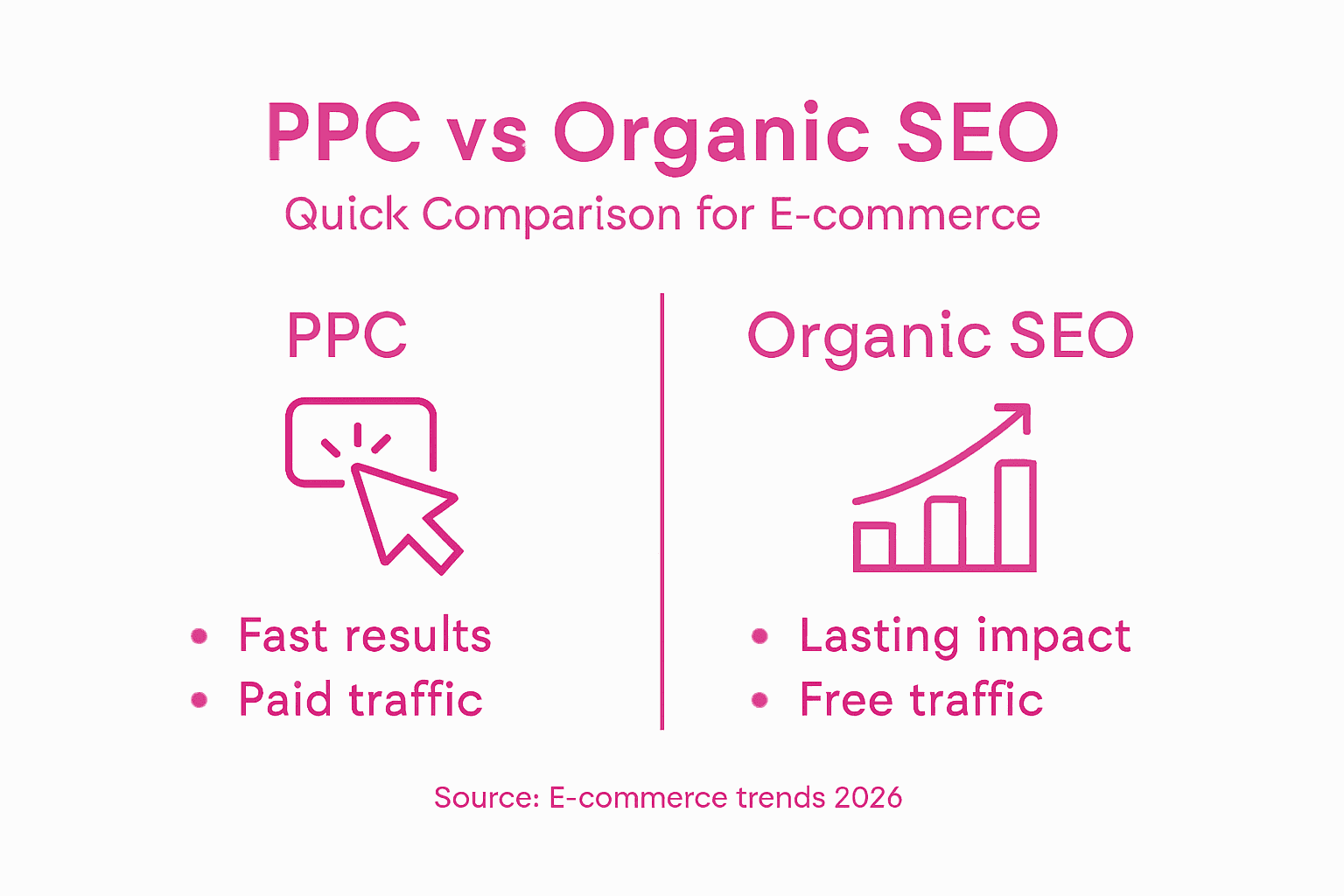
Cost Structure: PPC involves direct monetary investment per click, while SEO requires upfront time and resource allocation
Speed of Results: PPC delivers immediate visibility, SEO builds gradual, sustainable traffic
Budget Control: PPC offers precise spending management, SEO has less predictable resource requirements
Long-term Value: SEO creates compounding organic growth, PPC provides immediate but temporary traffic
Competitive Dynamics: PPC allows instant market entry, SEO demands consistent strategic development
Comparative performance metrics reveal nuanced strategic considerations:
Here is a comparison of the main differences between PPC and organic SEO for e-commerce businesses:
Dimension | PPC Advertising | Organic SEO |
Cost Model | Pay per click on each ad | Upfront investment in content and SEO |
Speed of Impact | Almost immediate traffic | Gradual, cumulative growth |
Traffic Longevity | Temporary, ends if budget stops | Long-lasting, maintains over time |
Budget Flexibility | Adjustable spend and daily caps | Less direct cost control |
Brand Recognition | Fast, but dependent on ad spend | Slow, but trust-building |
Immediate conversion potential
Sustainable traffic generation
Customer acquisition costs
Brand credibility development
Market positioning complexity
Successful digital marketing integrates both PPC and SEO, leveraging their respective strengths for comprehensive growth.
Pro tip: Develop a hybrid strategy that allocates resources between PPC and SEO based on your specific business goals and market dynamics.
Common Pitfalls and How to Avoid Them
Navigating the complex landscape of Pay-Per-Click (PPC) advertising requires strategic awareness and proactive management. PPC campaign strategies demand sophisticated approaches to mitigate potential risks and maximise advertising effectiveness.
The most critical pitfalls in PPC advertising fall into several key categories:
Keyword Mismanagement: Failing to research and select precise targeting terms
Budget Inefficiency: Poorly allocated spending without performance tracking
Ad Relevance Issues: Creating generic or misaligned advertising messages
Conversion Obstacles: Neglecting landing page optimisation
Negative Keyword Oversight: Ignoring irrelevant traffic sources
Prevention strategies for these common challenges include:
For easy reference, here is a summary of common PPC pitfalls and their recommended solutions:
Common Pitfall | Potential Consequence | Recommended Prevention |
Poor keyword management | Wasted budget on irrelevant clicks | Conduct thorough keyword research |
Neglecting landing pages | Low conversion rates | Optimise landing page experience |
Overlooking negative terms | Increased unwanted traffic | Add and update negative keyword lists |
Generic ad content | Low engagement and clicks | Tailor messages to audience segments |
Inefficient budget use | Quick budget depletion | Monitor and adjust bids frequently |
Conduct comprehensive keyword research
Implement granular audience segmentation
Develop compelling, targeted ad copy
Create conversion-optimised landing pages
Regularly audit and refine campaign parameters
Successful PPC campaigns require continuous learning, refinement, and strategic adaptation.
Pro tip: Establish a weekly review process to systematically analyse campaign performance and quickly address emerging inefficiencies.
Unlock Your E-commerce Growth Potential with Expert PPC Support
The article highlights the challenges many businesses face when managing Pay-Per-Click campaigns such as keyword mismanagement, budget inefficiency and the need for precise audience targeting. If you are aiming to drive immediate sales, gain advanced customer insights and boost your brand visibility in 2026, mastering modern PPC strategies is essential. Our expertise in digital marketing strategies including SEO, AI, Social Media and PPC, backed by over 25 years of scaling successful e-commerce brands, makes us your ideal partner to overcome these hurdles.

Take control of your PPC advertising with tailored campaigns that maximise your return on investment and ensure continuous growth. Visit us at iwanttobeseen.online to explore how our proven approach to PPC and integrated marketing solutions can transform your online presence. Start optimising your PPC campaigns today to stay ahead in the competitive e-commerce landscape by checking our marketing services and discover strategic growth support customised for your brand.
Frequently Asked Questions
What is PPC and how does it work for e-commerce growth?
PPC, or Pay-Per-Click, is a digital advertising model where businesses pay each time their ad is clicked. It drives e-commerce growth by allowing businesses to target specific keywords and demographics to attract potential customers and generate immediate sales.
How can I optimise my PPC campaigns for better results?
To optimise your PPC campaigns, focus on keyword selection, compelling ad copy, and landing page optimisation. Additionally, regularly monitor performance, adjust budgets, and utilise automated optimisation features to enhance campaign effectiveness.
What are the benefits of using PPC for my online store compared to organic SEO?
PPC offers immediate visibility and traffic, allowing for rapid sales conversion. In contrast, organic SEO builds traffic gradually over time. Combining both strategies can provide a balanced approach for sustained growth.
What common mistakes should I avoid in my PPC advertising campaigns?
Common mistakes include poor keyword management, neglecting landing page optimisation, and failing to monitor ad relevance. Regularly reviewing campaign performance and implementing targeted strategies can help avoid these pitfalls.
Recommended
Comments