.png)
What is zero click search? 2026 guide for ecommerce


You optimise your product pages, craft compelling meta descriptions, and watch your rankings climb. Yet traffic remains stubbornly flat. The culprit? Over 50% of Google searches now end without a single click, fundamentally reshaping how ecommerce brands must approach SEO strategy. Zero click search represents a seismic shift in user behaviour, where Google answers queries directly on the search results page. This guide explores what zero click search means for ecommerce marketers, why it matters in 2026, and how to adapt your SEO strategy to thrive in this evolving landscape.
Table of Contents
Key takeaways
Point | Details |
Zero click reduces direct traffic | Search visibility remains high but fewer users click through to websites, changing traditional traffic metrics |
Featured snippets drive visibility | Optimising for SERP features like knowledge panels and rich results captures attention without clicks |
Strategy must evolve beyond clicks | Focus shifts to brand awareness, impressions, and indirect conversions rather than pure click-through rates |
Analytics integration is essential | Combining SEO and PPC data reveals zero click impact and informs smarter marketing decisions |
What is zero click search? Defining the concept for ecommerce marketers
Zero click search refers to searches where the user’s query is answered directly on Google without clicking any results. Instead of navigating to a website, searchers find what they need in featured snippets, knowledge panels, or local packs displayed prominently at the top of search results. For ecommerce marketers, this phenomenon fundamentally alters how potential customers discover and interact with brands.
Several Google features drive zero click outcomes. Featured snippets extract concise answers from web pages and display them in highlighted boxes. Knowledge panels aggregate information about brands, products, or topics from multiple sources. Local packs show business details like opening hours and contact information for location-based queries. Product rich results display prices, availability, and reviews directly on the SERP.
Consider an ecommerce example. A shopper searching “waterproof hiking boots UK price range” might see a featured snippet listing typical price brackets, a shopping carousel with product images and prices, and local stores stocking hiking gear. The searcher absorbs this information without visiting any website. They have completed their initial research phase entirely within Google’s ecosystem.
This shift does not mean your content lacks visibility. Your brand might appear in these SERP features, building recognition and authority. The interaction model simply changes. Users consume information first, then decide whether deeper engagement warrants a click. Traditional metrics like click-through rate become less meaningful when evaluating true search performance.
Key distinctions separate zero click from traditional search:
Traditional search requires clicking a result to find answers, driving direct website traffic
Zero click search satisfies queries on the SERP itself, reducing immediate clicks but increasing brand exposure
Traditional SEO optimises for rankings and clicks, whilst zero click SEO targets SERP feature placement
User intent completion happens at different stages in the customer journey
Understanding these mechanics helps ecommerce marketers recognise that search success now extends beyond simple traffic generation to encompass broader visibility and brand positioning goals.
The rise of zero click search: Why it matters in 2026 ecommerce SEO
The trajectory of zero click search has accelerated dramatically. Studies indicate over 50% of Google searches result in zero click outcomes, challenging traditional traffic assumptions that once formed the foundation of SEO measurement. For UK and Ireland ecommerce brands, this trend directly impacts how you evaluate marketing effectiveness and allocate resources.
Organic traffic volumes no longer tell the complete story. A campaign might achieve first-page rankings and massive impression growth whilst showing declining click-through rates. This apparent contradiction reflects Google’s evolution towards becoming an answer engine rather than purely a discovery platform. Your visibility increases, but user behaviour shifts towards consuming information without leaving the SERP.
Google’s motivation centres on user experience enhancement. Providing instant answers keeps searchers satisfied and engaged within Google’s ecosystem. Mobile users particularly benefit from quick information access without loading multiple pages. Voice search amplifies this trend, with spoken queries often seeking single, definitive answers rather than browsing options.
This shift creates measurement challenges for ecommerce marketers accustomed to traffic-centric KPIs. Traditional analytics focus on sessions, bounce rates, and conversion paths beginning with a click. Zero click search disrupts these models. A searcher might view your brand in a featured snippet multiple times, building familiarity and trust, before eventually converting through a branded search or direct visit weeks later. Attribution becomes murky.
Yet opportunities emerge alongside challenges. Brands dominating SERP features gain disproportionate visibility and authority. Appearing in a featured snippet positions you as the definitive answer source, even if users do not click immediately. This exposure influences later purchase decisions when customers enter buying mode.
Several factors make zero click search particularly relevant for ecommerce in 2026:
Mobile commerce dominance means users prioritise speed and convenience over detailed browsing
Voice-activated shopping through smart speakers relies heavily on zero click answer formats
Google Shopping integration displays product information without requiring website visits
Local inventory features show stock availability directly on search results
AI-powered search summaries synthesise information from multiple sources into single answers
Adapting to this reality requires rethinking success metrics and recognising how organic reach influences ecommerce visibility beyond direct traffic. The brands thriving in 2026 treat SERP features as valuable real estate, optimising specifically for these placements whilst maintaining traditional SEO fundamentals. Understanding current SEO trends shaping ecommerce visibility becomes essential for staying competitive.
How to optimise for zero click search: Tactics for ecommerce success
Succeeding in zero click search demands distinct tactics from traditional SEO approaches. Whilst conventional optimisation targets rankings and clicks, zero click strategies prioritise SERP feature capture and information architecture that Google can easily extract and display. Optimising content for featured snippets and structured data boosts chances of zero click visibility and establishes brand authority.
Structured data implementation forms the foundation. Schema markup tells Google exactly what your content represents, whether product details, pricing information, reviews, or FAQs. This machine-readable format enables Google to confidently pull your data into rich results. Product schema should include availability, price, ratings, and specifications. FAQ schema formats questions and answers for direct SERP display.
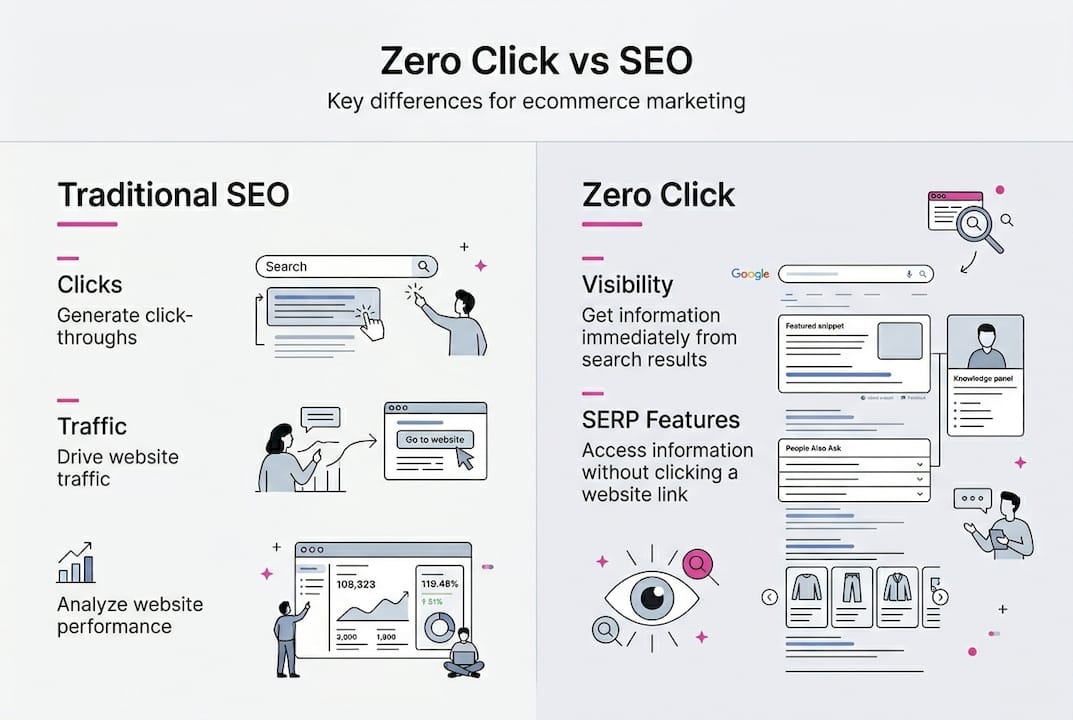
Content structure matters enormously. Featured snippets favour concise, well-organised answers. Use clear headings that mirror common search queries. Answer questions directly in the first sentence, then provide supporting detail. Bullet points and numbered lists increase snippet capture likelihood because they present information in easily scannable formats that Google prefers.
Comparing traditional and zero click SEO reveals strategic differences:
| Aspect | Traditional SEO | Zero Click SEO | | — | — | | Primary Goal | Drive clicks to website | Capture SERP feature placement | | Content Format | In-depth articles | Concise, structured answers | | Success Metric | Click-through rate | Impressions and brand visibility | | Technical Focus | Page speed and mobile usability | Schema markup and structured data | | User Intent | Research and exploration | Quick answer retrieval |
Semantic search understanding becomes crucial in 2026. Google’s algorithms now grasp context, intent, and relationships between concepts rather than matching keywords mechanically. Create content clusters addressing related queries comprehensively. When you answer one question thoroughly, link to related topics that explore adjacent concepts. This topical authority signals expertise to Google.
Practical optimisation tactics include:
Audit your current SERP features to identify which queries trigger snippets, knowledge panels, or rich results
Create dedicated FAQ sections answering common customer questions in 40-60 words per answer
Implement comprehensive schema markup across product pages, reviews, and informational content
Structure content with clear H2 and H3 headings that directly answer search queries
Monitor competitors’ SERP feature appearances to identify opportunities they have missed
Optimise for question-based queries using natural language that matches voice search patterns
Pro Tip: Regularly audit Google Search Console for high-impression, low-click queries. These often indicate zero click opportunities where you already have visibility but could improve SERP feature capture through better content structuring or schema implementation.
The most effective approach combines traditional SEO foundations with zero click-specific tactics. Maintain excellent site architecture, fast loading speeds, and quality backlinks whilst simultaneously optimising for featured snippet capture. Utilising the right SEO tools helps identify opportunities and track performance across both traditional and zero click metrics. Staying current with evolving SEO trends ensures your strategy adapts as Google’s SERP features continue developing.
Measuring impact and adapting marketing strategies for zero click search
Quantifying zero click search impact requires looking beyond traditional traffic metrics to understand the fuller picture of search performance. Ecommerce marketers must track impressions, position, and branded search volume alongside clicks to gauge true visibility and brand awareness growth. Using advanced analytics and combined SEO-PPC tools allows better tracking and strategy adaptation to zero click search trends.
Google Search Console becomes your primary diagnostic tool. The Performance report shows impressions separately from clicks, revealing queries where you achieve high visibility but low click-through rates. These represent potential zero click scenarios. Filter for queries with impressions above 1,000 but CTR below 5%. Investigate whether these queries trigger featured snippets or other SERP features where competitors capture attention.
Branded search volume serves as a proxy metric for zero click effectiveness. When users repeatedly see your brand in SERP features without clicking, they build familiarity. Later, they search specifically for your brand name when ready to purchase. Monitor branded query growth in Search Console and Google Trends. Increases often correlate with successful zero click visibility campaigns.
Key performance indicators shift in a zero click environment:
| Metric | Traditional Focus | Zero Click Focus | Why It Matters | | — | — | — | | Click-Through Rate | Primary success indicator | Secondary consideration | Lower CTR may indicate successful SERP feature capture | | Impressions | Supporting metric | Primary visibility measure | Shows how often your brand appears regardless of clicks | | Average Position | Ranking achievement | SERP feature eligibility | Top 3 positions more likely to trigger features | | Branded Search Volume | Brand awareness gauge | Indirect conversion indicator | Reflects recognition built through zero click exposure | | Direct Traffic | Separate channel | Attribution consideration | May increase as users remember brand from SERP features |
Integrating SEO and PPC efforts becomes essential for offsetting zero click traffic impact. When organic clicks decline due to SERP features, strategic PPC placement captures users who do want to click through. Analyse which queries show zero click behaviour, then bid on related terms where purchase intent remains high. This combined approach maintains visibility across the entire search results page.
Adapting your marketing strategy involves several best practices:
Expand measurement frameworks to include impression share and visibility metrics beyond clicks
Implement comprehensive tracking of branded searches and direct traffic as potential zero click attribution
Diversify content strategy to include formats optimised specifically for SERP feature capture
Coordinate SEO and PPC teams to develop unified search visibility strategies
Regularly audit competitor SERP feature presence to identify gaps and opportunities
Test different content structures and schema implementations to improve feature capture rates
Educate stakeholders about zero click realities so expectations align with modern search behaviour
Pro Tip: Conducting thorough keyword research specifically for zero click opportunities reveals queries where SERP features dominate. Target informational queries in your content strategy whilst focusing transactional queries on traditional click-optimised pages.
The most sophisticated ecommerce marketers treat zero click search as an upper-funnel awareness channel rather than a direct response mechanism. Content optimised for SERP features builds brand recognition and authority. Users exposed to your brand repeatedly through featured snippets develop trust. When purchase intent crystallises, they search for your brand specifically or visit directly, bypassing the zero click query entirely.
Leading PPC tools now incorporate zero click tracking features, allowing integrated analysis of search visibility across organic and paid channels. This holistic view reveals how different query types contribute to overall marketing effectiveness, even when direct attribution proves challenging.
Enhance your ecommerce SEO with tailored strategies
Navigating zero click search complexities requires expertise and specialised tools that many ecommerce teams lack internally. Adapting your SEO strategy to capture SERP features whilst maintaining traditional ranking performance demands both technical knowledge and ongoing optimisation effort.

Our team brings over 25 years of ecommerce experience, having scaled multiple successful brands through evolving search landscapes. We specialise in developing comprehensive SEO strategies that address both traditional rankings and zero click visibility. From implementing advanced schema markup to restructuring content for featured snippet capture, we help ecommerce brands maximise search presence across all SERP features. Visit iwanttobeseen.online to explore how our tailored SEO, PPC, and AI-driven marketing solutions can transform your search performance in 2026’s competitive landscape.
Frequently asked questions
What exactly is zero click search and how does it work?
Zero click search occurs when Google answers a query directly on the search results page through features like featured snippets, knowledge panels, or rich results, eliminating the need for users to click through to any website. The search engine extracts relevant information from web pages and displays it prominently, satisfying user intent without generating traditional website traffic.
How does zero click search affect ecommerce website traffic?
Zero click search typically reduces direct organic traffic because users find answers without clicking results. However, it simultaneously increases brand visibility and impressions, building awareness that may drive indirect conversions through later branded searches or direct visits. The net impact varies by query type and industry.
What content types work best for capturing zero click visibility?
FAQ pages, how-to guides, product comparison tables, and concise definition content perform exceptionally well for zero click capture. Structured content using bullet points, numbered lists, and clear headings increases the likelihood of featured snippet selection. Implementing proper schema markup further enhances visibility in rich results.
Can zero click search actually benefit ecommerce brands despite fewer clicks?
Absolutely. Appearing in featured snippets positions your brand as an authoritative answer source, building trust and recognition. This visibility influences purchase decisions even when users do not click immediately. Many searchers conduct research through zero click queries, then return via branded searches when ready to buy.
What tools help track zero click search performance effectively?
Google Search Console provides essential impression and position data for identifying zero click opportunities. SEMrush, Ahrefs, and Moz offer SERP feature tracking capabilities. Combining these SEO tools with Google Analytics and PPC platforms creates comprehensive visibility into how zero click searches influence overall marketing performance and customer journeys.
How is zero click search expected to evolve in ecommerce SEO?
AI-generated answer summaries will become more prominent as Google integrates advanced language models into search results. Voice and visual search will expand zero click behaviours, with smart speakers and image recognition providing instant answers. Ecommerce marketers must increasingly optimise for conversational queries and multimodal search experiences that prioritise immediate information delivery over traditional website navigation.
Recommended
Overall, I felt like the article laid out the concept of zero-click search in a way that was easy to follow. Funny enough, I was comparing a few options and landed on https://simpid.de, content felt organized. To be fair I only skimmed https://simpid.de, but the content split made sense.