.png)
What is a sales funnel? Guide for ecommerce success
- Darren Burns
- Mar 20
- 9 min read


Many eCommerce owners in the UK and Ireland believe sales funnels are complicated frameworks reserved for large corporations with massive marketing budgets. This misconception costs smaller businesses countless conversions every day. A sales funnel is simply a strategic map of your customer’s journey from first discovering your brand to completing a purchase. Understanding and optimising this journey can transform your online sales performance in 2026. This guide breaks down exactly what sales funnels are, why they matter for your eCommerce business, and how to implement them effectively to drive sustainable growth.
Table of Contents
Understanding The Core Concept Of A Sales Funnel And Its Stages
Why Sales Funnels Matter For Ecommerce Success In The UK And Ireland
Technology And Tools To Build And Automate Effective Sales Funnels
Common Mistakes And How To Optimise Your Sales Funnel For Maximum Ecommerce Growth
Transform Your Ecommerce Sales With Expert Funnel Optimisation
Key takeaways
Point | Details |
Sales funnel definition | A visualisation of customer journey stages from awareness through to purchase completion |
Funnel stages matter | Each stage targets different customer behaviours and requires tailored content and messaging |
Automation drives efficiency | Email platforms, CRM tools, and AI personalisation enhance funnel performance and conversion rates |
Common mistakes reduce ROI | Ignoring mobile optimisation, weak calls to action, and missing follow ups sabotage funnel effectiveness |
Continuous testing essential | Regular A/B testing and analytics monitoring enable data driven improvements that boost sales |
Understanding the core concept of a sales funnel and its stages
A sales funnel represents the complete path potential customers travel from first awareness of your eCommerce brand to final purchase. Think of it as a roadmap showing exactly where prospects are in their buying journey and what they need at each point. Sales funnels guide potential customers sequentially from awareness to purchase, increasing conversion likelihood by delivering the right message at precisely the right moment.
The traditional funnel comprises four distinct stages. Awareness sits at the top, where potential customers first discover your brand through search engines, social media, or advertising. Interest follows as prospects actively research your products and compare options. Decision comes next when customers evaluate specific items and consider purchasing. Action represents the bottom stage where the actual transaction occurs.
Each stage demands different approaches. Awareness stage content focuses on education and brand visibility through blog posts, social media engagement, and SEO optimised pages. Interest stage materials provide detailed product information, customer reviews, and comparison guides. Decision stage tactics include special offers, limited time promotions, and personalised recommendations. Action stage elements streamline checkout processes and remove friction points.
The key objectives shift as customers progress downward:
Awareness stage aims to maximise reach and attract qualified traffic to your website
Interest stage nurtures curiosity by demonstrating product value and building trust
Decision stage addresses objections and highlights competitive advantages
Action stage eliminates barriers and ensures smooth transaction completion
Marketing funnels differ slightly from sales funnels in scope and purpose. Marketing funnels encompass broader brand awareness activities and lead generation efforts across multiple channels. Sales funnels concentrate specifically on converting interested prospects into paying customers. Both work together, with marketing funnels feeding qualified leads into sales funnels for final conversion.
Why sales funnels matter for ecommerce success in the UK and Ireland
The UK and Irish eCommerce markets present unique challenges in 2026. Competition intensifies daily as new online retailers enter the space, whilst customer expectations for seamless shopping experiences continue rising. Consumers now demand personalised interactions, lightning fast page loads, and frictionless checkout processes. Meeting these expectations without a structured approach becomes nearly impossible.
Sales funnels directly address critical pain points facing regional eCommerce owners. Cart abandonment rates hover around 70% across UK online stores, representing enormous lost revenue. Unclear purchase paths confuse customers and send them to competitors. Poor mobile experiences frustrate the majority of shoppers who browse on smartphones. Lack of post purchase engagement means missed opportunities for repeat sales and customer loyalty.
Optimising sales funnels can significantly boost ecommerce sales and reduce cart abandonment rates by creating logical, persuasive customer journeys. Structured funnels identify exactly where prospects drop off, enabling targeted improvements. Data shows businesses implementing comprehensive funnel strategies see conversion rate increases of 20% to 35% within six months.

Pro Tip: Focus your initial optimisation efforts on middle and bottom funnel stages where purchase intent is highest. These improvements deliver faster ROI than top of funnel awareness campaigns.
Consider these specific benefits for UK and Irish eCommerce businesses:
Systematic identification of conversion bottlenecks through stage by stage analytics
Reduced customer acquisition costs by improving conversion efficiency
Higher average order values through strategic upselling and cross selling
Improved customer lifetime value via post purchase nurturing sequences
Funnel optimisation drives sustainable growth by transforming one time buyers into loyal repeat customers who actively recommend your brand.
The reduction of cart abandonment alone justifies funnel implementation. Strategic interventions like abandoned cart emails, exit intent popups, and simplified checkout processes recover 15% to 30% of otherwise lost sales. These recovered transactions require no additional advertising spend, making them pure profit generators.
Technology and tools to build and automate effective sales funnels
Implementing sales funnels manually becomes unmanageable as your customer base grows. Technology automates repetitive tasks, personalises communications at scale, and provides actionable insights for continuous improvement. The right tools transform your funnel from a static concept into a dynamic, self optimising system.
Email marketing platforms form the foundation of funnel automation. These systems trigger personalised messages based on customer behaviours like browsing specific products, abandoning carts, or completing purchases. Effective automation of email marketing is crucial for managing large funnel systems and maintaining customer engagement without overwhelming your team.
Customer Relationship Management tools centralise customer data and interaction history. They track where each prospect sits in your funnel, what content they’ve engaged with, and their likelihood to convert. This visibility enables sales teams to prioritise high value leads and personalise outreach effectively.
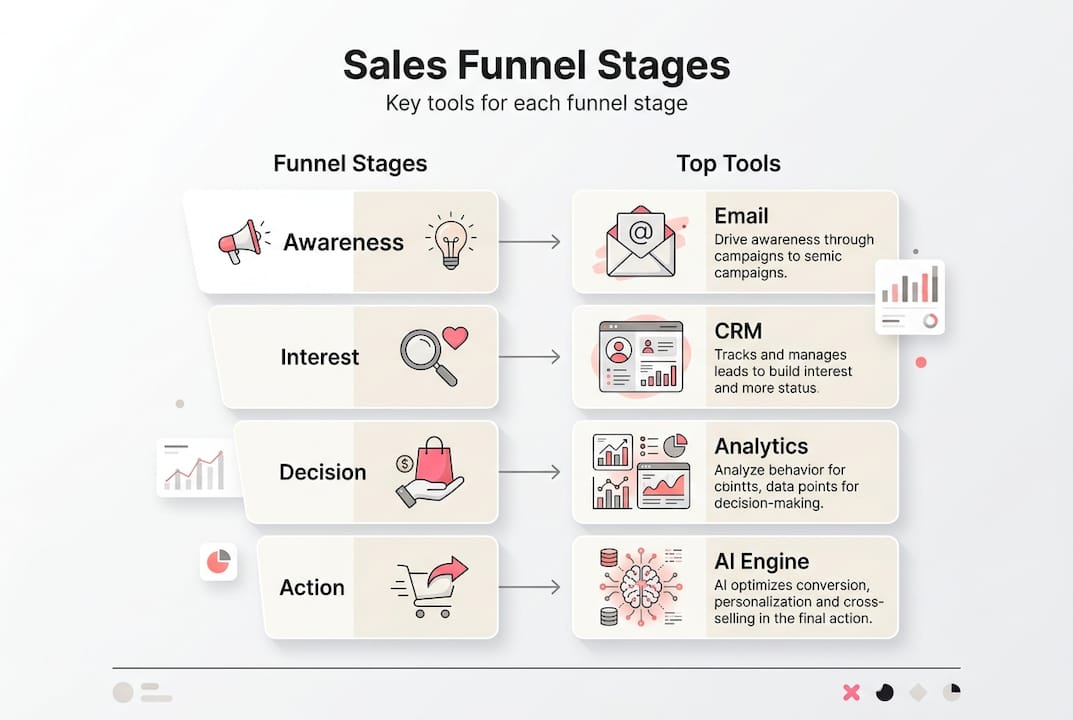
AI driven personalisation engines analyse customer behaviour patterns to predict preferences and recommend relevant products. These systems dynamically adjust website content, product suggestions, and email messaging for each individual visitor. AI tools for ecommerce boost online sales by delivering hyper relevant experiences that traditional segmentation cannot match.
Tool Category | Key Features | Cost Effectiveness | Best Funnel Stage |
Email Platforms | Automated sequences, segmentation, A/B testing | High ROI, £20-200/month | All stages |
CRM Systems | Contact management, lead scoring, pipeline tracking | Medium ROI, £15-150/month | Interest to Action |
AI Personalisation | Dynamic content, product recommendations, predictive analytics | Very High ROI, £100-500/month | Decision to Action |
Analytics Tools | Conversion tracking, funnel visualisation, behaviour analysis | Essential, £0-300/month | All stages |
Pro Tip: Test automation workflows with small customer segments before rolling out broadly. Monitor engagement metrics weekly during the first month to identify and fix issues quickly.
Choosing the best marketing automation types for eCommerce depends on your specific business model and customer base. Subscription businesses prioritise retention automation whilst one time purchase stores focus on acquisition and reactivation workflows. Start with core automations like welcome series, abandoned cart recovery, and post purchase follow ups. Expand to advanced sequences like browse abandonment and win back campaigns as you gain experience.
Integration capabilities matter enormously when selecting tools. Your email platform must connect seamlessly with your eCommerce platform, CRM, and analytics tools. Disconnected systems create data silos that prevent comprehensive funnel analysis and limit personalisation effectiveness.
Common mistakes and how to optimise your sales funnel for maximum ecommerce growth
Even well intentioned eCommerce owners make critical errors that sabotage funnel performance. Recognising these mistakes early prevents wasted marketing spend and lost conversions. Here are the most damaging funnel failures:
Neglecting mobile optimisation despite 65% of UK eCommerce traffic coming from smartphones
Using generic, weak calls to action that fail to create urgency or communicate value
Abandoning prospects after initial contact instead of implementing systematic follow up sequences
Ignoring funnel analytics and making decisions based on assumptions rather than data
Creating friction filled checkout processes with unnecessary form fields and confusing navigation
Failing to segment audiences, resulting in irrelevant messaging that decreases engagement
Poor Practice | Optimised Approach | Expected Outcome |
Single generic email blast to all contacts | Segmented campaigns based on behaviour and preferences | 3x higher open rates, 5x better conversions |
Complicated 5 step checkout process | Streamlined 2 step checkout with guest option | 25-40% reduction in cart abandonment |
No post purchase communication | Automated thank you, review request, and cross sell sequence | 15-20% increase in repeat purchase rate |
Static product pages for all visitors | Dynamic content based on traffic source and browsing history | 10-15% conversion rate improvement |
Pro Tip: Implement continuous A/B testing on high traffic funnel stages. Test one element at a time like headline copy, call to action buttons, or page layout to isolate what drives improvement.
Tracking conversions and analysing funnel metrics in 2026 allows precision optimisations that drive higher sales. Modern analytics platforms visualise exactly where customers exit your funnel, how long they spend at each stage, and which traffic sources produce the highest quality leads. This data transforms guesswork into strategic decision making.
Aligning funnel content with customer intent proves essential for conversion optimisation. Someone searching for “best running shoes for beginners” needs different information than someone searching for your brand name directly. Match content depth and focus to search intent and funnel stage. Top of funnel content educates and builds awareness. Bottom of funnel content removes objections and facilitates purchase decisions.
Leveraging analytics tools effectively requires setting up proper conversion tracking, defining clear funnel stage goals, and reviewing performance metrics weekly. Monitor bounce rates at each stage to identify content that fails to engage. Track average time spent to gauge content relevance and comprehension. Analyse traffic sources to double down on channels delivering qualified prospects.
Successful eCommerce businesses treat funnel optimisation as an ongoing process rather than a one time project. Customer behaviours evolve, market conditions shift, and competitor strategies change. Regular testing and refinement keep your funnel performing at peak efficiency. Boosting online sales for eCommerce requires this commitment to continuous improvement and data driven decision making.
Transform your ecommerce sales with expert funnel optimisation
Understanding sales funnels represents just the first step towards eCommerce success. Implementation and ongoing optimisation require specialised expertise, proven strategies, and sophisticated tools that most business owners lack time to master alone.

We’ve spent over 25 years building and scaling successful eCommerce brands, learning exactly what works in competitive UK and Irish markets. Our team specialises in creating high converting sales funnels powered by SEO, AI driven personalisation, strategic social media, and targeted PPC campaigns. We don’t just explain theory. We implement proven systems that consistently deliver measurable revenue growth. Whether you’re struggling with cart abandonment, low conversion rates, or ineffective customer acquisition, our data driven approach identifies bottlenecks and implements solutions that transform your funnel performance. Let us apply our decades of eCommerce experience to build a sales funnel that turns more visitors into loyal, profitable customers for your business.
Frequently asked questions
What is a sales funnel and why is it important for ecommerce?
A sales funnel maps the complete customer journey from initial brand awareness through to final purchase completion. It matters enormously for eCommerce because it provides a structured framework for understanding customer behaviour, identifying conversion obstacles, and optimising each stage systematically. Businesses using well designed funnels convert 20% to 35% more visitors into customers compared to those relying on unstructured approaches.
How can I create a sales funnel for my online store?
Start by defining your specific funnel stages based on your customer journey, typically awareness, interest, decision, and action. Map existing content and touchpoints to each stage, then identify gaps where customers need additional information or persuasion. Use marketing funnel frameworks to structure your approach systematically. Implement automation tools to nurture leads through email sequences, retargeting campaigns, and personalised recommendations that guide prospects smoothly from discovery to purchase.
What tools help automate sales funnels effectively?
Email marketing platforms like Klaviyo or Mailchimp automate personalised communication sequences based on customer behaviours. CRM software such as HubSpot or Salesforce tracks prospect interactions and manages lead nurturing workflows. AI personalisation tools analyse browsing patterns to deliver dynamic product recommendations and customised content. Automating email marketing for eCommerce creates systematic touchpoints that maintain engagement without requiring constant manual effort from your team.
How do I measure the success of my sales funnel?
Monitor conversion rates at each distinct funnel stage to identify where prospects drop off most frequently. Track bounce rates on key landing pages, average order values, and customer acquisition costs to assess overall funnel efficiency. Use analytics platforms to visualise the complete customer journey and measure time spent at each stage. Tracking conversions systematically in 2026 enables data driven optimisation decisions that continuously improve funnel performance and increase revenue without proportionally increasing marketing spend.
Recommended
Comments