.png)
What is retargeting? 97% visitors lost, 3-10x ROI


Nearly 97% of eCommerce visitors leave your site without making a purchase on their first visit. That’s a staggering loss of potential revenue, but retargeting offers a powerful way to bring those shoppers back. This guide explains what retargeting is, how it works, and how you can use it to recover lost visitors, boost conversions, and grow your eCommerce business in the UK and Ireland.
Table of Contents
How Retargeting Works: Technical Mechanisms And Campaign Types
Best Practices And Strategies For Effective Retargeting Campaigns
Legal And Privacy Considerations For Retargeting In UK And Ireland
Practical Steps To Implement Retargeting For Your Ecommerce Business
Summary: Why Retargeting Is Essential For Your Ecommerce Growth
Boost Your Ecommerce Success With Expert Digital Marketing Tools
Key takeaways
Point | Details |
Low first-visit conversion rates make retargeting essential | Only 2-3% of website visitors convert on their first visit, leaving 97% untapped. |
Retargeting campaigns deliver 3-10x higher conversion rates | Targeting warm audiences who already know your brand yields significantly better results than cold prospecting. |
Audience segmentation and frequency capping improve ad relevance | Personalised ads based on behaviour and controlled impression frequency prevent ad fatigue and enhance user experience. |
Compliance with GDPR builds trust and avoids fines | Obtaining consent and transparent data policies ensure legal compliance and protect your brand reputation. |
Tools like pixels and lists enable effective retargeting | Platforms such as Meta Ads, Google Ads, and TikTok offer accessible tools to implement retargeting at any budget. |
What is retargeting? Explaining the concept
Retargeting is a digital advertising strategy that targets users who visited your website but didn’t complete a purchase or desired action. It uses cookies and tracking pixels to identify these visitors and display personalised ads to them as they browse other websites, social media platforms, or search engines.
The mechanism is straightforward. When someone visits your site, a small piece of code (a pixel) drops a cookie in their browser. This cookie allows retargeting platforms to recognise that user and serve them tailored ads reminding them of products they viewed or encouraging them to return and complete their purchase.
Only 2-3% of website visitors convert on their first visit, which means most of your traffic leaves without buying. Retargeting aims to recapture this enormous pool of potential customers by keeping your brand top of mind and encouraging return visits. It’s far more efficient than constantly hunting for new visitors because you’re focusing on people who’ve already shown interest in what you offer.
Retargeting uses cookies and pixels to track visitor behaviour across the web.
Personalised ads remind users of products they viewed or abandoned in their cart.
It increases brand recall and encourages users to return and convert.
Dynamic remarketing takes this further by showing specific products users browsed.
For more detail on related tactics, explore what is remarketing and how it complements retargeting strategies.
Why retargeting matters to eCommerce businesses
Without retargeting, 97% of visitors to eCommerce sites do not return after their first visit. That’s an enormous missed opportunity. Retargeting helps you recover these lost visitors by keeping your products in front of them as they continue their online journey.

Retargeting boosts retention and conversion rates dramatically. Because you’re targeting warm audiences who already know your brand, conversion rates can be 3 to 10 times higher than standard display ads aimed at cold prospects. This translates directly into improved return on investment and more revenue from your existing traffic.
Recovering abandoned carts is one of the most powerful applications of retargeting. Shoppers abandon carts for many reasons: distraction, comparison shopping, or hesitation. Retargeting ads serve as gentle reminders, often combined with incentives like discounts or free shipping, prompting users to complete their purchases. This not only increases immediate sales but also enhances customer lifetime value by nurturing relationships.
Retargeting capitalises on existing visitor interest rather than seeking entirely new leads.
It reinforces brand recall, making your business the first choice when users are ready to buy.
Higher conversion rates from retargeting improve overall marketing ROI.
Retargeting is essential for competing effectively in crowded eCommerce markets.
Implementing these strategies is part of broader eCommerce marketing best practices that drive sustainable growth.
How retargeting works: technical mechanisms and campaign types
Retargeting relies on several technical approaches, each suited to different goals and audiences. Pixel-based retargeting is the most common method. You install a tracking pixel on your website that drops a cookie when someone visits. This cookie enables retargeting platforms to display your ads to that visitor as they browse other sites.
List-based retargeting targets users via uploaded email addresses or phone numbers. Platforms like Meta match these lists to user accounts and serve ads accordingly. This method is useful for reaching past customers or newsletter subscribers with tailored offers.
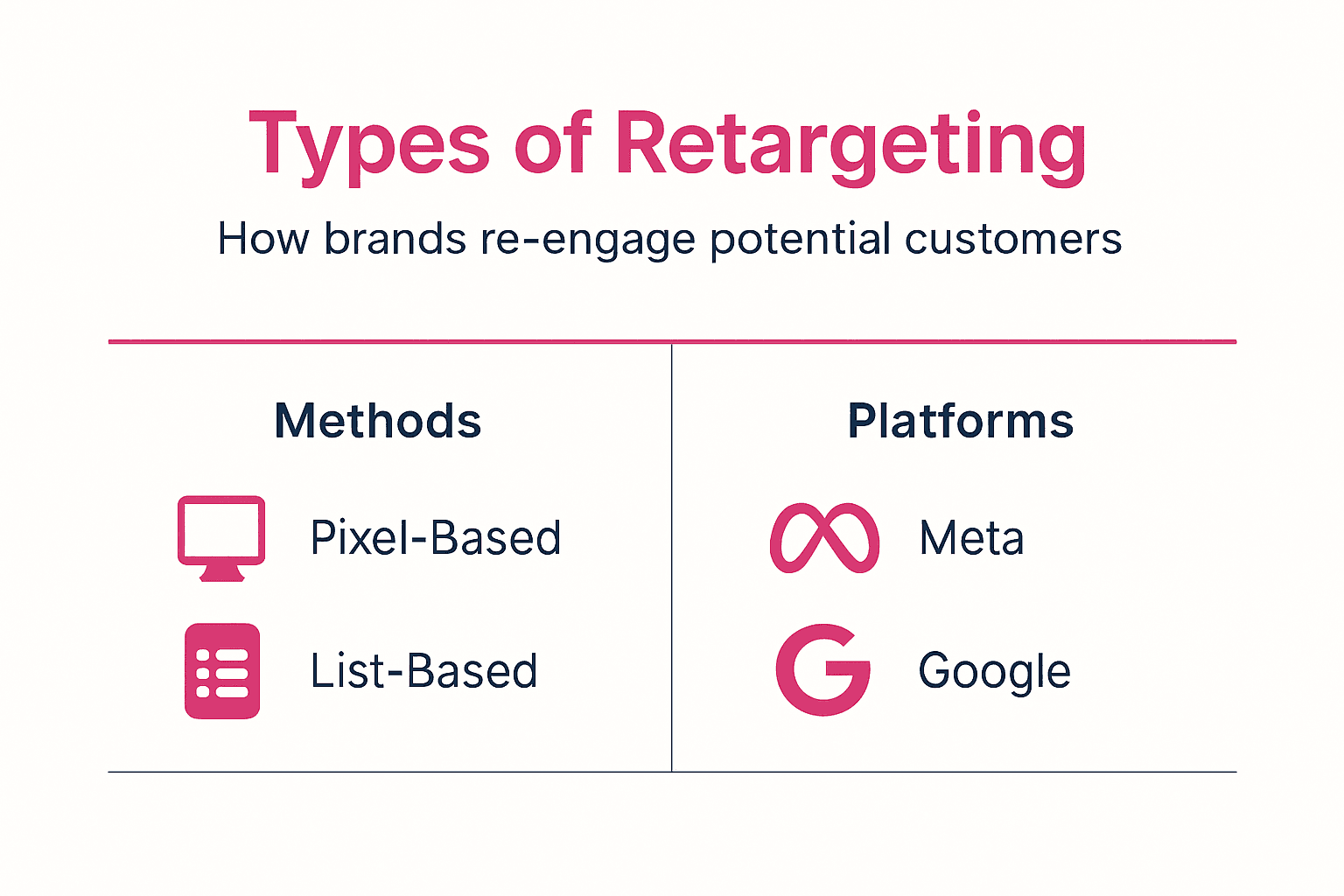
Engagement-based retargeting uses interactions on social media platforms to identify potential customers. If someone likes your post, watches a video, or engages with your content, you can retarget them without needing a website pixel. This extends your reach beyond site visitors.
Retargeting type | Mechanism | Best for |
Pixel-based | Tracks website visitors via cookies | Broad audience reach and cart abandonment |
List-based | Uploads customer emails or phone numbers | Past customers and email subscribers |
Engagement-based | Uses social media interactions | Building awareness and engagement |
Segmentation is critical for effective retargeting. Not all visitors are the same. Someone who abandoned a cart is more likely to convert than someone who only viewed your homepage. By segmenting audiences based on behaviour (cart abandoners, product viewers, past customers), you can deliver highly relevant ads that resonate with each group. Combining different retargeting types can extend reach and lift conversions by 25 to 35%.
Pixel-based retargeting is ideal for most eCommerce businesses starting out.
List-based methods work well for re-engaging existing customers with new offers.
Engagement-based retargeting builds awareness and nurtures cold audiences.
Segmentation ensures each audience sees ads tailored to their stage in the buying journey.
Pro Tip: Combine pixel-based and list-based retargeting to cover both new visitors and existing customers. This multi-layered approach maximises your reach and conversions.
To set up remarketing effectively, you’ll also benefit from understanding behavioural targeting in retargeting to refine your audience segments.
Common misconceptions about retargeting
Many eCommerce owners hesitate to use retargeting because of misunderstandings about how it works and its impact on users. Let’s clear up the most common myths.
Retargeting is intrusive and annoys customers. This is only true if campaigns are poorly executed. When ads are segmented and frequency capped, they feel helpful rather than stalking. Users appreciate being reminded of products they genuinely considered.
Retargeting is only for big businesses with large budgets. In reality, retargeting is highly cost-effective and scalable. Platforms like Meta Ads and Google Ads allow you to start with modest budgets and scale as you see results. Small and medium eCommerce businesses often achieve better ROI from retargeting than from broad awareness campaigns.
Retargeting overwhelms users with too many ads. This happens when frequency caps aren’t applied. By limiting the number of times a user sees your ad per day or week, you maintain a positive brand experience without causing fatigue.
Setting up retargeting is too complex and technical. Modern platforms have simplified retargeting setup significantly. Installing a pixel takes minutes, and many platforms offer step-by-step guides. You don’t need advanced technical skills to get started.
Retargeting doesn’t respect user privacy. When done legally and ethically, retargeting complies with GDPR and respects user consent. Transparent policies and cookie consent banners ensure users understand how their data is used, building trust rather than eroding it.
Best practices and strategies for effective retargeting campaigns
To maximise the effectiveness of your retargeting campaigns, follow these proven strategies.
Segment your audiences by behaviour. Create separate campaigns for cart abandoners, product viewers, past customers, and homepage visitors. Each group requires different messaging. Cart abandoners need a nudge to complete their purchase, while past customers might respond to new product launches or loyalty rewards.
Apply frequency caps to limit ad impressions. Showing the same ad too many times leads to ad fatigue and negative brand perception. Using frequency caps ranging 7 to 180 days and continuous testing improves campaign performance and user experience. A common guideline is 3 to 5 impressions per user per week.
Set retargeting windows adapted to your product type and buying cycle. High-consideration items like furniture may require longer retargeting windows (30 to 90 days), while impulse purchases like fashion accessories benefit from shorter windows (7 to 14 days). Match your retargeting duration to how your customers actually shop.
Personalise ads per segment with clear calls to action. Show cart abandoners the exact products they left behind. Offer product viewers related items or bundle deals. Use dynamic creative to automatically populate ads with relevant products. Each ad should have a specific, compelling call to action tailored to the user’s stage in the buying journey.
Continuously analyse campaign performance using analytics tools to identify what’s working.
Test different ad creatives, messages, and offers to optimise conversion rates.
Adjust your bidding strategy based on audience value (cart abandoners typically warrant higher bids).
Combine retargeting with other tactics from your ecommerce advertising guide for maximum impact.
Pro Tip: Use sequential retargeting to guide users through a journey. Show awareness ads first, then product-specific ads, and finally urgency-driven offers. This progression feels natural and increases conversion likelihood.
Legal and privacy considerations for retargeting in UK and Ireland
Retargeting in the UK and Ireland must comply with GDPR and related data protection regulations. These laws protect consumer privacy and impose strict requirements on how businesses collect and use personal data.
Obtain explicit cookie consent before tracking users. Your website must display a clear cookie consent banner that allows users to accept or reject non-essential cookies, including retargeting pixels. Pre-ticked boxes or implied consent are not sufficient under GDPR.
Use transparent data policies explaining retargeting practices. Your privacy policy should clearly state that you use retargeting, describe how cookies work, identify the platforms you use, and explain how users can opt out. Transparency builds trust and demonstrates respect for user privacy.
GDPR compliance is mandatory; fines can reach €20 million or 4% turnover, whichever is higher. Non-compliance risks not only financial penalties but also serious reputational damage. Customers are increasingly privacy-conscious, and brands that mishandle data lose trust.
Always obtain consent before dropping retargeting cookies on user devices.
Provide easy opt-out mechanisms and honour user preferences promptly.
Regularly review and update your privacy policies to reflect current practices.
Partner with platforms that are GDPR-compliant and offer robust data protection features.
Ethical retargeting fosters customer trust and brand reputation. When users see that you respect their privacy and give them control over their data, they’re more likely to engage positively with your brand.
Practical steps to implement retargeting for your eCommerce business
Ready to launch your first retargeting campaign? Follow these practical steps tailored for UK and Ireland eCommerce owners.
Choose your retargeting platforms. Start with Meta Ads (Facebook and Instagram) and Google Ads, which offer the widest reach and easiest setup. TikTok is also growing rapidly and can be effective for younger demographics. Select platforms where your target audience spends time.
Install tracking pixels or upload customer lists. For pixel-based retargeting, add the platform’s tracking code to your website (usually in the header). Most eCommerce platforms like Shopify or WooCommerce have plugins to simplify this. For list-based retargeting, export your customer email list and upload it to the platform.
Segment your audience by behaviour. Create audiences for cart abandoners, product page viewers, past purchasers, and homepage visitors. Most platforms allow you to define audiences based on specific URLs visited or actions taken.
Design personalised ads with clear calls to action for each segment. Show cart abandoners the products they left behind with a message like “Still thinking about this?” Offer product viewers related items or discounts. Use high-quality images and concise, compelling copy.
Set frequency caps and retargeting windows suited to your products. Limit impressions to 3 to 5 per user per week. Set windows of 7 to 14 days for fast-moving products or 30 to 90 days for higher-consideration items.
Launch the campaign and monitor results with analytics tools for optimisation. Track key metrics like click-through rate, conversion rate, cost per acquisition, and return on ad spend. Optimised tools and analytics can improve campaign performance by up to 40%. Adjust targeting, creative, and budgets based on what the data tells you.
Start small and scale as you learn what works for your audience.
Use A/B testing to compare different ad creatives, messages, and offers.
Integrate retargeting with your broader ecommerce advertising guide strategies.
Regularly review and refine your campaigns to maintain strong performance.
For detailed technical guidance, refer to our guide on how to set up remarketing for your eCommerce store.
Summary: why retargeting is essential for your eCommerce growth
Retargeting is a vital strategy for any eCommerce business serious about maximising conversions and revenue. By targeting warm, interested audiences who have already engaged with your brand, you achieve significantly higher conversion rates than broad prospecting campaigns.
Segmentation and frequency capping ensure your ads remain relevant and welcome, enhancing user experience rather than detracting from it. Legal compliance with GDPR not only protects you from fines but also builds customer trust and strengthens your brand reputation.
Retargeting transforms lost visitors into loyal customers. It’s not just about recovering sales; it’s about creating a smarter, more efficient marketing strategy that focuses your resources on the people most likely to buy. In a competitive eCommerce landscape, retargeting gives you the edge you need to grow sustainably and profitably.
Boost your eCommerce success with expert digital marketing tools

Retargeting is just one piece of a comprehensive digital marketing strategy. To truly scale your eCommerce business, you need the right tools and tactics working together. Explore our guide to the best digital marketing software to find platforms that integrate seamlessly with your retargeting campaigns and enhance every aspect of your marketing.
Understanding the full spectrum of digital marketing for ecommerce helps you build a cohesive strategy that drives sustained growth. From SEO and social media to PPC and AI-driven personalisation, each channel complements retargeting and amplifies your results. With over 25 years of experience scaling successful eCommerce brands, we provide the expertise and tools you need to succeed.
Frequently asked questions
What is the difference between retargeting and remarketing?
Retargeting generally refers to display ads targeting previous visitors via pixels or cookies placed on your website. Remarketing often involves email campaigns sent to previous customers or leads who have provided their contact information. Both strategies aim to re-engage users, but they use different channels and mechanisms.
How can small eCommerce businesses afford retargeting campaigns?
Retargeting can be scaled to fit modest budgets, starting with as little as £5 to £10 per day on platforms like Meta Ads or Google Ads. It often delivers better ROI than broad cold prospecting ads because you’re targeting warm audiences already familiar with your brand. Start small, measure results, and scale investment as you see positive returns.
What are the key legal requirements for retargeting in the UK and Ireland?
User consent for cookies is required before tracking visitors on your website. You must display a clear cookie consent banner and provide transparent data use policies explaining your retargeting practices. Non-compliance risks fines up to €20 million or 4% of annual turnover under GDPR. Ethical, compliant retargeting builds trust and protects your business.
What tools and platforms are best for retargeting campaigns?
Meta Ads (Facebook and Instagram), Google Ads, and TikTok are leading platforms for retargeting eCommerce audiences. Choose platforms based on where your target audience spends time and the ease of pixel or list integration. Most platforms offer user-friendly interfaces and detailed analytics to help you optimise campaigns effectively.
Recommended
Comments