.png)
What is lookalike audience targeting? How UK brands scale sales
- Darren Burns
- Mar 31
- 9 min read


Running ads that reach the wrong people wastes your budget and stalls growth. Most e-commerce businesses struggle to expand beyond their existing customer base because traditional targeting methods cast too wide a net or miss high-intent buyers entirely. Lookalike audiences solve this by using machine learning to identify new prospects who mirror your best customers’ behaviours and characteristics. This guide shows you how to harness lookalike audience technology to scale your UK or Ireland online shop efficiently, from setup through to optimisation.
Table of Contents
Key Takeaways
Point | Details |
Reach similar buyers | Lookalike audiences let you target new users who behave like your best customers, driving better sales outcomes. |
Easy to set up | Major ad platforms like Meta and Google provide simple tools to create effective lookalike campaigns from your existing data. |
Better ad efficiency | Using lookalikes often results in higher conversion rates and more efficient ad spend for e-commerce businesses. |
Seed quality matters | The effectiveness of your lookalike audience depends on providing a high-quality, well-matched seed audience. |
The basics: What is a lookalike audience?
A lookalike audience is a segment built by advertising platforms like Meta and Google using AI-powered algorithms to find new users who closely resemble your existing customers. The process starts with a seed audience, which is a group of your best customers, website visitors, or converters. Platforms analyse this seed group’s demographics, online behaviours, interests, and purchase patterns to identify fresh prospects with similar traits.
Key requirements and mechanics:
You need at least 100 matched users in your seed audience to create a lookalike on Meta
Platforms refresh your lookalike audiences every three days to maintain accuracy
Machine learning examines hundreds of data points to find statistical matches
You control audience size through similarity percentages (1-10% on Meta)
Think of it as cloning your ideal customer profile at scale. Instead of guessing who might buy from you, the platform’s algorithms do the heavy lifting by identifying people who share the same digital footprint as your proven buyers.
“Lookalike targeting transforms how e-commerce brands acquire customers by replacing guesswork with data-driven precision.”
The technology works across major advertising networks, giving you multiple channels to reach these high-potential prospects. Whether you’re selling fashion, electronics, or home goods, lookalike audiences help you find people who are statistically more likely to convert than cold traffic.
How lookalike audiences work behind the scenes
The machine learning process that powers lookalike audiences is sophisticated yet straightforward. Platforms analyse your seed audience across multiple dimensions simultaneously, creating a detailed profile of what makes these customers valuable. The system examines age ranges, locations, device usage, browsing habits, content engagement, purchase frequency, and dozens of other signals.
The matching process follows these steps:
Platform algorithms scan your seed audience data to identify common patterns
Statistical models weight each characteristic by its predictive value for conversion
The system searches the broader user base for people matching these weighted patterns
Results are ranked by similarity score and filtered by your chosen percentage
The final audience is delivered to your ad account for campaign use
You control the balance between reach and precision through the similarity range. A 1% lookalike gives you the closest matches, typically 1% of the total population in your target geography. This smaller group mirrors your seed audience most accurately. A 10% lookalike expands reach significantly but includes people with looser similarities.
Pro Tip: Start with a 1-2% lookalike for your first campaigns. Test performance for two weeks, then gradually expand to 3-5% if you need more volume without sacrificing conversion quality.
The algorithms continuously learn and adapt. As your seed audience grows and evolves, the platform refines its understanding of your ideal customer. This creates a feedback loop where successful campaigns improve future targeting, making your AI marketing strategies more effective over time.
Comparing lookalike audience options on Meta and Google
Both Meta and Google offer lookalike targeting, but their approaches differ in meaningful ways for UK and Ireland e-commerce businesses. Understanding these distinctions helps you choose the right platform for specific campaign goals.
Feature | Meta (Facebook/Instagram) | Google (Customer Match) |
Minimum seed size | 100 matched users | 1,000 users (5,000 for search) |
Refresh frequency | Every 3 days automatically | Manual updates required |
Similarity control | 1-10% granular selection | Broad match only |
Primary networks | Facebook, Instagram, Messenger | Search, YouTube, Display, Gmail |
Best for | Social engagement, visual products | High-intent search, remarketing |
UK audience reach | 40+ million active users | 60+ million search users |
Meta’s lookalike audiences excel for brands with strong visual appeal or those targeting specific lifestyle segments. The platform’s detailed similarity controls and automatic refresh make it easier to maintain campaign performance without constant manual intervention.
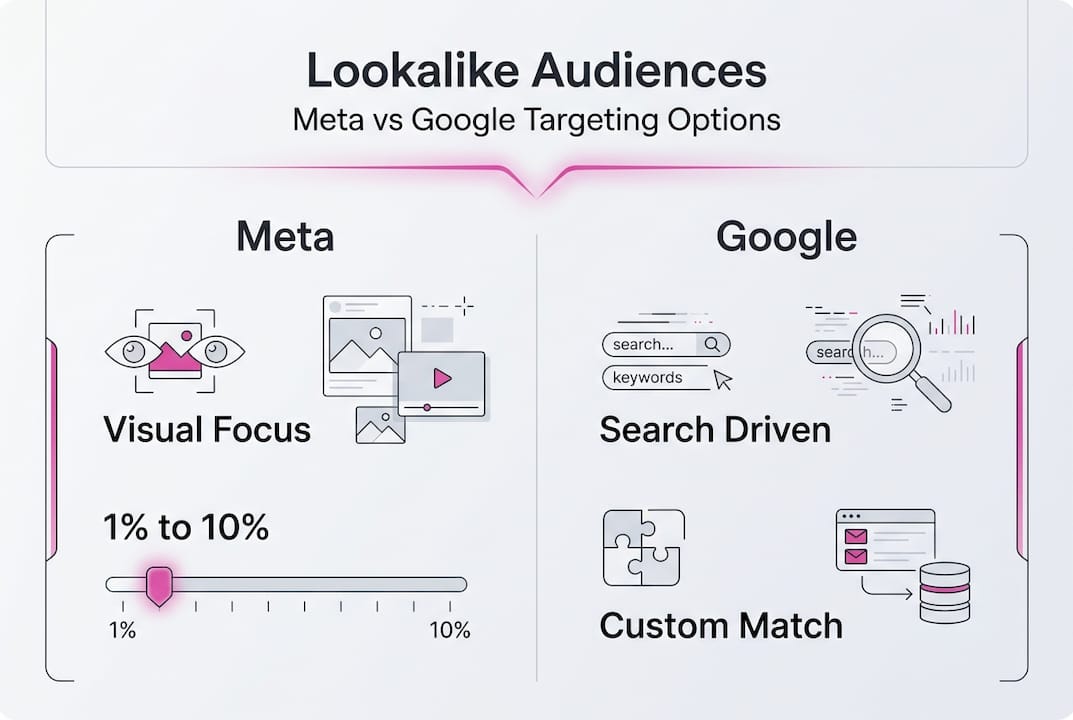
Google’s approach works brilliantly for capturing high-intent buyers actively searching for products. The higher seed requirement means you need more initial customer data, but the reach across search and YouTube can deliver exceptional results for established shops.
Platform selection considerations:
Choose Meta if you’re launching a new product line or testing market response
Select Google when you have strong search demand and want to capture ready-to-buy traffic
Use both platforms simultaneously for maximum market coverage
Consider your digital marketing software stack when managing multiple platforms
Many successful UK e-commerce brands run lookalike campaigns on both platforms, using Meta for awareness and consideration stages while deploying Google for bottom-funnel conversions. This multi-platform strategy maximises your ability to reach qualified prospects throughout their buying journey.
Benefits of using lookalike audiences for e-commerce
Lookalike audiences deliver measurable advantages that directly impact your bottom line. The technology addresses the core challenge every online retailer faces: finding more people who actually want to buy what you sell.
Primary benefits for UK and Ireland shops:
Higher conversion rates: Reach prospects pre-qualified by behavioural similarity to your best customers
Improved cost efficiency: Reduce wasted ad spend on unqualified traffic that never converts
Faster scaling: Expand your customer base without lengthy testing of cold audiences
Better ROAS: Achieve stronger returns by focusing budget on high-probability buyers
Market intelligence: Learn which customer characteristics drive the most value
The performance improvements from lookalike targeting compound over time. As you gather more customer data, your seed audiences become more refined, which produces even better lookalike matches. This creates a growth flywheel where success breeds more success.
Consider a Manchester-based fashion retailer who switched from broad demographic targeting to lookalike audiences. Their cost per acquisition dropped by 43% within the first month, whilst conversion rates increased by 67%. The key was using their highest-value customers as the seed, rather than all purchasers.
Pro Tip: Create separate lookalike audiences for different customer value tiers. Build one from your top 10% spenders and another from frequent repeat buyers. Test both to see which produces better long-term customer value, not just initial conversion rates.
The technology also accelerates market entry for shops expanding into new product categories. Instead of spending months testing various demographic combinations, you can leverage existing customer insights to find qualified buyers for new offerings. This approach works particularly well for AI-powered advertising strategies that prioritise data-driven decision making.
Step-by-step: Creating your first lookalike audience
Setting up your first lookalike audience takes about 15 minutes once you’ve identified your seed source. The process is similar across platforms, though we’ll focus on Meta since it offers the most accessible entry point for UK e-commerce businesses.
Complete setup process:
Prepare your seed audience: Export a list of your top 500-1,000 customers from your e-commerce platform, including email addresses and phone numbers
Access Meta Ads Manager: Navigate to Audiences under the Assets menu in your Business Manager account
Create custom audience: Click Create Audience, select Custom Audience, then choose Customer List as your source
Upload your data: Import your customer file and map the columns to Meta’s data fields (email, phone, name)
Wait for matching: Meta will match your list against its user database (typically 100+ matches required)
Build the lookalike: Once matched, click Create Audience again, select Lookalike Audience, choose your custom audience as the source
Set parameters: Select United Kingdom and/or Ireland as your location, choose 1% for your first test
Launch campaigns: Use your new lookalike audience in ad sets, starting with a modest daily budget of £20-50
The matching process usually completes within 24 hours. You’ll receive a notification when your lookalike audience is ready to use in campaigns.
Pro Tip: Create three lookalike audiences simultaneously at 1%, 2%, and 3% similarity. Run identical ad sets to each for two weeks, then allocate more budget to whichever performs best. This parallel testing reveals your optimal balance between reach and precision faster than sequential tests.
For Facebook Ads setup, pair your lookalike audience with relevant interests or behaviours to further refine targeting. A 1% lookalike of your best customers who also show interest in competitor brands often produces exceptional results for acquisition campaigns.
Common lookalike audience mistakes to avoid
Even experienced marketers stumble with lookalike audiences when they overlook fundamental principles. These mistakes waste budget and produce misleading performance data that can derail your entire acquisition strategy.
Critical errors to prevent:
Using low-quality seed data: Building lookalikes from all customers rather than your most valuable segments dilutes the signal
Insufficient seed size: Starting with barely 100 users creates unstable audiences that fluctuate wildly
Ignoring geographic relevance: Using a seed audience from multiple countries when targeting only UK buyers
Audience overlap: Running multiple campaigns to overlapping lookalike percentages without exclusions
Stale seed data: Never updating your source audience as your customer base evolves
Wrong similarity level: Choosing 10% reach when you need 1% precision, or vice versa
Neglecting creative testing: Assuming lookalike targeting alone guarantees success without compelling ad content
The seed audience quality issue deserves special attention. A lookalike built from customers who bought once on deep discount will find more discount hunters. A lookalike from repeat buyers at full price will find customers with higher lifetime value. The algorithm can only mirror what you feed it.
“Your lookalike audience is only as good as your seed audience. Garbage in, garbage out applies perfectly to algorithmic targeting.”
Another frequent mistake is failing to exclude existing customers from lookalike campaigns. You’re paying to reach new prospects, so make sure you’re not wasting impressions on people who already know your brand. Set up exclusion lists for website visitors, email subscribers, and past purchasers.
The refresh cycle oversight causes problems too. Whilst Meta updates lookalikes automatically every three days, your seed audience only refreshes when you manually update the source custom audience. Schedule monthly reviews to upload fresh customer data, ensuring your lookalikes evolve with your business.
Finally, many shops give up too quickly. Lookalike audiences need time to optimise through Meta’s learning phase. Run campaigns for at least two weeks before making major changes. Track cost per acquisition and customer lifetime value, not just immediate ROAS, to properly assess performance for your social media advertising efforts.
Next steps: Amplify your brand reach with expert help
You now understand how lookalike audiences work and how to implement them for your e-commerce business. The strategies outlined above will help you reach more qualified buyers and scale your customer acquisition efficiently. However, managing multiple platforms, optimising seed audiences, and coordinating lookalike campaigns with your broader marketing strategy requires significant time and expertise.

That’s where partnering with experienced digital marketing specialists makes the difference between good results and exceptional growth. Our team has spent over 25 years scaling e-commerce brands through data-driven advertising strategies, including advanced lookalike audience optimisation across Meta, Google, and emerging platforms. We handle the technical complexity whilst you focus on running your business.
We’ll audit your current customer data, identify your highest-value segments, and build lookalike strategies tailored to your specific products and market position. Our approach combines lookalike targeting with complementary tactics like SEO, AI-powered content, and conversion rate optimisation to maximise your return on every marketing pound spent. Ready to transform your customer acquisition? Connect with our team to discuss how we can accelerate your growth through expert lookalike audience management and comprehensive digital marketing support.
Frequently asked questions
What qualifies as a ‘seed audience’ for lookalike targeting?
A seed audience is a segment of your best customers, website visitors, or top converters with at least 100 users matched on Meta. Quality matters more than quantity, so focus on your most valuable customer segments rather than your entire database.
How often should I refresh my lookalike audiences?
Lookalike audiences on Meta are refreshed automatically every three days, but you should review and update your source seed data monthly. This ensures your lookalikes evolve as your customer base grows and changes.
Can lookalike targeting work for small e-commerce shops?
Yes, as long as you have data on at least 100 customers, lookalike targeting can help you find new high-potential buyers. Start with your most engaged customers as your seed, even if it’s a small group.
What is the difference between a 1% and 10% lookalike audience?
A 1% lookalike provides a closer match to your seed audience with higher conversion potential but smaller reach, whilst 10% offers broader reach with looser similarity. Test both to find your optimal balance for specific campaign goals.
Should I use lookalike audiences for remarketing campaigns?
No, lookalike audiences are designed for prospecting and finding new customers. Use custom audiences built from website visitors or past customers for remarketing, and reserve lookalikes for expanding your reach to fresh prospects who haven’t interacted with your brand yet.
Recommended
Comments