.png)
What is geo targeting and how to use it for ecommerce growth
- Darren Burns
- Mar 24
- 9 min read


Localised marketing boosts ecommerce conversions by up to 200% compared to generic campaigns, yet many UK and Ireland business owners overlook geo targeting as a growth lever. Geo targeting delivers tailored user experiences based on location, transforming how customers interact with your brand. This article explains geo targeting concepts, benefits, challenges, and practical steps to apply it effectively in your ecommerce marketing strategy.
Table of Contents
Key Takeaways
Point | Details |
Local storefronts outperform global | Separate UK and Ireland storefronts with localised pricing and checkout to boost trust and reduce friction. |
Local currency and language | Displaying prices in pounds sterling and tailoring language to the location reduces cognitive load and supports smoother purchases. |
Start broad then refine | Begin with country level targeting before moving to city or radius strategies to build baseline data and ease implementation. |
Testing and GDPR compliance | Run practical tests and ensure GDPR compliance to validate effectiveness and protect customer privacy. |
Understanding geo targeting: what it is and how it works
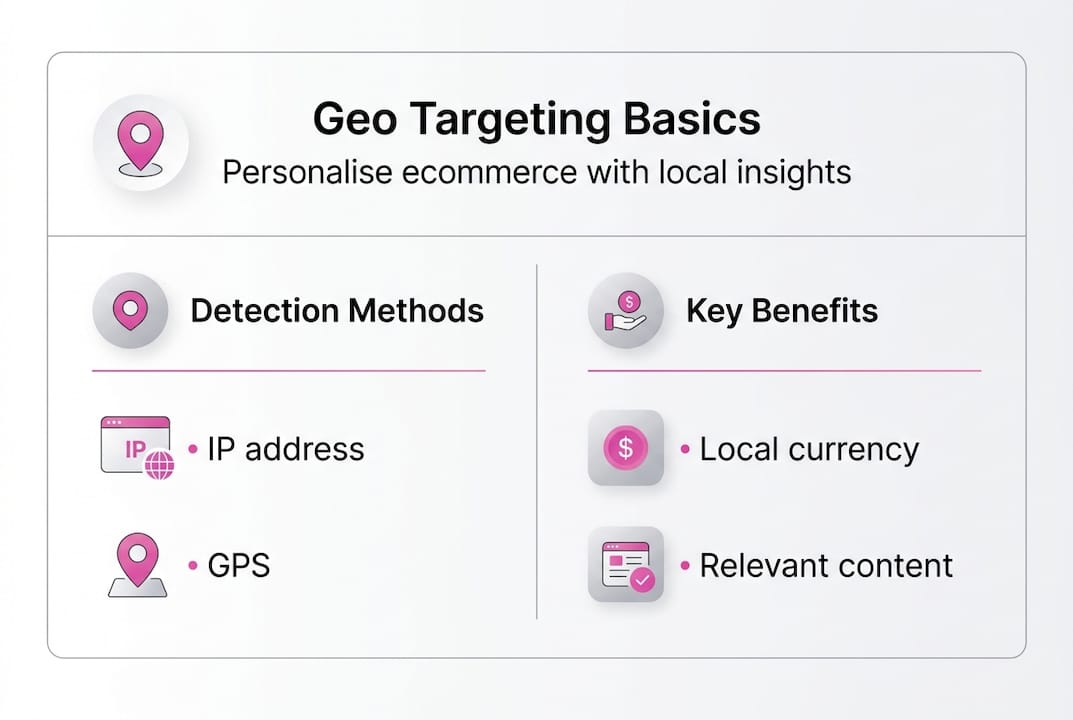
Geo-targeting uses IP addresses, GPS, or Wi-Fi to deliver customised content based on location. This technology enables ecommerce businesses to show different products, pricing, and messaging depending on where customers browse from. The core purpose is creating relevant experiences that resonate with local preferences and purchasing behaviours.
Location detection operates through multiple methods. IP geolocation maps internet addresses to geographic regions, providing country and city-level accuracy. GPS delivers precise coordinates from mobile devices, whilst Wi-Fi signals triangulate position using nearby network data. Each method offers different accuracy levels and works best in specific contexts.
Geo targeting encompasses several types. Country targeting segments audiences by nation, ideal for currency and language customisation. City targeting narrows focus to metropolitan areas, perfect for local promotions. Radius targeting creates circular zones around specific coordinates, whilst hyperlocal targeting pinpoints neighbourhoods or postcodes. Selecting the right type depends on your business model and customer distribution.
Core mechanics include geo redirection, where users automatically land on location-appropriate pages. Dynamic content swapping changes currency symbols, language text, and shipping estimates without redirecting. Geo-fencing triggers actions when customers enter defined areas, useful for mobile app notifications. Radius targeting limits ad visibility to users within set distances from physical locations.
Localised currency and language transform user experience. Displaying prices in pounds sterling for UK customers eliminates mental conversion calculations. Showing Irish euro pricing builds trust with Republic of Ireland shoppers. Language localisation extends beyond translation to include regional terminology and cultural references. These adjustments reduce friction in the purchase journey, directly impacting conversion rates and customer satisfaction. Combining geo targeting with dynamic remarketing ecommerce impact strategies amplifies results by re-engaging visitors with location-relevant messaging.
Pro tip: Start with country-level targeting before attempting city or radius strategies. Broader targeting requires less technical complexity and delivers measurable results faster, providing baseline data for more granular experiments.
The benefits of geo targeting for UK and Ireland ecommerce businesses
Geo targeting directly boosts conversions and sales by matching content to customer context. When shoppers see prices in their currency, shipping times for their location, and products available in their region, purchase decisions become easier. This relevance eliminates common objections that cause cart abandonment.
A UK apparel brand demonstrated geo targeting’s power by implementing location-specific product catalogues and pricing. Revenue grew from £0 to £1.23M within 18 months of launching separate Irish and UK storefronts with localised checkout experiences. The brand attributed this growth to reduced friction at checkout and increased trust from seeing familiar payment options and delivery partners.

Geo-focused ads deliver 1.5-2x higher conversion rates compared to non-targeted campaigns. Cart abandonment drops by 22% when customers receive location-relevant pricing and shipping information upfront. These improvements stem from removing uncertainty about final costs and delivery timeframes, two primary reasons customers abandon purchases.
Trust increases through localised experiences. Displaying a Belfast address and Irish phone number to Republic of Ireland customers signals legitimacy. Showing UK postcodes and telephone formats to British shoppers creates familiarity. Local payment methods like Klarna or Clearpay, popular in specific regions, further enhance credibility. These trust signals compound, creating psychological safety that encourages first-time purchases.
Synergy with remarketing maximises return on investment. Geo targeted ads reach previous visitors with location-specific offers, combining behavioural data with geographic relevance. A customer who browsed winter coats in Edinburgh sees ads featuring delivery to Scottish addresses, whilst a Dublin browser receives messaging about Irish stock availability. This dual targeting approach delivers superior performance compared to generic remarketing campaigns. Aligning geo targeting with ecommerce marketing best practices uk ireland creates cohesive strategies that address multiple customer touchpoints simultaneously.
Key benefits for UK and Ireland ecommerce:
Conversion rate improvements of 150-200% through localised experiences
Reduced cart abandonment by eliminating currency and shipping uncertainty
Enhanced customer trust via familiar payment methods and local contact details
Higher remarketing ROI by combining behavioural and geographic targeting
Improved customer lifetime value through relevant product recommendations
Challenges and expert nuances in geo targeting implementation
Technical limitations create accuracy issues that undermine geo targeting effectiveness. IP geolocation databases contain errors, sometimes placing users in wrong cities or regions. VPN usage and proxy servers mask true locations, causing mismatched content delivery. Mobile users switching between Wi-Fi and cellular networks trigger location changes mid-session. These edge cases affect 8-15% of traffic, requiring fallback strategies.
Regulatory challenges demand careful attention in UK and Ireland markets. GDPR requires explicit consent before collecting location data beyond what’s necessary for service delivery. Auto-redirecting users based on detected location without permission violates user experience principles and potentially breaches data protection regulations. Businesses must implement clear consent mechanisms and provide easy opt-out options.
Avoiding auto-redirect without user consent protects both compliance and experience. Present a banner asking users to confirm their location or select from available regional sites. This approach respects user autonomy whilst still enabling geo targeting benefits. Some users legitimately browse from locations different from their residence, such as travellers or expatriates shopping for home delivery.
Separate country sites outperform single global sites for several reasons. Dedicated domains or subdirectories enable precise SEO targeting for regional search engines. Content management becomes clearer when each site focuses on one market. Technical performance improves through region-specific hosting. Pricing and inventory control gain flexibility without complex conditional logic. The main drawback is increased maintenance overhead, but this cost typically justifies itself through improved conversion rates.
Geo test design requires rigorous methodology to produce reliable results. Use synthetic controls by selecting matched regions with similar demographics and purchase patterns. Compare performance between geo-targeted and control regions over identical timeframes. Edge cases like VPN usage and GDPR impact accuracy, so run tests for minimum four weeks to smooth temporary fluctuations. Avoid testing during seasonal peaks or promotional periods that could skew results.
“Successful geo targeting balances technical precision with user respect. The most effective implementations ask rather than assume, test rather than guess, and continuously refine based on real customer behaviour.”
Common pitfalls to avoid:
Implementing auto-redirect without consent mechanisms
Relying solely on IP data without fallback detection methods
Ignoring VPN and proxy users in targeting strategies
Testing geo campaigns during atypical seasonal periods
Neglecting GDPR compliance in location data collection
Pro tip: Implement a location selector that persists across sessions using cookies. This allows users to manually override detected locations whilst maintaining their preference for future visits, accommodating travellers and VPN users.
Aligning geo targeting with broader marketing objectives ecommerce brands ensures technical implementation supports strategic goals. Understanding geo targeting seo guide principles helps avoid common technical mistakes that harm search visibility whilst pursuing localisation benefits.
How to apply geo targeting effectively in your ecommerce marketing
Implementing geo targeting follows a structured process that minimises risk whilst maximising learning. Start with clear objectives tied to specific metrics like conversion rate improvement or cart abandonment reduction. Define target locations based on existing customer data and expansion goals. Select appropriate targeting granularity, beginning with country-level before advancing to cities or postcodes.
Step-by-step implementation process:
Analyse existing traffic sources to identify top geographic markets and underserved regions with potential
Choose targeting technology: platform-native tools like Google Ads geo targeting, third-party services, or custom development
Create location-specific content variations including currency, language, shipping information, and product availability
Implement detection and consent mechanisms that respect user privacy and provide manual override options
Launch controlled tests in matched regions, comparing geo-targeted areas against similar control markets
Monitor key metrics daily during initial rollout, watching for technical issues or unexpected user behaviour patterns
Analyse results after four to six weeks, calculating statistical significance before scaling successful approaches
Optimise based on learnings, refining targeting parameters and content variations for improved performance
Comparing single global site versus separate country stores reveals distinct advantages for each approach:
Approach | Advantages | Disadvantages | Best for |
Single global site | Lower maintenance overhead, unified analytics, simpler inventory management | Complex conditional logic, weaker SEO targeting, less pricing flexibility | Small catalogues, limited markets, early-stage businesses |
Separate country stores | Precise SEO control, clear content management, flexible pricing, better performance | Higher maintenance costs, duplicated effort, complex analytics consolidation | Established businesses, large catalogues, multiple markets |
Testing geo lift requires methodical design. Pair geo targeting with device filters to isolate mobile versus desktop performance differences. Select matched regions with similar population demographics, income levels, and historical purchase patterns. Run campaigns simultaneously in test and control regions, keeping all other variables constant. Calculate lift by comparing conversion rate changes between regions, accounting for baseline performance differences.
Avoiding common pitfalls protects implementation success. Never auto-redirect without explicit user consent or clear notification. Provide visible location selectors on every page, not buried in footer links. Test detection accuracy across devices and network types before full rollout. Monitor for VPN and proxy traffic patterns that might skew results. Document all targeting rules and content variations for team reference.
Optimising content swapping extends beyond basic translation. Adjust product descriptions to reference local contexts and use cases. Feature customer testimonials from the target region when available. Highlight local delivery partners and payment methods prominently. Display prices in local currency with tax included for EU markets, excluding VAT for UK business customers. Show realistic delivery timeframes based on regional logistics, not generic estimates.
Pro tip: Create a location testing checklist covering detection accuracy, consent flows, content rendering, payment processing, and shipping calculations. Run through this checklist across different devices, browsers, and network types before launching to customers.
Integrating geo targeting with conversion tracking through track conversions ecommerce success 2026 practices ensures accurate performance measurement. Optimising the broader customer journey via conversion funnel optimization ecommerce sales techniques amplifies geo targeting benefits by reducing friction at every stage.
Boost your ecommerce success with expert geo targeting support
Implementing effective geo targeting requires technical expertise and strategic planning that many ecommerce teams lack internally. Professional support accelerates results whilst avoiding costly mistakes that waste budget and damage customer experience.
Our digital marketing services specialise in geo targeting strategies tailored specifically for UK and Ireland ecommerce businesses. With over 25 years scaling successful ecommerce brands, we understand the nuances of localised marketing that drive measurable growth. We design campaigns that respect user privacy, comply with GDPR requirements, and deliver genuine conversion improvements.

Whether you need help implementing country-specific storefronts, optimising geo-targeted advertising campaigns, or designing rigorous testing frameworks, our team provides hands-on support. We analyse your existing traffic patterns, identify high-potential markets, and create actionable implementation roadmaps. Our approach combines technical precision with strategic insight, ensuring geo targeting investments generate positive returns. Explore our advertising solutions for ecommerce to discover how localised marketing transforms business performance. Learn proven techniques through our ecommerce marketing best practices guide, or dive deeper into campaign strategy with our comprehensive ecommerce advertising guide.
Frequently asked questions
What exactly is geo targeting in ecommerce?
Geo targeting customises marketing content, product displays, and pricing based on a customer’s geographic location detected through IP addresses, GPS, or Wi-Fi signals. It enables ecommerce businesses to show relevant currency, shipping options, and localised messaging that matches where customers browse from, improving conversion rates by eliminating friction in the purchase journey.
How does geo targeting differ from geo-fencing?
Geo targeting broadly refers to delivering customised content based on location, whilst geo-fencing specifically creates virtual boundaries that trigger actions when users enter or exit defined areas. Geo-fencing typically applies to mobile apps sending notifications when customers approach physical stores, whereas geo targeting encompasses wider applications including website content personalisation and advertising campaign segmentation across any device type.
Does geo targeting improve local SEO rankings?
Geo targeting indirectly supports local SEO by enabling creation of location-specific content that ranks for regional search queries. Separate country or city sites with dedicated domains or subdirectories allow precise optimisation for local keywords and search engines. However, geo targeting alone doesn’t improve rankings; it must combine with proper technical SEO, localised content, and regional backlink building to deliver search visibility improvements.
What privacy considerations apply to geo targeting under GDPR?
GDPR requires businesses to collect only location data necessary for service delivery and obtain explicit consent for marketing purposes. You must provide clear privacy notices explaining how location data gets used, offer easy opt-out mechanisms, and never auto-redirect users without permission. Store location data securely and delete it when no longer needed. Implement cookie consent banners that specifically mention geo targeting functionality before activating location detection.
What are the best practices for first-time geo targeting implementation?
Start with country-level targeting before attempting granular city or radius strategies, as broader targeting requires less technical complexity. Implement user-controlled location selectors rather than forced auto-redirects to respect customer preferences. Run controlled tests comparing geo-targeted regions against matched control markets for at least four weeks. Begin with high-traffic markets where you have existing customer data, then expand to new regions once processes are proven. Monitor detection accuracy across devices and provide fallback options for VPN users.
Recommended
Comments