.png)
What Is Behavioral Targeting? 52% More Loyalty for Ecommerce


Many ecommerce owners struggle to engage customers with generic marketing that fails to drive conversions. Behavioral targeting personalizes marketing using real-time customer behavior, transforming how you connect with shoppers. This guide explains how understanding behavioral targeting can boost your ecommerce success by leveraging customer data to deliver the right message at exactly the right moment.
Table of Contents
Understanding Behavioral Targeting: Definition And Core Principles
Breaking Down Behavioral Data Types And Segmentation Techniques
Common Misconceptions And Privacy Compliance In Behavioral Targeting
Comparing Behavioral Targeting With Other Marketing Approaches
Implementing Behavioral Targeting In Your Ecommerce Business
Measuring Success And Optimizing Behavioral Targeting Efforts
Enhance Your Ecommerce Growth With Expert Marketing Solutions
Key Takeaways
Point | Details |
Personalization drives results | Behavioral targeting uses real-time customer data to deliver conversion rates up to 300% higher than generic marketing. |
GDPR compliance is essential | First-party data and explicit consent ensure legal, ethical targeting for UK and Ireland ecommerce businesses. |
Superior ROI | 76% of agencies prefer behavioral targeting over contextual methods for ecommerce due to better relevance and returns. |
Implementation is systematic | Success requires data collection, segmentation, personalization, privacy compliance, and continuous optimization. |
Loyalty increases dramatically | Personalized experiences boost customer loyalty by 52%, creating sustainable growth. |
Understanding Behavioral Targeting: Definition and Core Principles
Behavioral targeting uses customer online interactions such as browsing history, clicks, and engagement to create personalized marketing messages tailored to real-time behavior and intent. Unlike demographic targeting that relies on static attributes like age or location, behavioral targeting adapts dynamically to what customers actually do.
Contextual targeting places ads based on page content, while demographic targeting groups customers by broad categories. Behavioral targeting goes deeper, tracking individual actions to predict intent and deliver highly relevant offers.
Common behavior signals include:
Page views and time spent on product categories
Search queries and filter selections
Cart additions and abandoned purchases
Email opens and click patterns
Purchase history and repeat browsing
The typical data processing flows through four layers. Collection gathers behavior signals from your website and marketing channels. Analysis identifies patterns and segments customers by intent. Activation triggers personalized messages across email, ads, and onsite recommendations. Measurement tracks performance to refine targeting continuously.
First-party data forms the foundation of effective behavioral targeting. You collect this directly from customer interactions on your site, ensuring privacy compliance and data accuracy. This approach protects customer trust while delivering the personalization that drives behavioral targeting success.
For ecommerce, relevance is everything. Behavioral targeting lets you tailor product recommendations, adjust pricing offers, and time promotional emails based on where each customer sits in their buying journey.
How Behavioral Targeting Enhances eCommerce Performance
Targeted ads can increase conversion rates by up to 300% compared to generic campaigns. This dramatic uplift stems from showing customers products they’ve already expressed interest in through their browsing behavior.

Abandoned cart recovery sees remarkable improvements through behavioral retargeting. Behavioral retargeting recovers 26% of abandoned carts, transforming lost opportunities into completed sales. Timely email reminders featuring the exact products left behind bring shoppers back when purchase intent is highest.
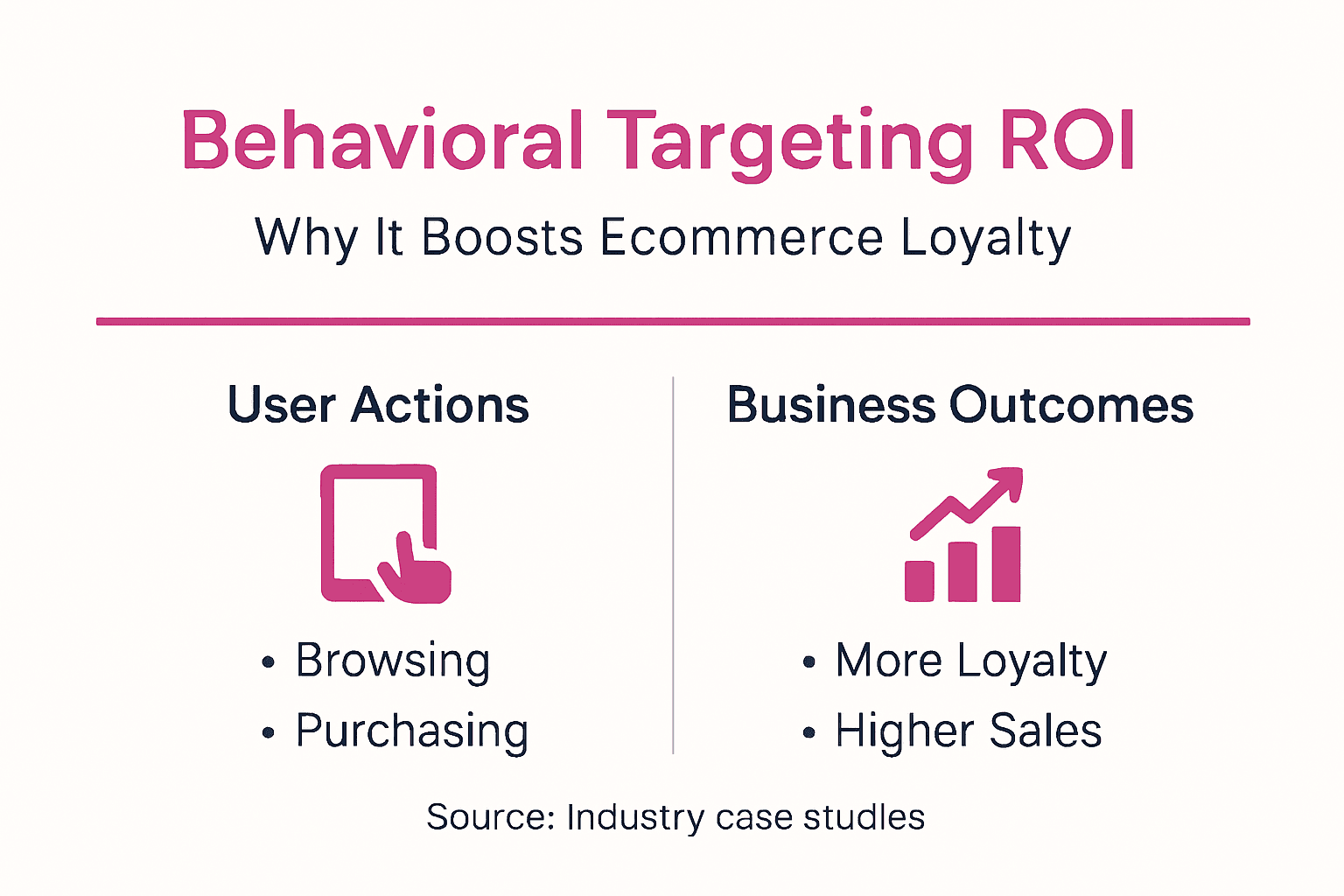
Personalization builds lasting relationships. Personalized experiences yield a 52% boost in customer loyalty, creating repeat buyers who spend more over time. Customers feel understood when you remember their preferences and anticipate their needs.
Beyond conversions, behavioral targeting impacts multiple KPIs:
Average order value increases when recommendations match customer interests
Customer lifetime value grows as personalization strengthens retention
Email click-through rates double when content reflects recent browsing
Return on ad spend improves by focusing budget on high-intent segments
Pro Tip: Segment abandoned cart users within 24 hours and send a personalized email featuring the exact products they viewed for maximum recovery rates.
These metrics translate directly to revenue growth. Higher conversions, larger orders, and loyal customers create compound returns. Programmatic advertising for ecommerce automates behavioral targeting at scale, making sophisticated personalization accessible even for growing businesses.
Breaking Down Behavioral Data Types and Segmentation Techniques
Behavioral data captures what customers do, not just who they are. Browsing paths reveal product interests and category preferences. Purchase history identifies buying patterns and seasonal trends. Cart actions signal strong intent, while engagement with marketing shows receptiveness to different message types.
Segmentation by customer journey stage maximizes relevance. New visitors need educational content and broad product overviews. Repeat customers respond to loyalty rewards and complementary product suggestions. Cart abandoners require gentle nudges and incentive offers to complete purchases.
Data Type | Example | Ecommerce Use Case |
Browsing Behavior | Viewed winter coats 3 times | Trigger coat promotion email |
Purchase History | Bought running shoes monthly | Recommend new athletic gear |
Cart Actions | Added skincare, didn’t checkout | Send 10% discount reminder |
Email Engagement | Opens fitness content | Segment into health-focused list |
Behavioral segmentation delivers efficiency. Instead of blasting your entire list with one message, you create targeted campaigns for each behavior cluster. High-value customers get exclusive previews. Price-sensitive shoppers see discount offers. Category enthusiasts receive new arrival alerts in their preferred products.
Personalized search and product recommendations can increase conversion rates by 43% by showing customers exactly what they want to see. Your remarketing setup guide explains how to implement these strategies technically.
Advanced segmentation techniques combine multiple behavior signals. A customer who browses premium products but only buys during sales gets targeted with early-access discount codes. Someone who abandons carts consistently might have checkout friction issues requiring a streamlined payment option offer.
Ecommerce analytics for segmentation provides the infrastructure to track and action these insights systematically.
Common Misconceptions and Privacy Compliance in Behavioral Targeting
Myth: Behavioral targeting violates privacy laws. Reality: GDPR-compliant first-party data use is perfectly legal when you obtain explicit consent and provide transparent data policies. The regulation actually encourages better data practices that build customer trust.
You must inform customers what data you collect and how you use it. Clear privacy notices and easy opt-out mechanisms aren’t just legal requirements but trust builders. Customers appreciate transparency and often consent willingly when they understand the personalization benefits.
Myth: Behavioral targeting is just retargeting after cart abandonment. Reality: The scope extends far beyond abandoned carts to include product recommendations, email personalization, dynamic pricing, content customization, and predictive inventory management.
Myth: Behavioral targeting guarantees instant sales. Reality: Success depends on data quality, segmentation accuracy, and strategic execution. Poor data creates irrelevant targeting that annoys customers. Strong behavioral targeting requires ongoing optimization and testing.
Key compliance practices include:
Obtain clear consent before collecting behavioral data
Explain data usage in plain language, not legal jargon
Provide simple opt-out mechanisms on every touchpoint
Store data securely with encryption and access controls
Delete data when customers request removal
Regular audits to ensure ongoing compliance
Pro Tip: Review your privacy notices quarterly and update opt-out mechanisms to reflect current GDPR standards, protecting your business from penalties while maintaining customer trust.
Ethical targeting drives consumer trust and long-term loyalty. When customers see that personalization helps rather than manipulates them, they engage more freely. Our GDPR and privacy best practices guide helps UK and Ireland ecommerce owners navigate compliance while maximizing marketing effectiveness.
Comparing Behavioral Targeting with Other Marketing Approaches
Three primary targeting methods serve different purposes. Behavioral targeting uses real-time customer actions. Contextual targeting matches ads to page content. Demographic targeting groups customers by age, gender, location, and income.
Approach | Data Used | Personalization | Privacy Concerns | Effectiveness |
Behavioral | Browsing, purchases, engagement | Highly personalized | Requires consent, first-party data | Highest ROI and relevance |
Contextual | Page content, keywords | Moderate relevance | Minimal privacy impact | Good for brand awareness |
Demographic | Age, location, gender | Broad segments | Low privacy concerns | Basic targeting only |
Behavioral targeting achieves higher ROI through real-time data that captures intent. A 25-year-old browsing engagement rings signals different intent than a 25-year-old browsing gaming laptops, even though demographics match. Behavior reveals what customers want now.
76% of agencies prefer behavioral targeting over contextual for ecommerce due to better audience relevance and measurable returns. The precision of behavioral data eliminates wasted ad spend on uninterested audiences.
Each method suits specific scenarios:
Behavioral targeting: Best when you have sufficient first-party data and customers consent to tracking
Contextual targeting: Ideal for privacy-conscious audiences or brand awareness campaigns where intent data is unavailable
Demographic targeting: Useful for broad market research or when launching in completely new markets with no behavioral data yet
Combining approaches often yields best results. Use demographics for initial targeting, contextual for brand-safe ad placement, and behavioral for conversion-focused personalization. Contextual advertising explained details how to integrate these strategies effectively.
Implementing Behavioral Targeting in Your eCommerce Business
Successful implementation follows a systematic five-step process:
Collect first-party behavioral data through website tracking, email engagement metrics, and purchase history records using analytics platforms.
Analyze and segment customers into behavior-based groups like frequent browsers, cart abandoners, loyal repeat buyers, and discount seekers.
Personalize marketing content with dynamic email recommendations, retargeting ads featuring viewed products, and customized homepage experiences.
Ensure GDPR compliance with clear consent forms, transparent privacy policies, and functional opt-out mechanisms on all channels.
Measure and optimize by tracking KPIs, running A/B tests, and refining segments based on performance data continuously.
Behavioral targeting is evolving post-third-party cookie era by focusing on first-party data, predictive analytics, and privacy-safe technologies like customer data platforms to maintain effective personalized marketing. CDPs centralize customer data from multiple sources, creating unified profiles that power targeting across channels.
Key tools include Google Analytics for behavior tracking, Klaviyo or Mailchimp for email personalization, and CDPs like Segment or Bloomreach for enterprise-scale data management. Most ecommerce platforms offer native integrations that simplify setup.
Pro Tip: Prioritize transparent privacy notices that explain personalization benefits in customer-friendly language to enhance user trust and maximize consent rates.
Integration tips for common platforms: Shopify offers built-in customer segmentation tools. WooCommerce integrates with WordPress plugins for behavioral tracking. Magento provides advanced customer data management for complex catalogs.
Adjust strategy based on performance feedback. If email open rates drop, test different subject lines or sending times. If retargeting ads underperform, refine your lookalike audiences or creative messaging.
Ongoing training keeps your team current on privacy regulations and data management best practices. GDPR updates regularly, and staying informed prevents costly compliance failures. Our ecommerce marketing best practices UK Ireland resource provides region-specific guidance.
Explore our ecommerce advertising guide for platform-specific setup instructions and remarketing setup tips for advanced campaign optimization.
Measuring Success and Optimizing Behavioral Targeting Efforts
Tracking the right KPIs reveals behavioral targeting performance and optimization opportunities. Conversion rates show how effectively targeting turns visitors into buyers. Abandoned cart recovery rates measure retargeting success. Customer lifetime value indicates whether personalization builds lasting relationships.
Additional critical metrics include:
Email click-through rates for engagement quality
Return on ad spend for campaign profitability
Retention indices showing repeat purchase frequency
Average order value growth from recommendation engines
Segment performance comparing behavior groups
A/B testing refines personalized content continuously. Test subject lines, offer types, product recommendation algorithms, and call-to-action placement. Run tests long enough to reach statistical significance, typically two weeks minimum for email campaigns.
Monitor user feedback and engagement metrics for trust signals. Rising unsubscribe rates or complaint frequency suggests targeting feels invasive rather than helpful. Adjust frequency and relevance accordingly.
Regular performance reviews adapt strategies to changing customer behavior. Quarterly reviews identify seasonal patterns and emerging segments. Monthly check-ins catch declining performance early, allowing quick corrections.
Integrate analytics dashboards for real-time monitoring. Automated alerts notify you when key metrics deviate from targets. This enables proactive optimization rather than reactive troubleshooting.
Continuous optimization maximizes ROI from behavioral targeting. Markets evolve, customer preferences shift, and competitors adapt. Your targeting must evolve too. Small incremental improvements compound over time into substantial competitive advantages.
Our boost online sales strategies guide provides detailed optimization frameworks for sustained growth.
Enhance Your Ecommerce Growth with Expert Marketing Solutions
Implementing behavioral targeting successfully requires the right tools, expertise, and ongoing optimization. We’ve helped ecommerce businesses across the UK and Ireland scale profitably for over 25 years by combining data-driven targeting with conversion-focused strategies.

Our tailored digital marketing solutions leverage behavioral targeting, SEO, AI-powered personalization, and PPC to maximize your ecommerce performance. We understand the unique challenges facing UK and Ireland online retailers and deliver proven strategies that drive measurable results.
Explore our best digital marketing software comparison to find the right platforms for your business. Discover region-specific tactics in our ecommerce marketing best practices UK and Ireland guide. Ready to transform browsers into buyers? Learn actionable techniques to boost online sales strategies starting today.
FAQ
What is behavioral targeting in ecommerce?
Behavioral targeting uses real-time customer actions like browsing history, cart additions, and purchase patterns to personalize marketing messages. This approach improves engagement and sales by delivering relevant content based on demonstrated interest rather than assumptions.
How does GDPR affect behavioral targeting for UK and Ireland ecommerce?
GDPR requires explicit user consent and transparent data use policies for behavioral targeting. Compliance builds trust and avoids penalties while enabling effective personalized marketing through first-party data collection.
What are the best tools to implement behavioral targeting?
Customer Data Platforms like Segment and Bloomreach centralize behavioral data, while analytics software like Google Analytics tracks customer actions. Select GDPR-compliant technology that integrates seamlessly with your ecommerce platform for best results. Our advertising guides for ecommerce compare leading solutions.
Can behavioral targeting guarantee immediate sales increases?
Behavioral targeting improves marketing efficiency but does not guarantee instant sales. Success depends on data quality, accurate segmentation, strategic execution, and proper customer journey alignment developed over time through testing and optimization.
Recommended
Comments