.png)
Voice Search Optimisation: Boosting eCommerce Visibility


Many online retailers in the United Kingdom and Ireland are noticing that customers interact differently with their sites when using voice search compared to typing. The shift towards voice-activated assistants transforms how people phrase questions, with queries becoming longer and more conversational. Optimising for voice search is more than tweaking old SEO tactics—it means focusing on natural language content and clear answers that match what users are actually saying. Find practical strategies to make your eCommerce site more visible and relevant for voice-driven shoppers.
Table of Contents
Key Takeaways
Point | Details |
Understanding VSO | Voice Search Optimisation requires a strategic approach that differs fundamentally from traditional SEO, focusing on natural language and user intent. |
Importance of Content | Content must be conversational, directly answering user queries to enhance voice search visibility. |
Technical Factors | Success in voice search demands structured data implementation, fast loading speeds, and mobile responsiveness. |
Avoiding Pitfalls | Businesses should understand conversational patterns and implement comprehensive strategies to optimise for voice search, avoiding rigid keyword practices. |
Voice Search Optimisation Defined and Debunked
Voice Search Optimisation (VSO) represents a sophisticated digital strategy that adapts traditional search engine optimisation techniques for voice-activated digital assistants. Unlike standard text searches, voice queries demand a nuanced approach that considers conversational language patterns and user intent.
The emergence of VSO stems from the rapid adoption of voice-enabled devices like smartphones, smart speakers, and virtual assistants. Academic research on voice search reveals that users interact differently when speaking compared to typing, presenting unique challenges for digital marketers and SEO professionals. Voice searches tend to be longer, more conversational, and often phrased as complete questions rather than fragmented keywords.
Understanding VSO requires debunking several common misconceptions. Contrary to popular belief, voice search optimization is not simply traditional SEO repackaged. Detailed academic analysis demonstrates that voice search behaviour fundamentally differs from text-based searches, necessitating a more strategic and contextually aware approach. Businesses must focus on natural language processing, local search relevance, and creating content that answers specific user queries concisely and directly.
Key characteristics of effective voice search optimization include:
Prioritising conversational, long-tail keywords
Implementing structured data markup
Creating FAQ-style content
Improving website loading speed
Ensuring mobile responsiveness
Pro tip: Develop content that directly answers potential user questions in a clear, concise manner, mimicking natural speech patterns to improve voice search visibility.
How Voice Search Differs from Traditional Search
Voice search represents a transformative approach to information retrieval, fundamentally distinct from traditional text-based searching. While keyboard searches typically involve fragmented keyword strings, voice queries reflect natural human conversation, introducing a more nuanced interaction with digital platforms.

Academic research on search behaviour reveals that voice search queries are significantly more detailed and contextually rich. Users speaking to digital assistants tend to articulate complete thoughts and questions, unlike the abbreviated keywords used in typed searches. This conversational approach means search algorithms must interpret more complex linguistic structures and implied meanings.
Comparative search analysis highlights several critical differences between voice and traditional search mechanisms. Voice searches typically:
Are longer and more conversationally structured
Include more specific contextual details
Prioritise natural language over precise keywords
Demonstrate higher user intent specificity
Require more sophisticated natural language processing
The technological implications are profound. Search engines now must understand context, intent, and conversational nuance rather than relying solely on literal keyword matching. This shift demands more advanced artificial intelligence and semantic understanding capabilities from search platforms.
Here’s a comparison of voice and traditional search behaviours to highlight their distinct business implications:
Search Type | Query Style | User Intent Clarity | Business Optimisation Approach |
Voice Search | Conversational, lengthy | Highly specific intent | Emphasise context and NLP |
Traditional Text | Fragmented, keywords | Often ambiguous | Focus on keyword density and tags |
Pro tip: Develop content that anticipates conversational questions and provides direct, spoken-language answers to improve voice search optimization.
Key Ranking Factors for Voice Search Success
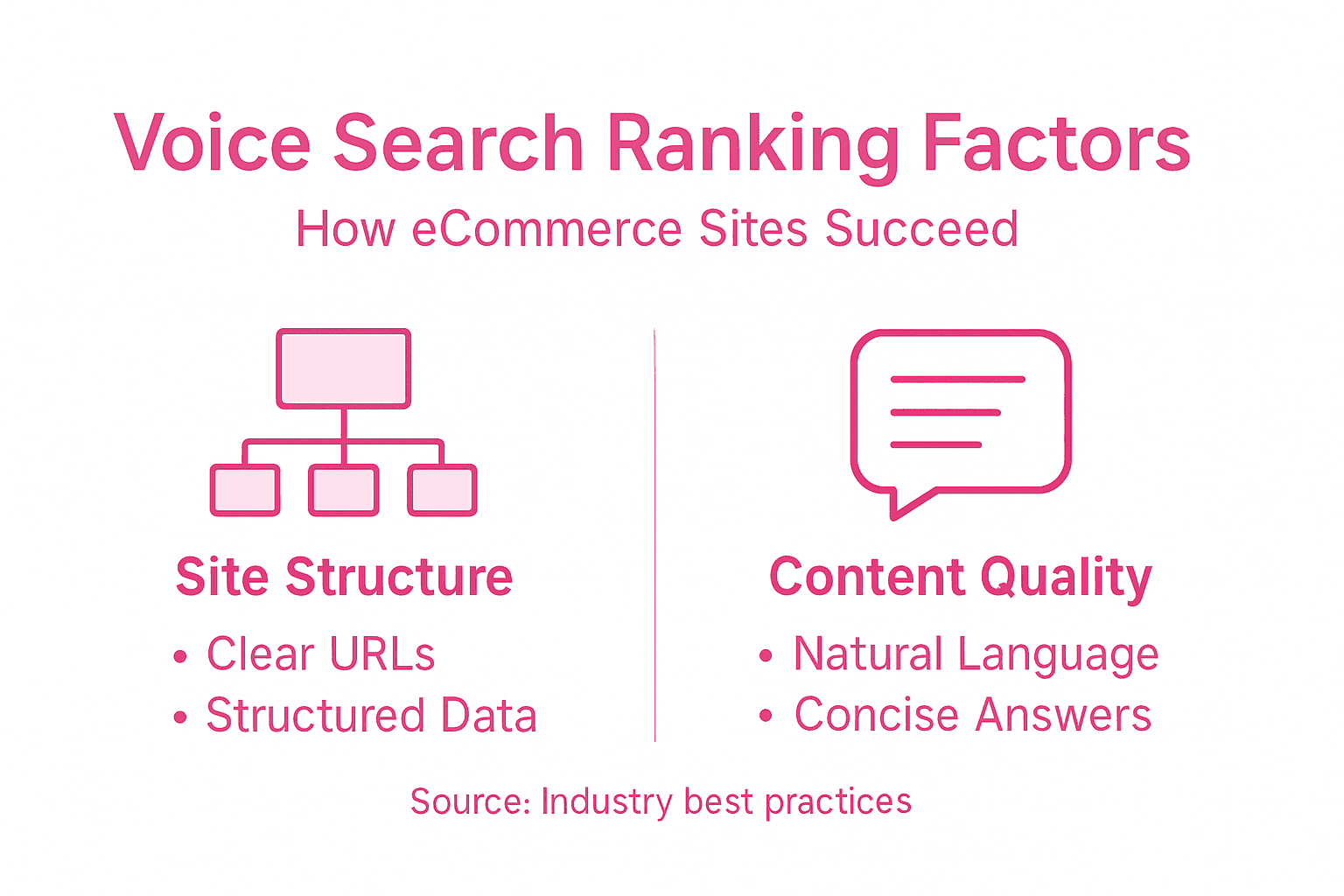
Successful voice search optimization requires a sophisticated understanding of how artificial intelligence and natural language processing interpret user queries. Unlike traditional SEO, voice search demands a more nuanced approach that prioritises conversational context and precise answer delivery.
Scholarly research on voice search technologies reveals several critical ranking factors that distinguish effective voice search optimization. These include structured data implementation, contextual relevance, and the ability to provide concise, direct answers to user queries.
Systematic review of voice search techniques highlights the most important ranking factors for voice search success:
Conversational keyword integration
Structured schema markup
Mobile responsiveness
Page loading speed
Natural language content
Context-aware answer delivery
Technical considerations play a crucial role in voice search ranking. Websites must leverage advanced semantic understanding, implement comprehensive schema markup, and create content that directly addresses user intent. This means moving beyond traditional keyword stuffing and focusing on creating genuinely helpful, conversationally structured content that AI can easily interpret and present to users.
Pro tip: Develop content that answers specific questions directly, using natural language and providing clear, concise information that voice assistants can easily extract and share.
Implementing Voice SEO for eCommerce Sites
Successful voice search optimisation for eCommerce requires a strategic approach that goes beyond traditional search engine optimization techniques. Online retailers must reimagine their digital presence to accommodate the conversational nature of voice-activated searches.
Professional implementation strategies reveal a comprehensive toolkit for adapting eCommerce platforms to voice search technologies. This involves a multi-dimensional approach that encompasses content strategy, technical optimization, and user experience design tailored specifically to voice-driven interactions.
Academic research on voice search optimization outlines critical implementation steps for eCommerce sites:
Conduct detailed voice query analysis
Develop conversational content matching natural language patterns
Implement structured data markup for products
Optimise site speed and mobile responsiveness
Create FAQ sections with direct, concise answers
Use long-tail, conversational keywords
Technical implementation requires careful attention to semantic search principles. eCommerce sites must structure product descriptions, category pages, and supporting content to anticipate and directly answer potential voice search queries. This means moving beyond traditional keyword targeting and focusing on providing clear, contextually relevant information that voice assistants can easily interpret and relay to users.
Pro tip: Create product descriptions using natural, conversational language that directly answers potential questions a customer might ask about the item.
Common Pitfalls and How to Avoid Them
Voice search optimization presents unique challenges that can easily derail even the most well-intentioned digital marketing strategies. Understanding these potential obstacles is crucial for eCommerce businesses seeking to improve their voice search visibility and user engagement.
Research on voice search optimization reveals several critical pitfalls that frequently undermine voice search performance. These challenges range from technical implementation errors to fundamental misunderstandings about how users interact with voice-activated search technologies.
Comprehensive voice search guidance highlights the most significant pitfalls eCommerce sites must avoid:
Failing to understand conversational query patterns
Neglecting local search optimization
Overusing rigid keyword strategies
Ignoring mobile device compatibility
Providing insufficient structured data
Creating content that lacks natural language flow
Technical implementation requires a nuanced approach. Many businesses mistakenly treat voice search as a mere extension of traditional text-based SEO, overlooking the fundamental differences in user interaction and search intent. Successful optimization demands a holistic strategy that considers natural language processing, user experience, and the unique contextual requirements of voice-activated search platforms.
For reference, here are common voice search pitfalls and strategic solutions for eCommerce sites:
Pitfall | Impact on Business | Recommended Solution |
Ignoring conversational queries | Reduced user engagement | Adopt natural language content |
Insufficient structured data | Lower search visibility | Implement robust schema markup |
Neglecting mobile compatibility | Poor device experience | Optimise for mobile platforms |
Pro tip: Regularly conduct voice search audits to identify and address potential optimization gaps in your content strategy.
Unlock the Power of Voice Search to Elevate Your eCommerce Brand
Voice search optimisation presents a new frontier where traditional SEO no longer suffices. If your eCommerce site struggles with capturing voice-driven queries or delivering the natural language answers modern customers demand you are not alone. The challenge lies in adapting content strategies to conversational keywords, enhancing mobile responsiveness, and leveraging structured data to make your products stand out in voice search results. These are exactly the hurdles that can limit visibility and sales growth without expert guidance.
At IWantToBeSeen Online we understand the intricate demands of voice SEO for eCommerce businesses. With over 25 years of hands-on experience scaling successful brands we specialise in crafting tailored solutions that integrate natural language content, optimise page speed, and implement precise schema markup. Our approach ensures your website is fully prepared to answer voice queries with clarity and context. Trust us to help you transform how your customers find you through voice technology and capture valuable traffic that turns into revenue.
Imagine converting every voice query into a customer engagement opportunity [Image:cta_image]
Take the first step today by visiting our digital marketing services page. Let us help you build a voice search strategy that meets users where they are and turns conversational searches into real business growth.
Frequently Asked Questions
What is Voice Search Optimisation (VSO)?
Voice Search Optimisation (VSO) is a digital strategy that adapts traditional SEO techniques for voice-activated assistants, focusing on conversational language patterns and user intent to improve search visibility.
How does voice search differ from traditional text search?
Voice search queries are generally longer and more conversational, reflecting natural language rather than fragmented keywords, necessitating a different optimisation approach.
What are the key factors for successful voice search optimisation?
Key factors include conversational keyword integration, structured data implementation, mobile responsiveness, page loading speed, and providing concise, contextually relevant answers to user queries.
How can eCommerce sites implement voice SEO effectively?
eCommerce sites can implement voice SEO by analysing voice queries, developing conversational content, implementing structured data for products, and optimising site speed and mobile responsiveness, among other strategies.
Recommended
Comments