.png)
Ad Fatigue – How it Impacts E-Commerce Campaigns
- Darren Burns
- Feb 26
- 10 min read


E-commerce managers across the United Kingdom and Ireland often find themselves puzzled when high-performing ads suddenly lose their spark. Declining effectiveness is rarely about product quality but is the result of repeated exposure causing your audience to disengage. Understanding the true nature of ad fatigue is crucial for anyone aiming to sustain digital ad performance and protect return on investment in PPC campaigns. This guide untangles common myths, clarifies the science behind fatigue, and outlines practical steps to keep your campaigns on track.
Table of Contents
Key Takeaways
Point | Details |
Understanding Ad Fatigue | Ad fatigue results from audience overexposure to ads, leading to diminished engagement, not dislike of the product. |
Types of Ad Fatigue | Creative fatigue, frequency fatigue, and audience saturation each require tailored strategies for resolution. |
Monitoring Performance | Regularly track click-through rates and conversion metrics to detect early signs of ad fatigue and address issues proactively. |
Regular Creative Refresh | Rotating creative assets and implementing frequency caps can significantly improve audience engagement and campaign performance. |
Defining Ad Fatigue and Common Misconceptions
Ad fatigue happens when your audience stops responding to your ads because they’ve seen them too many times. It’s not about disliking your product—it’s about declining effectiveness caused by overexposure.
Consumer disengagement from digital marketing stimuli occurs through both behavioural and psychological factors. When someone scrolls past your ad repeatedly without clicking, that’s ad fatigue at work. Their attention diminishes, not because your offer changed, but because repetition eroded the initial impact.
Most e-commerce managers misunderstand what ad fatigue actually is. Here are the common misconceptions:
It’s not about frequency alone. You could show an ad 50 times and still get engagement if the creative is varied and relevant. Frequency matters, but variation matters more.
It’s not always negative feedback. Low click-through rates don’t automatically mean customers hate your brand. They simply stopped noticing the ad.
It’s not permanent. Fresh creative, new messaging, or adjusted targeting can restore performance quickly.
It doesn’t affect all audiences equally. Some segments fatigue faster than others based on their browsing habits and engagement patterns.
The real culprit is repetition without variation. Your audience sees the same image, same headline, same call-to-action week after week. Their brain learns to filter it out—a psychological mechanism called habituation. This is why context, portrayal, and audience factors influence ad fatigue onset.
Another misconception: thinking ad fatigue only applies to display ads. It affects search ads, social media ads, video campaigns, and retargeting efforts equally. The platform doesn’t matter; the exposure pattern does.
You might also assume that showing more ads to more people solves low performance. Instead, it accelerates fatigue. Your cost per click rises, conversions drop, and you’ve wasted budget on an exhausted audience.
Ad fatigue doesn’t mean your product is failing—it means your audience has simply stopped seeing your message.
Pro tip: Track when your click-through rate drops below your baseline, as this signals early fatigue. Refresh your creative immediately rather than waiting for poor results to accumulate.
Types of Ad Fatigue in E-Commerce PPC
Ad fatigue doesn’t show up as one single problem. Different types emerge from different causes, and recognising them helps you fix the right issue in your campaigns.
Creative fatigue happens first. Your audience sees the same ad image, headline, and copy week after week. They stop noticing it because their brain has learnt to filter out familiar stimuli. This is the most common type e-commerce managers encounter, and it’s also the easiest to fix.

Frequency fatigue strikes when you show ads too often to the same people. Someone scrolls through social media and your product appears five times in their feed. They become annoyed or cynical, even if they liked your brand initially. Ad intensity and frequency create diminishing returns in consumer goodwill over time.
Audience saturation fatigue occurs when you’ve exhausted your available audience within a specific segment. You’ve already shown your ads to everyone interested in your product category. New impressions go to people unlikely to convert, wasting budget and driving up costs.
Here’s how these types differ and what causes each:
Creative fatigue: Same visual design and messaging repeated endlessly
Frequency fatigue: Too many impressions to the same person in short timeframes
Audience saturation: Limited pool of relevant prospects; you’re reaching the same people repeatedly
Each type requires a different response. Creative fatigue demands fresh visuals and new copy angles. Frequency fatigue needs targeted delivery strategies and adjusted impression caps. Audience saturation requires expanding your audience or shifting campaigns entirely.
Here’s a comparison of the main types of ad fatigue and how to address them:
Type of Fatigue | Primary Cause | Early Detection Signal | Most Effective Solution |
Creative Fatigue | Repetitive visuals and copy | Lower engagement despite stable frequency | Regular creative refreshes |
Frequency Fatigue | Excessive impressions per user | Spike in negative feedback or annoyance | Set frequency caps, stagger delivery |
Audience Saturation | Reaching same segment too often | Rising costs with flat conversions | Expand or rotate target audiences |
Your PPC campaigns likely suffer from multiple types simultaneously. Search ads might experience frequency fatigue while your display campaigns hit creative fatigue. Retargeting often combines all three—same creative, shown too frequently, to an exhausted pool.
Different types of fatigue need different solutions, not a one-size-fits-all approach.
Pro tip: Segment your fatigue analysis by ad format and audience group. Track creative performance and frequency metrics separately so you can identify which type is damaging your ROI most.
Key Signs and Causes of Ad Fatigue
Ad fatigue creeps in quietly. You won’t wake up one morning to find your campaigns have failed completely. Instead, performance decays gradually, and by the time you notice, budget damage is already done.
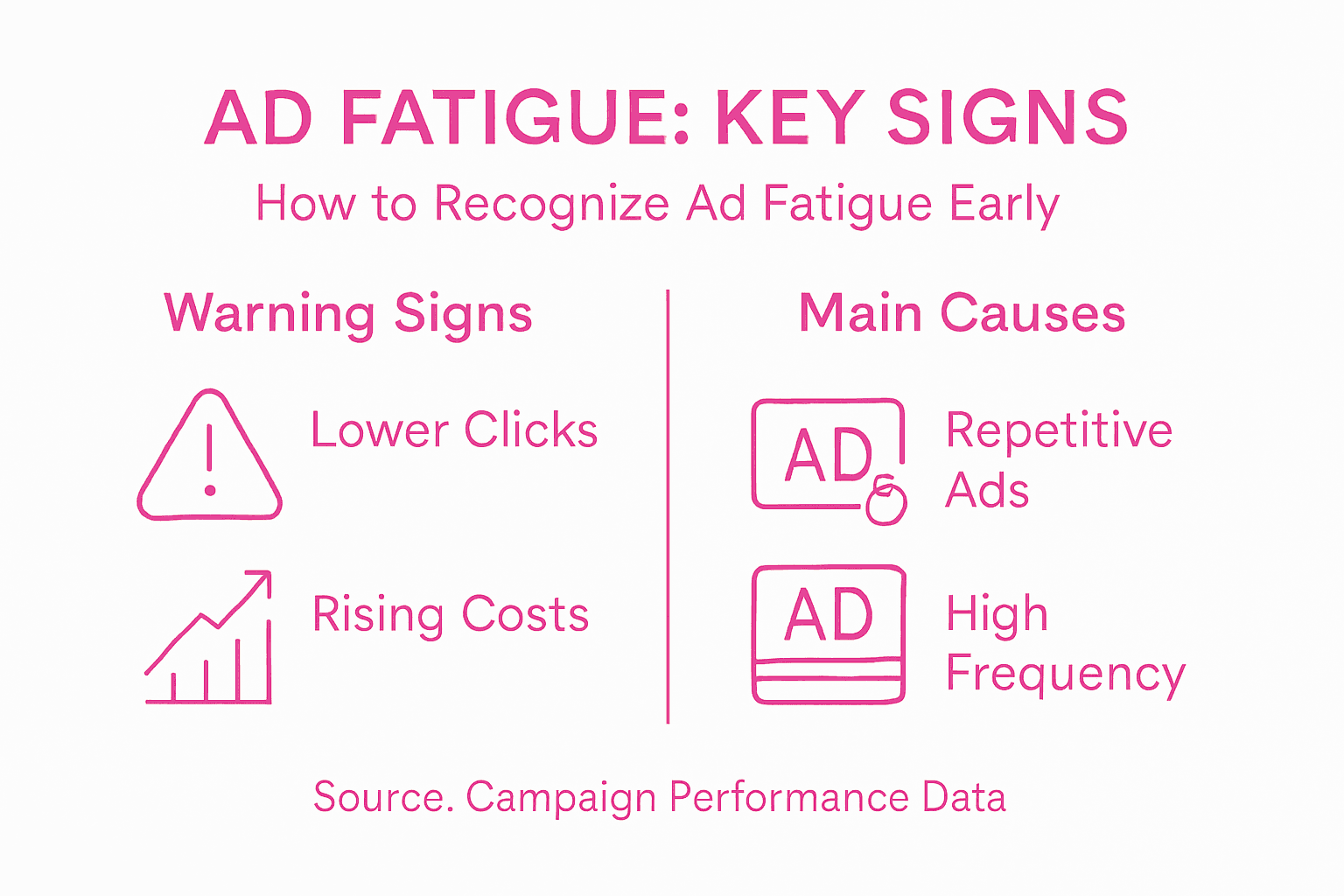
The first warning sign is a steady decline in click-through rates. Your ads were clicking at 3.5% last month; now they’re at 2.1%. This isn’t a platform issue or seasonal dip. It’s your audience mentally checking out from your message.
Your cost per action climbs while conversion volume stays flat or drops. You’re spending more to get the same results, which signals that remaining clicks come from less-qualified prospects. The easy conversions are gone.
Conversion rates fall even though your landing pages haven’t changed. People still click occasionally, but they’re less likely to buy. They’ve seen your offer multiple times and lost the urgency.
Watch for these additional warning signals:
Return on ad spend deteriorates month-over-month
Your audience engagement on social platforms drops noticeably
Customer acquisition cost rises without corresponding value improvement
Users actively avoid your ads or scroll past them faster
Decreased engagement and increased cost per action signal ad fatigue onset. The root causes sit on both sides of campaign management.
Overexposure to identical creative tops the cause list. You’ve run the same ad image and copy for months because it worked initially. Your brain knows it’s effective, so you leave it alone—exactly the wrong call.
Improper frequency capping allows the same person to see your ad ten times daily. No audience tolerance survives that bombardment. Lack of diversity means every impression looks identical, boring your viewers faster.
Audience saturation develops when you’ve exhausted your relevant pool. You keep targeting the same segments instead of expanding or rotating audiences. Ad optimisation for short-term outcomes accelerates fatigue onset, pushing platforms to deliver to anyone available rather than truly interested prospects.
Early detection of performance decline prevents catastrophic budget waste later.
Pro tip: Set up automated alerts for click-through rate drops below 10% of your baseline. This catches early fatigue before it damages your overall campaign metrics and spending efficiency.
Impact on Campaign Performance and ROI
Ad fatigue doesn’t just reduce clicks. It decimates your campaign economics, turning profitable channels into budget black holes.
The numbers are brutal. Campaign performance declines range from 20-50% when ad fatigue takes hold, and your advertising costs climb simultaneously. You’re spending more to achieve less—the exact opposite of what your business needs.
Your click-through rates plummet first. Fewer people engage with your ads because they’ve learnt to ignore them. But the real damage happens next: the remaining clicks convert at lower rates. Someone clicking your ad after seeing it fifty times isn’t genuinely interested—they’re just clicking by habit or accident.
Conversion rates suffer dramatically. Your landing pages are fine. Your offer hasn’t changed. But audience psychology has shifted. They’ve already decided “not now” or “not interested,” and fresh exposure won’t change their minds.
Here’s what happens to your metrics under ad fatigue:
Click-through rates drop 30-60% from baseline levels
Cost per click increases as competition for remaining inventory rises
Conversion rates fall even as traffic continues
Return on ad spend deteriorates below breakeven
Customer acquisition costs exceed customer lifetime value
Cost per acquisition explodes upwards. You’re bidding on the same keywords, targeting the same audiences, but results get worse monthly. The platform’s algorithm keeps serving your tired creative to anyone remotely interested, wasting pounds on low-quality interactions.
Large portions of digital ad budgets waste away on ineffective fatigued ads, eroding consumer trust and damaging brand perception simultaneously. When someone sees your ad repeatedly without converting, they might start viewing your brand negatively—“pushy” or “desperate.”
Your overall marketing ROI shrinks because fatigued campaigns drag down average performance. One underperforming channel makes it harder to justify spending across all channels. Budget that should flow to growth gets redirected to fixing broken campaigns.
The table below summarises the measurable impact of ad fatigue on essential campaign metrics:
Metric Affected | Initial Warning Sign | Impact if Unchecked |
Click-Through Rate (CTR) | Gradual month-on-month decline | 30–60% drop from baseline |
Cost Per Click (CPC) | Minor increase | Higher competition for uninterested users |
Conversion Rate | Fewer conversions per visitor | Sharp fall despite steady traffic |
Return on Ad Spend (ROAS) | Downward trend | May slip below breakeven point |
The financial bleeding accelerates silently. Many e-commerce managers don’t realise fatigue is the problem, so they increase bids hoping to revive performance—throwing good money after bad.
Unaddressed ad fatigue transforms your best-performing channels into your worst-performing ones.
Pro tip: Calculate your cost per acquisition baseline for each campaign, then set an alert when it rises 25% above that mark. This early warning catches fatigue before significant budget damage occurs.
Proven Strategies to Prevent Ad Fatigue
Preventing ad fatigue isn’t complicated, but it does require discipline and consistent action. The good news: you can reverse fatigue damage quickly once you implement the right tactics.
Rotate your creative assets regularly. Don’t run the same ad image for months. Create three to five variations of your core creative—different headlines, images, or angles—and rotate them weekly or every two weeks. Your audience stays engaged because they see something fresh.
Implement frequency caps across all platforms. Set limits on how many times the same person sees your ad daily. Most e-commerce brands perform best with frequency caps between two and five impressions per day, depending on campaign stage and audience size.
Use dynamic creative optimisation. Rather than managing variations manually, leverage AI to automate creative variations and optimise ad delivery in real-time. Platforms like Meta and Google can test combinations automatically and serve the best performers to each audience segment.
Your prevention toolkit includes:
Refresh creative assets every 2-3 weeks minimum
Test new ad formats (video, carousel, collection ads)
Segment audiences by purchase stage and behaviour
Personalise messaging based on audience segment
Monitor performance metrics daily for early warning signs
Adjust bids and budgets based on performance trends
Segment and personalise your audiences strategically. Don’t show the same message to brand-new prospects and repeat customers. Someone who visited your site three times needs a different message than someone seeing your brand for the first time. Tailor copy, creative, and offers to their journey stage.
Experiment with new ad formats continuously. If you’ve only run static image ads, test video. If video is working, try carousel ads or collection formats. Format variety keeps creative fresh even when messaging stays similar.
Monitor performance metrics obsessively. Check click-through rates, conversion rates, and cost per acquisition weekly. Catch performance drops early before they become catastrophic. Set up automated alerts so you’re notified the moment metrics decline.
Proactive creative rotation prevents fatigue far better than reactive scrambling once it starts.
Pro tip: Create a content calendar that schedules creative refreshes automatically. Build a library of 10-15 creative variations per campaign so you always have fresh assets ready to deploy without last-minute scrambling.
Combat Ad Fatigue to Boost Your E-Commerce Success
Ad fatigue can silently erode your campaign performance by causing your audience to ignore repetitive ads, leading to declining click-through rates and rising costs. If you are struggling with creative fatigue, frequency fatigue, or audience saturation, you need a proven strategy tailored to e-commerce PPC challenges. Our digital marketing services specialise in SEO, AI-powered optimisation, social media, and PPC solutions designed specifically to refresh your creative assets, manage frequency caps, and expand your audience effectively.

Take control of ad fatigue today and stop wasting precious budget on exhausted audiences. Partner with experts who have more than 25 years of experience scaling multiple successful e-commerce brands. Visit our landing page to explore how our customised campaigns can revive your advertising effectiveness. Discover actionable strategies at iwanttobeseen.online and learn more about how to prevent costly performance decline before it starts. Your next breakthrough is just one click away.
Frequently Asked Questions
What is ad fatigue and how does it occur?
Ad fatigue is when your audience stops responding to your ads due to overexposure. It occurs when viewers see the same ad repetitively, leading to a decline in engagement as their brains learn to filter out the familiar stimuli.
How can I identify signs of ad fatigue in my campaigns?
Key signs of ad fatigue include a steady decline in click-through rates, rising costs per action, and decreasing conversion rates, despite unchanged landing pages or offers. Monitoring these metrics regularly will help you catch fatigue early.
What are the different types of ad fatigue that affect PPC campaigns?
The main types of ad fatigue include creative fatigue, which arises from repetitive visuals and messaging, frequency fatigue from excessive impressions to the same users, and audience saturation fatigue when the target audience is fully exhausted.
What strategies can I implement to prevent ad fatigue in my campaigns?
To prevent ad fatigue, rotate your creative assets regularly, set frequency caps to limit how often the same user sees an ad, and personalise your messaging based on audience segments. Additionally, monitor performance metrics daily to catch early signs of fatigue.
Recommended
Comments