.png)
The ecommerce customer journey: a complete guide

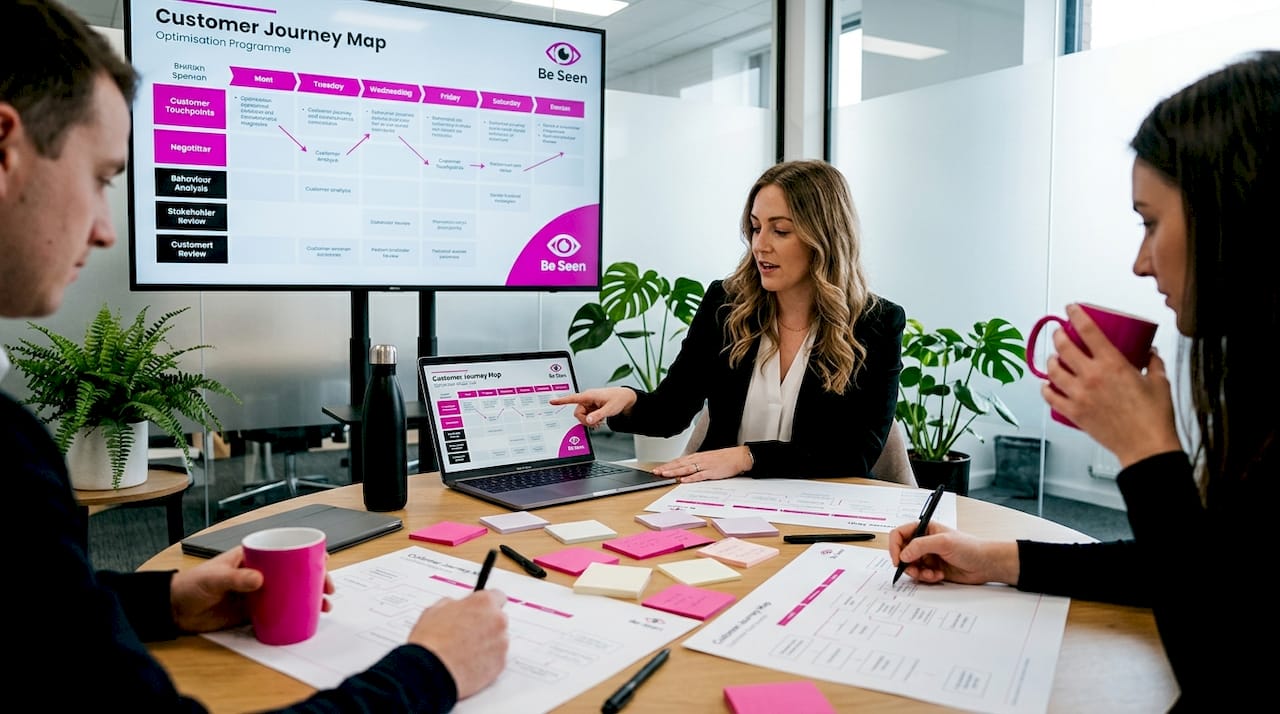
TL;DR:
Most ecommerce customer journeys are chaotic and multi-touch, requiring data-driven mapping for meaningful insights.
Understanding and continuously updating these omnichannel paths helps brands reduce friction, optimize conversions, and build customer loyalty.
Most ecommerce businesses secretly believe their customers follow a neat, predictable path from discovery to purchase. They draw a tidy funnel, set up a few retargeting ads, and wait for the conversions to roll in. The reality is far messier. The average shopper might discover your brand on Instagram, browse your site on a mobile phone during their lunch break, abandon a cart, receive an email, Google you again from a desktop, read two reviews, and only then complete a purchase. Understanding this chaotic, multi-touch reality is the foundation of every meaningful improvement you can make to your sales and engagement.
Table of Contents
Key Takeaways
Point | Details |
Journey is multi-stage | Every ecommerce customer journey includes awareness, consideration, purchase, and post-purchase touchpoints. |
Mapping reveals friction | Using data-driven maps helps identify where customers are lost or frustrated, highlighting improvement areas. |
Omnichannel is essential | Modern journeys cross channels and devices, so mapping and optimisation must adapt to where customers actually go. |
KPIs drive improvement | Attaching the right metrics to each stage makes customer journey mapping a tool for real, ongoing growth. |
Focus on real journeys | Mapping should address actual customer behaviours, not only idealised paths or static personas. |
Defining the customer journey in ecommerce
The term “customer journey” gets used loosely, so let’s fix that immediately. A customer journey is the end-to-end sequence of interactions customers have with a brand, typically spanning discovery and awareness through consideration, purchase, and then post-purchase retention and advocacy. It is not just your checkout flow. It is not your email sequence. It is every single touchpoint, in every channel, across every device, from the moment a person becomes aware your brand exists to the moment they recommend you to a friend.
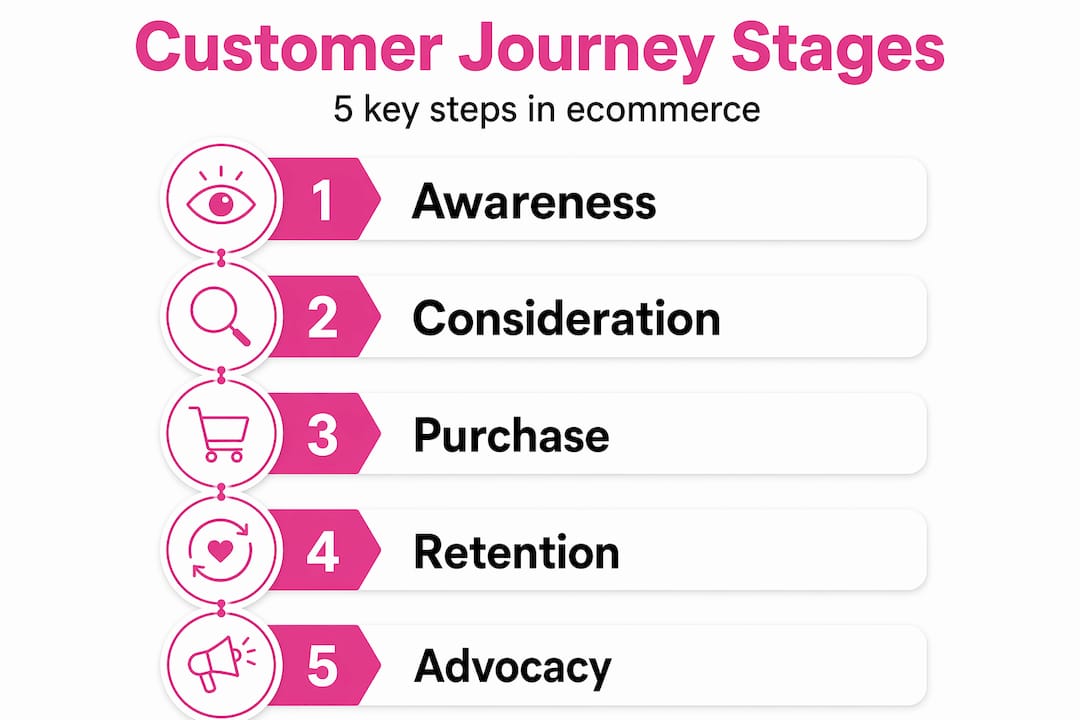
The five core stages
Understanding each stage helps you allocate budget, create the right content, and measure the right outcomes. Here is a quick breakdown:
Stage | What happens | Primary goal |
Awareness | Customer discovers your brand via search, social, ads, or word of mouth | Reach and visibility |
Consideration | Customer researches, compares products, reads reviews | Build trust and relevance |
Decision/purchase | Customer adds to basket, completes checkout | Convert interest to revenue |
Retention | Post-purchase emails, loyalty programmes, support | Encourage repeat buying |
Advocacy | Customer refers others, leaves reviews, shares on social | Generate organic growth |
Each stage demands a completely different strategy. What works at awareness (broad reach, creative content) actively damages conversion at the decision stage (where precision, trust signals, and frictionless checkout matter most).
“The biggest mistake brands make is treating the customer journey as a funnel to manage rather than a relationship to nurture.” This distinction separates the ecommerce businesses that scale from those that plateau.
The benefits of properly understanding your customer journey mapping process are concrete. You identify where money is leaking out of your business. You stop wasting budget on channels that do not convert at specific stages. You build the kind of customer experience that generates repeat revenue rather than one-off transactions.
A few key benefits at a glance:
Reduced acquisition costs by focusing effort on the channels that genuinely drive conversions
Higher lifetime value through targeted retention strategies at the right post-purchase moment
Improved customer satisfaction by removing friction before it drives abandonment
Smarter budget allocation across paid, organic, and owned channels
Mapping customer journeys: tools and key stages
Knowing the theory is one thing. Translating it into an actionable map for your specific business is where most brands stumble. Customer journey mapping for ecommerce involves turning analytics and customer behaviour data into a visual map of how customers move across touchpoints and where friction occurs. The key word there is data. Not assumptions. Not guesswork.

Essential mapping tools
You do not need expensive enterprise software to start. The following tools cover the most critical data points:
Google Analytics 4 (GA4): Funnel exploration reports, user paths, and traffic source analysis
Heatmap tools: Session recordings and click maps reveal exactly where users hesitate or abandon
CRM and email logs: Reveal open rates, click behaviour, and the timing of repeat engagement
On-site survey tools: Short exit-intent surveys capture the “why” that quantitative data misses
Ad platform dashboards: Show cross-channel attribution and assist conversions often overlooked in last-click models
How to build your journey map: step by step
Define your customer segments. Start with two or three distinct buyer types based on actual purchase data, not imagined personas.
List every known touchpoint. Include organic search, paid ads, social posts, emails, product pages, reviews, and customer service interactions.
Gather data for each touchpoint. Pull traffic volumes, conversion rates, bounce rates, and time on page from your analytics platform.
Identify the emotional state at each stage. A customer at the awareness stage is curious. At checkout, they are committing. At post-purchase, they are either delighted or anxious. Emotional context shapes copy, design, and timing.
Plot the actual paths customers take, not the paths you wish they would take. Use the path exploration report in GA4 for this.
Mark friction points explicitly. Any stage where a significant percentage of users drop off is a friction point worthy of investigation.
Prioritise by revenue impact. Fix the friction point that is costing you the most money first.
Touchpoint | Data to collect | Insight it reveals |
Google search ad | Click-through rate, cost per click | Messaging relevance at awareness |
Product page | Bounce rate, scroll depth, time on page | Content and trust signal effectiveness |
Basket page | Add-to-cart rate, abandonment rate | Pricing and UX clarity |
Checkout | Drop-off by step, payment method usage | Technical and trust barriers |
Post-purchase email | Open rate, repeat purchase rate | Retention strategy effectiveness |
Pro Tip: Avoid building your journey map around assumed personas. A large proportion of your site visitors are anonymous, meaning you cannot attach behaviour to a neat profile. Focus instead on observed, aggregated behaviour patterns. Your customer experience management strategy will be far stronger for it. This approach also feeds directly into smarter lifecycle marketing, where timing and relevance matter more than demographic labels.
The modern customer journey: omnichannel and non-linear
Here is the uncomfortable truth about the tidy five-stage model above: real customers rarely follow it in order. Ecommerce journeys are no longer linear and often become omnichannel, requiring regular optimisation and cross-device management. A shopper might loop back from the decision stage to the consideration stage after reading a negative review. They might jump from awareness directly to purchase because a social ad landed at exactly the right moment.
Common ways customers switch between channels
Seeing a TikTok video, then Googling the product to check price comparisons
Receiving a promotional email, then visiting the site on a different device
Abandoning a mobile basket, then completing the purchase on a desktop three days later
Visiting a physical store (if applicable) after browsing online, or vice versa
Clicking a retargeting ad after visiting the site organically two weeks prior
Each of these behaviours represents a real and measurable journey pattern. If your analytics only captures the final click, you are looking at a tiny fragment of the truth.
Modern approaches to journey measurement have shifted toward more dynamic measurement, sometimes called journey intelligence, rather than static maps. Journey intelligence uses live behavioural data to update your understanding of customer paths in real time, rather than relying on a snapshot taken during a quarterly workshop.
This shift matters enormously for ecommerce brands. If you built your journey map two years ago and have not revisited it, it likely does not reflect how your customers actually behave today. Platform algorithm changes, the rise of short-form video commerce, and evolving payment preferences have all altered the typical path to purchase.
A practical omnichannel strategy accounts for these shifts by connecting data across every channel into a single view. When you can see that a customer touched your brand seven times across four channels before converting, you can make genuinely informed decisions about where to invest.
Pro Tip: Treat your journey map as a living document, not a completed project. Schedule a quarterly review where you bring fresh data to the table and update the map based on what customers are actually doing. The brands that outperform their competitors in 2026 are the ones willing to admit their journey assumptions were wrong and adapt quickly.
Turning journey insights into results: KPIs, friction points, and optimisation
A journey map with no measurement attached to it is wallpaper. Journey mapping must be tied to measurable KPIs at each stage and touchpoint; otherwise it becomes just a description rather than an optimisation mechanism. The goal is to connect every stage of the journey to a number you can track, improve, and report on.
How to define and track journey KPIs by stage
Awareness: Track organic impressions, branded search volume, social reach, and cost per thousand (CPM) on paid campaigns. Rising branded search volume is a strong early indicator that awareness is working.
Consideration: Measure time on page, pages per session, product page conversion rate, and email list sign-up rate. These reveal whether your content is building genuine interest.
Decision/purchase: Monitor add-to-cart rate, checkout completion rate, average order value (AOV), and payment failure rate. A low checkout completion rate combined with a healthy add-to-cart rate almost always points to a checkout problem.
Retention: Track repeat purchase rate within 30, 60, and 90 days, email open and click rates, and net promoter score (NPS). These are your clearest signals of long-term revenue health.
Advocacy: Measure review submission rates, referral programme participation, and user-generated content volume. Strong advocacy metrics reduce your paid acquisition costs over time.
“What gets measured gets managed. In ecommerce, what gets measured at the right journey stage gets optimised.”
Finding and fixing friction points
Friction is anything that makes a customer’s progress harder than it needs to be. The most damaging friction tends to accumulate at checkout. Cart abandonment is heavily driven by late-arising friction, making the checkout experience the single most consequential journey moment for most ecommerce brands.
Common friction points and how to address them:
Unexpected delivery costs at checkout: Show shipping costs earlier in the journey, or test free delivery thresholds
Forced account creation: Offer guest checkout as the default option
Slow page load on mobile: A one-second delay in page load can reduce conversions by up to 7%
Lack of trust signals at payment: Add security badges, accepted payment logos, and money-back guarantee messaging directly adjacent to the “pay now” button
Complex return policies: State your returns policy clearly at the product page level, not just in the footer
Understanding the cart abandonment impact on your overall revenue is the starting point. Once you know the scale of the problem, you can apply targeted fixes to reduce cart abandonment methodically rather than guessing. Pair this with a regular review of your key ecommerce metrics to keep performance trends visible across the whole business.
Why most ecommerce journey maps miss the mark
After 25 years of scaling ecommerce brands, both our own and our clients’, we have seen the same mistake repeat itself across businesses of every size. Brands invest significant time and money in building a beautiful, colour-coded journey map. They hold workshops, create personas, and label each stage with precision. Then they put the map on a wall, go back to their day jobs, and nothing changes.
The fundamental flaw is that traditional journey maps can be misleading if they assume you know every customer and persona. Ecommerce typically includes a large share of anonymous visitors, so mapping should account for unidentified traffic and focus on observed behaviours and stage-specific measurement. When 60% or more of your site visitors are anonymous, a persona-based map is describing a fictional minority, not your actual audience.
The more practical approach is to map behaviour, not people. Ask what actions are being taken at each stage, which channels are driving progression, and where the largest drops in engagement occur. This shifts the conversation from “who is our customer?” (which you often cannot know for anonymous visitors) to “what are our customers doing?” (which your data can always tell you).
The second major mistake is building a map to reflect the journey you want customers to take, rather than the one they actually take. We call this wishful funnel thinking. You design a perfect linear path, optimise for that path, and remain completely blind to the 70% of customers who are doing something entirely different. Your conversion funnel optimisation efforts will be far more effective when they are grounded in observed paths rather than idealised ones.
Our advice: start with your exit points. Find where customers are leaving, work backwards to understand why, and fix those moments before you invest in drawing elaborate maps of hypothetical journeys.
Transform your ecommerce journey with expert support
Understanding the customer journey is one thing. Building a data-led strategy that actually improves conversion rates, retention, and lifetime value across every channel is where specialist expertise makes a measurable difference.
At iwanttobeseen.online, we have spent over 25 years building and scaling ecommerce brands from the inside. We understand the real-world complexity of omnichannel journeys because we have navigated them ourselves. Our team specialises in SEO, PPC, AI-driven marketing, and social media strategies that are built around your actual customer journey data, not generic templates. If you are ready to stop guessing and start optimising every stage of your ecommerce customer journey, get in touch with our team and let’s look at where your biggest opportunities are hiding.
Frequently asked questions
What are the main stages of the ecommerce customer journey?
The key stages are awareness, consideration, purchase, retention, and advocacy, though real journeys often loop and cross between these stages rather than following a neat linear progression.
How can ecommerce brands identify friction in their customer journey?
Brands can use analytics, heatmaps, funnel analysis, and customer feedback to find where customers drop off. Turning behaviour data into a visual map of touchpoints makes friction points far easier to spot and prioritise.
Why is the ecommerce customer journey not linear anymore?
Customers now move between channels and devices, switching paths as they research, shop, and seek support. Ecommerce journeys are omnichannel by nature, requiring cross-device tracking and regular strategy updates to stay accurate.
How do businesses measure the success of customer journey improvements?
Success is gauged by tracking KPIs tied to each journey stage, such as conversion rates, NPS, or stage-specific drop-off rates. Without stage-level KPIs, journey mapping remains descriptive rather than a true optimisation tool.
Recommended
Comments