.png)
Dynamic pricing strategies for UK and Irish e-commerce


TL;DR:
Dynamic pricing adjusts product prices automatically based on real-time market signals to maximize revenue and competitiveness. UK and Irish retailers can implement transparent strategies to ensure compliance and build customer trust while managing risks. Combining ethical communication with tailored pricing models enables small businesses to leverage dynamic pricing effectively and sustainably.
The prices you see on most major e-commerce sites are not fixed. They are shifting, sometimes by the minute, driven by algorithms that read demand signals, competitor moves, inventory levels, and browsing behaviour in real time. Dynamic pricing is a strategy where prices change flexibly in response to current market conditions rather than staying static, and it is no longer exclusive to airlines or hotel booking platforms. UK and Irish online retailers of every size are adopting it, and understanding how it works could be the difference between leaving money on the table and genuinely outpacing your competitors.
Table of Contents
Key Takeaways
Point | Details |
Dynamic pricing enables flexibility | Real-time price changes let e-commerce businesses respond to demand, competition, and stock instantly. |
Transparency is essential | Communicate clearly that prices may change to build trust and meet compliance standards. |
Choose models wisely | Select and blend dynamic pricing types based on your products and customers for best results. |
Risks must be managed | Backlash from unfair or confusing pricing can harm reputation—set clear guidelines and monitor customer sentiment. |
Success requires monitoring | Continually test and refine your pricing approach for profitability, compliance, and customer loyalty. |
Understanding dynamic pricing in e-commerce
At its core, dynamic pricing means your product prices are not set once and forgotten. Instead, they are adjusted automatically, or manually in response to live signals from the market. These signals include customer demand, current stock levels, what your competitors are charging, and even the time of day or day of the week. A product that sells steadily on a Tuesday might spike in demand on a Friday afternoon, and a smart pricing engine picks that up and responds.
The adjustments can be dramatic in their frequency. Price updates can happen by the hour, minute, or faster, using algorithmic inputs from demand, inventory, traffic, and competitor moves. Amazon reportedly changes millions of prices every day. That scale is not immediately available to a small Irish gift retailer, but the underlying logic absolutely is.
For UK and Irish e-commerce businesses, some of the most practical applications include:
Flash sale pricing: Automatically dropping prices for a set window to clear seasonal stock or boost conversion rates
Competitor-response pricing: Monitoring rival sites and adjusting your price to stay within a margin of their offers
Inventory-driven pricing: Raising prices when stock runs low, lowering them when you are overstocked
Time-of-day pricing: Adjusting margins during peak browsing hours to capture higher willingness to pay
Off-peak discounts: Reducing prices during historically quiet periods to stimulate demand
The reason this matters to your bottom line is straightforward. Fixed pricing is a blunt instrument. It leaves you undercharging when demand is high and overcharging when demand is soft. Price optimisation strategies built on dynamic inputs can close that gap, maximising revenue per unit sold and improving your overall margin without needing to increase traffic or ad spend.
“The best dynamic pricing systems do not just respond to what is happening right now. They learn from historical patterns and anticipate future demand, making them increasingly accurate over time.”
Types of dynamic pricing: models and methods
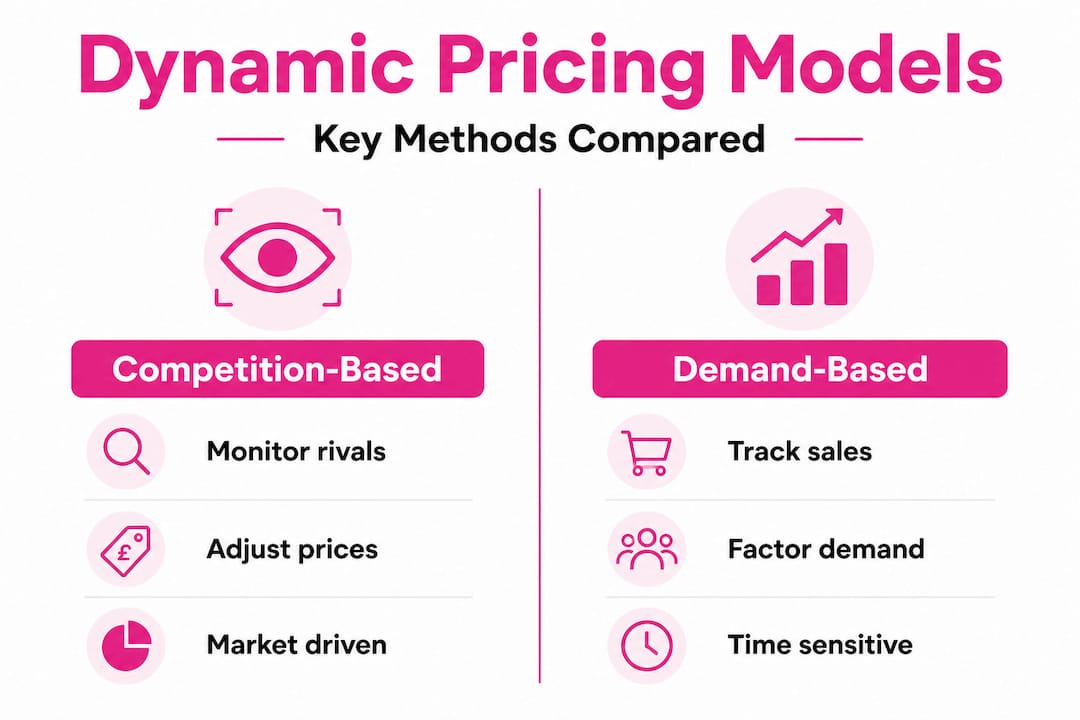
Not all dynamic pricing looks the same. Common dynamic pricing methodologies include competition-based pricing, demand-based pricing, and segmented or personalised approaches, and each suits different business contexts. Understanding these distinctions helps you choose the right model rather than just adopting the most complex one.

Competition-based pricing monitors what rival retailers are charging for the same or comparable products and adjusts your prices to remain competitive. This is particularly relevant in categories with low brand loyalty, such as consumer electronics or commodity household goods. The risk here is a race to the bottom if your margins are not carefully protected with floor prices.
Demand-based pricing uses signals such as sales velocity, page views, basket additions, and time sensitivity to infer how much customers are willing to pay at a given moment. It raises prices when demand is surging and reduces them when interest drops. This is the model closest to what airlines and event ticketing platforms use.
Personalised or segmented pricing adjusts prices based on customer attributes, such as loyalty tier, location, device type, or browsing history. This is where things get more ethically complex, and we will address that shortly.
Model | Key inputs | Main benefit | Primary risk |
Competition-based | Competitor prices, market data | Stays price-competitive | Race to the bottom on margins |
Demand-based | Traffic, sales velocity, inventory | Captures peak willingness to pay | Customer backlash if increases are sharp |
Personalised | User data, segments, loyalty status | Maximises value per customer | Regulatory and fairness concerns |
Time-based | Time of day, day of week | Smooths demand curves | Confusing to price-sensitive shoppers |
Most retailers do not pick just one method. Businesses often blend multiple models depending on product category and market behaviour, which is precisely why a thoughtful strategy beats a plug-and-play tool every time.
Pro Tip: Before choosing a model, map your product catalogue into tiers: high-competition commodities, branded exclusives, and slow-moving stock. Each tier may warrant a different dynamic pricing approach rather than applying one method across the board.
When it comes to monitoring the competition, pricing is just one dimension. Competitor promotions, bundling tactics, and seasonal strategies all feed into how you should position your own prices at any given time.
Regulatory and ethical considerations in the UK and Ireland
Dynamic pricing is entirely legal in the UK and Ireland. However, the way you implement it is subject to scrutiny, and getting it wrong carries real consequences for both your reputation and your compliance standing.
The CMA has been actively developing guidance around dynamic pricing and price transparency. The regulator is more likely to act where pricing is egregiously misleading or tied to aggressive practices that prey on vulnerable consumers. This is not abstract. The CMA has real enforcement powers, and the broader consumer protection landscape in both the UK and Ireland is tightening.
UK price-transparency guidance stresses that businesses should not create the impression that a specific price is fixed or guaranteed when prices are changing, and should consider telling consumers upfront that prices can change. That is a practical standard every e-commerce site should meet, and it is simpler to implement than most business owners fear.
Here are the essential compliance steps for UK and Irish e-commerce businesses:
Disclose that prices are dynamic: Add a clear, visible statement on product pages or at checkout explaining that prices may vary based on demand or other factors.
Avoid false reference prices: Do not show a “was £49.99, now £29.99” discount if the higher price was never genuinely charged for a meaningful period. This is a common pitfall.
Set floor and ceiling prices: Establish internal rules that prevent your pricing algorithm from going above or below acceptable thresholds, regardless of market conditions.
Maintain records: Keep logs of price changes, the inputs that triggered them, and the dates involved. This documentation is invaluable if a complaint is made.
Review personalised pricing carefully: If you are pricing differently by customer segment, ensure that the basis is commercially justifiable and not discriminatory under applicable consumer law.
Transparent pricing is not just a regulatory requirement. It is a commercial strategy. Customers who feel they understand why a price has changed are far less likely to abandon their basket or complain publicly than those who feel surprised or deceived.
Risks and when dynamic pricing can backfire
Dynamic pricing done poorly can be significantly more damaging than no dynamic pricing at all. The commercial upside is real, but so are the risks, and they tend to arrive quickly and publicly.
Research consistently links dynamic pricing, particularly demand-surge models, to perceived unfairness and potential reputational damage when customers feel they have overpaid or are being treated differently from other shoppers. The Uber surge pricing model is the most cited example in the popular press, and for good reason. When prices trebled during a storm or major event, the backlash was swift and damaging to trust, even though the economics were logical.
For UK and Irish e-commerce businesses, the risks look like this:
Price shock at checkout: A customer adds a product at one price and returns the next day to find it significantly higher, leading to basket abandonment and complaints
Loyalty erosion: Repeat customers who discover they paid more than new visitors feel undervalued and may not return
Negative reviews: Price-related grievances spread quickly on Trustpilot and social media, and they are disproportionately visible in search results
Algorithm errors: An unchecked pricing engine can occasionally produce absurd prices, either far too low (costing you margin) or far too high (damaging conversions)
Pro Tip: Set up automated alerts for any price that moves more than a defined percentage in a single adjustment cycle. This gives you a safety net against runaway algorithm decisions and protects your brand.
Understanding how to use dynamic pricing in marketing communications matters enormously here. If you run retargeting ads at a price point, and that price has since changed, you can create a genuinely misleading customer journey without intending to. Similarly, understanding the broader flexible pricing impact on your demand generation efforts helps you coordinate your pricing changes with your marketing calendar rather than running the two in isolation.
How to implement dynamic pricing successfully
Moving from concept to practice requires a clear, staged approach. Jumping straight to a complex AI-driven model without the right data infrastructure or internal review processes is a recipe for the kind of mistakes we described above.
Here is a practical implementation roadmap:
Audit your current pricing data: Understand your existing margins, historical price points, competitor benchmarks, and demand patterns before changing anything.
Define your pricing objectives: Are you optimising for revenue, margin, market share, or stock clearance? Different goals lead to different model choices.
Choose your starting model: For most SME e-commerce businesses, competition-based pricing is the lowest-risk entry point, with demand-based adjustments layered on later.
Set hard price boundaries: Establish non-negotiable floor and ceiling prices for every product group, and ensure your tools cannot breach them without manual approval.
Communicate the change internally: Your customer service team needs to understand why prices change, so they can handle queries professionally and accurately.
Launch on a subset of products: Test dynamic pricing on a controlled category before rolling it out across your full catalogue.
Monitor, measure, and adjust: Track conversion rates, basket abandonment, margin per unit, and customer sentiment weekly in the early stages.
Implementation action | Common mistake | How to avoid it |
Set price floor and ceiling | No limits on algorithm | Define hard minimum and maximum per SKU |
Communicate to customers | No disclosure of price changes | Add visible notice on product and checkout pages |
Monitor sentiment | Set and forget | Review Trustpilot and social weekly |
Coordinate with ad campaigns | Mismatched ad prices | Sync pricing updates with your PPC and social ad feeds |
Test before scaling | Full rollout immediately | Start with one product category |
Businesses blend multiple models as they scale their dynamic pricing capability, and that flexibility is a genuine strength. Your starting model does not have to be your permanent one.
Aligning your pricing strategy with your advertising and pricing activities is particularly important. If your Google Shopping feed is pulling live prices, dynamic changes will appear instantly in your ads, which can be a strength or a liability depending on the direction of the change. Working with smart e-commerce strategies across your digital channels ensures that pricing and promotion work together rather than against each other.
Why transparent dynamic pricing is the real competitive advantage
Here is something most dynamic pricing guides will not tell you: the algorithmic part is the easy bit. Tools that adjust prices based on demand or competitor data are widely available, increasingly affordable, and not difficult to configure. Your competitors can adopt the exact same tools with the same settings within weeks of seeing your approach.
What they cannot copy is the trust you build when customers understand and accept your pricing model. That takes time, consistent communication, and genuine commitment to fairness.
We have seen businesses in competitive product categories use optimisation and transparency together, clearly explaining to customers that prices reflect demand and availability, and convert better as a result. Not despite the price variability, but because of the honesty around it. Customers who know why a price is what it is are far more likely to complete a purchase than those left confused or suspicious.
For UK and European e-commerce owners, treat dynamic pricing as a governance and consumer-information problem as well as a pricing-optimisation problem. Aligning your price-display practices with transparency expectations, including clarity that prices can change, reduces both regulatory and trust risk. That framing is more valuable than any individual algorithm tweak.
The businesses that will win on dynamic pricing over the next five years are not the ones with the most sophisticated pricing engines. They are the ones that make customers feel respected throughout the experience, even when the price is higher than yesterday.
Advance your dynamic pricing strategy with expert guidance
Dynamic pricing is one of the most powerful levers available to UK and Irish e-commerce businesses, but it rewards those who implement it thoughtfully, not those who rush it.

At IWantToBeSeen, we have over 25 years of hands-on experience scaling e-commerce brands, and we know how quickly pricing strategy intersects with SEO, PPC, and paid social performance. Whether you need a pricing audit, help aligning your ad feeds with live pricing, or a full digital strategy that incorporates dynamic pricing as a core growth lever, our team can help. Explore our e-commerce digital marketing services to see how we support brands at every stage of their pricing and growth journey.
Frequently asked questions
Is dynamic pricing legal in the UK and Ireland?
Dynamic pricing is legal, provided companies are transparent about price changes and do not mislead consumers or use aggressive tactics. The CMA has been clear that its concern centres on egregiously misleading pricing or practices that target vulnerable consumers.
How can I explain price changes to my customers without losing trust?
Clearly state on your site that prices can change and avoid creating the impression prices are always fixed. UK guidance stresses that businesses should tell consumers upfront that prices may vary before they reach the checkout.
What is the main risk of using dynamic pricing?
Customers may feel pricing is unfair or inconsistent, which can damage trust and reputation if not managed transparently. Research links surge-style pricing to perceived unfairness and reputational risk when shoppers feel they have overpaid compared to others.
Can dynamic pricing work for small online shops?
Yes, even small e-commerce stores can use dynamic pricing by leveraging simple rule-based tools that factor in demand, competitor rates, and stock levels. Many affordable platforms offer competition-based repricing features that require no technical expertise to set up.
Which products benefit most from dynamic pricing?
Products with fluctuating demand, variable stock levels, or tight competition are best suited for dynamic pricing strategies. Seasonal items, consumer electronics, and fast-moving fashion lines are among the strongest candidates for a dynamic approach.
Recommended
https://casinobankidfritt.com came up while I was looking into the transparency angle you covered here, and it helped me see how clear communication can really soften the blow of price changes. The part about choosing pricing models wisely based on your products is a good reminder to start small rather than jumping into complex algorithms. Thanks for laying out the risks so clearly.