.png)
Boost ecommerce sales with SEO marketing: a step-by-step guide


TL;DR:
Most UK and Irish ecommerce stores experience declining SEO traffic, which impacts sales and revenue significantly.
Implementing targeted keyword research, optimizing product pages, fixing technical issues, and building local links can reverse this trend.
Regular monitoring and adapting strategies based on data and local market nuances are essential for sustainable growth.
Your online shop looks great, your products are competitively priced, and yet sales refuse to budge. Sound familiar? The most common culprit is invisible traffic, specifically, the customers who never find you because your SEO marketing isn’t pulling its weight. According to the UK ecommerce industry report, UK stores average 6,360 SEO visits per month as of January 2026, but that figure is already declining year on year. This guide gives you a practical, step-by-step roadmap to reclaim lost traffic, climb the rankings, and convert visitors into paying customers.
Table of Contents
Key Takeaways
Point | Details |
SEO traffic drives sales | Securing high SEO visibility brings the majority of customers to your ecommerce store. |
Local adaptation is key | Ecommerce strategies for the UK and Ireland must address shifting local search habits and market data. |
Tools and tracking matter | Systematic use of SEO tools and regular performance tracking is essential for ongoing improvement. |
Continuous strategy required | SEO is not a one-time fix but a process that requires constant refinement to keep up with changes. |
Why SEO marketing matters for ecommerce growth
Search engines are the single largest source of traffic for most online shops. Not social media. Not paid ads. Organic search. When someone in Birmingham types “buy handmade leather wallet UK” or a shopper in Dublin searches “sustainable yoga mats Ireland,” they are buyers with intent, and they go straight to Google to find what they need.
The numbers make the stakes crystal clear. UK ecommerce stores average 6,360 SEO visits monthly in January 2026, down 6.2% year on year, while Irish stores average 5,324 visits, a sharper fall of 29.9% year on year. That is not a minor blip. For a shop converting at 2%, losing even 500 monthly visits means roughly 10 fewer sales every single month. Multiply that over a year and the revenue impact is significant.
The reward for getting it right is equally striking. The top organic position attracts 39.8% of all clicks for a given search query. Position two gets roughly half that. By position five, you are fighting for scraps. This is why understanding why invest in SEO is not just an academic exercise. It is a direct revenue conversation.
Here is what poor SEO performance costs your ecommerce business in practice:
Lost discovery: shoppers never find your products because competitors rank above you
Wasted ad spend: paying for PPC to plug gaps that strong organic rankings could fill for free
Thin margins: discount-led promotions used to compensate for low traffic volume
Weaker brand authority: low rankings signal lower trustworthiness to both search engines and shoppers
Understanding the organic search impact on revenue helps you frame SEO not as a marketing cost but as your most reliable sales channel.
Essential tools and resources for SEO marketing
With the urgency established, you need the right toolkit before you start executing. Choosing the wrong tools wastes time and gives you bad data. Here is a clear breakdown matched to ecommerce shops of different sizes.
Tool | Purpose | Best for |
Google Search Console | Tracks keyword rankings, impressions, click-through rates | All shop sizes |
Google Analytics 4 | Measures organic traffic, conversions, and user behaviour | All shop sizes |
Ahrefs or SEMrush | Keyword research, competitor gap analysis, backlink audits | Mid to large shops |
Screaming Frog | Technical SEO crawl: broken links, duplicate content, metadata | Mid to large shops |
Ubersuggest | Budget-friendly keyword and content ideas | Small shops |
Google Keyword Planner | Volume and competition data, free with Google Ads account | All shop sizes |
For UK and Ireland specifically, you should use Google Search Console filtered by country to see exactly how you rank for local queries. Irish shops in particular should monitor both ".iedomain performance and broader English-language searches, since many Irish consumers shop on.co.ukor.com` sites without a second thought.
The complete ecommerce SEO guide covers platform-specific configurations for Shopify, WooCommerce, and Magento, which matters because each platform handles URL structure, canonical tags, and schema markup differently.
When selecting tools, resist the urge to subscribe to everything at once. Start with:
Google Search Console (free, essential)
Google Analytics 4 (free, essential)
One keyword research tool appropriate to your budget
Only add technical audit tools once your basics are running cleanly. Layering complexity onto a broken foundation solves nothing.
Pro Tip: Before buying any paid SEO tool, export three months of data from Google Search Console. You will often find your highest-impression, low-click-through keywords right there, and fixing those pages costs you nothing.
Solid keyword research tips will help you identify the precise terms your customers actually type, including regional variations. Irish shoppers, for instance, may search “runners” where UK shoppers search “trainers.” These nuances are invisible until you dig into localised data.
Step-by-step SEO marketing strategy for ecommerce stores
Once you have your toolkit, it is time to act. Here is a realistic four-step process built specifically for ecommerce owners in the UK and Ireland.

Step 1: Identify priority keywords for your products
Do not start with your homepage or brand name. Start with your best-selling product categories. Use your keyword tool to find terms with genuine buyer intent: phrases including “buy,” “best,” “UK,” “Ireland,” or specific product attributes. Long-tail keywords (four or more words) convert better because they match specific intent. “Buy merino wool scarf Ireland” is worth far more than just “scarf.”
Step 2: Optimise product pages for chosen keywords
Each product page should target one primary keyword plus two or three related terms. Include the primary keyword in the page title, meta description, H1 heading, first paragraph of the product description, and at least one image alt tag. Do not keyword-stuff. Write for customers first, then review for search engines. A product description that reads naturally will outperform a list of forced repetitions.
Step 3: Improve site structure and technical SEO
Site structure determines how search engines crawl and value your pages. A logical hierarchy (home, category, subcategory, product) helps both users and bots. Fix these common technical issues immediately:
Broken internal links and 404 errors
Duplicate product descriptions (especially problematic on large catalogues)
Slow page load speeds (Google’s Core Web Vitals are a direct ranking factor)
Missing or incorrect canonical tags on paginated pages
No structured data (product schema, review schema) to enable rich results
Step 4: Build links and local relevance
Backlinks remain one of the strongest ranking signals. For UK and Irish shops, targeted local SEO strategies include getting listed on UK and Irish business directories, earning press coverage from local media, and partnering with complementary brands for co-created content. Even one strong link from a respected UK trade publication outweighs dozens of low-quality directory submissions.
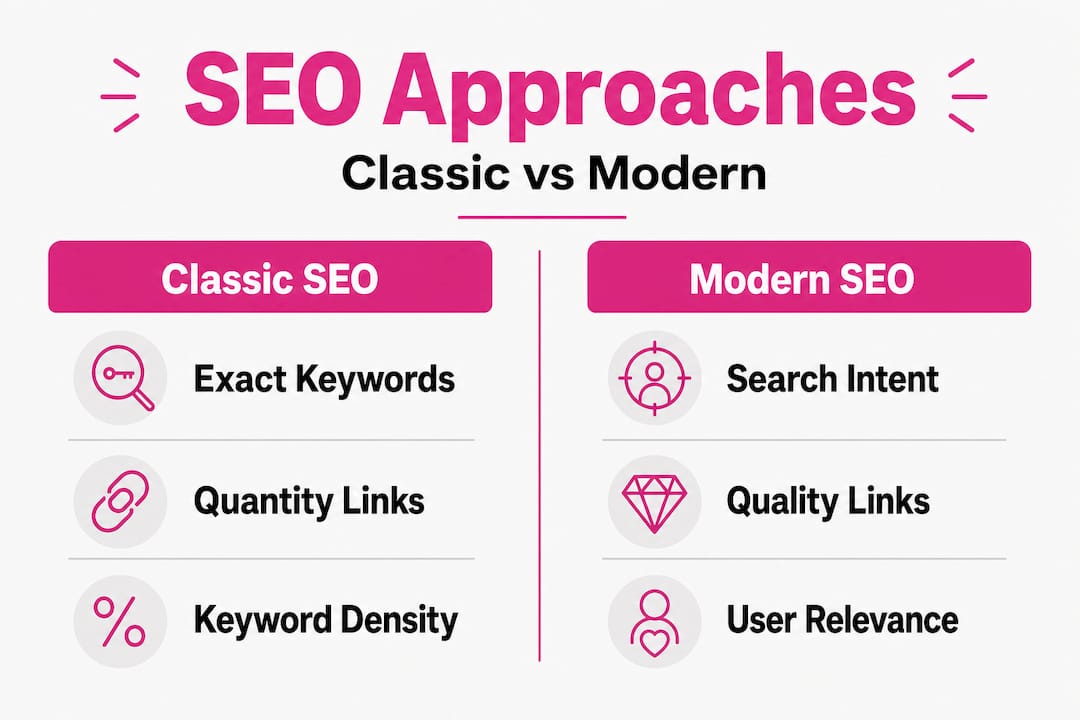
Here is a comparison of classic versus modern SEO approaches for ecommerce:
Approach | Classic SEO | Modern SEO |
Keywords | Exact-match repetition | Intent-based, natural language |
Content | Thin product descriptions | Rich, informative, question-answering |
Links | Volume of any links | Quality of relevant, earned links |
Technical | Desktop-first speed | Core Web Vitals, mobile-first indexing |
Measurement | Keyword position only | Traffic, conversions, revenue impact |
Pro Tip: Do not try to optimise your entire catalogue at once. Identify your top 20 revenue-generating products and make those pages excellent before moving on. The 80/20 rule applies strongly in ecommerce SEO.
Exploring the different types of digital marketing alongside SEO helps you understand where organic search fits in a broader revenue strategy and how channels like PPC and social can amplify your SEO gains.
Monitoring your success: tracking and tweaking your SEO results
A well-executed strategy only delivers if you monitor, assess, and refine it regularly. Most shop owners set up SEO once and forget it. That is a mistake. Search algorithms evolve, competitors adapt, and consumer habits shift. Regular review is not optional.
Set up a monthly reporting routine covering these key metrics:
Organic visits: total visitors arriving via search engines, tracked in Google Analytics 4
Click-through rate (CTR): the percentage of impressions that result in a click, found in Search Console
Keyword rankings: movement on your top 20 to 30 priority keywords
Conversion rate from organic traffic: how many organic visitors complete a purchase
Bounce rate and time on page: signals that content quality is meeting (or missing) user expectations
“The average UK ecommerce store receives 6,360 SEO visits per month, and Ireland averages 5,324. If your shop sits significantly below these industry benchmarks, you have a clear, measurable gap to close.”
Use these benchmarks as a baseline, not a ceiling. Shops in competitive niches might sit well below the average whilst those in niche markets with strong local content can exceed it considerably. The point is to track your own trajectory month on month.
When results stall, ask these diagnostic questions before changing anything major:
Have you recently added new products without optimising their pages?
Has a competitor launched a strong content campaign targeting your keywords?
Has Google released a core algorithm update affecting your niche?
Are your Core Web Vitals scores deteriorating as your site grows?
Understanding how to measure SEO performance in the context of ecommerce gives you the framework to diagnose accurately rather than reactively. Panic-driven changes after a ranking drop often make things worse.
The benefits of ecommerce SEO compound over time. Unlike paid ads that stop the moment your budget runs dry, organic rankings built on genuine content and solid technical foundations continue to drive traffic month after month, making every hour invested increasingly valuable.
Why textbook SEO isn’t enough for UK and Irish ecommerce
Here is the uncomfortable truth that most SEO guides will not tell you. Following a checklist perfectly is not the same as winning in your specific market. We have seen this repeatedly across the brands we have grown and the clients we have worked with. The shop that meticulously ticks every on-page SEO box but ignores the cultural nuances of UK and Irish consumer behaviour will consistently lose to a leaner competitor who genuinely understands their audience.
Google’s algorithm has become remarkably good at detecting genuine expertise and relevance. A product description written by someone who actually uses and understands the product performs better than one assembled from keyword research alone. This is the advantage local ecommerce shops have over large international retailers: authenticity and context.
Consider seasonal behaviour. UK shoppers have very different purchasing windows around events like Bank Holidays, the January sales, or Back to School compared to US patterns. Irish shoppers have their own distinct calendar anchored around events that global competitors simply do not bother to account for. Mapping your content and promotional SEO calendar to these local patterns is a genuine competitive edge.
Algorithm changes are the other reality. Google regularly updates its core ranking systems, and each update tends to reward content that demonstrates real-world expertise more heavily than content that merely follows technical rules. Staying current with these shifts requires ongoing attention, not a one-off audit. Being nimble, willing to test new content formats, adjust internal linking, and refresh old pages, will always outperform a rigid strategy followed blindly.
Our perspective, built across 25 years of growing ecommerce brands, is this: the best SEO practitioners are part analyst, part editor, and part customer psychologist. Data tells you what is happening. Local knowledge tells you why. And curiosity drives the creative adaptation that consistently beats the algorithm chasers. If you want to understand how this translates to sustainable growth, exploring practical tactics for boosting online sales is a strong next step.
Supercharge your ecommerce SEO marketing today
You now have a clear, actionable framework: understand why SEO matters for your revenue, equip yourself with the right tools, execute a structured optimisation strategy, and monitor progress with the right metrics. That is more than most shop owners ever put in place. But knowing what to do and having the bandwidth to do it consistently are two very different things.

At iwanttobeseen.online, we specialise in SEO marketing support for ecommerce businesses across the UK and Ireland. Our team brings over 25 years of hands-on experience scaling real ecommerce brands. We do not offer generic advice. We deliver tailored strategies built around your products, your market, and your growth targets. Whether you need a full managed SEO service, an expert audit to identify quick wins, or ongoing support to keep your rankings climbing, we can help you move from invisible to impossible to ignore.
Frequently asked questions
What is the average SEO traffic for ecommerce shops in the UK and Ireland?
In January 2026, UK stores averaged 6,360 SEO visits per month, whilst Irish stores averaged 5,324, both figures showing year-on-year declines that underline the urgency of strong SEO performance.
How important is it to rank top in Google for ecommerce keywords?
The top organic position receives 39.8% of all clicks for a given search query, making first-place rankings significantly more valuable than any lower position in terms of traffic volume and potential revenue.
What’s the first step to effective SEO marketing for my shop?
Start by researching and selecting keywords with genuine buyer intent for your core product categories, focusing on long-tail, specific phrases that reflect how your customers actually search rather than broad generic terms.
Which SEO metrics should ecommerce stores track regularly?
Track organic visits, click-through rate, keyword rankings, conversion rate from organic traffic, and bounce rate. Together these metrics give you a complete picture of both visibility and commercial performance.
Recommended
Comments