.png)
Shoppable Content: Driving Seamless Online Sales
- Darren Burns
- Feb 2
- 6 min read


Scrolling through Instagram or TikTok, it feels effortless when you spot a product and buy it without ever leaving the app. For growing e-commerce businesses in the United Kingdom and Ireland, mastering shoppable content can remove barriers in the customer journey and spark impulse purchases. This guide uncovers the real advantages of direct buying experiences, clarifies common myths, and highlights the best ways to turn everyday digital content into straightforward sales opportunities.
Table of Contents
Key Takeaways
Point | Details |
Shoppable Content Definition | Shoppable content allows consumers to purchase products directly within visual media, enhancing the online shopping experience. |
Key Platforms | Major platforms like Instagram, TikTok, and Pinterest offer unique shoppable content features to drive purchases. |
Buyer Journey Integration | Align content with the buyer’s journey stages to create engaging purchasing experiences at every point. |
Legal Compliance | Adhere to advertising regulations and ensure clear disclosures to promote transparency and protect consumer interests. |
Shoppable content explained and common myths
Shoppable content transforms digital media into direct purchasing opportunities, enabling consumers to buy products seamlessly within visual content. Understanding consumer purchase pathways reveals how these interactive experiences are revolutionising online shopping.
At its core, shoppable content represents digital assets that allow immediate product purchase directly through images, videos, or social media posts. Unlike traditional advertising, these interactive mediums reduce friction in the customer journey by eliminating multiple click-throughs and complicated checkout processes.
Shoppable content typically manifests across several key platforms:
Social media channels like Instagram and TikTok
Branded website product galleries
Digital marketing campaigns
Interactive video content
Influencer marketing collaborations
Common myths surrounding shoppable content often stem from misunderstandings about its functionality and implementation. Many entrepreneurs mistakenly conflate shoppable content with standard social commerce, assuming they are identical concepts. However, shoppable content specifically focuses on the ability to purchase directly within the content itself, while social commerce represents a broader ecosystem of selling through social platforms.
Key differences include:
Direct purchase capability
Minimal redirection
Seamless user experience
Visual product integration
Pro tip: Start implementing shoppable content by selecting platforms where your target audience already spends significant time and analysing which content types generate the most engagement.
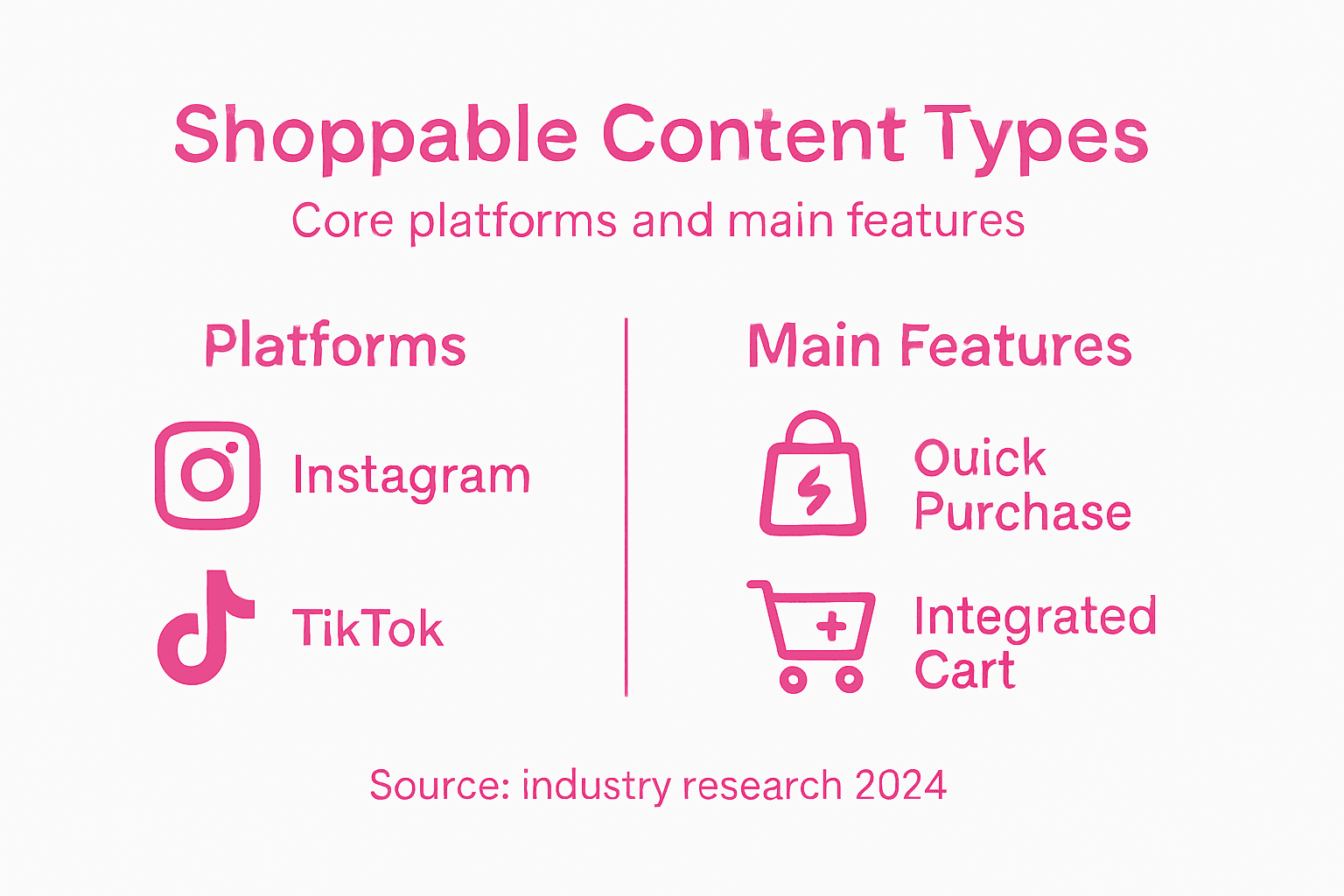
Core types and platforms for shoppable content
Shoppable content has evolved to encompass multiple digital platforms, each offering unique opportunities for direct purchasing experiences. Advanced content platforms now integrate seamlessly with ecommerce systems, enabling brands to transform digital media into immediate buying opportunities.
The primary platforms for shoppable content include social media channels, each with distinctive features and capabilities:
Instagram: Product tagging in posts and stories
TikTok: In-video shopping links and live stream purchases
Pinterest: Shoppable pins with direct product information
Facebook: Integrated marketplace and shop features
YouTube: Product links within video content
Beyond social media, brands can leverage shoppable content across multiple digital touchpoints. Websites now incorporate interactive product galleries, email marketing campaigns include purchasable imagery, and digital advertisements feature direct buying mechanisms.
Key technological capabilities that enable these platforms include:
Real-time product tagging
Seamless checkout experiences
User-generated content integration
Advanced analytics tracking
Cross-platform compatibility
Pro tip: Select shoppable content platforms by analysing where your target audience spends most of their digital time and which platforms offer the most intuitive purchasing experiences.
Key features and buyer journey integration
Shoppable content requires strategic alignment with the customer’s purchasing journey to create meaningful interactions. Mapping content to buyer stages enables brands to deliver precisely targeted purchasing experiences that resonate with consumers’ evolving needs.
The buyer journey typically encompasses three critical stages, each demanding unique content approaches:
Awareness Stage: Educational content and initial product introductions
Consideration Stage: Detailed product comparisons and in-depth information
Decision Stage: Conversion-focused content with direct purchasing mechanisms
Key technological features that support seamless buyer journey integration include sophisticated product tagging, contextual purchasing options, and intelligent content recommendation systems. These technologies allow brands to create frictionless pathways that guide potential customers from initial curiosity to final purchase.
Advanced integration strategies involve:
Personalised content recommendations
Dynamic product tagging
Contextual purchasing triggers
Intelligent cross-platform tracking
Adaptive user experience design
Pro tip: Develop a comprehensive content mapping strategy that anticipates customer questions and provides immediate, actionable purchasing opportunities at each stage of their journey.
Legal obligations and advertising compliance
Advertising regulations play a critical role in shaping shoppable content strategies for digital marketers. Mandatory advertising disclosures ensure transparency and protect consumer interests across digital platforms.
Key legal compliance requirements for shoppable content include:
Clear labelling of sponsored or advertising content
Explicit identification of influencer partnerships
Accurate product representation
Transparent pricing information
Adherence to data protection guidelines
Digital marketers must navigate complex regulatory landscapes that vary across different jurisdictions. This involves understanding specific requirements such as the General Data Protection Regulation (GDPR) in Europe and consumer protection laws in the United Kingdom.
Specific compliance strategies involve:
Using standardised disclosure hashtags
Implementing clear visual markers for advertising content
Maintaining accurate product information
Protecting consumer data privacy
Ensuring age-appropriate content restrictions
Pro tip: Consult with a legal professional specialising in digital marketing compliance to develop a robust framework for your shoppable content strategy.
For reference, here is a summary of legal compliance factors by region:
Region | Key Regulation | Main Requirement | Enforcement Body |
United Kingdom | Consumer Protection | Transparent pricing, fair ads | Competition & Markets Authority |
European Union | GDPR | Safeguarding personal data | European Data Protection Board |
United States | FTC guidelines | Clear sponsored disclosures | Federal Trade Commission |
Risks, pitfalls and comparisons with alternatives
Digital content strategies require careful evaluation of potential challenges and alternative approaches. Comparing content accessibility models reveals critical insights into potential risks and strategic alternatives for shoppable content implementation.
The primary risks associated with shoppable content strategies include:
Technical implementation complexity
Potential user experience friction
Higher development and maintenance costs
Privacy and data security concerns
Platform-specific limitations
Compared to traditional digital marketing approaches, shoppable content presents both unique advantages and significant challenges. While direct purchasing capabilities offer streamlined consumer experiences, they simultaneously introduce additional technical and regulatory complexities that businesses must carefully navigate.

Here’s a quick comparison of shoppable content and traditional digital marketing approaches:
Aspect | Shoppable Content | Traditional Digital Marketing |
Purchase Path | Immediate in-content buying | Multiple redirects to checkout |
User Engagement | Interactive and visually immersive | Passive consumption, less interactive |
Conversion Potential | Higher due to reduced friction | Lower due to longer journey |
Implementation Cost | Generally higher technical demand | Lower, but less innovative |
Regulation Complexity | Requires detailed compliance monitoring | Standard advertising requirements |
Alternative marketing approaches can be evaluated across several dimensions:
Direct conversion potential
Consumer engagement levels
Implementation complexity
Cost-effectiveness
Scalability and adaptability
Pro tip: Conduct thorough pilot testing and incremental implementation to mitigate potential risks and validate the effectiveness of your shoppable content strategy before full-scale deployment.
Elevate Your Online Sales with Expert Shoppable Content Strategies
The article highlights challenges such as technical complexities, regulatory compliance, and the need for seamless buyer journey integration to unlock the full potential of shoppable content. If you aim to reduce friction in your customer’s purchase path and create visually immersive, interactive experiences that boost conversions then expert guidance is essential. Understanding how to combine product tagging, personalised content mapping and compliance can transform your digital marketing into a powerful direct sales engine.
At https://iwanttobeseen.online we specialise in SEO AI Social Media and PPC tailored for ecommerce brands. With over 25 years of experience scaling multiple successful online businesses we know how to craft strategies that overcome common pitfalls of shoppable content — such as high implementation costs and platform limitations. Let us help you build momentum by delivering frictionless user experiences that increase engagement and drive sales while ensuring legal advertising compliance.
Unlock the true value of your digital assets with proven methods that align with your buyer’s journey from awareness to decision. Discover how our services can empower your brand starting today.
Increase Your Conversions with Proven Ecommerce Digital Marketing

Ready to transform your digital content into a seamless sales channel Take the next step and partner with a team that understands the nuances of shoppable content at iwanttobeseen.online. Explore expert strategies and tailored solutions designed to capitalise on emerging trends and deliver measurable growth now.
Frequently Asked Questions
What is shoppable content?
Shoppable content refers to digital media that allows consumers to purchase products directly through images, videos, or social media posts without redirecting to another page.
How does shoppable content improve the customer journey?
Shoppable content reduces friction by offering a seamless user experience where consumers can make purchases immediately, eliminating multiple click-throughs and complicated checkout processes.
What are the primary platforms that support shoppable content?
Key platforms include social media channels like Instagram, TikTok, Pinterest, Facebook, and YouTube, as well as branded websites and digital marketing campaigns that incorporate interactive product galleries.
What legal obligations should marketers consider when implementing shoppable content?
Marketers must ensure clear labelling of sponsored content, accurate product representation, transparent pricing information, and compliance with advertising regulations and data protection guidelines.
Recommended
Comments