.png)
Customer Lifecycle Marketing: Driving eCommerce Loyalty


Finding the right way to keep customers interested after their first purchase is a constant challenge for Ecommerce marketing managers. As competition grows stronger across the UK and Ireland, getting noticed is just the beginning—keeping shoppers loyal requires more than simple follow-ups. By focusing on customer lifecycle marketing, you can map every journey stage, tailor interactions to real behaviours, and drive true long-term relationships that support growth.
Table of Contents
Key Takeaways
Point | Details |
Customer Lifecycle Stages | Understanding the distinct stages of the customer journey is essential for effective lifecycle marketing in eCommerce. |
Data-Driven Personalisation | Sophisticated data analysis is crucial for tailoring marketing strategies to customers’ unique preferences at each lifecycle stage. |
Measurement of Success | Comprehensive metrics such as Customer Acquisition Cost and Customer Lifetime Value are vital for evaluating marketing effectiveness and ROI. |
Avoiding Common Pitfalls | Businesses should be aware of common traps, such as linear journey assumptions and insufficient data use, to enhance customer engagement strategies. |
Defining Customer Lifecycle Marketing for eCommerce
Customer lifecycle marketing represents a strategic approach to engaging customers throughout their entire journey with a brand, from initial awareness through sustained loyalty. Customer-centric marketing strategies focus on understanding and optimising interactions across multiple touchpoints to drive meaningful engagement and long-term value.
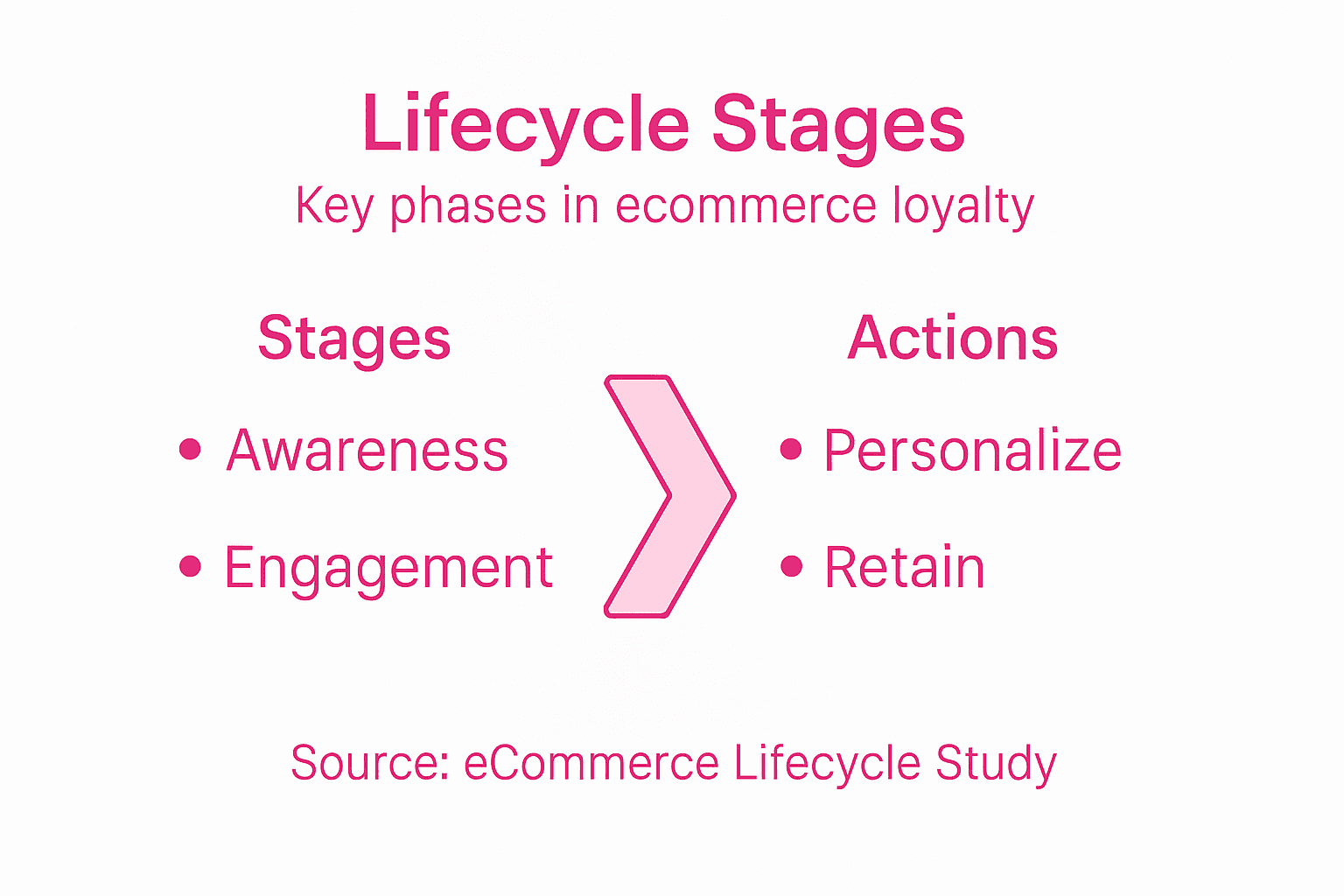
At its core, customer lifecycle marketing involves mapping and understanding the distinct stages customers experience when interacting with an eCommerce brand. These stages typically include:
Awareness: Initial brand discovery and introduction
Consideration: Exploring product options and evaluating offerings
Purchase: Completing the first transaction
Post-Purchase: Experiencing the product and initial customer service
Retention: Developing ongoing brand loyalty
Advocacy: Recommending the brand to other potential customers
Effective lifecycle marketing requires deep data analysis and strategic personalisation. Brands must collect behavioural insights, preferences, and interaction history to create targeted campaigns that resonate with customers at each unique stage of their journey.
Successful implementation demands sophisticated technology and analytical capabilities. eCommerce businesses need robust customer relationship management (CRM) systems, advanced analytics platforms, and integrated marketing automation tools to track, segment, and engage customers precisely.
Here’s a summary of technologies essential for effective customer lifecycle marketing:
Technology Type | Purpose | Business Impact |
CRM Systems | Manage customer data and interactions | Enables precise targeting and segmentation |
Analytics Platforms | Analyse behaviours and trends | Supports real-time strategy adjustments |
Marketing Automation | Automate personalised campaigns | Increases engagement and efficiency |
Data Platforms | Consolidate multi-channel information | Improves holistic customer understanding |
Pro tip: Develop detailed customer personas for each lifecycle stage to create more targeted and personalised marketing experiences.
Key Stages of the Customer Lifecycle
Customer lifecycle stages represent the critical journey a customer experiences with an eCommerce brand, from initial discovery through long-term loyalty. Customer relationship progression encompasses distinct phases that require strategic engagement and personalised interaction.
The core stages of the customer lifecycle typically include:
Awareness: First contact with the brand, discovering products or services
Engagement: Exploring offerings, comparing options, and developing initial interest
Conversion: Making the first purchase and experiencing the product
Retention: Building ongoing relationship and repeat purchasing behaviour
Advocacy: Becoming a brand supporter who recommends products to others
Each stage demands targeted approaches and nuanced strategies. Businesses must carefully map customer interactions, understanding that progression isn’t always linear. Some customers might skip stages or move between them unpredictably, requiring flexible marketing techniques.
Successful lifecycle management involves comprehensive data collection and sophisticated analysis. Companies need robust systems to track customer behaviours, preferences, and interactions across multiple touchpoints. This enables creating personalised experiences that resonate at each unique stage of the customer journey.
Effective lifecycle marketing transforms transactional relationships into meaningful, long-term brand connections.
Pro tip: Develop a dynamic customer tracking system that allows real-time adaptation of marketing strategies across different lifecycle stages.

Personalisation Strategies Across Each Stage
Customer journey personalisation requires a sophisticated approach that adapts dynamically to individual customer needs and behaviours. Customer preference mapping enables businesses to create targeted interactions that resonate at each unique lifecycle stage.
Personalisation strategies vary across different customer lifecycle stages:
Awareness Stage:
Use demographic and browsing data to create targeted advertising
Develop content that addresses specific customer pain points
Implement personalised retargeting campaigns
Engagement Stage:
Customise product recommendations based on browsing history
Create personalised email communications
Develop interactive content matching customer interests
Conversion Stage:
Offer personalised discounts or incentives
Provide tailored product bundles
Create specific landing pages based on customer segments
Retention Stage:
Develop personalised loyalty programmes
Send targeted post-purchase follow-up communications
Create customised re-engagement campaigns
Advocacy Stage:
Develop referral programmes with personalised rewards
Create exclusive content for loyal customers
Implement personalised brand ambassador initiatives
Successful personalisation demands comprehensive data collection and intelligent analysis. Businesses must invest in advanced analytics platforms that can track and interpret customer behaviours in real-time, allowing for immediate and precise customisation of marketing approaches.
Effective personalisation transforms generic interactions into meaningful, individually tailored experiences that drive customer loyalty and engagement.
Pro tip: Implement a robust customer data platform that consolidates information from multiple touchpoints to enable truly dynamic personalisation strategies.
Measuring Success and ROI in Lifecycle Marketing
Evaluating the effectiveness of customer lifecycle marketing requires a comprehensive approach to digital marketing performance analysis. Businesses must develop sophisticated measurement strategies that go beyond simple transactional metrics to understand the true value of their customer engagement efforts.
Key performance metrics for lifecycle marketing include:
Customer Acquisition Cost (CAC)
Total marketing expenses divided by number of new customers
Tracks efficiency of customer attraction strategies
Helps identify most cost-effective marketing channels
Customer Lifetime Value (CLV)
Projected total revenue from a customer relationship
Calculates long-term business impact
Guides investment in customer retention strategies
Conversion Rates
Percentage of potential customers completing desired actions
Measures effectiveness of engagement strategies
Identifies potential friction points in customer journey
Retention Rate
Percentage of customers continuing to do business
Indicates strength of customer loyalty programmes
Reflects overall customer satisfaction
Return on Marketing Investment (ROMI)
Measures net profit generated from marketing activities
Calculates direct financial impact of marketing efforts
Provides clear ROI assessment
Successful measurement requires advanced integration of analytics platforms and customer relationship management (CRM) systems. Businesses must develop robust data collection mechanisms that capture nuanced customer interactions across multiple touchpoints.
Effective ROI measurement transforms marketing from a cost centre to a strategic business driver.
Pro tip: Implement a unified analytics dashboard that consolidates metrics from all customer lifecycle stages to provide a comprehensive view of marketing performance.
Common Pitfalls and How to Avoid Them
Customer journey misconceptions can significantly undermine eCommerce marketing strategies. Understanding and navigating these challenges is crucial for developing robust, effective customer lifecycle approaches that drive meaningful engagement and sustainable growth.
Common pitfalls in customer lifecycle marketing include:
Linear Journey Assumption
Mistakenly believing customer interactions follow a straight path
Failing to account for complex, non-linear customer behaviours
Overlooking multiple potential entry and exit points
Insufficient Data Utilisation
Collecting data without meaningful analysis
Relying on superficial demographic information
Neglecting behavioural and intent-based insights
Inconsistent Omnichannel Experiences
Disconnected messaging across different platforms
Lack of unified customer communication strategy
Fragmented brand representation
Personalisation Limitations
Using generic, one-size-fits-all communication
Failing to leverage detailed customer preference data
Minimal effort in creating tailored interactions
Technology Integration Challenges
Poor synchronisation between marketing tools
Ineffective customer relationship management systems
Limited real-time data processing capabilities
Successful navigation of these pitfalls requires a holistic, data-driven approach. Businesses must invest in sophisticated analytics platforms, develop flexible customer journey mapping, and create dynamic, responsive marketing strategies that adapt to individual customer needs.
Here’s a comparison of pitfalls versus solutions for strong lifecycle marketing:
Common Pitfall | Resulting Challenge | Recommended Solution |
Linear Journey Assumption | Missed touchpoints, lower engagement | Map non-linear customer flows |
Insufficient Data Utilisation | Ineffective targeting and generic offers | Invest in advanced analytics and insights |
Inconsistent Omnichannel Experience | Fragmented brand perception | Unify messaging and integrate platforms |
Personalisation Limitations | Reduced loyalty and relevance | Develop dynamic, tailored communications |
Technology Integration Challenges | Slow responses, operational inefficiency | Choose interoperable, real-time systems |
Overcoming lifecycle marketing challenges demands continuous learning, technological innovation, and a customer-centric mindset.
Pro tip: Conduct regular customer journey audits to identify and address potential friction points across all interaction stages.
Unlock the Power of Customer Lifecycle Marketing for Your eCommerce Growth
Navigating the complexities of customer lifecycle marketing requires a strategic focus on personalisation, data-driven insights, and seamless technology integration to boost loyalty and advocacy. If you find yourself struggling with mapping non-linear customer journeys or crafting dynamic personalised campaigns, you are not alone. Many eCommerce brands face challenges such as inconsistent omnichannel messaging and ineffective data utilisation that limit long-term customer engagement.
At IWantToBeSeen, we leverage over 25 years of experience scaling successful eCommerce brands to help you implement powerful digital marketing strategies. From advanced SEO and PPC to AI-enhanced social media campaigns, our tailored solutions are designed to transform your customer interactions into meaningful, loyal relationships through data-led personalisation and lifecycle optimisation.
Are you ready to elevate your brand’s engagement and measure true marketing ROI with precision?
Discover how our expert team can support your journey with proven strategies crafted to overcome the common pitfalls of lifecycle marketing. Visit our homepage, explore our approach to digital marketing services, and start building a customer-first growth engine today.
Frequently Asked Questions
What is customer lifecycle marketing?
Customer lifecycle marketing is a strategic approach that focuses on engaging customers throughout their entire journey with a brand, from initial awareness to becoming loyal advocates. It involves mapping the distinct stages customers experience and optimising interactions at each phase to drive meaningful engagement.
What are the key stages of the customer lifecycle in eCommerce?
The key stages typically include Awareness (initial brand discovery), Engagement (exploring options), Conversion (making a purchase), Retention (building loyalty), and Advocacy (recommending the brand to others). Each stage requires tailored marketing strategies and personalisation.
How can personalisation be implemented during the customer lifecycle?
Personalisation can be implemented by using customer data to tailor communications, offers, and campaigns according to individual preferences and behaviours. This includes customised recommendations, targeted discounts, and personalised follow-up communications to enhance customer experience at each lifecycle stage.
What metrics should businesses track to measure success in customer lifecycle marketing?
Key metrics include Customer Acquisition Cost (CAC), Customer Lifetime Value (CLV), Conversion Rates, Retention Rate, and Return on Marketing Investment (ROMI). These metrics help assess the effectiveness of marketing strategies and understand the overall impact on business growth.
Recommended
Comments