.png)
SEO Trends in 2025: Boost Your E-Commerce Visibility Fast


A single shift in search engine algorithms can send even the most established british e-commerce shops plummeting or soaring overnight. For business owners in the United Kingdom and Ireland, understanding the latest SEO trends is not just helpful, it is necessary for survival. With nearly 90 percent of all online product searches beginning on Google, this guide breaks down key strategies that help transform fresh insights into measurable results for your online store.
Table of Contents
Quick Summary
Key Insight | Explanation |
1. Connect Analytics Tools | Linking your website to Google Analytics and Search Console is crucial for tracking key performance metrics. |
2. Leverage AI for Keywords | Use AI-driven keyword research tools to identify valuable keywords and adapt content strategies effectively. |
3. Focus on Technical SEO | Optimise technical aspects like page speed and mobile responsiveness to boost search visibility and user experience. |
4. Create Multi-Platform Content | Develop content designed for various search platforms to enhance visibility across different formats. |
5. Monitor Performance Metrics | Regularly review detailed KPIs to validate the effectiveness of SEO enhancements and adapt strategies dynamically. |
Step 1: Assess current SEO performance with fresh analytics
Measuring your e-commerce website’s SEO performance requires a strategic approach using comprehensive search analytics techniques. By systematically evaluating key performance indicators, you can uncover precise insights that drive visibility and traffic growth.
Start by connecting your website with Google Analytics and Google Search Console to track critical metrics. Focus on analysing organic search traffic, keyword rankings, click-through rates, and user engagement signals. Pay special attention to metrics like average session duration, bounce rate, and conversion rates from search traffic. These indicators reveal how effectively your current SEO strategies are performing. A thorough SEO audit will help you identify specific areas requiring improvement.
Your goal is transforming raw data into actionable insights. Examine which keywords drive the most valuable traffic, understand user search intent, and pinpoint content gaps that represent growth opportunities. Track your website’s performance across mobile and desktop platforms to ensure comprehensive visibility.
Top tip: Use advanced Google Analytics segments to isolate and analyse e-commerce search traffic performance with laser precision.
Step 2: Adopt AI-driven keyword research and content strategies
Understanding the power of AI-driven keyword research enables e-commerce businesses to unlock sophisticated content strategies that transcend traditional search engine optimisation techniques. Artificial intelligence now provides unprecedented capabilities for identifying nuanced search patterns and user intent.

Leverage advanced AI tools that analyse search trends, user behaviour, and competitive landscapes to generate comprehensive keyword insights. These intelligent systems can identify high potential long tail keywords, predict emerging search trends, and recommend content strategies tailored to your specific e-commerce niche. Consider integrating AI marketing strategies that help you understand semantic search connections and user intent beyond simple keyword matching.
Implement machine learning algorithms that continuously refine your keyword strategy by tracking performance metrics, understanding user engagement signals, and adapting recommendations in real time. This dynamic approach ensures your content remains relevant and competitive in the rapidly evolving digital marketplace.
Top tip: Experiment with multiple AI keyword research tools and cross reference their recommendations to develop a more robust and comprehensive strategy.
To clarify how AI tools can enhance keyword research, consider the following comparison:
Capability | Traditional Tools | AI-driven Tools |
Keyword Suggestion Speed | Manual and slower | Instant, automated outputs |
Understanding Search Intent | Largely surface-level | Deeper semantic analysis |
Trend Prediction | Historical focus | Predicts future trends |
Adaptation Over Time | Requires manual updates | Self-improving algorithms |
Step 3: Implement advanced technical SEO enhancements
Advanced technical SEO requires a comprehensive approach to rendering and ranking strategies that go beyond traditional optimisation techniques. By focusing on sophisticated technical elements, you can significantly improve your e-commerce website’s search engine performance and user experience.
Begin by optimising your site’s core technical infrastructure. Implement Server-Side Rendering (SSR) or Static Site Generation (SSG) to enhance page load speeds and improve search engine crawlability. Ensure your website utilises secure HTTPS protocols, has a clean and logical URL structure, and incorporates semantic HTML elements for improved content understanding. Prioritise mobile SEO optimisation to address the increasing number of mobile search users and meet search engine ranking criteria.
Utilise advanced AI performance monitoring tools to proactively identify and resolve technical SEO issues. These intelligent systems can help you track page speed, analyse site architecture, and recommend precise improvements that enhance your website’s overall search engine visibility. Continuously audit and refine your technical infrastructure to stay ahead of evolving search engine algorithms.
Top tip: Conduct monthly technical SEO audits using multiple diagnostic tools to catch and resolve potential performance issues before they impact your search rankings.
Here is a summary of essential technical SEO enhancements and their impact:
Enhancement | Description | Impact on E-commerce SEO |
Server-Side Rendering (SSR) | Renders pages on the server for users | Faster load times, better crawling |
HTTPS Security | Encrypts data exchanged with visitors | Increases trust, ranking factor |
Clean URL Structure | Uses logical, readable URLs | Improves navigation and indexation |
Semantic HTML Elements | Adds meaning and structure to content | Better content understanding by bots |
Step 4: Optimise for evolving search behaviours and platforms
Mastering generative engine optimization represents the cutting edge of modern SEO strategy for e-commerce businesses seeking to remain competitive in an increasingly AI-driven search landscape. Understanding how search algorithms are transforming requires a proactive and adaptive approach to content creation and visibility.
Focus on developing content that serves multiple search platforms simultaneously. This means creating structured, conversational content that works equally well for traditional web searches, voice search, and emerging AI knowledge repositories. Prioritise creating comprehensive, authoritative content that answers user queries directly while incorporating holistic SEO strategies that address multi platform visibility. Ensure your content is adaptable across mobile devices, social media platforms, and conversational search interfaces.
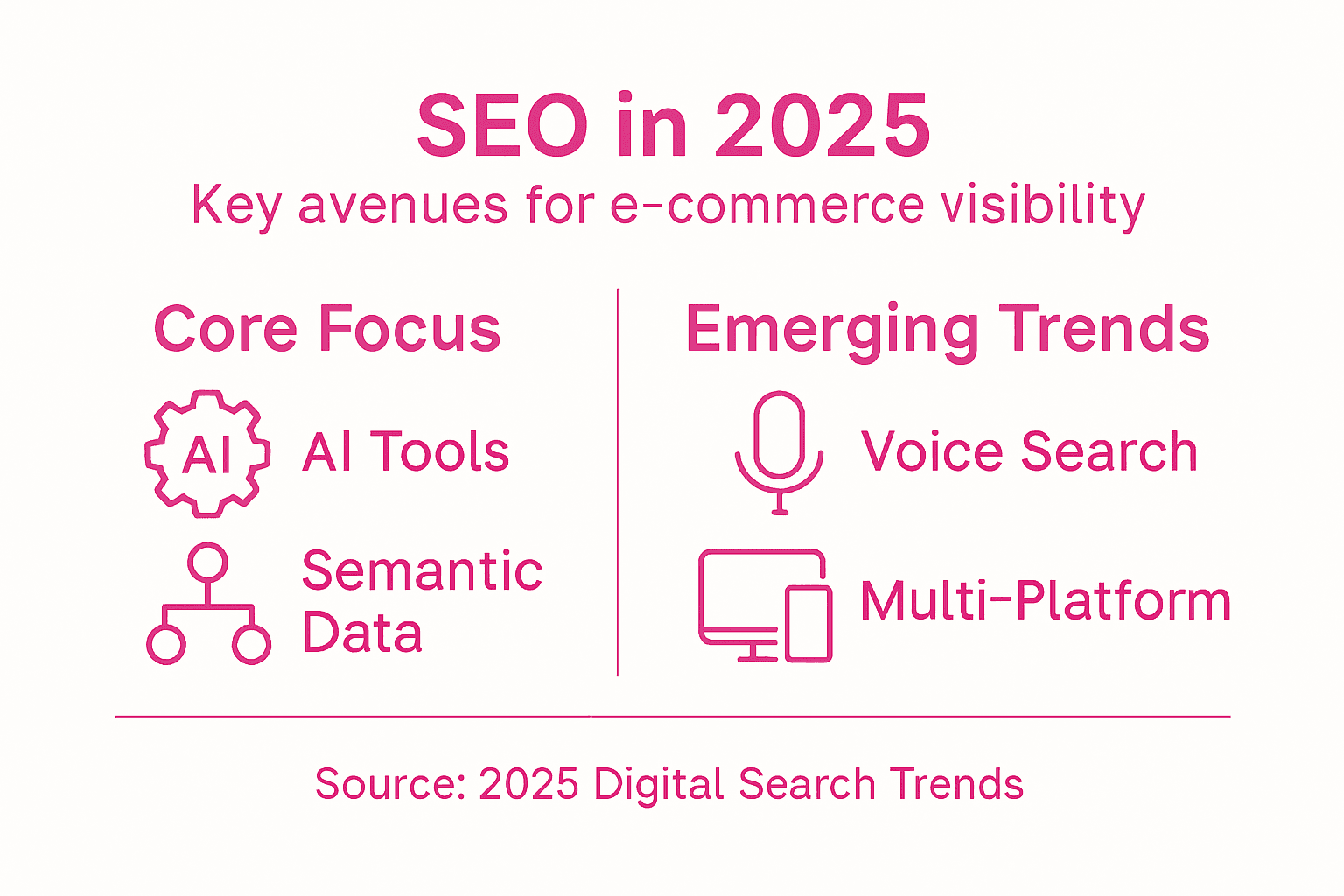
Integrate advanced semantic markup and structured data to help search engines understand your content’s context more precisely. Develop content that anticipates user intent, utilises natural language processing principles, and can be easily interpreted by both human readers and AI algorithms. Continuously monitor emerging search trends and be prepared to rapidly adapt your content strategies to meet changing user behaviours.
Top tip: Regularly experiment with different content formats and analyse their performance across various search platforms to stay ahead of evolving search technologies.
Step 5: Validate improvements with targeted performance tracking
Implementing verification optimization techniques transforms raw data into meaningful insights that validate your SEO strategy’s effectiveness. This process ensures the improvements you have implemented translate into tangible performance gains for your e-commerce platform.
Develop a comprehensive set of Key Performance Indicators (KPIs) that go beyond surface-level metrics. Track organic search traffic, conversion rates, average session duration, bounce rates, and keyword ranking progressions. Utilise performance tracking systems that provide granular insights into how each SEO modification impacts your overall digital performance. Compare current metrics against baseline measurements to quantify the precise impact of your strategic changes.
Create a structured monitoring framework that allows continuous evaluation and rapid adaptation. Set up automated reporting mechanisms that highlight performance trends, anomalies, and potential areas for further optimization. Regular analysis will help you understand which strategies are delivering results and which require refinement, ensuring your SEO approach remains dynamic and responsive to changing digital landscapes.
Top tip: Schedule quarterly comprehensive SEO performance reviews to maintain a strategic and data driven approach to your digital marketing efforts.
Elevate Your E-Commerce SEO with Expert Support Today
The challenge of staying ahead in the ever-evolving SEO landscape, especially with AI-driven keyword strategies and advanced technical enhancements, can feel overwhelming. You want to unlock the full potential of your e-commerce website by mastering cutting-edge SEO trends in 2025, yet tracking performance and adapting to new search behaviours takes time and expertise. Key pain points like integrating AI-driven keyword research, optimising for generative search engines and maintaining flawless technical SEO demand focused attention to boost your visibility fast.

Take control of your SEO success with our bespoke digital marketing services designed specifically for e-commerce. With over 25 years of experience scaling highly successful brands, we provide proven strategies in SEO, AI, social media and PPC marketing tailored to your unique goals. Don’t let complex SEO trends slow your growth. Visit iwanttobeseen.online and discover how our expertise in AI marketing strategies and mobile SEO optimisation can transform your e-commerce site. Start your journey today and ensure your brand shines brightly in the digital marketplace.
Frequently Asked Questions
How can I assess my e-commerce website’s current SEO performance in 2025?
Measuring your e-commerce website’s SEO performance begins with connecting to analytics platforms like Google Analytics and Google Search Console. Focus on analysing organic search traffic, keyword rankings, and user engagement metrics to identify areas for improvement within 30 days.
What role does AI play in keyword research for my e-commerce site?
AI-driven tools help identify nuanced search patterns and user intent, making your keyword research more efficient and insightful. Utilise AI technology to discover high-potential long-tail keywords and emerging search trends that can enhance your content strategy immediately.
What technical SEO enhancements should I prioritise for better visibility?
Focusing on improvements like Server-Side Rendering and securing your site with HTTPS can significantly enhance your search engine performance. Begin by optimising your website’s core infrastructure to improve page load speeds and search engine crawlability in the next few weeks.
How can I create content that resonates with evolving search behaviours?
To adapt to new search trends, develop content that works for various platforms, including voice search and AI knowledge repositories. Start by structuring your content to answer user queries directly and experimenting with different formats to remain competitive.
What KPIs should I track to measure the effectiveness of my SEO strategies?
Key metrics such as organic search traffic, conversion rates, and average session duration are crucial for tracking your SEO effectiveness. Create a dashboard to monitor these indicators quarterly, comparing them against baseline metrics to quantify your improvements.
How often should I review my SEO performance to stay competitive in 2025?
Conduct quarterly comprehensive SEO performance reviews to evaluate your strategies and ensure they remain effective in the rapidly evolving digital landscape. Set up automated reporting mechanisms to streamline this process and adapt quickly to any emerging trends.
Recommended
Comments