.png)
Review management: Build trust and grow your e-commerce brand


TL;DR:
Effective review management involves monitoring, responding, and soliciting genuine customer feedback regularly.
Authentic, well-handled reviews build trust, improve brand reputation, and increase customer loyalty.
Most businesses err by neglecting ongoing strategies, risking regulatory penalties and damaged reputation.
Many e-commerce businesses assume that more reviews automatically mean more sales. It sounds logical, but it is dangerously incomplete thinking. A flood of unmanaged, fake, or poorly handled negative reviews can quietly destroy the trust you have spent years building, and in the UK and Ireland, regulators are watching closely. This guide cuts through the noise to explain what review management actually involves, why it is one of the most strategically important activities your business can undertake, and how to implement it in a way that produces genuine, lasting results for your brand and your bottom line.
Table of Contents
Key Takeaways
Point | Details |
Review management defined | It means systematically monitoring, responding to and encouraging genuine reviews to enhance your brand reputation. |
Authenticity is crucial | Genuine reviews, even negative ones, build lasting trust and comply with UK law. |
Strategic framework needed | An effective review management plan covers monitoring, response, analysis, and feedback solicitation. |
Smart tools help scale | Choosing suitable review platforms and integrating them with your marketing stack simplifies the process. |
Start today | Proactive review management drives better reputation, loyalty, and sales for e-commerce businesses. |
What is review management? Key definitions and principles
Review management is not simply reading what customers write about you and hoping for the best. It is a deliberate, ongoing business function.
That definition carries real weight. Notice the three active verbs: monitoring, responding, and soliciting. Each represents a distinct responsibility that requires dedicated attention, not occasional dipping in and out of your Google Business Profile.
Monitoring means knowing what is being said about your brand, across every platform where your customers gather. That includes Google, Trustpilot, your own website, social media, and industry-specific directories. A review left unanswered for two weeks sends a louder message than the review itself.
Responding means engaging thoughtfully with every review, positive or negative, in a way that reflects your brand’s values. A well-crafted response to a critical review can actually convert sceptical browsers into buyers, because it demonstrates that you care and that you take responsibility.
Soliciting means proactively inviting genuine feedback from real customers at the right moment in their journey. This is not about gaming the system. It is about removing the friction that stops satisfied customers from sharing their experience.
The strategic importance of all three cannot be overstated. Brand reputation and e-commerce success are deeply intertwined. A brand with a strong, actively managed review presence earns more clicks, more conversions, and more repeat business than one that simply accumulates stars passively.
Here are the core principles that underpin every effective review management function:
Treat reviews as business intelligence, not just public relations. What customers say repeatedly is data you can act on to improve your product, fulfilment, or support.
Respond within 24 to 48 hours wherever possible. Speed signals professionalism and genuine care.
Maintain a consistent brand voice across all responses, whether you are thanking a loyal customer or addressing a complaint.
Never incentivise or fabricate reviews. UK regulations have tightened considerably, and the reputational damage of getting caught far outweighs any short-term gain.
Use feedback loops to improve operations. A spike in complaints about delivery times is a signal to audit your logistics partner, not just manage the optics.
Understanding social proof in e-commerce helps clarify why this function matters so much. Buyers look to other buyers for validation, and that behaviour has only intensified with the growth of mobile shopping and social commerce in the UK and Ireland.
How review management shapes brand reputation and customer loyalty
Trust is the currency of e-commerce. You cannot hold a product before you buy it online. You cannot speak to a salesperson in a physical shop. What you can do is read what hundreds of other customers experienced, and that heavily influences whether you proceed to checkout.
UK and Irish consumers are particularly attuned to authenticity. Research shows that fake review manipulation is now a priority enforcement area for the Competition and Markets Authority (CMA), which has significantly increased pressure on businesses that buy fake reviews, suppress negative ones, or offer incentives without proper disclosure. Genuine, balanced reviews build long-term trust in a way that manufactured perfect scores never can.
The contrast between managed and unmanaged review practices is stark. The table below illustrates the difference:
Factor | Managed reviews | Unmanaged reviews |
Response rate | High, consistent | Sporadic or absent |
Customer trust | Grows steadily over time | Erodes, especially after negatives |
Negative review impact | Mitigated by visible resolution | Amplified by silence |
Regulatory risk | Minimal when compliant | High if fake or undisclosed |
Repeat purchase rate | Improved through loyalty signals | Unaffected or declining |
SEO and visibility | Boosted by fresh, relevant content | Stagnant |
The implications for customer loyalty strategies are direct. When a customer sees you respond graciously to a complaint and offer a genuine resolution, their perception of your brand often improves beyond what it would have been had nothing gone wrong. That is the counterintuitive power of good review management.
Best practices for responding to both positive and negative reviews include:
Positive reviews: Thank the customer by name, reference a specific detail they mentioned, and invite them back. This reinforces the relationship and signals to other readers that real people are behind the brand.
Negative reviews: Acknowledge the issue clearly without being defensive. Apologise for the experience rather than the complaint. Offer a concrete next step, such as a direct contact or a replacement. Never argue publicly.
Neutral reviews: These are often overlooked but represent an opportunity. A thoughtful response to a three-star review can nudge the customer toward a more positive view and demonstrate your commitment to improvement.
Pro Tip: Build a response playbook for your team. Document approved phrases, escalation procedures, and brand voice guidelines so that every response, regardless of who writes it, feels consistent and professional. This becomes invaluable as your review volume grows and multiple team members contribute.
Strong brand reputation principles are built on consistency. Customers notice when responses feel automated, generic, or copy-pasted. Invest the effort in genuine communication, and the loyalty returns will compound over time.
Core elements of an effective review management strategy
Knowing why review management matters is one thing. Knowing exactly how to implement it is another. Here is a four-step framework tailored for e-commerce businesses operating in the UK and Ireland.
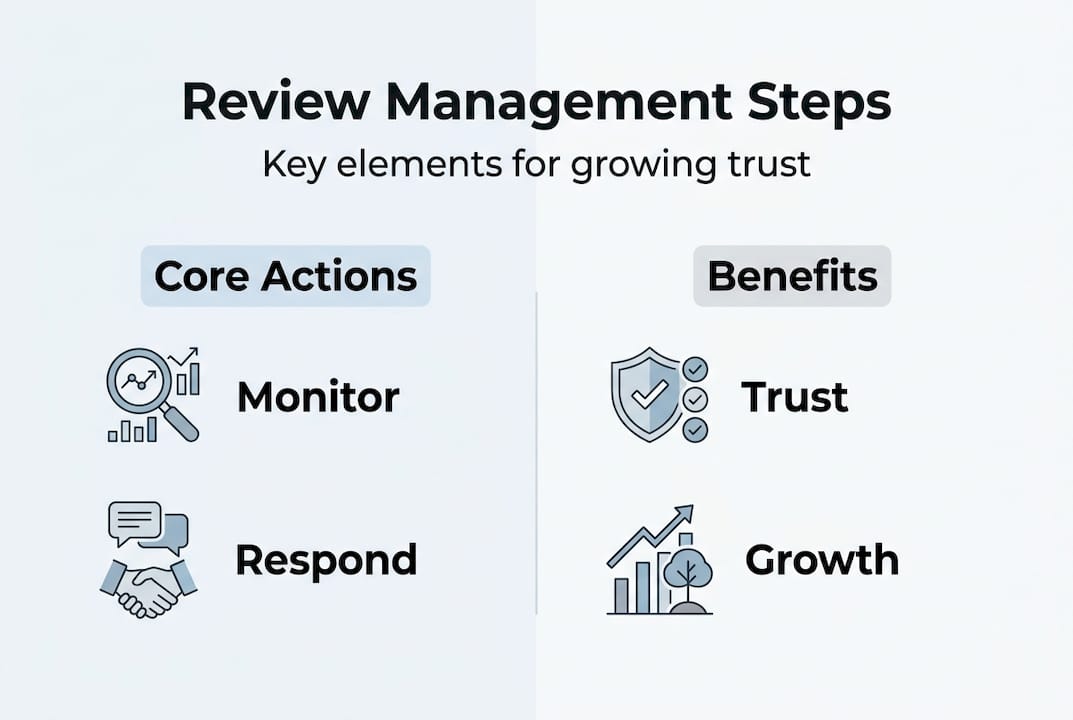
Step 1: Monitor. Set up alerts and dashboards so you know within hours when a new review appears anywhere online. Most platforms allow you to enable notifications directly. For larger operations, a centralised tool that aggregates reviews across channels is essential.

Step 2: Respond. Establish a response protocol that covers timing, tone, and escalation. Aim for responses within 24 hours. Assign clear ownership so reviews do not fall through the cracks between departments.
Step 3: Analyse. Review data is operational gold. Regularly audit your reviews for recurring themes. If multiple customers mention slow packaging, confusing returns, or poor product descriptions, that is a priority list for your operations team. Good customer experience management treats every review as a signal, not just an opinion.
Step 4: Solicit. Actively request reviews from satisfied customers using compliant, transparent methods. The timing matters enormously. A request sent two days after a confirmed delivery consistently outperforms one sent immediately at checkout, because the customer has had time to form a real opinion.
Here is a numbered action list your team can follow:
Identify every platform where your business currently receives reviews and create a master monitoring list.
Set up Google Alerts and platform-specific notifications for your brand name.
Draft a response template library, covering common positive, negative, and neutral scenarios.
Schedule a weekly review audit to identify patterns in customer feedback.
Create a post-purchase email sequence that includes a transparent, pressure-free review request.
Assign a named team member as your review management lead with clear KPIs.
Report monthly on review volume, average rating, response rate, and key themes.
The table below outlines the primary review platforms relevant to UK and Irish e-commerce businesses and what each does best:
Platform | Strengths for UK/Ireland e-commerce | Best use case |
Google Business Profile | High visibility in search results | Local and national brand trust |
Trustpilot | Widely recognised consumer trust signal | Service-based and retail e-commerce |
Feefo | Verified purchase reviews only | High-trust product categories |
Yelp | Strong in Ireland and urban UK areas | Local and niche retail |
On-site product reviews | Owned data, conversion-focused | Product pages and UX improvement |
As review management is a systematic process across platforms, using a consistent framework across each channel ensures nothing slips. Compliance and transparency are non-negotiable at every stage, particularly in light of UK consumer law developments.
Choosing the right tools and platforms for review management
The right tools can transform review management from a time-consuming manual task into a streamlined, scalable operation. As review management grows more complex with each new platform, automation and integration become genuinely important for UK e-commerce brands.
Here is a breakdown of popular options and their key strengths:
Trustpilot Business: Excellent for UK and Irish e-commerce. Offers automated review invitations, response management, and integrations with major e-commerce platforms including Shopify and WooCommerce. Recognised by UK consumers as a credible trust signal.
Yotpo: Strong product review capabilities with visual marketing features. Integrates well with social platforms and supports loyalty programme integration. Popular with fashion and beauty brands.
Podium: Particularly strong for businesses that want to consolidate reviews, messaging, and customer communications in a single dashboard. Works well for multi-location or multi-channel retailers.
BrightLocal: Primarily an SEO tool, but its review management features are excellent for local and national e-commerce brands wanting to track reputation alongside search performance.
Google Business Profile (native tools): Free and powerful for monitoring and responding to Google reviews. Should be the starting point for every business before investing in paid platforms.
Integrating your review management tools with your broader marketing software and social media tools is where the real efficiency gains appear. When your review data feeds into your social content calendar, you can quickly amplify positive feedback as user-generated content. When it connects to your SEO tools, you can see how review volume and recency affect your search rankings in real time.
Pro Tip: Start with one or two tools that solve your most pressing need, whether that is monitoring or soliciting reviews, and build from there. Trying to implement a full-stack review management solution overnight often leads to poor adoption. Simplicity at the start creates the habits; automation comes later as your volume justifies the investment.
The critical question is not which tool is the best in the abstract, but which tool fits your current team size, budget, and platform mix. A business generating 50 reviews per month has different needs from one managing 5,000. Plan for where you want to be in 18 months, not just where you are today.
Most businesses get review management wrong: Here’s what actually works
Here is the uncomfortable truth we have observed across more than 25 years of scaling e-commerce brands: most businesses treat review management as reputation polish rather than business strategy. They chase five-star averages, suppress or ignore anything below four stars, and celebrate volume over substance. It backfires, consistently and often spectacularly.
The UK’s CMA has made it abundantly clear that fake review crackdowns are not a future threat but a present reality. Brands manipulating their review profiles face not just regulatory penalties but the kind of press coverage that permanently damages consumer trust.
What actually works is counterintuitive. A brand with a 4.3-star average and visibly resolved complaints outperforms a brand with a suspiciously perfect 5.0 in terms of genuine consumer trust. Customers are not looking for perfection; they are looking for authenticity and accountability. They want to see that when something goes wrong, you make it right.
Our experience confirms that the brands winning long-term on brand reputation are those that treat every review, positive or negative, as an invitation to demonstrate their values publicly. That is the strategy worth building.
Ready to take control of your online reputation?
Review management is not a one-time fix. It is an ongoing commitment that, done well, compounds into a significant competitive advantage for your e-commerce business. The brands that invest in this now will be the ones customers trust instinctively in 2026 and beyond.

At iWantToBeSeenOnline, we specialise in helping UK and Irish e-commerce businesses build the kind of digital reputation that drives real growth. From SEO-integrated review strategies to social media amplification and conversion-focused content, our team brings over 25 years of hands-on e-commerce experience to your reputation challenges. If you are ready to move from reactive to strategic, we would love to help you build a review management system that genuinely works.
Frequently asked questions
Why is review management important for e-commerce businesses in the UK and Ireland?
Proactive review management builds customer trust, strengthens reputation, and reduces the risk posed by fake or negative reviews. Because review management shapes both perception and operations, it directly affects your conversion rates and long-term brand equity.
What’s the best way to respond to negative reviews?
Respond swiftly, acknowledge the issue without being defensive, offer a concrete resolution, and show your genuine commitment to improving the customer experience. A well-handled negative review can actually strengthen buyer confidence more than a glowing one.
Can you remove fake reviews under UK law?
You can report fake reviews to platforms for removal through their official processes, but you must never attempt to create, purchase, or manipulate reviews yourself, as CMA enforcement actively targets these practices and penalties are significant.
How do I encourage more reviews from real customers?
Ask customers at the right moment post-purchase, make the process simple with a direct link in your follow-up email, and always follow CMA guidelines on transparency and disclosure to keep your solicitation process fully compliant.
Recommended
Comments