.png)
Responsive Search Ads for Ecommerce Results


More than half of British ecommerce businesses miss out on higher conversions simply by sticking to outdated ad formats. In a digital market where customer interests change quickly, relying on static ads can leave your pay-per-click results lagging. Responsive Search Ads offer adaptive tools that help British and Irish online retailers reach customers more precisely and increase conversions with smart automation and real-time optimisation.
Table of Contents
Key Takeaways
Point | Details |
Dynamic Ad Creation | Responsive Search Ads allow e-commerce businesses to input multiple headlines and descriptions, enabling automated optimisation through machine learning. |
Strategic Variability | Crafting at least 8-10 unique headlines enhances the potential for discovering high-performing ad combinations that resonate with diverse audiences. |
Continuous Optimisation | Regularly monitor performance metrics and replace underperforming ad components to refine and improve campaign effectiveness. |
Distinct Messaging | Ensure ad components are contextually aligned yet distinct to avoid redundancy and maximise engagement with potential customers. |
Responsive Search Ads Explained for Ecommerce
Responsive Search Ads (RSAs) represent a dynamic advertising approach that allows e-commerce businesses to create flexible, automatically optimised search advertisements. Unlike traditional static ads, RSAs enable marketers to input multiple headline and description variations, which Google’s machine learning algorithms then automatically test and combine to deliver the most effective ad combinations.
The core mechanism of RSAs relies on advanced machine learning techniques. Personalised ad retrieval frameworks in e-commerce sponsored search have evolved beyond traditional keyword-based methods, enabling more intelligent ad matching. By providing up to 15 headline variations and 4 description options, advertisers give Google’s system the flexibility to generate thousands of potential ad permutations, ensuring maximum relevance for different user search queries.
Successful RSA implementation requires strategic input from marketers. Businesses must craft headlines and descriptions that are distinct yet complementary, covering various value propositions, features, and customer pain points. The algorithm prioritises combinations that demonstrate higher click-through rates and conversion potential, effectively creating a self-optimising advertising approach. By continuously testing and refining ad components, e-commerce brands can achieve more precise audience targeting and improved campaign performance.
Pro Tip - Ad Variation Strategy: Create at least 5 unique headlines that highlight different product benefits, pricing advantages, or unique selling points to maximise your RSA’s potential for discovering high-performing ad combinations.
How Responsive Search Ads Work in PPC
Responsive Search Ads (RSAs) function through a sophisticated machine learning process that dynamically assembles advertisement components to maximise performance in pay-per-click (PPC) campaigns. Unlike traditional static advertisements, RSAs allow advertisers to input multiple headline and description variations, enabling Google’s algorithms to automatically test and combine these elements to identify the most effective ad combinations.

Computational frameworks for keyword optimisation play a crucial role in understanding how RSAs generate superior advertising outcomes. These frameworks analyse multiple variables including headline text, description content, and contextual search intent to create highly targeted advertisements. Advertisers provide up to 15 headline options and 4 description variations, which the system then dynamically assembles into thousands of potential ad permutations, ensuring maximum relevance for diverse user search queries.
The underlying mechanism of RSAs relies on advanced machine learning techniques that continuously evaluate advertisement performance. By modelling and evaluating advertisement frameworks, these systems can quickly identify which ad combinations generate the highest click-through rates and conversion potential. The algorithm prioritises ad variations that demonstrate stronger user engagement, effectively creating a self-optimising advertising approach that adapts in real-time to audience responses.
Pro Tip - Performance Tracking: Regularly review your RSA performance metrics and be prepared to retire low-performing ad components, focusing on headlines and descriptions that consistently demonstrate superior engagement rates.
Core Features and AI Capabilities
Responsive Search Ads (RSAs) represent a sophisticated AI-powered advertising technology that transforms how e-commerce businesses create and optimise their digital marketing strategies. The core capabilities of these advanced ads extend far beyond traditional static advertisement formats, leveraging machine learning to dynamically generate and test multiple ad combinations in real-time.
Diversity-driven query rewriting techniques have revolutionised the AI capabilities of search advertising by enabling more intelligent content generation. These advanced reinforcement learning approaches allow advertisers to create multiple headline and description variations that can be dynamically assembled to match specific user search intents. The system intelligently evaluates each combination’s potential performance, selecting variations that demonstrate the highest likelihood of engaging potential customers.
The fundamental AI capabilities of Responsive Search Ads include sophisticated asset management and dynamic content optimisation. By providing multiple headline and description options, advertisers enable the AI to conduct continuous performance experiments. The underlying algorithms analyse historical performance data, user interaction patterns, and contextual relevance to automatically prioritise ad variations that generate the most effective engagement. This approach allows e-commerce businesses to create more nuanced, contextually relevant advertisements that adapt in real-time to changing market dynamics and consumer preferences.
Pro Tip - AI Experimentation: Develop a diverse set of ad components with distinct value propositions, allowing the AI to discover unexpected high-performing combinations that human marketers might not have initially predicted.
Setting Up and Optimising Your Ads
Setting up and optimising Responsive Search Ads (RSAs) requires a strategic approach that balances creativity with data-driven precision. E-commerce businesses must carefully craft ad components that provide maximum flexibility for Google’s machine learning algorithms while maintaining a coherent brand message across multiple potential ad combinations.
Creative best practices for ad asset creation emphasise the importance of developing diverse yet contextually aligned headlines and descriptions. Successful implementation involves creating at least 8-10 unique headlines that highlight different product benefits, pricing strategies, and unique selling propositions. This approach enables the AI to dynamically test and identify the most compelling ad variations that resonate with specific audience segments.
The optimisation process involves continuous performance monitoring and strategic asset management. Marketers should focus on developing high-quality ad variations that cover different customer pain points, value propositions, and search intents. Key strategies include incorporating popular keywords, using strong call-to-action phrases, and strategically pinning critical information to ensure essential messages are always displayed. By providing multiple options, advertisers allow the machine learning system to conduct sophisticated performance experiments that progressively refine ad effectiveness.
Pro Tip - Variation Strategy: Create headline variations that represent distinctly different value angles, ensuring your RSA can effectively target diverse customer motivations while maintaining a consistent brand narrative.
Comparing Expanded Text and Responsive Ads
Responsive Search Ads (RSAs) and Expanded Text Ads (ETAs) represent two distinct approaches to digital advertising, each with unique characteristics that impact e-commerce marketing strategies. While Expanded Text Ads provided a static, predetermined ad structure, Responsive Search Ads introduce a dynamic, machine learning-powered alternative that fundamentally transforms ad creation and performance optimisation.
Comparative analysis of search ad technologies reveals significant advantages for Responsive Search Ads. Unlike traditional Expanded Text Ads that required marketers to manually create fixed ad variations, RSAs enable advertisers to input multiple headline and description options. The underlying AI system then automatically tests and combines these components to generate the most effective ad combinations, potentially increasing click-through rates and overall campaign performance.
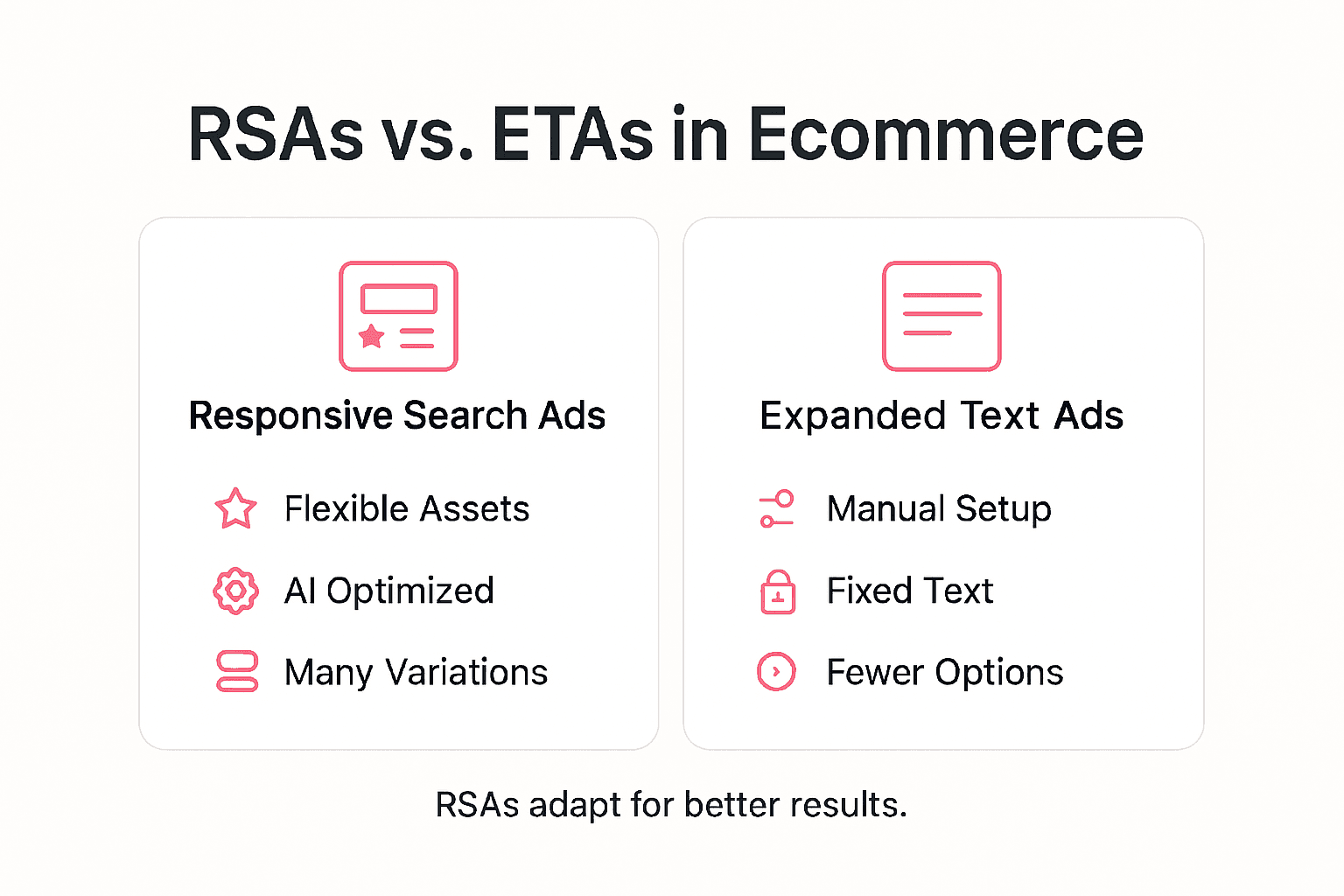
The key differences between these ad formats extend beyond mere technical mechanics. Expanded Text Ads required marketers to manually create and select specific ad variations, limiting flexibility and requiring constant manual intervention. In contrast, Responsive Search Ads leverage machine learning algorithms to dynamically assemble ad components, continuously adapting to user behaviour and search intent. This approach allows for more nuanced targeting, greater ad relevance, and a more sophisticated mechanism for discovering high-performing advertising strategies.
Here’s a side-by-side comparison of Responsive Search Ads and Expanded Text Ads in e-commerce:
Aspect | Responsive Search Ads (RSAs) | Expanded Text Ads (ETAs) |
Ad Component Flexibility | Up to 15 headlines, 4 descriptions | 3 headlines, 2 descriptions |
Optimisation Method | Machine learning, automated testing | Manual testing, human control |
Adaptation to Audience | Dynamic, real-time adjustments | Static, one-size-fits-all |
Performance Tracking | Continuous asset evaluation and refinement | Requires manual analysis |
Relevance to User Intent | High, via ongoing machine learning | Lower, as text is fixed |
Pro Tip - Transition Strategy: Gradually migrate your existing Expanded Text Ad campaigns to Responsive Search Ads, maintaining some static ads during the transition to compare performance and ensure smooth advertising continuity.
Common Mistakes and Best Practices
Responsive Search Ads require a strategic approach that balances creativity with data-driven precision. Many e-commerce marketers inadvertently limit their campaign potential by falling into common implementation traps that can significantly reduce ad performance and engagement rates.
Strategic recommendations for Responsive Search Ad optimisation highlight critical mistakes that businesses frequently encounter. These include providing insufficient headline variety, neglecting to incorporate compelling call-to-action phrases, and failing to leverage the full potential of machine learning capabilities. Successful implementation demands creating at least 8-10 distinct headlines that explore different value propositions, address varied customer pain points, and demonstrate nuanced messaging approaches.
The most effective Responsive Search Ads strategies involve continuous experimentation and performance monitoring. Marketers must develop ad components that are contextually aligned yet distinct enough to provide meaningful variation. This means crafting headlines that can stand alone while complementing each other, avoiding repetitive language, and ensuring that each asset communicates a unique aspect of the product or service offering. Strategic pinning of critical information becomes crucial, allowing advertisers to guarantee that essential messages remain consistently visible across different ad combinations.
Below is a summary of common RSA mistakes and actionable best practices for marketers:
Common Mistake | Consequence | Best Practice |
Limited headline variety | Reduced ad performance | Provide 8-10 unique headlines |
Weak calls-to-action | Lower engagement rates | Use persuasive action phrases |
Overlapping ad messages | Ad fatigue, less variety | Ensure distinct messaging angles |
Neglecting asset performance | Missed optimisation chances | Review and replace weak assets |
Poor keyword incorporation | Lower relevance to searches | Integrate top performing keywords |
Pro Tip - Variation Management: Develop a systematic approach to headline creation by categorising your ad assets into distinct messaging buckets such as benefit-driven, price-focused, feature-oriented, and emotional appeal to ensure comprehensive coverage and maximum testing potential.
Unlock the Full Potential of Responsive Search Ads for Your Ecommerce Business
If you are facing challenges in maximising your Responsive Search Ads performance through effective headline variety or mastering AI-driven optimisation, you are not alone. Many ecommerce marketers struggle with creating the right mix of ad components that engage diverse customer motivations while ensuring continuous improvement driven by machine learning. Key pain points include limited headline variations, weak calls-to-action, and underutilising Google’s dynamic ad combinations – all of which can hold back your campaign’s true potential.
At Iwanttobeseen.online, we specialise in tailored digital marketing solutions that help ecommerce brands like yours overcome these hurdles. With over 25 years of experience scaling successful brands, our expertise spans SEO, AI, Social Media, and PPC strategies designed to elevate your Responsive Search Ads. We understand how to craft diverse, compelling ad assets that empower machine learning algorithms to work smarter for your business.
Boost your campaign results today by partnering with experts who know how to transform your PPC efforts.
Create compelling headlines. Harness AI optimisation. Drive higher click-through and conversion rates.

Ready to see measurable growth with Responsive Search Ads? Explore how our proven strategies can revitalise your campaigns at Iwanttobeseen.online. Visit us now and start turning your ecommerce advertising challenges into lasting success.
Frequently Asked Questions
What are Responsive Search Ads and how do they work?
Responsive Search Ads (RSAs) are a type of advertisement that allows e-commerce businesses to input multiple headlines and descriptions. Google’s machine learning algorithms then automatically test and combine these elements to determine the most effective ad combinations for different user search queries.
How can I optimise my Responsive Search Ads for better performance?
To optimise your RSAs, create at least 8-10 unique headlines and ensure they highlight different benefits, pricing strategies, and customer pain points. Regularly monitor performance metrics and retire low-performing components while focusing on high-engagement variants.
What are the advantages of using Responsive Search Ads over Expanded Text Ads?
Responsive Search Ads offer greater flexibility by allowing up to 15 headline options and 4 description options, unlike Expanded Text Ads, which are static. RSAs utilise machine learning to continuously optimise ad combinations in real time, leading to potentially higher click-through rates and improved performance.
What common mistakes should I avoid when creating Responsive Search Ads?
Common mistakes include providing insufficient headline variety, using weak calls to action, allowing overlapping ad messages, neglecting performance monitoring, and poor keyword integration. It’s essential to develop a diverse range of headlines and regularly review the performance of your ads.
Recommended
Comments