.png)
What is Gray Hat SEO and Its Impact on eCommerce
- Darren Burns
- Dec 25, 2025
- 9 min read


Most british eCommerce brands underestimate how quickly gray hat SEO tactics can shift from clever advantage to risky liability. As search engines evolve, strategies that seem harmless today might be penalised in the next algorithm update. For marketing managers in the United Kingdom and Ireland, understanding the true risks and rewards of gray hat techniques helps them stay ahead of aggressive competitors. Unpacking misconceptions and revealing proven approaches gives your brand the edge most retailers never truly master.
Table of Contents
Key Takeaways
Point | Details |
Understanding Gray Hat SEO | Gray hat SEO techniques fall into a morally ambiguous zone, offering tactical advantages while posing risks of algorithmic penalties. |
Continuous Monitoring Required | Regularly audit SEO strategies to stay informed about changes in search engine algorithms that may reclassify techniques as unacceptable. |
Strategic Risk Assessment | Maintain a balance of white hat to gray hat techniques to mitigate potential long-term ranking consequences and protect brand reputation. |
Authenticity Over Manipulation | Prioritise genuine user experience and high-quality content over manipulative strategies to ensure sustainable digital marketing success. |
Gray hat SEO explained with common myths
Gray hat SEO exists in a nebulous space between ethical white hat techniques and overtly manipulative black hat strategies. Unlike clear-cut approaches, gray hat methods challenge search engine guidelines without completely violating them. Shifting definitions of SEO tactics mean techniques that seem acceptable today could become penalised tomorrow.
Common myths surrounding gray hat SEO often misrepresent its true nature. Many eCommerce marketing managers mistakenly believe these techniques guarantee instant ranking improvements without consequences. In reality, gray hat strategies involve calculated risks that might temporarily boost performance but could ultimately harm long-term search visibility. Techniques like purchasing expired domains, creating multiple microsites targeting similar keywords, or using subtle link manipulation fall into this controversial category.
Understanding the nuanced landscape requires recognising that search engines continuously evolve their algorithms. What might constitute a gray hat technique in one algorithm update could become a direct violation in the next. For eCommerce businesses, this means constant vigilance and adaptability are crucial. Monitoring algorithm changes, staying informed about search engine webmaster guidelines, and maintaining a strategic approach can help mitigate potential risks associated with gray hat practices.
Pro Tip: Strategic Assessment: Carefully evaluate each potential gray hat technique against your long-term SEO goals, considering potential short-term gains versus potential ranking penalties.
Types of gray hat SEO techniques for eCommerce
Ecommerce businesses often explore complex SEO techniques that navigate ethical boundaries to gain competitive advantages. Gray hat techniques represent strategic approaches that technically do not violate search engine guidelines but exist in a morally ambiguous zone. These methods typically involve subtle manipulations designed to boost search rankings without triggering immediate penalties.

Some prevalent gray hat techniques in eCommerce include purchasing expired domains with existing authority, creating multiple microsites targeting similar keywords, and employing sophisticated content spinning strategies. Online retailers might leverage these approaches to quickly improve visibility, such as generating similar content across different domains or acquiring backlinks through less transparent means. These tactics can provide short-term ranking improvements but carry substantial risks of future algorithmic penalties.
The most sophisticated gray hat techniques require nuanced understanding and calculated risk management. Practitioners might engage in practices like strategic link exchanges, creating content networks that appear organic but are strategically engineered, or using advanced cloaking techniques that present different content to search engines versus human visitors. While these methods can momentarily boost performance, they demand constant monitoring and adaptability to evolving search engine algorithms.
Pro Tip: Risk Management: Regularly audit your SEO strategies, maintaining a 70-30 ratio of white hat to gray hat techniques to minimise potential long-term ranking consequences.
How gray hat tactics work with real-world examples
Gray hat SEO tactics operate through sophisticated manipulation of search engine algorithms, creating scenarios where technical compliance meets strategic exploitation. These techniques involve intricate approaches that push boundaries without overtly violating guidelines. For instance, an eCommerce retailer might purchase an expired domain with established authority and redirect its existing backlink profile to their current website, artificially boosting their search rankings through seemingly legitimate means.
Another prevalent gray hat technique involves content syndication networks, where businesses create multiple microsites with slightly modified content targeting similar keywords. By generating interconnected content that appears unique but shares fundamental similarities, these networks aim to increase overall digital footprint and search visibility. This approach might involve creating region-specific landing pages, each optimised for slightly different long-tail keywords while maintaining a core content structure that minimises detection by search engine crawlers.
Moreover, advanced practitioners employ nuanced link-building strategies that blur ethical lines. These might include guest posting on marginal websites, participating in controlled link exchanges, or developing complex content networks that simulate organic link growth. Such tactics require meticulous planning and constant adaptation, as search engines continuously refine their algorithms to detect and penalise manipulative practices. The key lies in creating systems that appear natural while strategically enhancing search performance.
Pro Tip: Strategic Monitoring: Develop a robust tracking system to continuously assess the performance and potential risks of your gray hat SEO tactics, ensuring you can quickly pivot if search engine algorithms show signs of detecting your strategies.
Legal, ethical and algorithmic risks for brands
Gray hat SEO techniques represent a complex landscape of potential reputational and algorithmic risks for eCommerce brands. Maintaining brand reputation becomes increasingly challenging when organisations employ tactics that skirt the edges of search engine guidelines. These strategies can trigger severe consequences, ranging from subtle ranking penalties to complete removal from search index results, which can devastate online visibility and consumer trust.
The algorithmic risks associated with gray hat techniques are particularly nuanced. Search engine algorithms continuously evolve, becoming more sophisticated in detecting manipulative practices. Brands engaging in techniques like cloaking, hidden text, link farms, or sophisticated content spinning may initially experience short-term ranking improvements. However, these gains are inevitably temporary, with potential long-term damage to domain authority and search engine credibility. Modern algorithms can retroactively penalise websites, potentially resulting in dramatic drops in organic traffic and substantial revenue losses.
Legal and ethical considerations extend beyond technical search engine guidelines. Businesses must consider potential regulatory implications, particularly in industries with strict advertising standards. Gray hat techniques can be interpreted as deceptive marketing practices, potentially triggering investigations from consumer protection agencies. Moreover, these strategies fundamentally undermine the principles of transparent digital marketing, eroding customer trust and potentially leading to significant reputational damage that far outweighs any marginal search ranking improvements.
Pro Tip: Risk Assessment: Conduct quarterly comprehensive audits of your SEO strategies, mapping each technique against potential algorithmic and legal risks to maintain a sustainable, ethical digital marketing approach.
Here is a summary of the key risks associated with gray hat SEO for eCommerce brands:
Risk Type | Description | Potential Impact |
Algorithmic | Detection and penalisation by search engines | Loss of rankings, reduced traffic |
Legal | Breach of advertising or consumer regulations | Investigations, fines, legal fees |
Reputational | Damage to brand credibility and trust | Loss of customers, negative press |
Ethical | Undermining transparency in digital marketing | Erosion of user confidence |
Comparing gray hat SEO to white and black hat strategies
Understanding the nuanced spectrum of SEO strategies requires a comprehensive exploration of white, gray, and black hat techniques. SEO strategies in eCommerce fundamentally differ in their approach to search engine guidelines, ethical considerations, and long-term sustainability. White hat SEO represents the most transparent and recommended approach, strictly adhering to search engine guidelines by creating high-quality, relevant content and implementing genuine user-focused optimisation techniques.
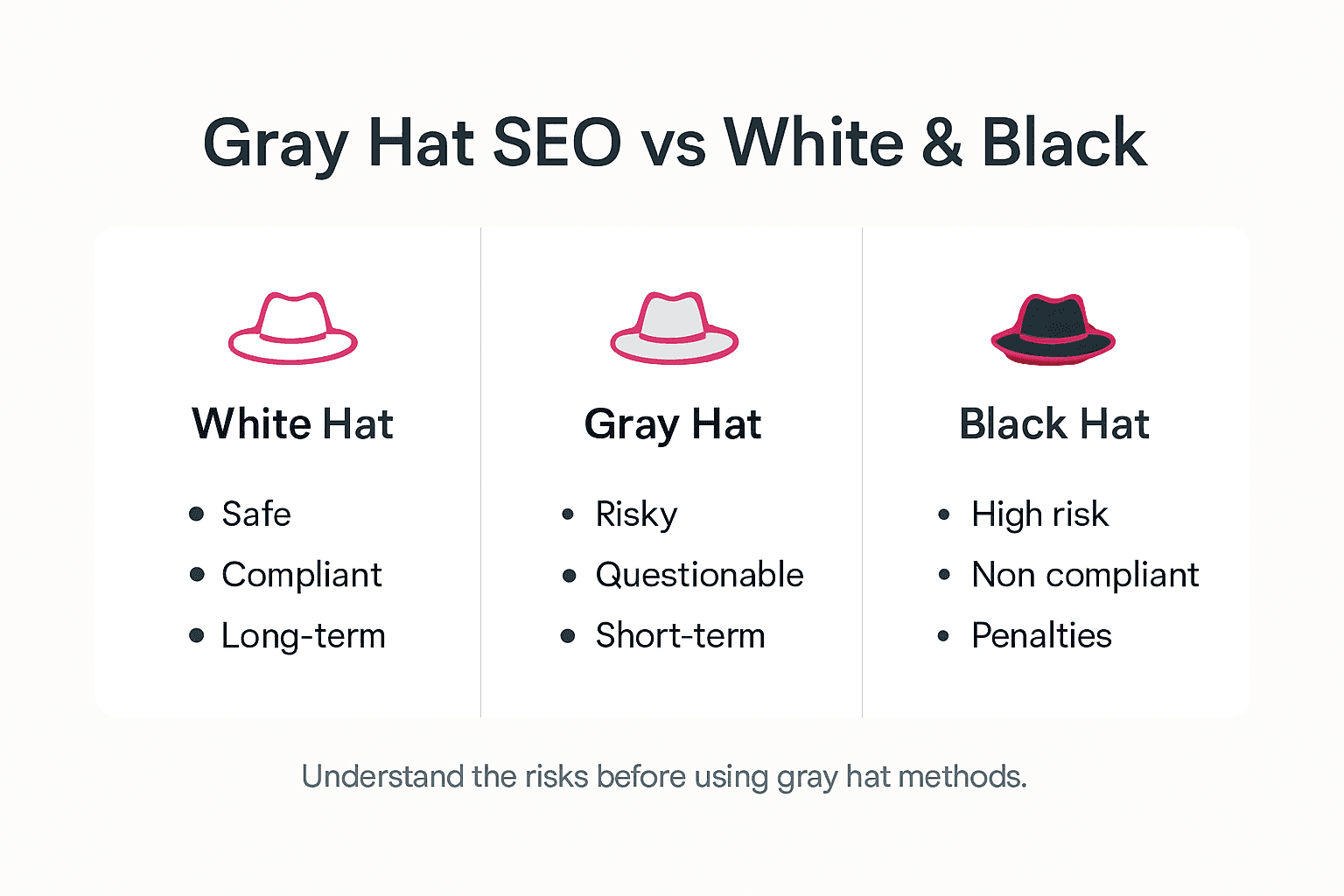
Black hat SEO sits at the opposite end of the spectrum, involving explicitly prohibited practices designed to manipulate search rankings through deceptive means. These techniques include cloaking, hidden text, keyword stuffing, and creating artificial link networks. Gray hat SEO emerges as a complex middle ground, employing strategies that technically do not violate guidelines but exist in an ethical grey area. While white hat techniques prioritise user experience and long-term credibility, and black hat techniques risk immediate penalties, gray hat approaches represent a calculated risk-taking strategy that attempts to exploit algorithmic nuances.
The key distinctions between these approaches become evident in their implementation and potential consequences. White hat SEO focuses on organic growth, investing in quality content, genuine user engagement, and natural link-building. Black hat techniques guarantee short-term gains with inevitable long-term destruction, potentially resulting in complete search engine delisting. Gray hat strategies occupy a precarious position, offering temporary performance improvements while maintaining a thin veneer of plausible deniability. eCommerce businesses must carefully weigh the potential short-term ranking benefits against the substantial risks of algorithmic penalties and reputational damage.
Pro Tip: Strategic Alignment: Develop a comprehensive SEO strategy that leans 90% towards white hat techniques, using gray hat approaches sparingly and with rigorous risk assessment.
This table outlines the differences between white hat, gray hat, and black hat SEO strategies:
Approach | Compliance Level | Main Techniques | Long-Term Outcome |
White Hat | Strictly follows rules | Original content, genuine optimisation | Sustainable growth, stable rankings |
Gray Hat | Exploits rule ambiguities | Expired domains, link manipulation | Temporary gains, risk of penalties |
Black Hat | Overtly violates rules | Cloaking, hidden links, keyword stuffing | Quick results, eventual severe penalties |
Mistakes to avoid when using gray hat approaches
eCommerce businesses must navigate gray hat SEO strategies with extreme caution. Critical mistakes in SEO implementation can rapidly transform seemingly clever techniques into catastrophic ranking penalties. Over-optimisation represents the most prevalent error, where brands aggressively manipulate content and backlink profiles beyond natural boundaries, triggering sophisticated search engine algorithm warnings.
Another significant mistake involves neglecting comprehensive risk assessment and continuous monitoring. Gray hat techniques require constant evaluation, as strategies that appear marginally acceptable today might become explicitly prohibited in future algorithm updates. Businesses frequently err by creating intricate networks of microsites, purchasing expired domains, or engaging in controlled link exchanges without understanding the nuanced risks. These approaches might provide temporary ranking improvements but can result in substantial long-term visibility damage when search engines detect manipulative patterns.
Perhaps the most dangerous mistake is treating gray hat techniques as a sustainable strategy rather than a calculated, short-term tactic. Many eCommerce brands mistakenly believe they can consistently outmanoeuvre search engine algorithms, failing to recognise the increasingly sophisticated detection mechanisms. Techniques like content spinning, hidden redirects, and artificial link networks might seem clever, but they fundamentally undermine the core principle of providing genuine value to users. Successful digital marketing requires a holistic approach that prioritises authentic user experience and high-quality, original content.
Pro Tip: Risk Mitigation: Implement a quarterly comprehensive SEO audit that explicitly identifies and eliminates any gray hat techniques, replacing them with transparent, user-focused strategies.
Mastering Gray Hat SEO Risks with Expert eCommerce Solutions
Navigating the complex world of gray hat SEO requires deep understanding and strategic foresight to avoid costly penalties that could damage your brand’s reputation and search rankings. If your eCommerce business is struggling to balance short-term ranking gains against long-term sustainability while managing risks like expired domain usage or subtle link manipulation, you need proven digital marketing expertise tailored for this delicate landscape.

Take control now by partnering with specialists who have over 25 years of experience scaling successful eCommerce brands through transparent SEO, AI, social media, and PPC strategies. Visit our homepage to explore how our bespoke services can help you maintain search engine compliance and grow your online presence without risking penalties. Your brand deserves a smart strategy that prioritises ethical growth and continual algorithm adaptability. Start safeguarding your eCommerce success today.
Frequently Asked Questions
What is gray hat SEO?
Gray hat SEO refers to techniques that fall between white hat practices, which are fully compliant with search engine guidelines, and black hat practices, which directly violate them. Gray hat strategies may exploit ambiguities in guidelines without crossing the line into outright deception.
How do gray hat SEO techniques impact eCommerce businesses?
Gray hat techniques can provide short-term ranking improvements for eCommerce businesses; however, these methods carry risks of future penalties from search engines. Relying too heavily on these practices can lead to long-term visibility and reputational damage.
What are some common gray hat SEO techniques used in eCommerce?
Common gray hat techniques include purchasing expired domains, creating multiple microsites targeting similar keywords, and employing sophisticated link manipulation methods. While these strategies can boost visibility, they must be managed carefully to mitigate risks.
Why is it important to monitor changes in search engine algorithms when using gray hat SEO?
Search engine algorithms are continually evolving, meaning techniques that may be acceptable today could become penalised tomorrow. Monitoring these changes helps eCommerce businesses adapt their strategies and avoid potential penalties associated with gray hat practices.
Recommended
Comments