.png)
Predictive Marketing: Boosting eCommerce Sales Growth


More than 60 percent of british online shoppers expect tailored product recommendations every time they visit an e-commerce site. As a growing business owner in the UK or Ireland, staying ahead means understanding how data-driven predictive marketing can transform your customer targeting strategy. This overview reveals how modern analytics help you anticipate shopper needs with precision, giving your store a competitive edge in crafting relevant offers and driving sales.
Table of Contents
Key Takeaways
Point | Details |
Predictive Marketing Utilises Data Analytics | E-commerce businesses can leverage data analytics to anticipate customer behaviours and create targeted marketing strategies. |
Advanced Models Enhance Precision | Techniques like machine learning and deep learning enable the analysis of complex data patterns for hyper-personalisation. |
Integration of Diverse Data Sources | Combining data from various customer interactions supports accurate model training and actionable insights. |
Risks of Data Quality and Bias | Maintaining data quality and mitigating biases in models are crucial to ensure reliable predictions and ethical decision-making. |
Predictive Marketing Defined for eCommerce
Predictive marketing represents a sophisticated data-driven approach that enables e-commerce businesses to anticipate customer behaviours, preferences, and potential purchasing patterns using advanced machine learning and statistical techniques. By leveraging sophisticated data analytics, organisations can transform raw customer information into strategic insights that drive targeted marketing initiatives.
At its core, predictive marketing utilises complex algorithms to analyse both structured and unstructured data from multiple consumer touchpoints. This methodology allows e-commerce platforms to develop highly personalised marketing strategies that go beyond traditional demographic segmentation. Businesses can now predict individual customer needs with unprecedented accuracy, enabling them to create tailored product recommendations, optimise pricing strategies, and design precision-targeted marketing campaigns.
The practical implementation of predictive marketing involves integrating multiple data sources including browsing history, purchase records, social media interactions, and real-time engagement metrics. Advanced machine learning techniques help businesses understand nuanced consumer behaviour patterns, transforming raw data into actionable marketing intelligence. This approach enables e-commerce companies to anticipate customer requirements, reduce inventory waste, and significantly improve overall sales performance.
Pro tip: Start by auditing your existing customer data infrastructure and identifying key predictive markers that can help segment and personalise your marketing approach effectively.
Key Types and Data-Driven Models Explained
Predictive marketing leverages multiple sophisticated data-driven models to transform raw customer information into actionable marketing strategies. Machine learning techniques offer e-commerce businesses unprecedented capabilities to analyse complex behavioural patterns and forecast consumer interactions with remarkable precision.
The primary categories of predictive marketing models include statistical regression models, machine learning algorithms, and advanced deep learning approaches. Statistical regression models provide foundational insights by establishing linear relationships between variables, while machine learning algorithms like Support Vector Machines (SVM) and Extreme Gradient Boosting (XGBoost) can capture more nuanced, non-linear relationships in customer data. Deep learning neural networks represent the most advanced tier, capable of processing intricate, multidimensional datasets and generating highly personalised predictions.

Each model type offers unique strengths for e-commerce marketing. Regression models excel at simple trend prediction, machine learning algorithms provide complex pattern recognition, and deep learning approaches enable hyper-personalised customer segmentation. The selection of an appropriate model depends on data complexity, available computational resources, and specific marketing objectives. Businesses must carefully evaluate their data infrastructure, computational capabilities, and strategic goals to choose the most effective predictive marketing approach.
Here’s a structured overview of predictive marketing model types and their business impacts:
Model Type | Main Function | Data Complexity Suitability | Impact on Personalisation |
Statistical Regression | Finds linear relationships | Best for simple, structured data | Basic segmentation and trend prediction |
Machine Learning | Captures complex patterns | Handles moderate data complexity | Enables targeted recommendations |
Deep Learning Neural Net | Analyses multidimensional data | Ideal for large, complex datasets | Drives hyper-personalised experiences |
Pro tip: Invest in comprehensive data quality management and consistently validate your predictive models against real-world performance metrics to ensure ongoing accuracy and effectiveness.
How Predictive Marketing Works in Practice
Predictive marketing operates through a sophisticated, multi-stage process that transforms raw data into actionable marketing intelligence. Machine learning techniques enable e-commerce businesses to systematically collect, analyse, and leverage customer data for precision-targeted marketing strategies. This process begins with comprehensive data collection from multiple sources, including website interactions, purchase histories, social media engagement, and demographic information.
The core mechanism involves sophisticated data processing and model training. Analytics platforms like Google Analytics help businesses aggregate diverse data points, which are then cleaned, structured, and prepared for algorithmic analysis. Machine learning algorithms examine these datasets to identify complex patterns, customer segments, and predictive indicators of future purchasing behaviour. Advanced AI-driven analytics platforms enable businesses to develop dynamic predictive models that continuously learn and adapt based on new incoming data, creating increasingly accurate customer insights over time.
Implementation typically involves several key stages: data collection, feature extraction, model training, and predictive deployment. E-commerce businesses can use these insights to personalise product recommendations, optimise pricing strategies, predict potential customer churn, and design highly targeted marketing campaigns. The most sophisticated predictive marketing approaches integrate real-time data processing, allowing businesses to make immediate, data-driven decisions that respond dynamically to changing customer behaviours and market conditions.
Pro tip: Regularly audit and refresh your predictive marketing models to ensure they remain accurate, and invest in robust data infrastructure that supports comprehensive, high-quality data collection.
Practical Benefits and eCommerce Use Cases
Predictive marketing offers transformative benefits for e-commerce businesses, providing strategic insights that directly impact operational efficiency and revenue generation. Predictive analytics enables businesses to develop sophisticated strategies that go far beyond traditional marketing approaches. Key practical benefits include enhanced inventory management, more accurate sales forecasting, and the ability to create highly personalised customer experiences that drive engagement and conversion rates.
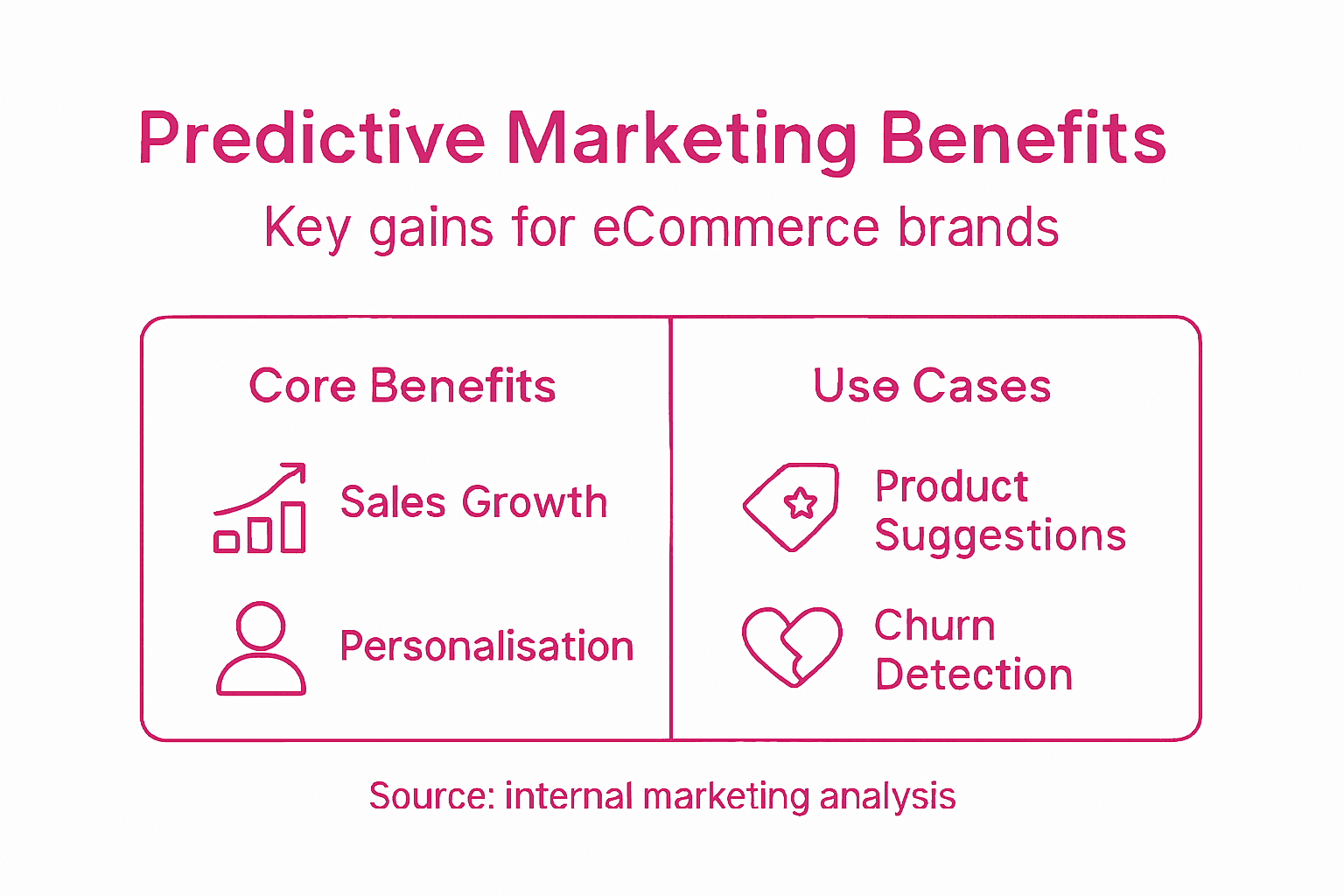
The specific use cases for predictive marketing in e-commerce are diverse and powerful. Targeted marketing strategies can be implemented across multiple business functions, including customer segmentation, dynamic pricing, personalised product recommendations, and fraud detection. For instance, machine learning algorithms can analyse historical purchasing data to predict future buying patterns, allowing businesses to proactively manage stock levels, design targeted promotional campaigns, and create individualised shopping experiences that significantly improve customer loyalty and retention.
Operational benefits extend beyond marketing, encompassing strategic decision-making across the entire business ecosystem. Predictive models can help e-commerce companies optimise pricing strategies by analysing market trends, competitor pricing, and individual customer price sensitivity. They can also predict potential customer churn, enabling businesses to develop preemptive retention strategies. The most advanced predictive marketing approaches integrate real-time data processing, allowing for immediate, data-driven decisions that respond dynamically to changing market conditions and individual customer behaviours.
The following table summarises major predictive marketing benefits for e-commerce use cases:
Benefit | Description | Typical Use Case |
Enhanced Inventory Mgmt | Reduces overstock and shortages | Automated stock optimisation |
Accurate Sales Forecasting | Improves revenue planning | Seasonal demand anticipation |
Personalised Experiences | Increases engagement and conversions | Individualised product offers |
Real-Time Decision-Making | Responds promptly to customer behaviour | Dynamic pricing adjustments |
Pro tip: Develop a comprehensive data collection strategy that captures multi-dimensional customer interactions, ensuring your predictive models have rich, diverse data sources to generate more accurate insights.
Risks, Limitations and Common Pitfalls
Data quality challenges represent the most significant risk in predictive marketing for e-commerce businesses. These challenges emerge from multiple sources, including incomplete customer datasets, inconsistent data collection methods, and inherent biases that can dramatically skew predictive model accuracy. E-commerce organisations must recognise that predictive models are only as reliable as the underlying data, making rigorous data validation and continuous quality assessment critical to maintaining meaningful insights.
Another substantial limitation involves the complex technical challenges of developing scalable and adaptable predictive models. Machine learning algorithms frequently encounter the ‘cold start’ problem, where insufficient historical data makes accurate predictions challenging for new products or emerging customer segments. Predictive model interpretability remains a significant concern, as many advanced algorithms operate as ‘black box’ systems, making it difficult for businesses to understand exactly how specific predictions are generated. This lack of transparency can potentially undermine stakeholder confidence and create ethical concerns around automated decision-making processes.
Furthermore, e-commerce businesses must be acutely aware of potential systemic biases that can inadvertently be encoded into predictive models. These biases might arise from historical data reflecting previous discriminatory practices, leading to skewed recommendations or unfair customer segmentation. Computational complexity also presents challenges, with sophisticated machine learning models requiring significant computational resources and expertise to develop, maintain, and continuously refine. The risk of over-relying on automated systems without sufficient human oversight cannot be understated, as predictive models should augment rather than completely replace human strategic decision-making.
Pro tip: Implement a robust model governance framework that includes regular bias audits, maintains human oversight, and ensures continuous model retraining to mitigate predictive marketing risks.
Unlock the Power of Predictive Marketing to Accelerate Your eCommerce Growth
Struggling to turn complex customer data into real sales growth? This article highlights key challenges like data quality, model complexity, and the demand for hyper-personalisation faced by eCommerce businesses relying on predictive marketing. At IWantToBeSeen Online, we understand these hurdles and specialise in digital marketing solutions tailored for eCommerce brands looking to harness the full potential of AI-driven strategies. Our expertise in SEO, AI, Social Media, and PPC combines with over 25 years of experience scaling successful online stores to help you predict and meet your customers’ needs with precision.
Imagine reducing inventory waste and boosting conversions through perfectly targeted campaigns that use accurate predictive insights. Our bespoke services transform your raw customer data into strategic growth opportunities while maintaining model transparency and ensuring ethical, bias-free outcomes. Partner with us and gain a competitive edge by personalising every customer interaction based on sophisticated machine learning models.
Take the next step now and explore how our digital marketing experts can refine your predictive marketing approach and deliver measurable sales increases. Discover your potential with IWantToBeSeen Online today.

Ready to elevate your eCommerce strategy using predictive marketing? Visit IWantToBeSeen Online and request a consultation to start turning complex data into clear results.
Frequently Asked Questions
What is predictive marketing in eCommerce?
Predictive marketing in eCommerce is a data-driven approach that uses advanced analytics and machine learning to anticipate customer behaviour, preferences, and purchasing patterns, allowing businesses to create personalised marketing strategies.
How does predictive marketing improve customer experiences?
Predictive marketing improves customer experiences by enabling eCommerce businesses to offer tailored product recommendations, optimise pricing strategies, and design targeted marketing campaigns based on individual customer insights.
What are the main types of predictive marketing models?
The main types of predictive marketing models include statistical regression models, machine learning algorithms, and deep learning approaches. Each model type captures different complexities in data and offers unique strengths for eCommerce marketing.
What are the potential risks of implementing predictive marketing?
Potential risks of predictive marketing include data quality challenges, technical difficulties in developing scalable models, issues with interpretability of algorithms, and the risk of systemic biases in recommendations. Businesses need to implement robust governance frameworks to mitigate these risks.
Recommended
Comments