.png)
Pillar content meaning: boost e-commerce SEO by 30%


TL;DR:
Pillar content is a strategic, comprehensive resource central to topic clusters for SEO.
Properly built pillar pages can generate over 30% more organic traffic for e-commerce brands.
Regular updates and maintenance are crucial for maintaining topic authority and search rankings.
Pillar content is one of the most misunderstood concepts in e-commerce SEO. Many marketing teams assume it simply means writing a very long article, publish it, and wait for rankings to climb. That assumption is costly. True pillar content acts as a strategic SEO anchor, building topical authority across your entire site and pulling in organic traffic at scale. Done correctly, it can drive over 30% more organic traffic than standard content approaches. This guide cuts through the confusion, explains exactly what pillar content means, and gives you a clear, actionable framework to build and maintain it for your e-commerce brand.
Table of Contents
Key Takeaways
Point | Details |
Pillar content explained | Pillar content is a comprehensive, central resource that anchors your SEO and supports related subtopic pages. |
Drives measurable SEO growth | E-commerce brands can achieve over 30% higher organic traffic with the pillar-cluster model. |
Quality beats quantity | Consistently updated, high-quality pillar and cluster pages drive more results than large volumes of mediocre content. |
Maintain for ongoing results | Quarterly updates and a clear linking strategy are vital for keeping pillar content effective and relevant. |
Defining pillar content: meaning, structure, and purpose
Let us be precise. A pillar page is not simply a long blog post. It is a comprehensive, strategically structured resource that sits at the centre of a topic cluster. Think of it as the trunk of a tree, with supporting cluster articles branching out from it. Pillar pages are comprehensive, long-form resources that act as a central hub for a topic cluster strategy, linking to and from a set of related, more specific articles.
Structurally, a well-built pillar page typically runs between 3,000 and 5,000 words. It includes a table of contents for easy navigation, clear section headings, and deliberate internal links to every cluster article in its topic group. It is designed to answer a broad question thoroughly while signposting readers to deeper dives on specific subtopics.
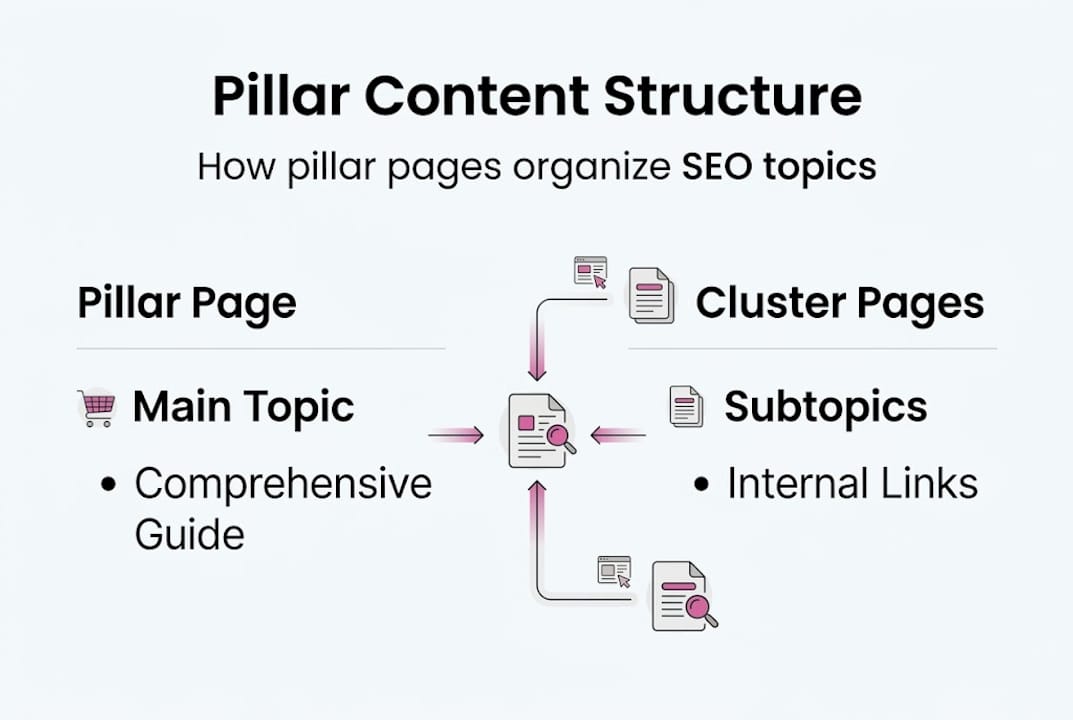
The purpose is threefold. First, it builds topical authority, signalling to search engines that your site covers a subject in depth. Second, it addresses broad user intent, capturing visitors at different stages of the buying journey. Third, it creates a scalable content marketing strategy for e-commerce that compounds in value over time.
Here is where many teams get confused. There is an important distinction between pillar content, content pillars, and a link hub:
Format | Description | SEO value |
Pillar page | Deep, long-form resource with cluster links | High |
Content pillar (theme) | A broad topic theme for brand messaging | Indirect |
Link hub | A curated list of links to related pages | Low to moderate |
These are not interchangeable. A content pillar is a messaging framework used in brand strategy. A link hub is a navigation page. Neither delivers the SEO depth of a true pillar page.
“The goal of a pillar page is not just length. It is to become the most useful, authoritative resource on a topic within your niche.”
Understanding content marketing’s impact on organic growth makes it clear why getting this structure right from the start matters enormously for e-commerce teams.
How pillar content powers e-commerce SEO: the pillar-cluster model
With a structural understanding in place, let us look at the powerful impact pillar content creates for e-commerce brands through the pillar-cluster model.
The model works like this. Your pillar page covers a broad topic, for example, “sustainable outdoor clothing.” Your cluster articles each cover a specific subtopic within that theme: waterproof fabrics, ethical supply chains, care instructions, and so on. Each cluster article links back to the pillar, and the pillar links out to each cluster. This creates a web of relevance that search engines reward.

The technical SEO benefit is significant. Every internal link between pillar and cluster passes authority in both directions, reinforcing the site’s expertise on that topic. Search engines see a coherent, interconnected body of content rather than isolated pages competing against each other.
The results from brands that have implemented this model are striking. The pillar-cluster approach can result in 30 to 43% more organic traffic and three-figure keyword growth. Some e-commerce brands have reported 3,403% keyword growth, a 30,400% traffic boost, and a 56% revenue rise after restructuring their content around the pillar-cluster model.
To map a pillar-cluster structure for your online shop, follow these steps:
Identify your top three to five product categories.
Choose one broad topic per category that has strong search demand.
Research 8 to 15 subtopics within each broad topic using tools like Ahrefs or SEMrush.
Assign each subtopic to a cluster article (1,000 to 2,500 words each).
Build or update your pillar page to link to every cluster article.
Ensure every cluster article links back to the pillar page.
Explore content marketing ideas for e-commerce to help generate subtopic ideas that align with real buyer questions. You can also review e-commerce content strategy steps to see how this fits into a broader planning framework.
Pro Tip: For UK and Ireland SMEs, resist the temptation to build ten pillar pages at once. Start with one topic cluster, execute it well, measure the results, and then expand. Quality always outperforms volume in competitive niches.
Best practices: building and maintaining effective pillar content
To make pillar content work for your business, let us turn to the techniques and best practices that separate high-performing strategies from the rest.
Choosing the right broad topic is the foundation. Start with your main product categories and use keyword tools like Ahrefs or SEMrush to identify terms with high search volume and clear informational intent. Avoid topics that are too narrow (better suited to cluster articles) or too broad (impossible to cover authoritatively).
Once your topic is confirmed, map your subtopics carefully. Each subtopic should be specific enough to warrant its own article but clearly connected to the pillar theme. Think about the questions your customers actually ask before, during, and after a purchase.
When writing the pillar page itself, follow these principles:
Open with a direct answer to the main question within the first 100 words.
Include a linked table of contents at the top.
Use H2 and H3 headings to create scannable sections.
Embed internal links to cluster articles naturally within the body text.
Add visuals, tables, and summaries to improve time on page.
Internal linking deserves special attention. Every cluster article should link to the pillar using consistent anchor text. The pillar should link to each cluster at the most relevant point in the text. This bidirectional linking is what makes the model work technically.
Quarterly updates and strong internal linking are essential for keeping pillar content relevant and performing well. Set a calendar reminder every three months to review each pillar page. Check for outdated statistics, broken links, new competitor content, and gaps in your cluster coverage.
Common mistakes to avoid:
Publishing a pillar page without any cluster articles in place.
Writing thin cluster content just to hit a number.
Forgetting to update the pillar when cluster articles are added or revised.
Ignoring marketplace SEO insights that could inform your topic selection.
“A pillar page that is not maintained is a pillar page that is slowly losing ground to competitors who are.”
Understanding content marketing’s role in the wider SEO ecosystem will help you prioritise pillar maintenance as a core business activity, not an afterthought.
Pillar content myths, pitfalls, and expert nuances
Even with a strong plan, it is easy to fall into common traps or accept persistent myths. Here is what every e-commerce marketer must know.
Myth 1: Longer content always ranks better. This is simply not true. Structure and linking matter more than sheer word count. A 5,000-word page with poor navigation and no cluster links will underperform a well-structured 3,000-word page every time.
Myth 2: A content hub is the same as a pillar page. It is not. A hub page curates links to related content. A pillar page provides comprehensive explanations, supports SEO through topical depth, and anchors a cluster of supporting articles. Conflating the two leads to weak execution.
Myth 3: Pillar content is a one-off project. This is perhaps the most damaging misconception. Brands that publish a pillar page and never revisit it will see performance plateau and then decline as competitors update their own content.
For UK and Ireland SMEs specifically, the volume trap is a real risk. It is tempting to commission dozens of cluster articles quickly to build out a topic cluster. However, thin or repetitive cluster content actively harms your SEO by diluting topical authority rather than strengthening it. Focused quality consistently outperforms scattered volume.
Pro Tip: Before publishing any cluster article, ask yourself: does this genuinely add something new to the topic, or is it just padding? If it is padding, cut it or combine it with another article.
You can explore how differentiating pillar content from other content types sharpens your overall strategy and prevents wasted effort.
“The brands winning at pillar content are not the ones producing the most. They are the ones maintaining the best.”
Advanced teams also pay close attention to search intent at the cluster level. Each cluster article should target a specific intent, whether informational, navigational, or transactional, and the pillar should clearly signpost which cluster serves which need.
Why most pillar content falls short—and how to get it right
After years of building and scaling e-commerce content strategies, one pattern stands out clearly. Most pillar content fails not because of poor writing but because of poor architecture. Teams invest heavily in word count and almost nothing in structure, navigation, or ongoing maintenance.
The uncomfortable truth is that a pillar page without a maintained cluster is just a long article. It will not build the topical authority that drives compounding SEO growth. We have seen brands with beautifully written pillar pages sitting dormant because no one scheduled a quarterly review or built out the supporting cluster.
For UK and Ireland e-commerce brands especially, user intent and clear navigation for buyers matter enormously. Your customers are not reading for pleasure. They are researching a purchase. Your pillar page needs to guide them efficiently, answer their questions directly, and connect them to the right products or deeper content through shoppable content strategy thinking.
The brands that outperform their competitors treat pillar content as a living asset, not a published document. Commit to the maintenance cycle and the results will compound.
Amplify your SEO with proven pillar content strategies
Strong pillar content is one of the highest-return investments an e-commerce brand can make in its organic growth. It builds topical authority, drives sustained traffic, and supports revenue growth at scale. But it only works when it is built correctly, linked strategically, and maintained consistently.

At I Want To Be Seen, we have over 25 years of experience scaling e-commerce brands through SEO, content strategy, and digital marketing. We help e-commerce marketing managers across the UK and Ireland build pillar content frameworks that deliver measurable results. If you are ready to put a winning pillar content strategy in place for your brand, get in touch with our team today and let us show you what is possible.
Frequently asked questions
How many cluster pages should connect to a pillar page?
Aim for 8 to 15 high-quality cluster pages linked to and from your pillar for optimal SEO results. Quality of each cluster article matters more than hitting the upper limit.
What is the difference between a pillar page and a content hub?
A pillar page is a deep, long-form resource supported by cluster articles, while a content hub simply curates links to related content. Pillar pages support SEO through topical depth; hubs primarily aid navigation.
Does pillar content work for small e-commerce brands?
Absolutely. UK and Ireland SMEs consistently report stronger engagement and growth by focusing on focused quality pillar content rather than producing high volumes of thin content.
How often should pillar content be updated?
Update your pillar content every quarter. Quarterly updates keep your content relevant, maintain search visibility, and ensure your cluster links remain accurate and useful.
Recommended
Comments