.png)
Mobile Commerce – How It Drives Ecommerce Success


Shopping on a smartphone or tablet is now simply how most of your customers decide what to buy. Mobile commerce has overtaken traditional online shopping, with global m-commerce revenue projected to hit approximately £2 trillion by 2025, making almost two thirds of all retail e-commerce purchases mobile-driven. For experienced British and Irish ecommerce owners, standing out depends on adapting to where and how customers engage every day. This guide spotlights what defines modern mobile commerce and how you can pivot strategies for stronger sales.
Table of Contents
Key Takeaways
Point | Details |
Mobile Commerce Growth | Mobile commerce is expected to generate around £2 trillion by 2025, accounting for nearly two-thirds of all retail e-commerce transactions. |
Optimising User Experience | A seamless mobile experience is crucial; focus on speed, simplicity, and trust to reduce cart abandonment and improve conversion rates. |
Legal Compliance | Adhere to regulations like UK GDPR to protect customer data and avoid hefty fines, ensuring clear terms of service and privacy policies. |
Security Measures | Implement robust security protocols and regular audits to protect against data breaches, as these can have significant financial and reputational impacts. |
What Is Mobile Commerce Today?
Mobile commerce is simply shopping on a smartphone or tablet. That’s it. No computers, no sitting at a desk. Customers browse products, compare prices, and complete purchases anywhere they are—in a coffee shop, on the train, waiting for their kids at school. The convenience factor is everything. Mobile commerce refers to the entire ecosystem of buying and selling through wireless handheld devices, powered by the internet, and it’s become the primary way millions of people shop online.
The scale of this shift is staggering. Global m-commerce revenue is expected to reach approximately £2 trillion by 2025, with mobile accounting for nearly two-thirds of all retail e-commerce transactions. Think about that for a moment. The majority of online purchases now happen on screens smaller than a paperback book. For UK and Irish ecommerce owners, this isn’t a trend to watch anymore—it’s your primary sales channel. Your customers aren’t visiting your website from a desktop. They’re buying from you at 11 PM in their living room, scrolling on their phone, with one hand holding their tea.
What makes today’s mobile commerce different from even five years ago is the sophistication of the experience. Smartphones are faster, payment systems are seamless (Apple Pay, Google Pay, one-click checkout), and users are comfortable making larger purchases on mobile. The platforms themselves—whether that’s your website or apps—are designed specifically for small screens, not squeezed desktop versions. Additionally, social commerce has transformed how people discover and purchase products, with influencer recommendations and in-app shopping becoming increasingly dominant. Combined with rising 5G adoption and improving mobile payment infrastructure, mobile commerce has matured from a “nice to have” feature into the backbone of any successful ecommerce business.

One challenge persists though: cart abandonment on mobile devices remains stubbornly high. Customers add items to their basket and disappear. Clunky checkout processes, unexpected shipping costs, and security concerns all contribute. This is where optimising your mobile experience matters enormously—and it’s where many ecommerce businesses lose significant revenue.
Pro tip: Audit your mobile checkout right now by testing it yourself on a real smartphone (not just your browser’s mobile preview). Count the steps from product page to purchase completion and look for friction points like form fields requiring manual entry, unclear shipping costs, or trust signals that don’t display well on small screens.
Main Types Of Mobile Commerce Transactions
Mobile commerce isn’t one thing. It’s a collection of different ways people use their phones to spend money, and each type serves a distinct purpose. Understanding what your customers are actually doing on their mobile devices helps you optimise for their specific behaviour. The main categories break down into mobile shopping, mobile payments, mobile banking, mobile ticketing, and in-app purchasing. Each has its own user experience requirements and conversion challenges.
Mobile shopping remains the foundation of everything. Customers browse your product catalogue, read descriptions, compare prices, and make purchasing decisions—all on their phone. This happens through either your optimised website or a dedicated mobile app. Then there’s mobile payment technology, which has exploded in recent years. Digital wallets like Apple Pay and Google Pay mean users don’t fumble with card details anymore. They tap their phone, use their fingerprint or face recognition, and the transaction completes in seconds. The convenience is remarkable. Mobile banking allows customers to manage accounts and transfer funds directly, whilst mobile ticketing handles event bookings, cinema tickets, and transport passes. In-app purchasing sits alongside these, where customers buy digital goods or upgrades within apps themselves.
What’s particularly relevant for UK and Irish ecommerce owners is how these types overlap. A customer might discover your product through social media (social commerce), click through to your mobile website, add items to their basket, then checkout using Apple Pay. That’s three different mobile commerce types happening in one customer journey. The barrier between each type is blurring. Mobile payments are the fastest-growing segment, projected to expand from £52 billion in 2023 to over £900 billion by 2028. This growth is driven by biometric authentication making payments safer and faster. Your customers trust their fingerprint more than they trust remembering passwords.
The key insight here is that different transaction types require different optimisations. Mobile shopping needs smooth navigation and fast loading times. Mobile payments need clear trust signals and security badges. Mobile banking needs transparency about fees. You can’t optimise for all of them equally, so focus on which transaction types matter most for your business model.
Here’s a comparison of the main mobile commerce transaction types and their typical user experiences:
Transaction Type | Primary Use Case | Key User Experience Focus | Common Challenge |
Mobile Shopping | Buying physical products online | Fast browsing and simple checkout | High cart abandonment |
Mobile Payments | Completing digital transactions | Security signals and quick payment | User trust in payment method |
Mobile Banking | Managing accounts and transfers | Transparent fees and easy access | Regulatory compliance risks |
Mobile Ticketing | Event and transport ticket purchase | Instant delivery and code scanning | Device compatibility issues |
In-App Purchasing | Buying digital upgrades or content | Seamless integration and speed | Unintuitive purchase flows |
Pro tip: Track which payment methods your mobile customers use most (Apple Pay, Google Pay, credit card, etc.) by reviewing your analytics and payment gateway data, then prioritise accelerating checkout with your top two methods to reduce cart abandonment.
Core Features And User Experience Factors
Mobile commerce lives or dies by user experience. Your customers won’t tolerate a slow, confusing, or clunky mobile app or website. They have dozens of alternatives available, and switching takes seconds. The core features that matter most centre on speed, simplicity, and trust. Responsive design ensures your site looks perfect on any screen size without zooming or scrolling sideways. Fast load times keep customers engaged rather than staring at loading spinners. Simplified search functionality lets users find products quickly. Intuitive menus mean customers navigate without confusion. All of these work together to create a frictionless journey from browsing to purchase.
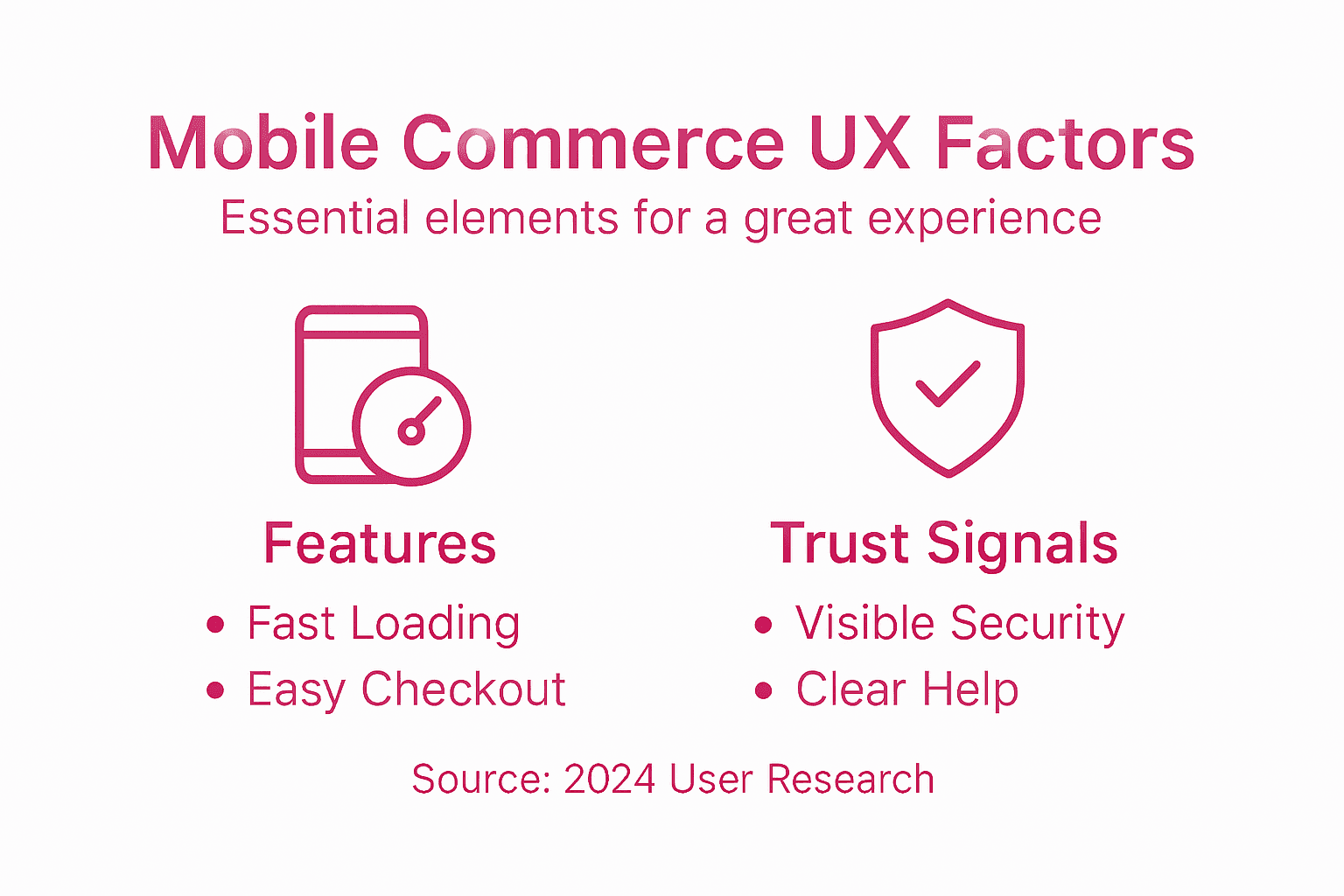
Personalisation transforms a generic shopping experience into something that feels built just for that individual customer. Responsive mobile-optimised interfaces paired with fast load times reduce cart abandonment significantly. When your system tracks what a customer viewed last time and suggests similar items on their next visit, they feel understood. Timely notifications about restocks, sales, or abandoned items bring them back. However, there’s a balance. Too many notifications become annoying. Too many recommendations create decision paralysis. The best mobile commerce experiences personalise without overwhelming. Payment options deserve special attention here. One-click checkout, Apple Pay, Google Pay, and mobile wallets aren’t luxuries anymore—they’re essentials. Customers expect multiple payment routes. If forcing them through a lengthy card entry form is your only option, you’ll lose sales.
Security and trust signals sit quietly in the background but matter enormously. Your customers are entering payment information on a small screen in public spaces. They need reassurance that their data is safe. SSL certificates, security badges, clear privacy policies, and transparent return policies all contribute to this trust. Emerging technologies like augmented reality and artificial intelligence are beginning to reshape mobile commerce experiences. AR lets customers visualise furniture in their living room before buying. AI chatbots answer questions instantly at 3 AM. These features aren’t gimmicks—they reduce buyer hesitation and boost conversion rates.
For UK and Irish ecommerce owners, the practical takeaway is this: don’t chase shiny technology. Master the fundamentals first. Does your site load in under three seconds on 4G? Can customers find products in two taps? Can they checkout in under 60 seconds? If not, that’s where your effort should go before worrying about AR or AI.
Pro tip: Use Google PageSpeed Insights and test your mobile site’s actual load time on a real 4G connection (not your office WiFi), then identify and fix the slowest elements—typically large images and unoptimised JavaScript—before implementing anything else.
Legal, Security And Compliance Essentials
This is where many ecommerce owners get uncomfortable. Legal and compliance feels abstract, bureaucratic, and expensive. But here’s the reality: a single data breach or compliance violation can cost more than years of marketing investment. Your mobile commerce operation sits at the intersection of multiple legal frameworks, and ignoring them isn’t a risk you can afford to take. The main areas demanding your attention are data protection, consumer protection, payment security, and advertising standards.
Data protection is non-negotiable. If you operate in the UK or Ireland, you’re bound by the UK General Data Protection Regulation (GDPR) and equivalent national laws. Your customers enter personal information—names, addresses, payment details—into your mobile app or website. You’re legally responsible for protecting that data from unauthorised access. Compliance with evolving legal frameworks and robust data privacy safeguards strengthens customer trust whilst protecting your business from severe penalties. GDPR violations carry fines up to £20 million or 4% of global annual revenue, whichever is higher. That’s not hyperbole. Implement encryption for data in transit and at rest. Use secure payment gateways that handle card details separately from your systems. Never store sensitive payment information yourself unless you’re PCI DSS certified, which is expensive and complex. Most small and medium ecommerce businesses use third-party payment processors specifically to avoid this liability.
Beyond data protection, mobile commerce enterprises must navigate intricate legal landscapes encompassing consumer protection and advertising laws. Your terms and conditions must be clear about refund policies, delivery timelines, and dispute resolution. Display prices prominently including all taxes and delivery charges before customers reach checkout. Be honest about what customers are buying. If your product has limitations or requirements, say so upfront. Advertising regulations prohibit misleading claims, so review testimonials and before-and-after images carefully. Track consent for email marketing. These aren’t suggestions. They’re legal requirements.
Consider working with a solicitor who specialises in ecommerce law. The cost of a consultation is minimal compared to the cost of enforcement action or reputational damage. Many ecommerce owners discover compliance issues only after customers or regulators point them out.
Pro tip: Conduct a compliance audit right now by downloading the UK Information Commissioner’s Office’s data protection self-assessment tool and reviewing your privacy policy, terms and conditions, and payment processor agreements against current regulations.
Risks, Pitfalls And Strategic Mistakes To Avoid
Mobile commerce introduces risks that desktop ecommerce doesn’t face. The threats are real, the mistakes are common, and the consequences are expensive. Understanding what goes wrong helps you avoid becoming another cautionary tale. The major categories of risk cluster around security vulnerabilities, technical performance failures, user experience oversights, and strategic miscalculations about how people actually behave on mobile devices.
Security breaches represent the most immediate threat. Hackers target mobile apps and payment systems because they know customers store payment information and personal data there. Data breaches, malware, and ransomware attacks can devastate your business overnight. Beyond the immediate financial loss, you face regulatory penalties, customer lawsuits, and permanent reputational damage. But here’s the thing most ecommerce owners miss: security isn’t just about installing firewalls. It’s about how you design your entire system. Store minimal data. Use third-party payment processors. Implement encryption. Update software regularly. Many owners ignore these basics because they seem tedious, then pay the price.
Technical performance failures kill conversions silently. Poor mobile optimisation causing high cart abandonment rates remains one of the most damaging pitfalls in mobile commerce. A three-second load delay reduces conversions by 7%. Slow pages mean frustrated customers abandoning their baskets without completing purchases. Complicated checkout flows with too many form fields, unexpected fees appearing at the last step, or unclear shipping information all contribute to this. Another frequent mistake is replicating your desktop experience on mobile without adapting it. Your desktop website might display 50 products per page with detailed specifications. On mobile, that’s overwhelming. Users are multitasking, distracted, and navigating with one thumb. They need streamlined interfaces that prioritise what matters most.
Strategic mistakes often stem from underestimating mobile user behaviour. You think users shop the same way on mobile as desktop. They don’t. Mobile users browse during commutes, lunch breaks, or late at night. They expect immediate results. Overlooking the impact of slow load times and failing to anticipate users’ mobile context and multitasking habits leads to experiences that frustrate rather than convert. Test your mobile experience on real devices with actual network conditions, not just your office WiFi. See what happens on 4G with a flaky connection. That’s your actual customer experience.
The following table summarises critical mobile commerce pitfalls and effective prevention strategies:
Pitfall | Example Impact | Prevention Strategy |
Security vulnerabilities | Data breach, loss of trust | Use third-party processors, update software |
Slow load times | Customer abandonment | Optimise images, streamline scripts |
Complicated checkout flows | Lost sales, user frustration | Reduce form fields, offer autofill |
Poor mobile design | Low conversion, high exits | Test on devices, prioritise UX |
Pro tip: Set up monthly security audits using automated vulnerability scanning tools like Nessus or Qualys, and establish a clear incident response plan before a breach happens so you’re not making crisis decisions under pressure.
Unlock Your Mobile Commerce Potential with Expert Digital Marketing
Mobile commerce demands a seamless, secure, and lightning-fast mobile shopping experience to reduce cart abandonment and build customer trust. If your ecommerce business in the UK or Ireland struggles with slow load times, complicated checkout flows, or low mobile conversions it is time to act boldly. Drawing on over 25 years of experience scaling successful ecommerce brands, our digital marketing services specialise in SEO, AI, Social Media, and PPC tailored to enhance your mobile commerce strategy and elevate user experience.

Discover how we can help you harness key mobile commerce concepts like optimised responsive design, frictionless payment methods, and personalised customer journeys to boost your revenue. Visit our website now and transform your mobile sales channel into your ecommerce powerhouse. Dont let cart abandonment steal your successpartner with us today to deliver fast, secure, and user-friendly mobile commerce solutions that convert.
Frequently Asked Questions
What is mobile commerce?
Mobile commerce refers to the act of shopping using a smartphone or tablet, allowing customers to browse products, compare prices, and complete purchases from anywhere, at any time.
How does mobile commerce differ from traditional ecommerce?
Mobile commerce focuses specifically on transactions conducted via mobile devices, offering smoother navigation, faster load times, and enhanced payment options that cater to on-the-go consumers compared to traditional desktop ecommerce.
What are the main types of mobile commerce transactions?
The main types of mobile commerce transactions include mobile shopping, mobile payments, mobile banking, mobile ticketing, and in-app purchasing, each with unique user experience requirements and challenges.
Why is user experience important in mobile commerce?
User experience is crucial in mobile commerce because consumers prefer fast, simple, and secure transactions on their mobile devices. A poor mobile experience can lead to high cart abandonment rates, affecting overall sales and customer retention.
Recommended
Comments