.png)
Ad Scheduling: Boosting eCommerce ROI With Precision


Paying for ads that show up when your customers are asleep in London or distracted at midday in Dublin can drain your PPC budget fast. For eCommerce businesses across the UK and Ireland, aligning your ad spend with actual shopper behaviour is crucial. By using ad scheduling to concentrate efforts during peak traffic or high-conversion timeframes, you reduce budget waste and improve ROI. This guide explains how targeted scheduling transforms your PPC campaigns into smarter investments.
Table of Contents
Key Takeaways
Point | Details |
Ad Scheduling Importance | Ad scheduling reduces budget waste by ensuring ads only run when target audiences are most likely to convert. |
Data-Driven Decisions | Implement ad schedules based on actual performance data rather than assumptions to maximise campaign effectiveness. |
Monitoring and Adjusting | Regularly review and adjust your ad scheduling to account for changing consumer behaviours and market conditions. |
Flexibility in Strategy | Use a combination of scheduling methods to balance control and responsiveness according to your business model. |
Ad Scheduling Defined For eCommerce Success
Ad scheduling is the strategic practice of limiting when your ads appear to specific days and times when your target audience is most active and likely to convert. Rather than letting ads run 24/7, you’re essentially telling Google, Facebook, or Microsoft Ads: “Show my products during these windows when my customers are actually paying attention.”
For eCommerce businesses, this distinction matters significantly. Ad scheduling refers to strategically limiting the display of ads to ensure they only show when your audience is most receptive. Think about your own shopping habits. You might browse products on your lunch break at 1pm, or late at night when you can’t sleep. You probably don’t shop at 3am on a Tuesday. Yet without ad scheduling, your budget gets spent on impressions at exactly those moments when no one’s buying. You’re essentially paying to show products to people who have zero intention of purchasing.
Where ad scheduling becomes powerful for eCommerce is in reducing budget waste and concentrating spending during peak conversion periods. If you run a UK-based fashion retailer, you might discover that your highest-value purchases happen between 7pm and 11pm on weekdays, with an even stronger surge on Sunday mornings (when people are planning their week). Weekend traffic patterns differ from weekdays. Seasonal surges spike at different hours. By aligning your ad spend with these patterns, you’re not just spending less. You’re spending smarter. The research shows that reducing budget waste during low-engagement periods and increasing conversions by concentrating efforts during peak traffic or high-conversion timeframes directly improves campaign efficiency and return on investment through precise timing.
When implementing ad scheduling, you’re essentially making two decisions. First, which days actually matter for your business? A luxury goods seller might see strong activity throughout the week, whilst a discount flash-sale retailer might see their best performance on specific promotional days. Second, which hours? This requires honest data analysis rather than assumptions. You might think your customers shop in the evening, but your analytics might reveal strong afternoon activity instead.
Pro tip: Start by reviewing your Google Analytics data for the last three months, looking at when visitors actually complete purchases rather than just when they visit, then layer in your conversion value by hour to identify your true peak windows before adjusting your ad schedule.
Types Of Ad Scheduling And Key Differences
Not all ad scheduling approaches work the same way. The method you choose depends on your business model, audience behaviour, and how much flexibility you need. Understanding the main types helps you pick the right fit for your eCommerce operation.
Dayparting is the most straightforward approach. You divide your day into specific segments and assign different bid adjustments or pause ads entirely during certain periods. If your analytics show that your customers shop heavily between 6pm and 10pm, you’d run ads at full budget during those hours and reduce spending (or stop completely) during low-performing times. The advantage is simplicity. You set it once and it runs consistently. The disadvantage is rigidity. If a customer suddenly clicks at 2pm on a Wednesday, your ads aren’t there. Peak hour targeting takes this further by focusing exclusively on your highest-converting periods. Rather than running ads throughout the day with adjustments, you concentrate your entire budget on the two or three hours when conversions spike. This works brilliantly for flash sales or limited-time campaigns. Frequency capping operates differently from these timing-based methods. Instead of controlling when ads appear, it controls how often ads are shown to prevent fatigue, ensuring the same person doesn’t see your product ad fifteen times in one day and get annoyed.

Beyond these traditional models, eCommerce marketers use three primary scheduling strategies. Fixed scheduling runs ads at preset times you determine in advance. You know from historical data that Sundays between 10am and 2pm generate sales, so those slots get full budget. It’s predictable and reliable. Flexible scheduling adapts in real-time based on performance data and customer behaviour signals. Platforms analyse traffic patterns and adjust when your ads appear automatically. This requires less manual intervention and catches trends you might miss manually. Time zone-targeted scheduling is essential for businesses selling across multiple regions. A UK retailer selling to European customers wouldn’t want ads showing at 3am in Germany when the audience is asleep. Instead, you tailor ad visibility to each region’s peak activity times.
The real distinction lies in control versus intelligence. Fixed and dayparting give you maximum control but require accurate data upfront. Flexible and real-time approaches let algorithms handle the work but demand trust in automation. For most UK and Irish eCommerce businesses starting out, dayparting combined with frequency capping offers the sweet spot between effort and results. You’re not over-complicating things with multiple time zones initially, yet you’re still preventing ad fatigue and concentrating spend where it matters.
To illustrate the distinctions, here is a comparison of popular ad scheduling methods for eCommerce:
Scheduling Method | Level of Control | Flexibility | Best Use Case |
Dayparting | High | Low | Predictable peak shopping times |
Peak Hour Targeting | Medium | Medium | Short flash sales or urgent promotions |
Frequency Capping | Low | High | Preventing ad fatigue |
Fixed Scheduling | High | Low | Consistent weekly patterns |
Flexible Scheduling | Low | High | Real-time data response |
Time Zone-Targeted | Medium | Medium | Multi-region customer bases |
Pro tip: Test one scheduling method for a full four weeks before switching approaches, as many eCommerce businesses jump between methods too quickly before giving the data time to stabilise and reveal true patterns.
How Ad Scheduling Works In PPC Platforms
When you set up ad scheduling in platforms like Google Ads, Facebook, or Microsoft Advertising, you’re essentially telling the system: “These are the times when I want my ads to be active.” The platform then respects those parameters and only serves your ads during the windows you specify. It sounds simple, but the mechanics behind it are what make ROI improvements possible.
Here’s how the process actually unfolds. You log into your PPC platform and navigate to the ad scheduling settings. From there, you select which days of the week matter for your business (you might not need ads on Mondays, for example), then specify which hours within those days get impressions. Google Ads lets you set schedules at the campaign level, which means different campaigns can have completely different schedules. Your summer sales campaign might run 9am to 9pm, whilst your year-round product ads run only 12pm to 8pm. Once you’ve set these parameters, the platform only serves your ads during selected schedule windows, which prevents budget waste on low-performing periods entirely.
The real power comes from bid adjustments and performance analysis. Most PPC platforms don’t just pause and play your ads like an on-off switch. They allow you to apply bid modifiers to different time periods. Say your data shows that Tuesday mornings convert at 40% higher rates than Wednesday afternoons. You can increase your bid by 30% on Tuesday mornings, ensuring your ads appear in better positions when customers are most receptive. Conversely, you might lower bids on Wednesday afternoons to stretch your budget further during lower-converting times. Ad scheduling works by leveraging performance data to run ads only during times when user engagement and conversion rates are higher, which means you’re not just preventing waste—you’re actively prioritising your best moments. The platform also provides reporting by time of day, showing you exactly which hours and days generated conversions, clicks, and revenue. This data becomes your roadmap for ongoing optimisation.
Here is a summary showing how bid adjustments enhance ad schedule effectiveness on PPC platforms:
Scenario | Bid Adjustment Example | Expected Business Outcome |
Tuesday morning high conversions | Increase bid by 30% | More ad visibility during key period |
Wednesday afternoon lower conversions | Decrease bid by 20% | Reduced cost during slow hours |
Evening block peak traffic | Boost bid by 40% | Maximise reach when demand peaks |
For eCommerce businesses operating across time zones, platforms handle regional scheduling automatically. If you’re selling to customers in London, Dublin, and Glasgow, the platform recognises each user’s local time and applies the correct schedule accordingly. A customer in Dublin won’t see your ads at their 2am just because it’s peak time in London.
Pro tip: Start by reviewing your campaign data for 30 days without scheduling active, then implement schedules based on actual conversion data rather than assumptions—most businesses find their peak hours differ significantly from what they expected.
Setting Up Effective Ad Schedules
Setting up an effective ad schedule requires moving beyond guesswork. You need actual data about when your customers convert, not assumptions about when they might be shopping. The difference between a schedule built on hunches and one built on evidence can mean the difference between a profitable campaign and one that haemorrhages budget on wasted impressions.
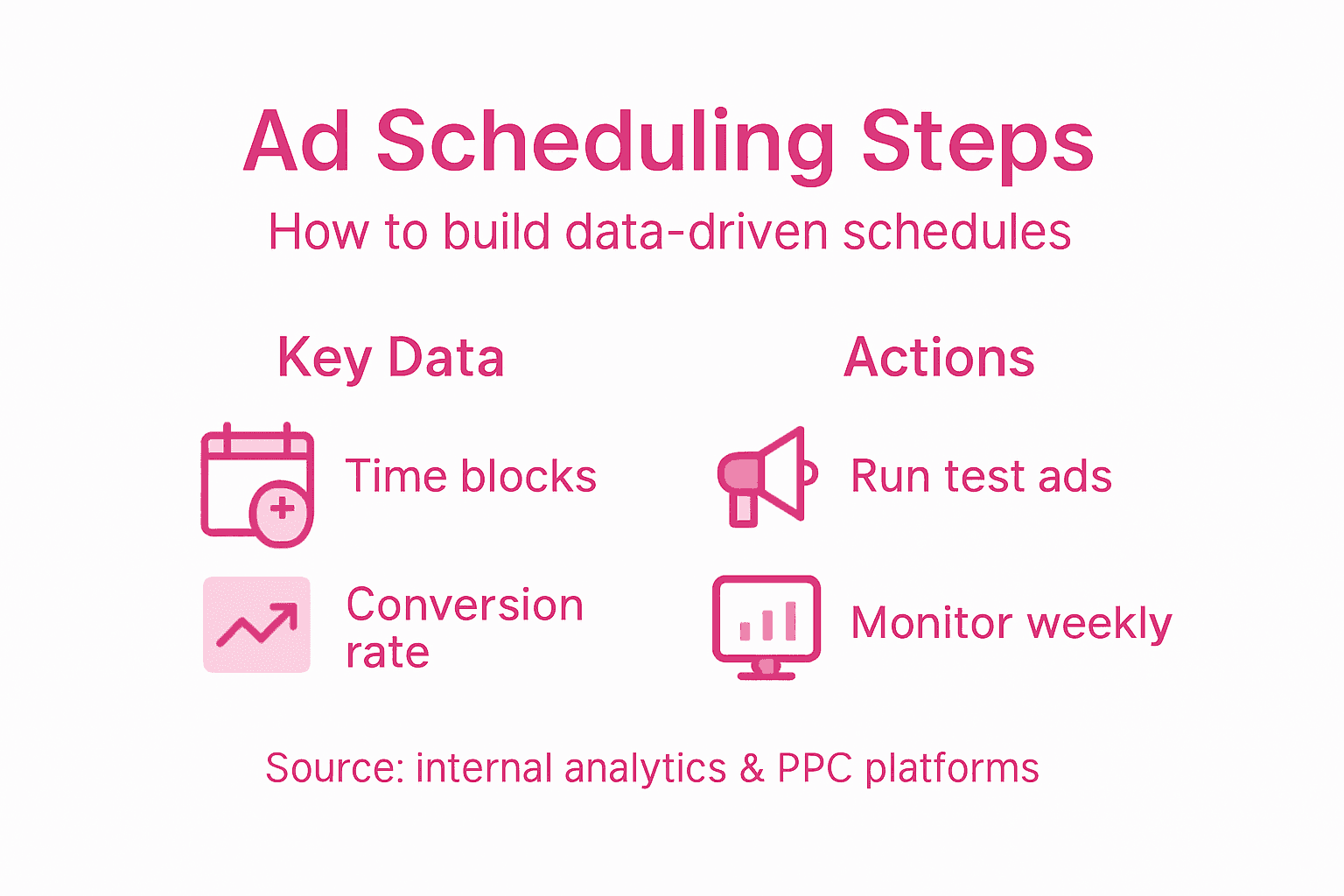
Start by gathering baseline performance data. If you’re new to ad scheduling, run your campaigns for at least two to four weeks without any scheduling restrictions active. During this period, export your performance metrics segmented by hour of day and day of week. Most platforms provide this breakdown automatically. Look for patterns in conversion rates, not just clicks. A high-traffic time slot that generates few conversions is a poor target for your budget. You want to identify the specific windows where your customers actually complete purchases. Once you’ve identified these windows, select specific days and hours when ads should run based on data-driven insights of audience activity. This is where precision matters. If your data shows that Friday evenings between 6pm and 10pm generate 3.5 times more conversions than Tuesday mornings, your schedule should reflect that priority.
When you build your actual schedule, think in time blocks rather than random hours. Segmenting your day strategically prevents you from creating a scattered schedule that’s difficult to manage or analyse. Many UK eCommerce businesses use a simple three-block approach: morning (7am to 12pm), afternoon (12pm to 5pm), and evening (5pm to 11pm). Then they apply different bid adjustments to each block based on performance data. The evening block might get a 40% bid increase, whilst the afternoon block remains at baseline. This approach scales well as your campaigns grow more complex. Leveraging data analytics to optimise ad timing by segmenting the day into strategic time blocks ensures your budget concentrates where it matters most.
Don’t set your schedule and forget it. Seasonal changes, competitor activity, and shifts in customer behaviour mean your schedule needs periodic review. A schedule that works perfectly in November (peak online shopping season) might be completely wrong in July. Similarly, if you run flash sales or promotional events, your schedule should adapt temporarily. The most successful eCommerce operators treat their ad schedule as a living document, adjusting it monthly based on new performance data rather than quarterly or annually. Also consider time zones carefully. If you’re selling across the UK and Ireland, your schedule should account for the fact that peak shopping times in London differ slightly from Dublin. Most platforms allow you to set different schedules for different geographic regions, so use that capability.
Pro tip: Create a simple spreadsheet tracking your conversion rate by hour and day of week, updating it monthly, so you have a clear visual reference for where your budget should concentrate and can spot seasonal trends before they impact your ROI.
Common Pitfalls In Ad Scheduling Strategies
Even with the best intentions, many eCommerce businesses stumble when implementing ad scheduling. The mistakes aren’t usually obvious, which makes them particularly dangerous. You might think your schedule is optimised when it’s actually costing you thousands in lost revenue.
The first major pitfall is building schedules on assumptions rather than data. A business owner might assume their customers shop in the evening because they do their own shopping then. So they set their schedule to run 6pm to 11pm, completely missing the afternoon surge between 2pm and 4pm when customers browse during work breaks. Or they assume weekends are crucial and barely run ads on weekdays, only to discover their actual data shows Wednesday afternoons outperform Saturday mornings. Setting schedules based on assumptions instead of data is shockingly common and expensive. The solution is simple but requires discipline: export your actual conversion data, look at what happened, then build your schedule around reality rather than imagination.
A second critical error is neglecting time zone variations, particularly for businesses selling across multiple regions. You’ve set your schedule to run 9am to 5pm, thinking that covers your market. But if you’re selling to customers across the UK, Ireland, and continental Europe, that schedule is showing ads at 8am in Dublin (when some customers haven’t started their day) and at midnight in Paris (when anyone still awake probably isn’t shopping). Each region has different peak hours. The fix requires either setting region-specific schedules or using platform features that automatically adjust based on the user’s local time.
A third pitfall is treating your schedule as permanent. Market conditions change. Consumer behaviour shifts. Competitors launch new campaigns. A schedule that works brilliantly in January might be completely wrong by June. Many businesses set their schedule and forget it for months, wondering why their ROI deteriorates. The solution is straightforward: review your schedule monthly. Set a calendar reminder for the first Tuesday of each month to pull your performance data and assess whether adjustments are needed. Additionally, insufficient monitoring prevents optimisation of ad scheduling effectiveness and campaign ROI, meaning passive approaches fail where active management succeeds. Finally, some businesses overcorrect by creating schedules so broad and flexible they become useless. If you’re running ads virtually all hours anyway, you’ve negated the entire benefit of scheduling. The goal is deliberate concentration, not near-constant presence.
Pro tip: Set three specific dates each year to audit your ad schedule completely: January for post-holiday patterns, June for mid-year adjustments, and September before the autumn shopping surge, treating these reviews as non-negotiable business tasks.
Unlock the Full Potential of Your eCommerce Ad Scheduling Today
Ad scheduling can dramatically reduce wasted ad spend and sharply increase your conversion rates by targeting your audience at the exact moments they are most ready to buy. If you find yourself struggling with assumptions rather than data or missing out on peak traffic windows, you are not alone. The challenge of balancing dayparting, bid adjustments, and time zone targeting requires a tailored strategy backed by expert insight. With over 25 years of experience scaling multiple successful eCommerce brands, our team understands how to transform complex scheduling data into actionable campaigns that boost ROI.

Take control of your PPC ad performance now with our specialised digital marketing services focused on SEO, AI, Social Media and PPC for eCommerce websites. Visit us at https://iwanttobeseen.online to explore how precise ad scheduling can become your biggest advantage. Don’t let budget misallocation hold your business back any longer. Partner with us to harness data-driven scheduling and watch your sales soar. Learn more about optimising your campaigns with effective PPC strategies tailored for your brand.
Frequently Asked Questions
What is ad scheduling and how can it benefit my eCommerce business?
Ad scheduling is the practice of timing your ads to appear only during specific days and hours when your target audience is most likely to engage and convert. This helps reduce budget waste and ensures your ads are visible during peak shopping times, ultimately boosting your return on investment (ROI).
How can I determine the best times to schedule my ads?
To find the optimal times for ad scheduling, review your Google Analytics data for the past few months. Analyze when conversions occur rather than just website visits to identify high-performing periods for your business.
What are the different methods of ad scheduling available for eCommerce?
The primary ad scheduling methods include dayparting, peak hour targeting, frequency capping, fixed scheduling, flexible scheduling, and time zone-targeted scheduling. Each method varies in terms of control, flexibility, and is suited for different eCommerce business models.
How often should I review and adjust my ad schedule?
Ad schedules should be reviewed regularly, ideally on a monthly basis, to account for changes in market conditions, seasonal variations, and consumer behaviour. This ensures your ad scheduling remains effective and continues to optimise your advertising spend.
Recommended
Comments