.png)
How to write product descriptions that convert for eCommerce


Most product pages are quietly haemorrhaging sales. Shoppers land, skim a few lines of dull, feature-heavy copy, and leave without buying. It is not the product that fails them; it is the description. Benefit-focused descriptions boost conversions by 30 to 78%, yet the majority of UK and Irish eCommerce stores still rely on manufacturer copy or generic bullet points. This guide walks you through every step of writing product descriptions that genuinely sell, from understanding what makes copy work psychologically, to optimising for Google Shopping and building the kind of trust that turns browsers into buyers.
Table of Contents
Key Takeaways
Point | Details |
Lead with benefits | Highlight what your product does for the customer, not just what it is. |
Keep it unique | Write fresh, original copy for every product to boost SEO and avoid search penalties. |
Make it scannable | Use short paragraphs, bullets, and bold points for easier reading on mobile. |
Include social proof | Showcase reviews and ratings to build trust and drive conversions. |
Test and refresh regularly | A/B test and update your descriptions each quarter to keep them working harder for you. |
Understanding what makes product descriptions effective
A product description is not a specification sheet. It is a conversation with a potential buyer at the exact moment they are deciding whether to part with their money. The stores that understand this write copy that connects emotionally before it informs rationally.
The single biggest mistake we see from UK and Irish eCommerce owners is leading with features rather than benefits. A waterproof jacket is not just “seam-sealed with a 10,000mm hydrostatic rating.” For a customer in Cork or Manchester, it is the jacket that keeps you dry on the commute without looking like you are heading to a campsite. Benefits over features is the principle that drives conversions, and it applies to every category.
Several psychological triggers make descriptions work harder:
Storytelling: Place the customer inside a scenario where the product solves their problem.
Scannability: Most shoppers read in an F-pattern. Structure your copy so the key value lands in the first glance.
Social proof: Ratings, reviews, and user photos signal that real people trust the product.
Sensory language: Words like “buttery soft,” “crisp,” or “whisper-quiet” activate imagination and reduce purchase hesitation.
“The best product descriptions do not describe the product. They describe the customer’s life after buying it.”
If you want to go deeper on the principles behind content writing for sales, the fundamentals of persuasive copy apply across every page of your site, not just product listings.
With the conversion power of descriptions clear, let us look at what you need to get started.
Preparation: Information and assets you’ll need
Rushing to write without preparation is the fastest route to generic copy. Before you type a single word, gather the raw material that will make your description specific, credible, and compelling.
Start by defining your customer persona. Who are they? What problem are they trying to solve? A 45-year-old cyclist in Dublin has different priorities to a 22-year-old fashion buyer in London. Knowing this shapes every word choice.
Next, identify your product’s unique selling points (USPs). What does it do that competitors cannot, or do better? Then compile your support material:
Full product specifications and dimensions
High-quality images and any video assets
Existing customer reviews and testimonials
Competitor descriptions (for reference only, never copy)
Any certifications, awards, or press mentions
Asset | Why it matters |
Customer reviews | Surface real benefits and language your buyers use |
Product specs | Provide factual accuracy and answer technical questions |
Competitor descriptions | Identify gaps and opportunities to differentiate |
High-quality images | Reduce reliance on words alone; support image SEO |
Testimonials | Ready-made social proof to weave into copy |
Pro Tip: Mine your one-star and two-star reviews. They reveal the objections and anxieties buyers have before purchasing. Address those directly in your description and you will reduce returns and increase confidence.
Optimal description length for most eCommerce products sits between 300 and 500 words. That is your target zone for the writing stage. Understanding semantic search for ecommerce also helps you plan which related terms and concepts to naturally include.
With your prep done, you are ready to write. Let us break it into proven steps.
Step-by-step: How to write product descriptions that sell
Follow this sequence and you will have a structured, high-converting description every time.
Write a benefit-led headline. Your headline should answer “what does this do for me?” before anything else. Tie it to a pain point or a desired outcome.
Open with a core summary. Two to three sentences that capture the product’s main benefit and who it is for. This is what scanners read.
List key features as benefits. Use bullet points. Each bullet should start with the benefit, then support it with the feature. “Stays warm in sub-zero temperatures, thanks to recycled down insulation.”
Add sensory and evocative detail. Sensory language and storytelling connect emotionally with the ideal customer. Use it in the body paragraphs below the fold.
Include a below-the-fold deeper section. For higher-value or technical products, expand on materials, sizing, care instructions, and compatibility.
Close with a subtle call to action. “Order before 3pm for next-day delivery across the UK and Ireland” works harder than a generic “Buy now.”
Scannable formatting is non-negotiable for mobile optimisation for ecommerce. Short paragraphs, bold benefits, and bullet points are not stylistic choices; they are conversion tools.

Format | Best for | SEO impact | Conversion strength |
Ultra-short (50-150 words) | Simple, low-cost items | Lower | Moderate |
Standard (300-500 words) | Most eCommerce products | Strong | High |
Long-form (500+ words) | Technical or high-value goods | Highest | Very high |
A responsive web design for ecommerce ensures your carefully structured copy renders correctly on every device, which matters enormously when over 60% of UK shopping traffic is mobile.
Pro Tip: Use AI tools to generate a first draft quickly, but always edit for tone, accuracy, and brand voice. AI copy tends to be generic; your edit is what makes it yours.
Once your description is drafted, ensure it is optimised for discovery and trust.
Optimising for SEO and Google Shopping
A brilliant description that nobody finds is a wasted asset. SEO and Google Shopping optimisation are what get your products in front of buyers who are actively searching.
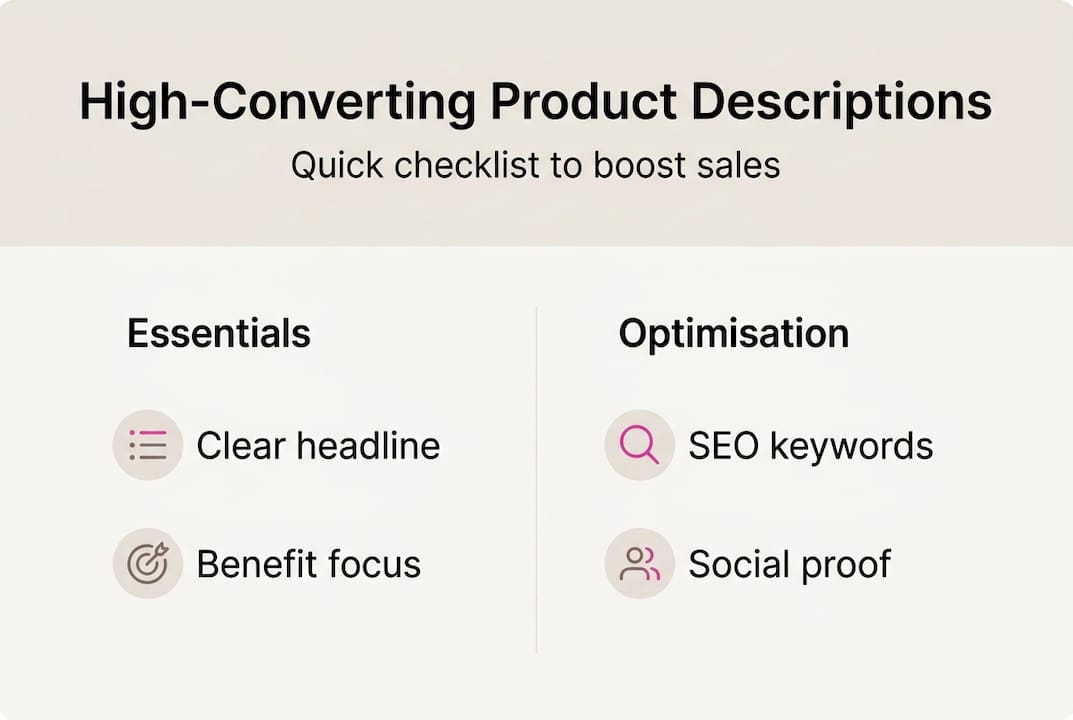
Unique descriptions per product are essential. Copying manufacturer copy or duplicating text across variants triggers Google’s duplicate content filters and suppresses your rankings. Write original copy for every product, even if it takes longer.
Here is where to place your primary keyword naturally:
Product title and H1 heading
First 100 words of the description
Subheadings within the description
Image alt text
Meta description
For UK and Ireland stores, localise where it adds value. Mention delivery timescales relevant to your region, use British English spelling throughout, and reference local contexts where they fit naturally. A customer searching “waterproof boots Ireland” responds better to copy that acknowledges Irish weather than generic global copy.
Avoid keyword stuffing. Google’s algorithms in 2026 are sophisticated enough to penalise unnatural repetition. Aim for natural placement and use long-tail keyword variations. Keep up with ecommerce SEO trends to stay ahead of algorithm updates, and review your Google Shopping strategies to ensure your product feed data aligns with your on-page copy. For local visibility, local website SEO principles apply directly to product pages targeting regional buyers.
SEO brings visitors, but trust and conversion need finishing touches.
Building trust and handling objections in your descriptions
Even the best-written description will fail if the buyer does not trust you. Trust signals and objection handling are the final layer that separates a good description from a great one.
Social proof, ratings, and facts that support your claims reduce purchase anxiety and build confidence. Practically, this means:
Displaying star ratings and review counts near the product title
Pulling a compelling quote from a verified buyer into the description itself
Including user-generated photos where possible
Citing any independent testing, certifications, or press coverage
Five or more reviews can lift conversion rates by up to 270%, and detailed, accurate descriptions reduce returns by 30 to 50%. Those are numbers worth taking seriously.
Handle objections before they arise. Common ones for UK and Irish shoppers include sizing and fit, material and quality concerns, delivery timescales, and return policies. Weave the answers into your description naturally rather than hiding them in a separate FAQ tab. Learn more about using social proof effectively and how trust signals in ecommerce influence buying decisions at every stage of the customer journey.
With everything in place, ensure your descriptions keep working by testing and refreshing.
Testing, iterating and maintaining product descriptions
Writing a great description is not a one-time task. The stores that consistently outperform their competitors treat product copy as a living asset.
Start with simple A/B tests. You do not need expensive software to begin:
Test your headline. Run a benefit-led version against a feature-led version for two weeks and compare add-to-cart rates.
Test format. Try bullet points versus short paragraphs for the same product and measure time on page and bounce rate.
Test length. A 150-word version versus a 400-word version on comparable products reveals what your audience prefers.
Test your call to action. Specific, time-sensitive CTAs typically outperform generic ones.
A/B testing elements like length, format, and benefit versus feature focus, tracked against conversion rate, add-to-cart percentage, bounce rate, and time on page, gives you real data to improve with.
Schedule a quarterly review of your top and bottom performing product pages. Update descriptions to reflect seasonal trends, new customer reviews, changes in Google Shopping requirements, and any shifts in UK or Irish consumer behaviour. Your ecommerce mobile SEO guide is a useful companion for ensuring your updated copy performs on mobile as well as desktop.
“Write for humans first, then refresh regularly for Google and trust. The two goals are not in conflict; they reinforce each other.”
A solid content strategy for small business ties your product description updates into a broader plan, so nothing gets left to go stale.
You now have a complete, evidence-backed roadmap. Here is how we can support your next steps.
How we help you boost sales with better product descriptions
Knowing what to do and having the time and expertise to do it consistently are two very different things. That is where we come in.

At iwanttobeseen.online, we have spent over 25 years scaling eCommerce brands, our own and our clients’, across the UK and Ireland. We offer product description audits, SEO-optimised copywriting, and full content strategies built specifically for eCommerce. Whether you need a single category overhauled or a site-wide content refresh, our team combines deep SEO knowledge with conversion-focused writing to deliver measurable results. If your product pages are not performing the way they should, get in touch and let us show you exactly where the opportunity lies.
Frequently asked questions
What is the best length for a product description?
Aim for 300 to 500 words for most products. Use 50 to 150 words for simple, low-cost items and go longer for technical or high-value goods where buyers need more detail to feel confident.
How can I make my product description stand out in Google Shopping?
Use original, unique copy for every product, place your main keyword in the title and first 100 words, and highlight benefits that resonate specifically with UK or Irish customers, such as local delivery times or regional relevance.
Do product reviews help product descriptions convert?
Absolutely. Five or more reviews can increase conversion rates by up to 270% and significantly reduce return rates when combined with accurate, detailed descriptions.
Should I focus on benefits or features when writing?
Always lead with benefits over features. Benefits drive the emotional decision to buy; features provide the rational justification. Use both, but never let features lead.
Recommended
Comments