.png)
How to Reduce Cart Abandonment for Higher Conversions


Every ecommerce manager knows the frustration of watching a full basket turn into a missed sale within seconds. Understanding why customers leave at crucial moments is key if you want to keep more revenue and edge closer to your targets. This guide offers step-by-step actions rooted in research, including why tracking detailed cart abandonment metrics and optimising your checkout experience can make a measurable difference for British online retailers.
Table of Contents
Quick Summary
Key Insight | Explanation |
1. Establish your baseline rate | Determine your current cart abandonment rate to benchmark progress. Knowing this guides your improvement efforts. |
2. Simplify the checkout process | Reduce form fields and steps in checkout to increase conversion rates as extra fields significantly decrease sales. |
3. Implement automated recovery emails | Send timely recovery emails within the hour after abandonment to reclaim lost sales effectively. |
4. Test changes systematically | Perform A/B testing on checkout elements to identify successful strategies for reducing cart abandonment. |
5. Use multiple payment options | Offering various payment methods caters to customer preferences, increasing completed transactions and reducing drop-off. |
Step 1: Assess current cart abandonment metrics
Before you can reduce cart abandonment, you need to understand exactly where customers are dropping off. This means gathering specific data about your current situation so you can identify patterns and prioritise improvements.
Start by establishing your baseline abandonment rate. This is the percentage of shopping carts created that never convert to completed purchases. Calculate it by dividing the number of completed transactions by the number of carts initiated, then subtract from 100. For most UK ecommerce retailers, abandonment rates hover between 60-80%, so knowing your exact figure gives you a clear starting point.
Next, track cart abandonment at different stages of your checkout process. Are customers leaving after adding items? During payment entry? At the shipping cost reveal? Each abandonment point tells a different story. You might discover customers bail when they see unexpected fees, or they abandon because your payment options are limited.
Understanding cart composition helps predict abandonment—research shows higher proportions of hedonic items increase abandonment due to consumer guilt, so tracking what people buy alongside their primary items reveals valuable insights.
Use your analytics platform to gather these metrics:
Total carts created in a specific period
Carts progressed to checkout
Carts abandoned at each checkout step
Recovery email open rates and click-through rates
Revenue recovered from abandoned cart campaigns
Look at 7 Key Marketing Metrics Every eCommerce Owner Should Track to ensure you’re monitoring the right indicators alongside your abandonment data.
Document these numbers weekly for at least 4 weeks. This reveals whether abandonment spikes on certain days or follows seasonal patterns. A spike on Sundays might suggest mobile checkout friction, whilst seasonal peaks could indicate shipping cost sensitivity during busy periods.
Compare your metrics against your industry benchmarks. Different product categories have different abandonment rates—beauty products typically abandon lower than luxury goods. Knowing where you stand helps set realistic targets.
Here is a summary of typical cart abandonment benchmarks by product category in UK ecommerce:
Product Category | Average Abandonment Rate | Main Contributing Factor |
Beauty & Cosmetics | 60-65% | Shipping cost sensitivity |
Electronics | 75-80% | Price comparison behaviour |
Luxury Goods | 80-85% | Higher perceived risk and research |
Apparel & Fashion | 68-75% | Sizing uncertainty |
Home & Living | 70-75% | Delivery options and costs |
Comparing your metrics against these benchmarks provides valuable insight into improvement opportunities.
Pro tip: Set up automated abandoned cart recovery emails immediately, even before optimising your checkout—these typically recover 10-15% of abandoned revenue with minimal effort whilst you work on deeper improvements.
Step 2: Optimise checkout flow for seamless experience
Your checkout process is where you win or lose sales. A clunky, confusing checkout turns ready-to-buy customers into abandoners, whilst a smooth one converts them reliably. This step focuses on removing friction points that make customers hesitate.

Start by mapping your current checkout journey. Count every step from cart to confirmation. Most sites have 5-7 steps, but reducing checkout steps significantly improves conversions. Consider whether customers truly need to fill every field you’re asking for. Address fields like company name, phone number, or delivery instructions—do they matter for processing the order?
Simplify your form fields ruthlessly. Research shows each extra field you require reduces conversion by roughly 3.7%. Your absolute essentials are name, email, billing address, and payment details. Everything else is optional or can be requested later.
Guest checkout is non-negotiable—forcing account creation before purchase is a primary abandonment trigger, so always allow customers to buy without registering.
Implement a progress indicator so customers know where they are in the process. This psychological reassurance matters more than you’d think. Customers abandon when they feel trapped in an endless checkout loop.
Optimise for mobile ruthlessly. Over 50% of UK ecommerce traffic comes from mobile devices, yet most checkout flows are desktop-first. Ensure your mobile checkout experience matches your desktop flow in simplicity.
Add multiple payment methods. Provide at least:
Debit and credit cards
PayPal or similar digital wallets
Apple Pay or Google Pay
Buy Now, Pay Later options (Clearpay, Klarna)
Don’t hide costs. Show shipping, taxes, and any additional fees before payment entry—not after. Surprise charges at the final step are the fastest way to lose sales.
Display trust signals prominently. Security badges, customer reviews, money-back guarantees, and SSL certificates reduce anxiety about payment security.
To clarify the impact of checkout optimisation features, here is an overview of key elements and their business benefits:
Optimisation Feature | Business Impact | Recommended Action |
Fewer Form Fields | Higher conversion rates | Only ask essential information |
Guest Checkout | Lower abandonment at registration | Enable anonymous purchase option |
Progress Indicator | Reduced drop-off mid-process | Show checkout progress visually |
Multiple Payment Methods | Increased completed transactions | Offer cards, wallets, BNPL, etc. |
Transparent Costs | Fewer surprises, more trust | Display charges early in journey |
Trust Signals | Reduced payment security concerns | Show badges and guarantees |
Implementing these features helps create a seamless checkout and improves sales retention.
Pro tip: Test your checkout on actual devices before launching changes—what looks simple on desktop often becomes confusing on mobile, and mobile testing reveals friction points you’d never spot on a computer screen.
Step 3: Implement abandonment recovery strategies
Not every abandoned cart is lost forever. With the right recovery tactics, you can win back 10-15% of those sales. This step focuses on systematically re-engaging customers who’ve left items behind.
Your first recovery tool is the automated email sequence. Send the first email within 1 hour of abandonment—whilst the purchase is still fresh in their mind. Keep it simple: remind them what they left behind, show the product image, and include a direct link back to their cart.
Wait 24 hours before sending a second email. This one can be slightly more persuasive. Add a customer review, highlight product benefits, or mention stock limitations. Avoid aggressive discounting at this stage unless your margins allow it.
Personalised follow-up communications based on customer behaviour significantly increase recovery rates by making customers feel understood rather than pressured.
Your third email comes 3-5 days later. Now you can introduce a modest incentive—10% off, free shipping, or a limited-time offer. This creates urgency without devaluing your products permanently.
Beyond email, deploy these additional recovery channels:
SMS reminders for opted-in customers with time-sensitive offers
Retargeting ads on Facebook and Google showing the exact products abandoned
Live chat prompts offering immediate help when visitors return to your site
Push notifications if you have a mobile app
Analyse why customers abandoned their carts. Was it price sensitivity? Shipping costs? Limited payment options? Use this data to address root causes rather than just chasing recovery sales.
Segment your recovery efforts. A customer who abandoned a £15 item needs different treatment than someone who walked away from a £150 purchase. Tailor your messaging and incentives accordingly.
Track recovery metrics religiously. Monitor email open rates, click-through rates, recovered revenue, and recovery rate by product category. This reveals which recovery tactics work best for your specific audience.
Pro tip: Start your recovery sequence immediately after abandonment, not days later—the first email within one hour recovers significantly more sales because the purchase intent is still active in the customer’s mind.
Step 4: Test and verify reduction in cart abandonment
Making changes to your checkout process or recovery strategy is only half the battle. Without proper testing and measurement, you won’t know if your efforts actually work. This step ensures you have solid evidence that your improvements are genuinely reducing abandonment.
Start with A/B testing your most impactful changes. Change one element at a time—test a shorter form against your current form, test a different payment method layout, or test your email subject line. Running multiple tests simultaneously muddles your results because you won’t know which change drove improvement.
Choose your test duration carefully. Run tests for at least 2 weeks minimum, preferably 4 weeks. This accounts for weekly shopping patterns and ensures statistical significance rather than random fluctuation. If you’re testing during seasonal peaks like Christmas, extend the period further.
A/B testing and real-time analytics identify which checkout elements genuinely impact abandonment, allowing you to prioritise high-impact changes over guesswork.
Use your analytics platform to track these specific metrics during testing:
Cart abandonment rate percentage
Conversion rate at each checkout step
Average order value
Revenue impact of changes
Recovery email open and click rates
Monitor user behaviour beyond basic metrics. Session recordings and heatmaps reveal exactly where customers hesitate or struggle. Watch how they interact with your forms, which fields cause them to pause, and where they click before abandoning.
Document your findings systematically. Create a simple spreadsheet tracking which tests you ran, what changed, the results, and whether you’ll keep the change. This creates a knowledge base of what works for your specific audience.
Compare your results against your initial baseline metrics. Did abandonment drop by 5%? 15%? Which recovery channel performed best? This data guides your next optimisation round.
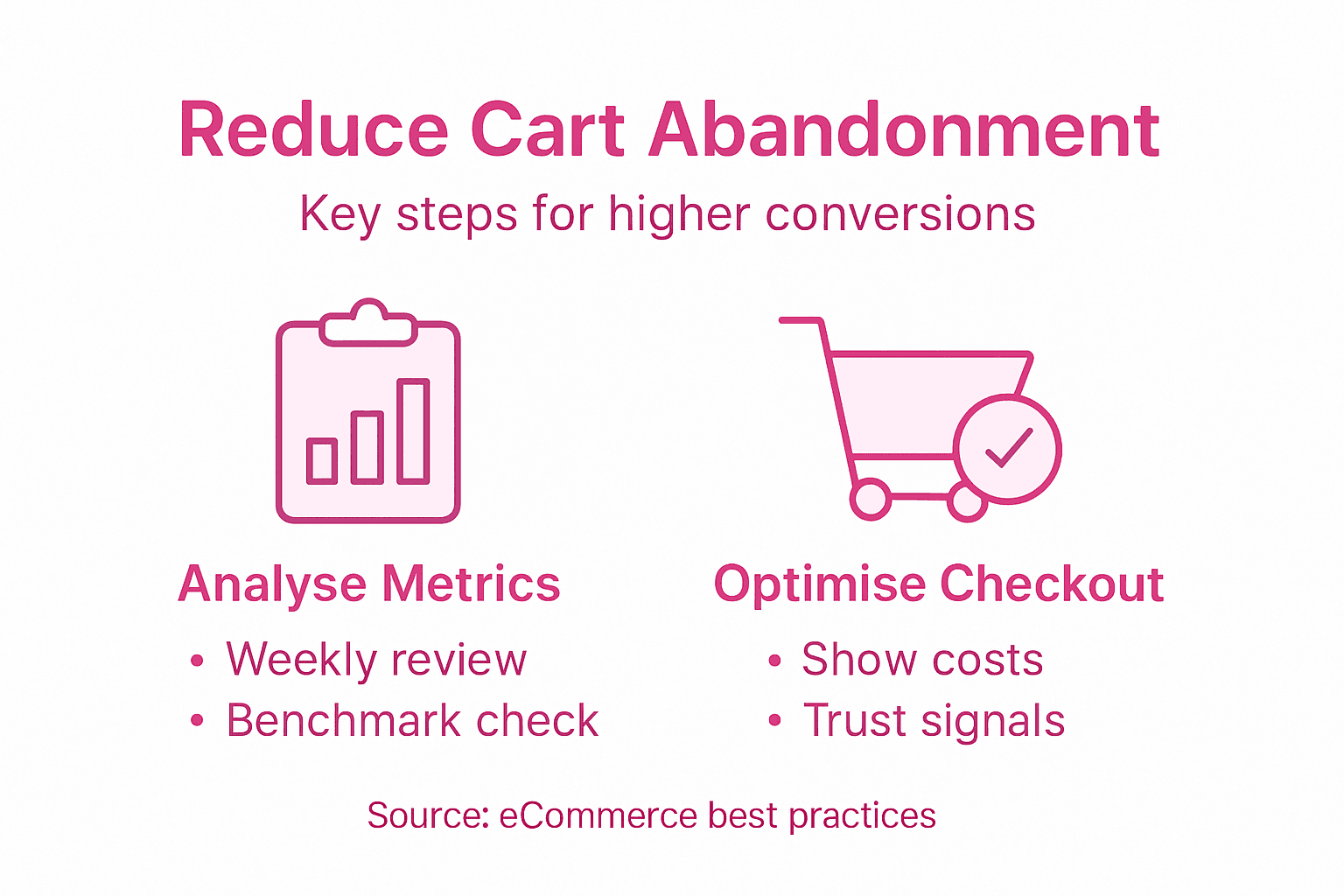
Continue testing indefinitely. Cart abandonment reduction isn’t a one-time project. Small, consistent improvements compound over months and years into substantial revenue gains.
Pro tip: Don’t wait for statistical perfection to implement successful tests—once a change shows clear improvement, implement it whilst testing the next element, because incremental continuous improvement beats waiting for a perfect moment that never arrives.
Take Control of Cart Abandonment and Boost Your eCommerce Sales Today
Cart abandonment is one of the most frustrating challenges for eCommerce retailers. High abandonment rates caused by complex checkout flows, unexpected costs, or limited payment options can silently drain your revenue. This article reveals how optimising your checkout experience and deploying smart recovery strategies can transform drop-off points into loyal customers. If improving metrics like abandonment rates, recovery email effectiveness and conversion at each checkout step feels overwhelming, you are not alone.

At iwanttobeseen.online, we specialise in digital marketing solutions tailored to eCommerce businesses seeking to reduce cart abandonment and raise conversions. Backed by over 25 years of experience scaling successful brands, we provide expert guidance in SEO, AI-driven optimisation, Social Media strategies and PPC campaigns that enhance your entire customer journey. Don’t let abandoned carts silently erode your profits—partner with us and leverage proven tactics to recover lost revenue and streamline your checkout.
Unlock the full potential of your eCommerce site now by visiting our homepage to discover how our services align perfectly with the challenges highlighted in this guide. See how a seamless checkout combined with targeted recovery campaigns can deliver measurable growth. Take action today and stop losing sales to cart abandonment before your competitors do.
Frequently Asked Questions
How can I assess my current cart abandonment rate?
To assess your cart abandonment rate, divide the number of completed transactions by the number of initiated carts and subtract from 100. Document this metric weekly for at least four weeks to identify trends and patterns.
What steps should I take to optimise my checkout flow?
Map your current checkout journey and simplify it by reducing the number of fields required. Aim for a streamlined experience with only essential information needed for processing, which can significantly improve conversion rates.
What recovery strategies can I implement for abandoned carts?
Implement an automated email sequence to remind customers of their abandoned carts. Start with a reminder email within one hour of abandonment and follow up with a more persuasive message 24 hours later to boost chances of conversion.
How do I effectively test changes in my checkout process?
Conduct A/B tests by changing one element at a time in your checkout process and run these tests for at least two weeks. Monitor significant metrics, such as conversion rates and abandonment rates, to evaluate the impact of each change.
What factors contribute to high cart abandonment rates?
Common factors include unexpected shipping costs, a complicated checkout process, and limited payment options. Identifying and addressing these issues can help you reduce abandonment by targeting specific pain points for your customers.
How often should I check my cart abandonment metrics?
Regularly check your cart abandonment metrics at least once a week. This will help you track any spikes or trends, allowing you to respond to issues quickly and potentially reduce abandonment by around 5-15%.
Recommended
Ces conseils sont géniaux pour booster mes ventes. Merci beaucoup pour ces astuces très utiles pour réduire les abandons de panier. https://epicerie-grecque.com/
I was searching for something less generic and found this resource:
https://novynypoltavy.com
There are several examples there that can easily be adapted.
I thought I would share it here as well.
Часом знаходжу ці джерела випадково, іноді хтось скине в чат, іноді сам зберігаю “на потім”. Частину переглядаю рідко, частину — коли шукаю щось локальне чи нестандартне. Вони різні: новини, огляди, думки, регіональні стрічки. Я не беру все за правду — скоріше, для порівняння та пошуку контрасту між подачею. Можливо, хтось іще знайде серед них щось цікаве або принаймні нове. Головне — мати з чого обирати. Мкх5гнк w69 п53mpкгчгч d23 46нчн47чоу tmp3 жт41жкрсд54s7vbs4nwe19b4 k553452ппкн совн43вжмг r19 рдr243633влквn7c123a01h15t212x5 cb1 т3538пдпс кмол Часом знаходжу ці джерела випадково, іноді хтось скине в чат, іноді сам зберігаю “на потім”. Частину переглядаю рідко, частину — коли шукаю щось локальне чи нестандартне. Вони різні: новини, огляди, думки, регіональні стрічки. Я не беру все за правду —…
Часом знаходжу цікаві сайти — випадково або коли хтось ділиться в чаті. Частину зберігаю про запас, іноді повертаюсь до них при нагоді. Тут є різне — новини, блоги, локальні стрічки чи просто незвичні штуки. Деякі переглядаю рідко, деякі — коли хочеться вийти за межі звичних джерел. Поділюсь добіркою — може, хтось натрапить на щось нове: Мкх5гнкw69п53mpкгчгч d23 46нчнчоу жт41жкрсд54s7vbs4nwe19b4k553452ппкн совн43вжмг r19 r243633влквn7c123a01h15t212x5 cb1 т3538пдпс кмол Щодо загальної інформації — іноді буває корисно мати кілька додаткових ресурсів під рукою. Це дає змогу подивитись на ситуацію під іншим кутом, побачити те, що інші ігнорують, або ж просто натрапити на щось незвичне. Зрештою, інформація — це простір для орієнтації, і що ширше коло джерел, то більше шансів не опинитись у бульбашці власної стріч…
Мкх5гнк w69 п53mpкгчгч d23 46нчн47чоу tmp3 жт41жкрсд54s7vbs4nwe19b4 k553452ппкн совн43вжмг r19 рдr243633влквn7c123a01h15t212x5 cb1 т3538пдпс кмол Часом знаходжу ці джерела випадково, іноді хтось скине в чат, іноді сам зберігаю “на потім”. Частину переглядаю рідко, частину — коли шукаю щось локальне чи нестандартне. Вони різні: новини, огляди, думки, регіональні стрічки. Я не беру все за правду — скоріше, для порівняння та пошуку контрасту між подачею. Можливо, хтось іще знайде серед них щось цікаве або принаймні нове. Головне — мати з чого обирати.