.png)
Duplicate content in eCommerce: SEO impact and fixes
- Darren Burns
- Apr 23
- 9 min read


TL;DR:
Duplicate content erodes SEO visibility, wastes crawl budget, and causes keyword cannibalization.
Detect and fix duplicates using canonical tags, redirects, noindex, and unique content strategies.
Addressing duplicate issues promptly can significantly boost organic traffic and search rankings.
Nearly a third of all web pages contain duplicate content, yet most eCommerce managers in the UK and Ireland treat it as a minor housekeeping task rather than a serious commercial threat. That misunderstanding is costly. Duplicate content does not just confuse search engines; it quietly erodes your organic visibility, dilutes the authority of your best pages, and wastes the crawl budget Google allocates to your site. This article explains what duplicate content actually is, why it matters far more than most people realise, how to find it, and precisely how to fix it so your store can compete more effectively in search.
Table of Contents
What is duplicate content and where does it occur in eCommerce?
Why duplicate content matters: SEO impact and business risks
How to detect duplicate content issues: tools and methodology
Effective solutions: fixing and preventing duplicate content
Why tackling duplicate content now gives your eCommerce site a competitive edge
Key Takeaways
Point | Details |
Clear definition | Duplicate content is identical or very similar material available across multiple URLs, often hidden in eCommerce catalogue structures. |
SEO harm, not penalty | Duplicate content does not trigger Google penalties, but it does dilute link authority, wastes crawl budget, and causes ranking issues. |
Audit and tools | Managers should regularly audit for duplicate content, using tools like Search Console, Semrush, and manual checks for best coverage. |
Fixes boost traffic | Taking action with canonical tags, redirects, and unique descriptions reliably delivers up to 155% traffic increases for eCommerce sites. |
Proactive advantage | Early resolution of duplicate content sets your store apart in AI-optimised search environments and outpaces competitors. |
What is duplicate content and where does it occur in eCommerce?
Duplicate content is not simply copying an article from another website. Identical or substantially similar content accessible from multiple URLs, whether internally across your own site or externally across different domains, qualifies as duplicate content. For eCommerce sites, the problem is almost always structural rather than intentional, and that makes it trickier to spot.
The two main types work differently. Internal duplicates occur when the same product or collection page is accessible via several distinct URLs on your own site. External duplicates arise when your product descriptions match those of competitors, suppliers, or affiliate partners word for word. Both carry SEO risk, but internal duplication is far more common and more controllable.
Type | Common cause | SEO risk level |
Internal | Filter parameters, session IDs, multiple category paths | High |
External | Manufacturer product descriptions, syndicated content | Medium to high |
Near-duplicate | Similar product variants with minimal copy changes | Medium |
In eCommerce, common causes include product pages accessible via multiple category paths and faceted navigation filters generating endless parameter URLs. Here are the most frequent culprits you will encounter:
Faceted navigation filters (e.g., colour, size, brand) creating hundreds of unique parameter URLs with near-identical content
Session IDs appended to URLs by the platform, producing a new URL for every visitor session
Manufacturer product descriptions copied and pasted without modification
Collection path variations in Shopify, where a product exists under "/products/and also under/collections/category/products/`
HTTP and HTTPS versions or www vs. non-www serving the same pages
Printer-friendly and mobile page variants treated as separate URLs
Shopify’s catalogue structure is a well-known source of internal duplication because every product is technically accessible via both its direct product URL and any collection it belongs to. Magento sites face similar issues with layered navigation generating parameter strings that multiply page counts dramatically. Understanding this is the first step to protecting your organic search impact.
Pro Tip: Schedule a site crawl at least once per quarter and always after major catalogue changes or platform migrations. Catching duplicates early prevents them from compounding into large-scale crawl inefficiencies that take months to recover from. Following Google Webmaster guidelines on URL structure from the outset saves significant remediation effort later.
Why duplicate content matters: SEO impact and business risks
The most persistent myth in this space is that Google will penalise your site for duplicate content. It will not, unless the duplication is clearly manipulative. What Google actually does is more subtle and arguably more damaging: it selects a canonical URL, dilutes link equity across competing pages, wastes crawl budget, and causes keyword cannibalisation. Your best content may simply never get the visibility it deserves.
“Nearly 29% of web pages contain duplicate content. eCommerce sites that resolve these issues report 20% to 155% organic traffic uplift post-fix.”
Crawl budget matters especially for large catalogues. If Googlebot is spending its allocated crawl time revisiting hundreds of near-identical filter pages, it has less capacity to index your new arrivals, seasonal promotions, or editorial content. That directly affects how quickly your holistic SEO for eCommerce strategy delivers results.

SEO impact | Reality vs myth |
Google penalty | Myth: no manual penalty for non-manipulative duplicates |
Crawl budget waste | Reality: Googlebot revisits duplicates instead of new content |
Link equity dilution | Reality: backlinks split across multiple versions of the same page |
Keyword cannibalisation | Reality: multiple URLs compete for the same query |
Ranking loss | Reality: wrong URL may rank, or none at all |
For UK and Ireland eCommerce managers, the business risks go beyond search rankings. Here is what duplicate content can cost you in practical terms:
Lost revenue from lower organic rankings on high-intent product and category pages
Wasted PPC budget when paid and organic presence overlap on duplicated URLs, as poor link building strategies compound the effect
Reduced domain authority as backlinks split across competing URLs rather than consolidating on one strong page
Slower site indexation meaning new products take longer to appear in search results
Poor AI search performance as large language model-driven search results increasingly favour semantically unique, authoritative content per Shopify’s research
How to detect duplicate content issues: tools and methodology
Knowing where to look is half the battle. Fortunately, detection methodologies include both free and paid tools, and a structured audit does not need to be complicated.
Here is a step-by-step process to audit your eCommerce store methodically:
Start with Google Search Console. Check the Coverage and URL Inspection reports for pages flagged as duplicates or alternate canonicals. This gives you a platform-level view with zero cost.
Run a full crawl with Screaming Frog or Semrush Site Audit. These tools identify duplicate page titles, meta descriptions, and body content across your entire catalogue. Export the report and filter by duplication score.
Use Siteliner for internal duplication scoring. Siteliner highlights which pages share the most duplicate content and gives a site-wide percentage, useful for tracking improvement over time.
Check external duplication with Copyscape. Paste key product descriptions into Copyscape to see whether the same copy appears on supplier sites, competitor stores, or affiliate pages.
Perform a manual phrase search. Take a distinctive sentence from a product description, wrap it in quote marks, and search Google. Multiple results from different URLs signal a duplication problem.
Review parameter handling in Google Search Console. Under the Legacy Tools section, check how parameters like ?colour=red or ?sort=price are being treated.
Platform nuances matter here. Shopify managers should pay close attention to collection path duplication using the canonical tag report in Screaming Frog. Magento managers should audit layered navigation parameters specifically, as these can generate thousands of near-identical URLs rapidly. Both platforms benefit from a well-structured content strategy that anticipates these structural issues before launch, and from content marketing ideas that ensure editorial pages remain genuinely distinct.
Pro Tip: Always run an audit immediately after a site relaunch or major theme update. Platform upgrades frequently reset canonical tag configurations without warning, creating sudden duplication that can silently damage rankings for weeks before anyone notices. Follow Google’s recommendations on parameter handling to stay ahead of these issues.
Effective solutions: fixing and preventing duplicate content
Once you have diagnosed the problem, you have several reliable tools at your disposal. The right fix depends on the cause, and in many cases you will need a combination of methods working together.
Canonical tags are the primary solution for most eCommerce duplication. A canonical tag tells search engines which URL is the preferred version of a page. For Shopify’s collection path duplication, the platform applies canonical tags automatically, but you should verify these are pointing to the correct /products/ URL and have not been overridden by theme code.
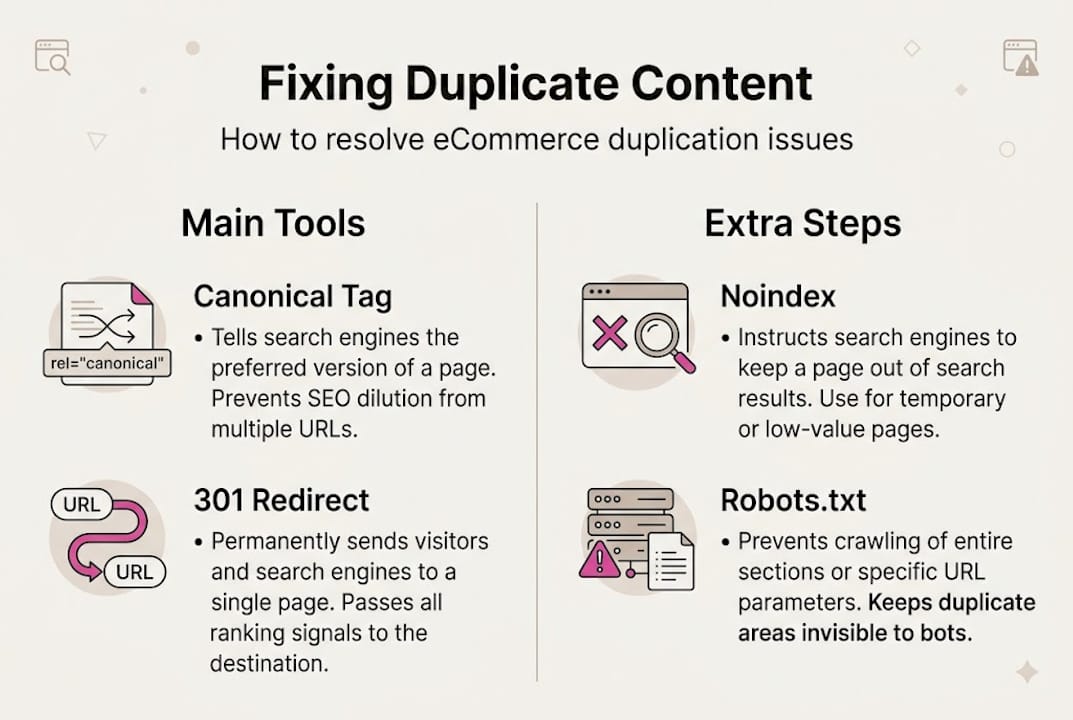
301 redirects are appropriate where you want to permanently consolidate two URLs into one. If you have both HTTP and HTTPS serving the same content, a sitewide 301 redirect to HTTPS resolves this cleanly and also consolidates any accumulated link equity. Well-executed redirects support a stronger content marketing strategy.
Noindex directives on filter pages and internal search result pages prevent Google from indexing low-value parameterised URLs without blocking Googlebot from crawling them entirely. This is often more practical than robots.txt blocking for faceted navigation.
Robots.txt parameter blocking is useful where filters generate entirely unique URLs that have no SEO value. Block the parameters at source to prevent Googlebot from wasting crawl budget on them.
Unique product descriptions are the most impactful long-term fix for external duplication. Manufacturer copy is almost always duplicated across dozens of reseller sites. Writing even 100 words of original, benefit-focused copy per product, as explored in content marketing’s impact, dramatically differentiates your pages. Industry data confirms eCommerce traffic uplift of 20% to 155% following systematic content rewrites combined with technical fixes.
Here is a practical checklist for UK and Ireland eCommerce managers:
Apply canonical tags and redirects to all parameter and session ID URLs
Set self-referencing canonicals on every paginated and filtered collection page
Add noindex to internal search results, account pages, and cart pages
Block non-essential parameter strings in robots.txt
Rewrite at least the top 20% of products by revenue with unique descriptions
Audit and update hreflang tags if serving both UK and Irish audiences from the same domain
Review Shopify’s duplicate content guidance for platform-specific canonical handling
Pro Tip: Use self-referencing canonical tags on every page, not just duplicates. This defensive tactic signals clearly to Google which URL is authoritative, even when no duplication currently exists, protecting you from future parameter issues.
Why tackling duplicate content now gives your eCommerce site a competitive edge
Here is something most eCommerce managers get wrong: they wait for a visible ranking drop before acting on duplicate content. By then, the damage is already done, link equity has drained, crawl budget has been wasted for months, and recovery takes time. The managers who move first gain ground that their competitors will struggle to reclaim.
In our experience working with eCommerce brands across the UK and Ireland, duplicate content fixes consistently deliver faster wins than many other SEO initiatives. A well-executed canonical and redirect project can move rankings within weeks, not quarters. That speed matters when you are competing in price-sensitive markets.
What makes this even more pressing in 2026 is the rise of AI-driven search. Large language models reward semantic uniqueness and topical authority. A site with hundreds of near-identical product pages sends weak, contradictory signals to both traditional and AI-powered search systems. Fixing duplicates is not just a technical task; it is a signal of content quality that benefits your entire site.
Many managers also underestimate how platform-specific duplicates compound over time on growing catalogues. A site with 500 products and no duplication strategy can easily generate 5,000 indexed URLs, most of them near-identical. The brands that build duplication controls into their catalogue management workflow from the start maintain cleaner sites and stronger rankings. Fixing duplicate content is a foundational SEO upgrade, not a cosmetic one. It is also one of the clearest demonstrations that organic search success depends on getting structural basics right.
Enhance your eCommerce site’s SEO with expert support
Resolving duplicate content across a growing product catalogue is genuinely complex work, especially on platforms like Shopify and Magento where structural duplication is baked into the architecture. Getting it right requires both technical precision and a clear content strategy.

With over 25 years of experience scaling eCommerce brands, we have helped businesses across the UK and Ireland reclaim organic visibility, consolidate link equity, and build catalogues that search engines trust. Whether you need a one-off audit, a full remediation plan, or ongoing SEO support, our team at iwanttobeseen.online can identify exactly where duplicate content is costing you and implement fixes that deliver measurable results.
Frequently asked questions
Does Google penalise duplicate content on eCommerce sites?
Google does not issue penalties for duplicate content unless it is clearly manipulative; instead, it selects a canonical URL and may leave your preferred pages under-indexed or under-ranked.
How can I check for duplicate content on my eCommerce store?
Use Google Search Console alongside site audit tools like Semrush or Screaming Frog, Copyscape or Siteliner, and manual phrase searches wrapped in quote marks to identify both internal and external duplicates.
What are the quickest ways to fix duplicate content?
Apply canonical tags and 301 redirects to consolidate duplicate URLs, set noindex on filter and search pages, and rewrite manufacturer product descriptions with original copy to differentiate your pages immediately.
How much organic traffic can I gain by fixing duplicate content?
eCommerce sites that systematically resolve duplication issues report a 20% to 155% uplift in organic traffic, with the largest gains typically coming from combining technical fixes with unique product copy rewrites.
Recommended
Comments