.png)
Customer journey mapping: enhance your e-commerce experience


TL;DR:
Customer journey mapping visualizes every touchpoint and emotion from awareness to post-purchase.
Regularly updating the map helps identify friction points and uncover hidden revenue opportunities.
Treat journey mapping as an ongoing culture rather than a one-time project for best results.
Most e-commerce marketing managers are brilliant at optimising individual channels. The PPC campaigns are tight, the SEO is solid, and the email sequences are polished. Yet customers still drop off, abandon carts, and never return. The problem is rarely the channels themselves. It’s the gaps between them. Customer journey mapping gives you a bird’s-eye view of the entire experience, from the moment someone first discovers your brand to the point where they become a repeat buyer. This article will walk you through what journey mapping actually involves, how to build one that works for your business, and the pitfalls that quietly derail most efforts.
Table of Contents
Key Takeaways
Point | Details |
Journey mapping defined | Customer journey mapping visually details every interaction, emotion, and pain point to improve e-commerce experiences. |
Omnichannel focus | Effective mapping covers every touchpoint across channels, from initial search to post-purchase support. |
Actionable process | Building a journey map involves structured steps: set goals, gather data, chart stages, prioritise fixes, and iterate. |
Common pitfalls | Teams often miss edge cases and fail without cross-team input or regular map updates. |
Continuous improvement | Review and update your journey map regularly for the best ROI and customer loyalty. |
What is customer journey mapping? Core concepts explained
At its simplest, customer journey mapping is the visualisation of every touchpoint and emotion from awareness to post-purchase. Think of it as a diagram or timeline that captures not just what customers do, but how they feel at each step. For e-commerce managers, this is especially powerful because the journey spans so many channels, paid search, organic, social media, email, on-site, and even offline touchpoints like delivery and returns.
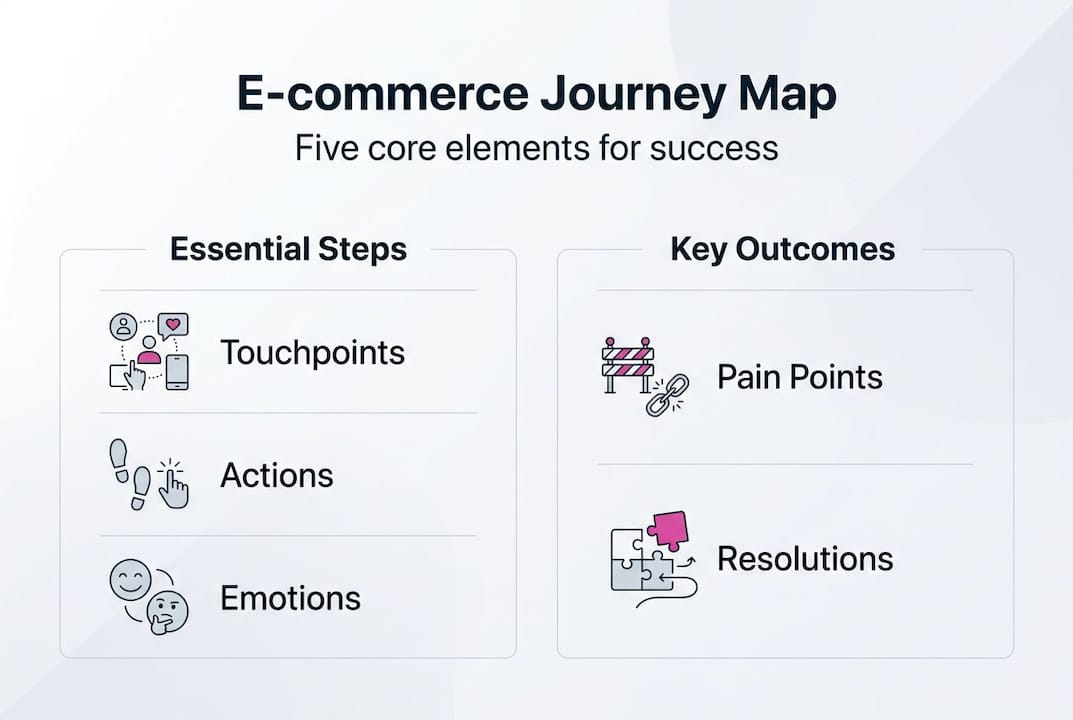
A well-built journey map covers five core elements. First, touchpoints: every interaction a customer has with your brand. Second, customer actions: what they actually do at each touchpoint, such as clicking an ad or reading a review. Third, emotions: how they feel, frustrated, excited, uncertain. Fourth, pain points: where friction kills momentum. Fifth, opportunities: where you can improve the experience and drive better outcomes.
Element | Description | Example | Opportunity |
Touchpoint | Where interaction occurs | Google Shopping ad | Improve ad copy relevance |
Customer action | What the customer does | Clicks through to PDP | Strengthen product page |
Emotion | How they feel | Uncertain about sizing | Add size guide or reviews |
Pain point | Source of friction | Slow checkout | Streamline payment flow |
Opportunity | Area for improvement | Post-purchase silence | Trigger follow-up email |
For UK and Ireland retailers, customer experience management sits at the heart of sustainable growth. Here is why journey mapping is non-negotiable:
It reveals friction points you cannot see from channel-level data alone
It aligns your entire team around the customer rather than internal KPIs
It uncovers revenue opportunities hidden in overlooked stages like post-purchase
Loyal customers represent a minority of your audience but generate a disproportionate share of revenue. Improving their experience compounds over time in ways that acquisition spend simply cannot match.
Key stages in the e-commerce customer journey
With the foundation established, the next step is to break down how a typical e-commerce customer journey unfolds. According to research on journey structure, most journeys involve five to seven stages, and mapping them requires both analytics and customer interviews to get right.
Here are the six main stages for e-commerce:
Awareness: The customer discovers your brand via search, social, or word of mouth
Consideration: They research, compare products, and read reviews
Decision: They add to cart and move towards purchase
Purchase: The transaction itself, including checkout and payment
Post-purchase: Delivery, unboxing, and first use of the product
Loyalty and advocacy: Repeat buying, referrals, and reviews
Each stage demands a different marketing response. Awareness calls for strong SEO and paid social. Consideration needs compelling content and social proof. The decision stage is where building e-commerce loyalty begins, not after purchase, but right at the moment of choice. Post-purchase is where most brands go quiet and lose the relationship entirely.
Factor | UK/Ireland e-commerce | Traditional retail |
Primary channel | Search, social, email | In-store, print |
Data source | GA4, CRM, heatmaps | POS, footfall data |
Typical pain point | Checkout friction, delivery cost | Queue times, stock availability |
Loyalty driver | Personalised follow-up | Staff relationships |
One statistic worth holding onto: loyal customers make up roughly 21% of your audience but contribute around 44% of total revenue. That makes the later stages of the journey, post-purchase and loyalty, far more commercially significant than most teams treat them. Integrating customer lifecycle marketing into your strategy is how you close that gap.
How to build your own customer journey map
Understanding the stages is one thing. Actually building a map specific to your business is another. The methodology involves defining goals, researching personas, identifying stages, prioritising opportunities, and acting iteratively. Here is how to do it in practice:
Define your persona: Start with one customer segment. Choose the one that drives the most revenue or the one with the highest churn risk.
Gather data: Pull together GA4 data, heatmaps, session recordings, support tickets, and post-purchase survey responses. Do not skip the qualitative side.
Identify stages: Map the journey from first awareness through to repeat purchase for that persona.
Map actions and emotions: For each stage, document what the customer does and how they feel. Use real data, not assumptions.
Prioritise opportunities: Score each pain point by impact and ease of fix. Focus on the highest-impact items first.
Iterate: Revisit the map quarterly. Journeys change as your product range, channels, and customer expectations evolve.
For UK and Ireland teams, balancing quantitative data with qualitative insight is critical. Analytics tells you what is happening. Customer interviews and surveys tell you why. Both are essential for personalised marketing strategies that actually resonate.

Pro Tip: Run a cross-functional workshop with your marketing, customer service, and logistics teams before finalising the map. Each team sees a different slice of the journey, and combining those views removes internal bias fast. Even a simple whiteboard session can surface insights that months of solo analysis would miss. This collaborative approach also feeds directly into a stronger branding process for e-commerce that stays consistent across every touchpoint.
You do not need expensive software to start. Miro, Lucidchart, or even a shared Google Slide works perfectly well for a first version. The goal is clarity, not polish.
Pitfalls and expert tips: what most e-commerce teams miss
Once you know how to build a map, it is vital to understand what can go wrong. The most common mistake is mapping only the happy path, the smooth, frictionless journey where everything works perfectly. Real customers do not always follow that route. Edge cases, breakdowns, and recovery paths must be considered. Static maps without iteration fail, and the risk of internal bias is high when teams rely on assumptions rather than real data.
Other common pitfalls include:
Building the map once and never updating it
Working in silos, where marketing maps the journey without input from logistics or support
Treating the map as a presentation asset rather than a working document
Advanced teams also factor in reducing cart abandonment as a specific journey breakdown to map and resolve. Delivery problems, failed payments, and post-purchase complaints are all edge cases that belong on the map. Ignoring them means your conversion funnel optimisation efforts will always have a ceiling.
Pro Tip: Always pair your current state map (the as-is version) with a future state map (the to-be version). The as-is map shows where you are. The to-be map shows where you want to be. Together, they create a clear brief for your product, marketing, and operations teams.
To validate your map before acting on it, try these three approaches:
Customer interviews: Ask five to ten recent buyers to walk you through their experience in their own words
Session replay analysis: Watch real user sessions to confirm or challenge your assumptions
Support ticket review: Categorise your last 50 support tickets by journey stage to find the biggest pain clusters
Over-polishing an early journey map is one of the most common ways teams waste time. A rough, honest map built from real data beats a beautiful diagram built from guesswork every time.
A smarter way forward: our take on journey mapping for UK/Ireland e-commerce
Most guides treat journey mapping as a project. We see it differently. After 25 years of scaling e-commerce brands, the teams that get the most value from mapping are the ones that treat it as an ongoing cultural practice, not a one-off deliverable.
Quarterly iteration consistently outperforms the annual big-bang review. Markets shift, customer expectations rise, and new channels emerge. A map built in January can be misleading by October if no one has touched it. The brands that win are those that build a rhythm of reviewing and updating, not those that produce the most elaborate initial version.
The ROI from journey mapping is also broader than most teams expect. Yes, it improves conversion. But the less obvious gains come from reduced support costs, fewer returns, and stronger retention. In the UK and Ireland, where service expectations are high and switching costs are low, a single bad post-purchase experience can erase the value of an otherwise excellent acquisition campaign.
Our strongest recommendation: start with a minimum viable map. Cover one persona, one journey, and three to five key pain points. Act on those findings. Then update the map. This approach builds momentum and proves value internally far faster than trying to map everything at once. The cart abandonment impact alone often justifies the entire exercise within the first quarter.
Take the next step to elevate your customer experience
Journey mapping is only as valuable as the actions it drives. If the insights sit in a slide deck, nothing changes.

At I Want To Be Seen, we work with e-commerce managers across the UK and Ireland to translate journey mapping insights into concrete marketing improvements, from SEO and PPC to personalised email sequences and conversion optimisation. Our e-commerce marketing expertise spans over 25 years of hands-on brand scaling, so we understand what the data is really telling you. If you are ready to connect your journey mapping findings to personalised e-commerce marketing that drives measurable results, we would love to help you take that next step.
Frequently asked questions
What is the main goal of customer journey mapping?
The main goal is to identify and resolve pain points at every stage of the customer experience to improve satisfaction and drive better business results. Mapping identifies opportunities for improvement from awareness right through to post-purchase.
How often should I update my journey map?
You should update your map quarterly or whenever there are significant changes in customer behaviour, product range, or marketing channels. Quarterly iteration is especially important for adapting to shifting local expectations in the UK and Ireland.
What is the difference between ‘as-is’ and ‘to-be’ journey maps?
‘As-is’ maps document your current customer experience, while ‘to-be’ maps outline the improved future state you are working towards. Both map types are needed to reveal gaps and create a clear plan for improvement.
Why do journey mapping projects sometimes fail?
They fail most often because teams rely on internal assumptions rather than real customer data, map only the ideal path, or never revisit the map after the initial build. Assumption-based maps and lack of iteration are the two most common root causes.
Recommended
Comments