.png)
What Is Contextual Advertising and Why It Matters


More than 63 percent of British ecommerce managers say privacy rules have forced them to rethink their advertising strategies. For online retailers across the United Kingdom and Ireland, finding a privacy-friendly way to attract and engage customers is now a top priority. Contextual advertising promises smarter, compliant ad placements and higher sales potential by matching ads with the actual content customers browse, rather than their personal data.
Table of Contents
Key Takeaways
Point | Details |
Contextual Advertising Strategy | Focus on webpage content rather than personal data to enhance user privacy and engagement. |
Algorithmic Process | Utilise advanced algorithms for precise ad placement, ensuring relevance to the content being consumed. |
Emerging Technology | Leverage AI and machine learning for improved contextual ad targeting, adapting swiftly to content nuances. |
Compliance with Privacy Regulations | Align advertising practices with GDPR to promote transparency and maintain consumer trust. |
Defining Contextual Advertising Today
Contextual advertising represents a strategic digital marketing approach where online advertisements are dynamically matched to the specific content of a webpage. Privacy-conscious ad targeting has become increasingly important as traditional behavioural targeting methods face growing regulatory scrutiny.
At its core, contextual advertising functions by analysing the semantic meaning and keywords within webpage content to determine the most appropriate advertisements. Unlike behavioural advertising, which relies on personal user data and browsing history, contextual advertising focuses exclusively on the immediate content environment. Advanced semantic content analysis now enables more sophisticated matching between ad content and webpage context.
The key mechanisms of contextual advertising involve sophisticated algorithmic processes that scan webpage text, images, and metadata to understand the page’s primary subject matter. For ecommerce marketing managers, this means potential customers see advertisements directly related to the content they are currently consuming, increasing the likelihood of engagement and conversion. Modern AI technologies have dramatically enhanced the precision of contextual ad placement, allowing for more nuanced and relevant advertisement selection.
Pro tip: When implementing contextual advertising, focus on creating high-quality, niche content that naturally attracts your target audience, as this increases the probability of relevant ad placements.
How Contextual Ad Targeting Works
Contextual ad targeting operates through sophisticated algorithmic processes that analyse webpage content to match advertisements precisely. Automated keyword scanning systems enable digital platforms to identify and display relevant advertisements based on the immediate content environment.

The targeting mechanism involves several critical steps. First, advanced algorithms parse webpage text, identifying primary themes, keywords, and semantic contexts. These algorithms then cross-reference a comprehensive database of advertisement inventory, selecting ads that align most closely with the page’s specific content. Programmatic advertising auctions have further refined this process, leveraging artificial intelligence to optimise ad placement with unprecedented precision.
For ecommerce marketing managers, this means advertisements can be dynamically matched to relevant content, creating a more engaging and less intrusive user experience. Unlike traditional behavioural targeting, contextual advertising respects user privacy by focusing exclusively on the immediate content environment. Modern AI technologies have dramatically enhanced the granularity of ad matching, allowing for nuanced placement that feels organic and contextually appropriate.
Pro tip: Invest in high-quality, semantically rich content to improve contextual ad relevance and increase the probability of attracting precisely targeted advertisements.
Key Types and Technology Variations
Contextual advertising encompasses several sophisticated technological approaches that enable precise digital marketing strategies. Semantic analysis technologies have evolved to provide increasingly nuanced methods of matching advertisements with relevant content environments.
The primary types of contextual advertising can be categorised into three distinct technological variations. First, keyword-based targeting scans webpage content for specific terms and matches corresponding advertisements. Second, topic-based targeting analyses broader thematic contexts, allowing for more sophisticated ad placement. Advanced machine learning techniques represent the third and most sophisticated approach, utilising natural language processing to understand complex content meanings and user engagement patterns.
Modern contextual advertising technologies leverage artificial intelligence to interpret subtle content nuances, sentiment, and real-time intent. This enables ecommerce marketing managers to deploy highly targeted advertisements that feel organic and contextually relevant. The most advanced systems can now analyse multimedia content, including images and video, expanding the potential for precise ad placement across diverse digital platforms.
Key technology variations in contextual advertising:
Type of Targeting | Mechanism | Strengths |
Keyword-based | Scans for specific terms | Simple, quick to deploy |
Topic-based | Analyses broader themes | Greater relevance, flexible |
Machine learning/NLP | Processes complex semantics | Highest accuracy, adapts fast |
Pro tip: Continuously update your content taxonomies and keyword databases to ensure your contextual advertising remains precise and adaptable to emerging digital marketing trends.
Privacy, Compliance, and GDPR Impacts
The introduction of the General Data Protection Regulation (GDPR) has fundamentally transformed digital advertising strategies, particularly in the realm of targeted marketing. GDPR opt-in requirements have dramatically reduced the number of consumers observable by advertising intermediaries, compelling businesses to adopt more privacy-conscious approaches.
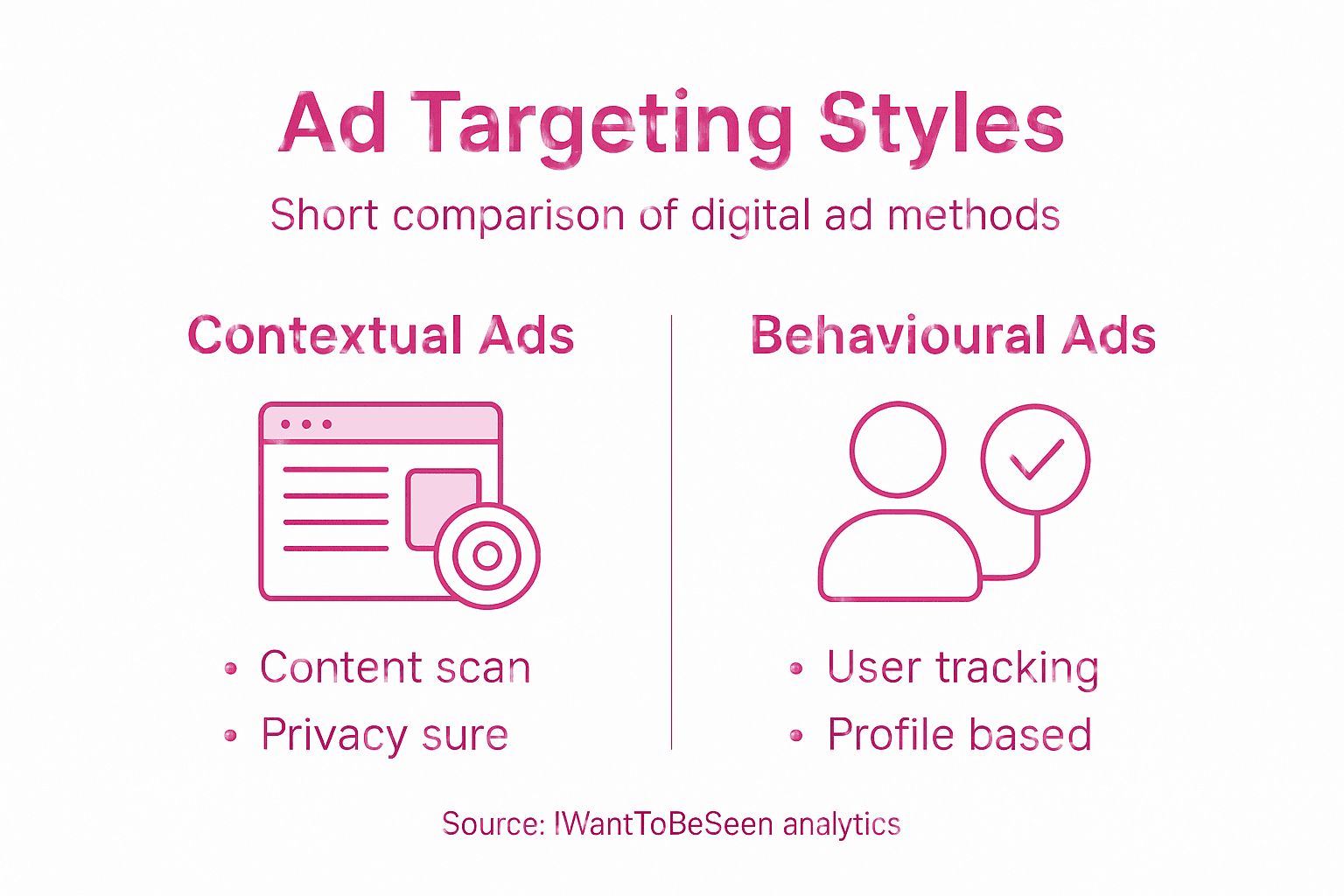
Contextual advertising has emerged as a primary solution to the privacy challenges posed by GDPR. Unlike behavioural targeting, which relies on personal user data, contextual advertising focuses exclusively on webpage content, thus inherently complying with strict data protection regulations. Display advertising performance metrics demonstrate that while traditional targeted advertising has experienced significant revenue reductions, contextual advertising provides a resilient and legally compliant alternative.
For ecommerce marketing managers, navigating GDPR compliance requires a strategic shift towards privacy-first advertising methods. This means prioritising ad placement based on content relevance rather than individual user tracking. The most sophisticated contextual advertising technologies now leverage artificial intelligence to analyse webpage contexts while maintaining strict adherence to data protection principles, offering a sophisticated balance between effective marketing and user privacy.
Pro tip: Develop a comprehensive consent management strategy that transparently communicates your data usage practices and provides users with clear, granular opt-in and opt-out mechanisms.
Comparing Contextual and Behavioural Ads
Contextual and behavioural advertising represent two fundamentally different approaches to digital marketing, each with distinct strategies for targeting potential customers. Ad targeting methodologies reveal significant differences in how advertisements are matched with potential audiences, with privacy and relevance playing crucial roles in their effectiveness.
Behavioural advertising relies on comprehensive user data, tracking individual browsing histories, demographics, and online interactions to create highly personalised ad experiences. Natural language processing technologies have enhanced both targeting methods, but contextual advertising maintains a critical advantage by focusing exclusively on webpage content rather than personal user information. This approach prioritises privacy and relevance, making it increasingly attractive in a digital landscape with growing data protection concerns.
For ecommerce marketing managers, the choice between contextual and behavioural advertising is not necessarily binary. The most sophisticated strategies often combine elements of both approaches, leveraging contextual targeting’s privacy compliance while utilising behavioural insights to refine ad placement. Advanced AI technologies now enable more nuanced ad targeting that respects user privacy while maintaining high relevance and engagement potential.
Here’s a comparison of contextual and behavioural advertising approaches:
Aspect | Contextual Advertising | Behavioural Advertising |
Data Usage | Relies on webpage content | Utilises personal user data |
Privacy Compliance | High, GDPR-compliant | Lower, faces regulatory challenges |
Ad Relevance | Based on page context | Driven by user history |
User Experience | Less intrusive and organic | Highly personalised, sometimes invasive |
Technology Dependence | Semantic and AI content scanning | Tracking cookies, profiling |
Pro tip: Develop a hybrid advertising strategy that balances contextual precision with carefully consented behavioural insights to maximise both user privacy and marketing effectiveness.
Best Practices for Ecommerce Retailers
Contextual advertising strategies demand a nuanced approach for ecommerce retailers seeking to maximise digital marketing effectiveness. Customer-oriented marketing approaches demonstrate that personalised, real-time content placement can significantly enhance site satisfaction and customer loyalty.
Successful implementation requires adhering to rigorous ethical standards and technical precision. Online advertising guidelines emphasise transparent ad identification, truthful representation, and responsible data management. This means creating contextual advertisements that are not only relevant but also respectful of user privacy and experience.
Ecommerce marketing managers should focus on developing sophisticated contextual targeting strategies that leverage advanced AI technologies. Key considerations include understanding webpage semantics, matching ad content precisely with page context, and maintaining a delicate balance between relevance and user privacy. The most effective approaches integrate multiple data signals while prioritising user consent and content alignment.
Pro tip: Regularly audit your contextual advertising strategies, using machine learning tools to continuously refine ad relevance and ensure alignment with evolving privacy regulations and user expectations.
Unlock The Power of Contextual Advertising for Your Ecommerce Brand
The challenge ecommerce marketing managers face today is mastering contextual advertising to achieve precise, privacy-compliant targeting that truly connects with their audience. As the article explains, focusing on semantic content analysis rather than personal data is essential to staying ahead in a GDPR-driven world where user privacy cannot be compromised. You want to increase ad relevance while respecting regulations and improving customer engagement with your products.
Our digital marketing services at IWantToBeSeen are specifically designed to help ecommerce businesses like yours navigate this evolving landscape. With over 25 years of experience scaling successful ecommerce brands, we specialise in advanced SEO, AI-driven strategies, and PPC campaigns that integrate contextual advertising principles. We ensure your ads are placed thoughtfully within relevant content environments and optimise your online presence for maximum conversion.
If you are ready to transform your advertising strategy with privacy-first, highly relevant contextual ads, it is time to take action.

Discover how our expert team can elevate your ecommerce marketing efforts through superior contextual targeting and compliance solutions. Visit IWantToBeSeen Digital Marketing Services to start crafting campaigns that respect user privacy while driving real growth today.
Frequently Asked Questions
What is contextual advertising?
Contextual advertising is a digital marketing strategy where ads are matched to the content of a webpage based on its specific themes and keywords, rather than relying on user behaviour or personal data.
How does contextual advertising work?
Contextual advertising works by using advanced algorithms to scan webpage content for keywords and semantic meaning, dynamically selecting relevant ads that align with the page’s content to enhance user engagement.
What are the benefits of contextual advertising compared to behavioural advertising?
The main benefits of contextual advertising include greater privacy compliance, as it does not rely on personal data, and enhanced relevance since ads are directly tied to the content users are consuming, leading to a less intrusive experience.
What are some best practices for implementing contextual advertising?
Best practices for implementing contextual advertising include developing high-quality, semantically rich content, regularly auditing ad relevance, leveraging AI technologies, and maintaining transparency with user data usage to respect privacy regulations.
Recommended
Comments