.png)
Chatbot Marketing: Enhancing Ecommerce Engagement Online
- Darren Burns
- Jan 11
- 8 min read


British ecommerce owners know the pressure to stand out in a crowded online marketplace. With more than 65 percent of consumers now expecting instant responses from retailers, chatbots have quickly become an essential tool for driving engagement and improving user satisfaction. This guide explores practical chatbot marketing strategies designed to help UK and Ireland businesses deliver meaningful customer interactions while pushing sales and strengthening their brand.
Table of Contents
Key Takeaways
Point | Details |
Chatbot Functionality | Chatbots enhance ecommerce by providing instant, personalised interactions, improving customer engagement and satisfaction. |
Types of Chatbots | Understanding the distinctions between rule-based, AI-powered, and hybrid chatbots is vital for effective implementation in ecommerce strategies. |
Marketing Benefits | Chatbot marketing transforms digital interactions, enabling targeted recommendations and better customer journey tracking to enhance overall marketing efforts. |
Compliance and Risks | Awareness of legal and ethical challenges is crucial, as businesses must navigate regulatory requirements and ensure robust data security measures with chatbot implementations. |
Chatbot marketing explained for ecommerce
Chatbot marketing represents a transformative approach for ecommerce businesses, leveraging artificial intelligence to revolutionise customer interactions and streamline online shopping experiences. These intelligent digital assistants are no longer simple scripted response tools, but sophisticated platforms capable of understanding customer queries, providing personalised recommendations, and supporting purchasing decisions in real time.
The core functionality of ecommerce chatbots centres on advanced natural language processing, enabling them to comprehend user intent with remarkable accuracy. Through machine learning algorithms, these chatbots can interpret complex customer requests, track order statuses, offer product suggestions, and even handle customer support enquiries without human intervention. They operate continuously, providing instant responses that significantly enhance customer engagement and satisfaction.
Modern chatbot technologies integrate seamlessly with existing ecommerce platforms, offering features like personalised shopping experiences, abandoned cart recovery, and proactive customer support. By analysing user behaviour and purchase history, these AI-powered tools can deliver targeted product recommendations, answer frequently asked questions, and guide customers through the purchasing journey with unprecedented efficiency.
Pro tip: Implement a chatbot with clear escalation protocols that seamlessly transfer complex customer queries to human support agents when necessary to maintain high-quality customer service.
Types of chatbots and their key distinctions
Chatbot technologies in ecommerce have evolved into sophisticated systems with distinct operational approaches, each designed to address specific customer interaction needs. Understanding these variations is crucial for businesses seeking to implement the most effective digital assistance strategy for their online platforms.
The primary categories include rule-based and AI-driven chatbots, each offering unique capabilities and limitations. Rule-based chatbots operate through predefined conversational pathways, functioning best for straightforward tasks like answering frequently asked questions, providing basic product information, and guiding customers through simple processes. These chatbots follow strict decision trees, ensuring consistent and predictable responses but lacking the nuanced understanding of more advanced systems.
In contrast, AI-powered chatbots leverage advanced machine learning and natural language processing to deliver more dynamic and intelligent interactions. These sophisticated systems can understand context, learn from previous conversations, and adapt their responses in real-time. They excel at handling complex customer queries, providing personalised product recommendations, and creating more engaging conversational experiences that closely mimic human customer service representatives.

Hybrid chatbot models represent an increasingly popular approach, combining the reliability of rule-based systems with the adaptability of AI technologies. These versatile platforms can switch between predefined response protocols and intelligent interpretation, offering businesses a flexible solution that balances consistency with sophisticated interaction capabilities.
Here’s a comparison of the main chatbot types used in ecommerce:
Chatbot Type | Key Technologies | Typical Tasks | Suitable Business Use |
Rule-based | Decision trees, scripting | FAQs, order status, simple info | Small online shops |
AI-powered | Machine learning, NLP | Personalised recommendations, complex queries | Large ecommerce sites |
Hybrid | Combined algorithms | Switches between simple and complex queries | Businesses seeking scalability |
Pro tip: Select a chatbot solution that matches your specific ecommerce complexity, starting with a hybrid model that can scale and adapt as your business requirements evolve.
How chatbot marketing enhances engagement
Chatbot marketing represents a revolutionary approach to digital customer interaction, fundamentally transforming how ecommerce businesses communicate with their audience. By providing instant, personalised communication channels, chatbots bridge the critical gap between customer enquiries and comprehensive support, creating more meaningful and responsive engagement experiences.
Research demonstrates that chatbots significantly improve customer satisfaction through enhanced response times and information quality. These intelligent systems offer immediate answers to customer queries, reducing waiting periods and providing consistent, accurate information across multiple interaction points. By analysing customer behaviour and preferences in real-time, chatbots can deliver targeted recommendations, personalised product suggestions, and contextually relevant assistance that feels intuitive and user-centric.
The strategic implementation of chatbot technologies goes beyond simple query resolution. Modern chatbots function as sophisticated engagement tools that can track customer journeys, analyse interaction patterns, and provide valuable insights into consumer behaviour. They seamlessly integrate with existing marketing platforms, enabling businesses to capture detailed customer interaction data, understand purchasing motivations, and refine their marketing strategies dynamically. This data-driven approach allows for continuous improvement of customer experience and more targeted marketing efforts.
Moreover, chatbots excel at maintaining consistent brand communication across various digital touchpoints. They can be programmed to reflect a brand’s unique tone of voice, ensuring that every customer interaction reinforces brand personality and values. By providing round-the-clock support and instant responses, these AI-powered systems create a sense of reliability and accessibility that modern consumers increasingly expect from online businesses.
Pro tip: Implement progressive complexity in your chatbot design, starting with basic interaction flows and gradually introducing more advanced conversational capabilities as you analyse user engagement patterns.
Proven chatbot use cases for online stores
Chatbots have revolutionised customer interaction strategies for online retailers, offering sophisticated solutions that extend far beyond simple query management. These intelligent digital assistants have become critical tools for transforming customer experience and driving business performance across multiple operational domains.
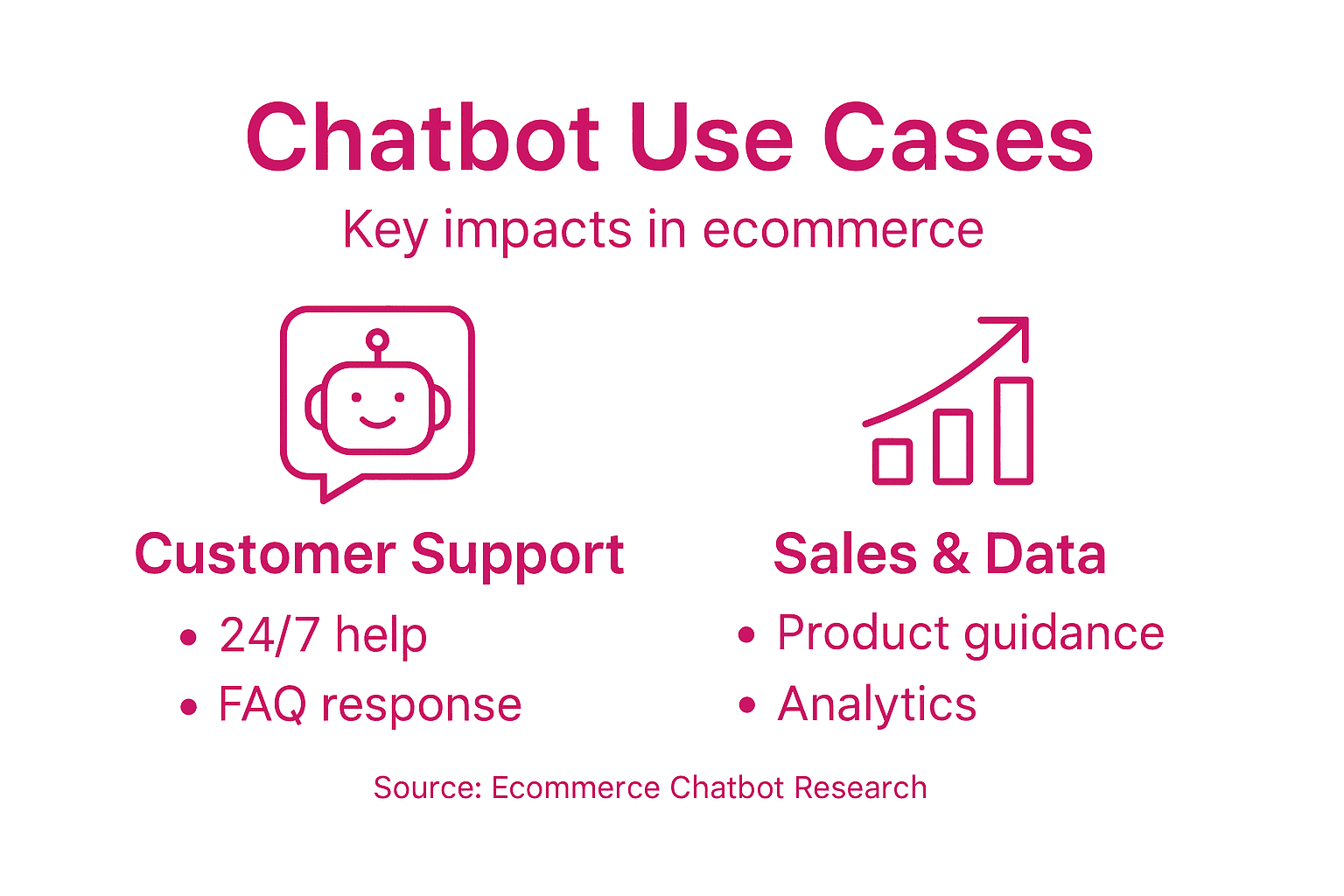
One of the most prominent chatbot applications in e-commerce involves comprehensive customer support automation. Online stores now leverage chatbots to handle a wide range of interactions, from answering frequently asked questions and tracking order statuses to providing detailed product information and resolving customer concerns instantaneously. By offering 24/7 support, these AI-powered systems ensure that customers receive immediate assistance, dramatically reducing response times and improving overall satisfaction levels.
Beyond customer support, chatbots play a crucial role in sales and marketing strategies. They excel at personalised product recommendations, analysing customer browsing history and purchase patterns to suggest relevant items. Moreover, chatbots are particularly effective in managing abandoned shopping carts, proactively engaging customers with targeted messages, offering discounts, or addressing potential purchase barriers. This strategic intervention can significantly reduce cart abandonment rates and boost conversion opportunities for online stores.
Additionally, chatbots serve as powerful data collection and analytics tools. They can capture detailed customer interaction insights, preferences, and behavioural patterns, enabling businesses to continuously refine their marketing strategies. By integrating with existing customer relationship management systems, these intelligent interfaces provide real-time feedback and actionable intelligence that can drive product development, inventory management, and personalised marketing campaigns.
Below is a summary of common chatbot use cases and their business impact:
Use Case | Description | Business Impact |
Customer support automation | Handling enquiries and FAQs instantly | Boosts satisfaction, reduces cost |
Cart abandonment recovery | Engaging shoppers who leave carts | Increases conversion rates |
Product recommendations | Analysing behaviour for suggestions | Drives upselling and loyalty |
Data analytics | Collecting customer interaction data | Enables targeted campaigns |
Pro tip: Configure your chatbot with clear escalation protocols to seamlessly transfer complex queries to human agents, ensuring a smooth and comprehensive customer support experience.
Risks, pitfalls, and compliance essentials
While chatbots offer transformative potential for ecommerce businesses, they also introduce complex legal and ethical challenges that demand strategic navigation. Understanding these risks is crucial for responsible implementation and maintaining customer trust in an increasingly sophisticated digital landscape.
The emergence of chatbot regulatory frameworks highlights the significant legal complexities surrounding AI-powered customer interactions. Businesses must be acutely aware of potential risks such as misinformation dissemination, unintended bias in conversational algorithms, and the potential for generating misleading or inappropriate responses. These challenges necessitate robust governance mechanisms and continuous monitoring to ensure chatbots operate within acceptable ethical and legal boundaries.
Regulatory compliance represents a critical consideration for ecommerce platforms implementing chatbot technologies. The European Union’s AI Act introduces stringent requirements for transparency, risk management, and user protection. Organisations must implement clear disclosure protocols, ensuring users understand they are interacting with an artificial intelligence system. This includes providing mechanisms for users to understand the chatbot’s limitations, opt out of AI interactions, and access human support when required. Failure to comply can result in substantial financial penalties and potential reputational damage.
Technical vulnerabilities pose another significant risk for chatbot implementations. Potential issues include data privacy breaches, insufficient security protocols, and the risk of malicious actors exploiting conversational interfaces. Businesses must invest in robust cybersecurity measures, implement rigorous data protection strategies, and develop comprehensive risk mitigation frameworks to protect both customer information and organisational integrity.
Pro tip: Conduct regular comprehensive audits of your chatbot’s conversational algorithms, focusing on identifying potential bias, verifying response accuracy, and ensuring alignment with evolving regulatory standards.
Boost Your Ecommerce Success with Expert Chatbot Marketing Solutions
The article highlights the challenge ecommerce businesses face in delivering instant, personalised customer engagement through sophisticated chatbot marketing. Tackling issues like cart abandonment, 24/7 customer support, and seamless AI-human escalation demands a strategic approach powered by industry expertise. If improving customer satisfaction, increasing conversion rates, and ensuring regulatory compliance are your priorities, then adopting advanced chatbot strategies aligned with your business goals is essential.
At iwanttobeseen.online, we specialise in digital marketing services crafted for ecommerce brands. With over 25 years of experience scaling successful online stores, we understand the power of integrating AI-driven chatbots alongside SEO, social media, and PPC campaigns to elevate your customer interaction and boost sales.
Discover how our team can customise chatbot marketing solutions that effectively recover abandoned carts, provide personalised product recommendations, and maintain consistent brand communication—all while complying with AI regulations and data privacy standards.
Take control of your ecommerce growth today with a proven partner who knows what it takes to win in the digital marketplace.
Explore our services and transform your customer engagement with intelligent chatbot marketing.

Ready to enhance your ecommerce engagement with tailored chatbot marketing? Visit iwanttobeseen.online now and start your journey towards higher conversions and happier customers.
Frequently Asked Questions
What is chatbot marketing in ecommerce?
Chatbot marketing in ecommerce refers to the use of artificial intelligence-powered chatbots to enhance customer interactions, provide personalised recommendations, and streamline the online shopping experience.
How do AI-powered chatbots differ from rule-based chatbots?
AI-powered chatbots utilise advanced machine learning and natural language processing to understand context and learn from previous interactions, offering more dynamic and personalised responses. In contrast, rule-based chatbots follow predefined scripts and decision trees, limiting their ability to handle complex queries.
What are the main benefits of using chatbots for ecommerce marketing?
Chatbots improve customer satisfaction by providing instant responses to inquiries, personalising product recommendations, assisting with abandoned cart recovery, and collecting valuable customer behaviour data, which can enhance overall marketing strategies.
What precautions should businesses take when implementing chatbots?
Businesses should ensure compliance with regulatory frameworks, conduct regular audits to prevent bias in responses, protect customer data through robust cybersecurity measures, and create clear protocols for escalating complex queries to human agents.
Recommended
Comments