.png)
AI content workflow: boost SEO results by 23%


TL;DR:
Pure AI content ranks lower and has a higher risk of deindexation than hybrid or human-created content.
A structured workflow with human review and original input improves SEO performance and brand consistency.
Successful e-commerce teams focus on process mastery and brand voice rather than just advanced AI tools.
Scaling content output has never been more tempting for e-commerce marketing teams. AI writing tools promise speed, volume, and cost savings, yet many brands are quietly haemorrhaging search rankings by leaning too hard on automation. Pure AI content ranks 23% lower in Google search results and carries a significantly higher deindexation risk than content produced through a disciplined human-AI collaboration. If you are managing content for an e-commerce brand and want to scale without sacrificing visibility, this guide walks you through an evidence-based workflow that actually holds up under algorithm updates.
Table of Contents
Key Takeaways
Point | Details |
Hybrid workflows win | Combining AI drafting with human review delivers the highest SEO and customer engagement performance. |
Pure AI is risky | Relying solely on AI content leads to lower rankings and higher deindexing risk. |
Quality tools matter | The right mix of AI tools and workflow management is essential for e-commerce teams seeking visibility and growth. |
Human expertise is vital | Human input ensures brand voice, originality, and unique value in every piece. |
Why standard AI content fails e-commerce SEO
Having framed the opportunity and challenges, let’s pinpoint where standard AI approaches go wrong. The appeal of generating hundreds of product descriptions or blog posts overnight is obvious, but the performance data tells a sobering story.
Pure AI content does not just underperform slightly. It ranks 23% lower and carries a 3.2x higher deindexation risk compared to content that involves meaningful human input. For e-commerce sites where organic traffic is a primary revenue channel, that gap is commercially devastating. Understanding AI’s impact on marketing helps explain why the technology alone is never sufficient.
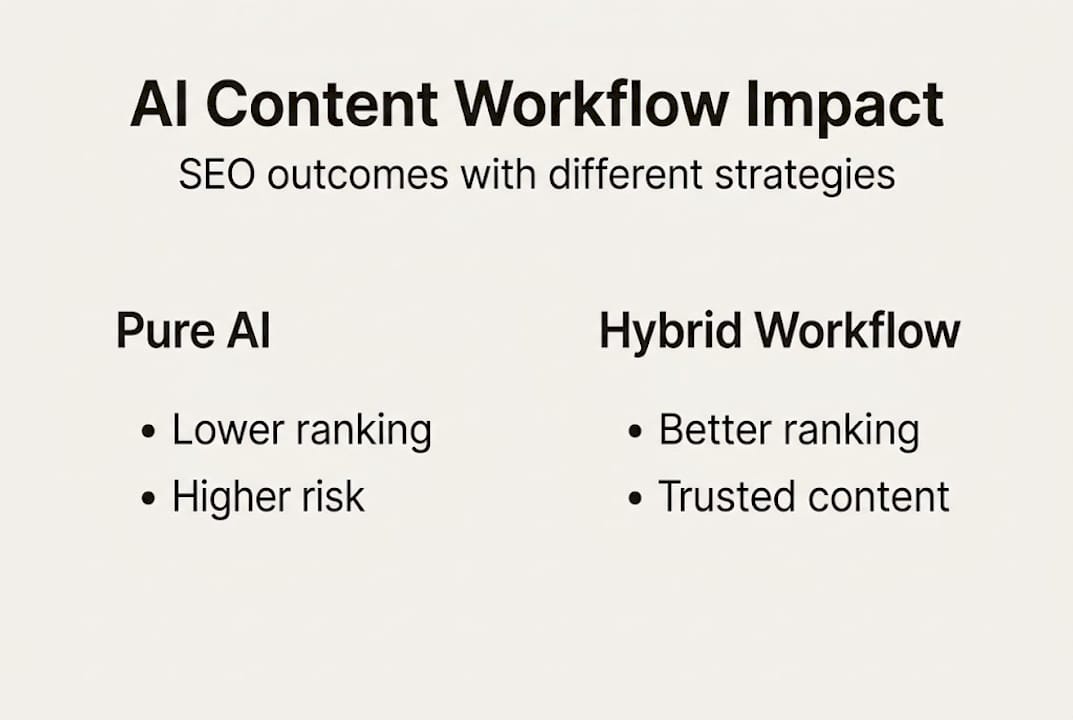
Here is a quick comparison of how different approaches perform across key SEO metrics:
Metric | Pure AI content | Hybrid AI + human | Manual human only |
Average ranking position | Lower by ~23% | Comparable to manual | Benchmark |
Deindexation risk | 3.2x higher | Low | Low |
Backlink acquisition | Weak | Strong | Strong |
Scalability | High | High | Low |
Brand voice consistency | Inconsistent | Controlled | Controlled |
The most common mistakes e-commerce teams make when relying solely on automation include:
Skipping editorial review, leaving factual errors and generic phrasing unchecked
Ignoring YMYL signals (Your Money or Your Life), where Google scrutinises expertise and trustworthiness most heavily
Replicating competitor content structures because AI tools draw from the same training data
Publishing without originality checks, increasing duplicate content penalties
Neglecting brand voice, making every page feel interchangeable with rivals
The deeper problem is structural. AI tools are trained on existing web content, so they naturally produce output that resembles what already ranks. That creates a homogenisation effect across e-commerce categories. If your product pages and buying guides read identically to your competitors’, Google has no reason to favour yours. Knowing how to use AI for SEO means understanding where the tool ends and your expertise begins.
Your essential toolkit for AI content creation
Understanding the pitfalls, let’s gather all the right tools for a robust workflow. The good news is that you do not need a dozen platforms. You need the right combination, used deliberately.

Hybrid human-AI workflows outperform pure AI in long-term SEO, and the tools you choose should actively support that collaboration rather than encourage full automation. A well-structured ecommerce content strategy begins with selecting tools that complement human judgement.
Tool category | Recommended options | Primary purpose |
AI writing | ChatGPT, Claude, Jasper | Draft generation, ideation |
SEO research | Ahrefs, Semrush, Surfer SEO | Keyword targeting, competitor analysis |
Originality checking | Copyscape, Originality.ai | Duplicate and AI detection |
Workflow management | Notion, Trello, Asana | Editorial calendar, task tracking |
Brand voice reference | Internal style guide, Notion | Consistency across writers and AI |
Beyond the tools themselves, your integration essentials should include:
A content calendar that maps AI drafting slots alongside human review deadlines
A prompt library with tested, brand-specific instructions that consistently produce on-tone output
A review workflow with defined sign-off stages before any content is published
A style guide that documents tone, vocabulary preferences, and formatting standards
A performance tracker linking published content to organic traffic and ranking changes
Pro Tip: Build a folder of your best-performing existing content and use it as reference material when prompting AI tools. Paste excerpts directly into your prompts and instruct the AI to match the tone, sentence structure, and level of specificity. This single habit dramatically reduces the editing time needed to bring AI drafts up to brand standard.
Step-by-step: Building a high-performing workflow
With the toolkit ready, here is exactly how to execute a workflow that gets results. The sequence matters as much as the individual steps.
Hybrid workflows see higher rankings and more backlinks than either AI-only or human-only approaches, but only when the process is followed consistently. Cutting corners at any stage reintroduces the risks you are trying to avoid. A solid content marketing workflow is the backbone of sustainable SEO growth.
Preparation: Define the topic, target keyword, search intent, and any unique data points or brand angles you want to include. Brief the AI as you would brief a junior writer.
AI drafting: Use your prompt library to generate a structured first draft. Aim for a solid skeleton, not a finished article.
Human enrichment: A skilled editor adds proprietary data, customer insights, real product examples, and brand-specific opinions that AI cannot generate.
Originality check: Run the draft through Copyscape or Originality.ai before proceeding. Flag and rewrite any passages that trigger similarity warnings.
Final optimisation: Refine headings, meta descriptions, internal links, and readability. Check keyword placement without forcing density.
Publishing and tracking: Publish with a clear URL structure, submit to Search Console, and log the piece in your performance tracker.
Here is how the three main approaches compare across the full production cycle:
Factor | Pure AI | AI + human | Manual only |
Time per piece | Very fast | Moderate | Slow |
SEO performance | Poor long-term | Strong | Strong |
Scalability | High | High | Low |
Brand authenticity | Low | High | High |
Pro Tip: Assign one senior editor as the final gatekeeper for brand and style review. This person does not need to rewrite content from scratch. Their job is to ask one question before approving: does this sound like us? That single check prevents the gradual drift in brand voice that happens when multiple team members interact with AI tools independently. Explore AI marketing strategies to see how leading e-commerce brands are structuring these roles.
Quality control and troubleshooting common mistakes
Once your content is in production, ongoing checks and fixes keep your workflow future-proof. Even a well-designed process develops blind spots over time.
Over-reliance on AI harms performance most severely for YMYL topics, which in e-commerce includes anything touching health products, financial decisions, or safety-related purchases. These categories require demonstrable expertise, and AI alone cannot provide it. A robust content strategy review process catches these issues before they affect rankings.
Your ongoing quality control checklist should cover:
AI pattern detection: Read drafts aloud. Repetitive sentence structures, vague transitions, and hollow qualifiers are telltale signs of unedited AI output
Repetition audit: Check for repeated phrases or ideas across your content library, particularly in product category pages
YMYL expertise verification: Confirm that any health, safety, or financial claims are reviewed by a qualified team member or external expert
Originality confirmation: Never skip this step, even for short-form content. Duplicate issues compound over time
Internal link integrity: Broken or irrelevant internal links signal poor maintenance to both users and search engines
The two most damaging errors teams make in production are skipping human review under deadline pressure and assuming that passing an AI detection tool means the content is Google-safe. Detection scores and ranking performance are not the same thing.
Pro Tip: Run a quarterly spot-check using Google Search Console to identify pages with declining impressions. Cross-reference those pages with your content log to see whether they were produced with full human review or rushed through. The pattern will almost always reveal where your process broke down.
Critical warning: Pure AI content faces a 3.2x higher deindexation risk, and this risk spikes sharply following major algorithm updates. One core update can wipe out months of traffic gains if your content library contains unreviewed AI pages.
Why the key to success is not just smarter AI, but smarter managers
After troubleshooting workflows, it is worth stepping back and asking a harder question: why do some e-commerce teams consistently outperform others, even when they use the same tools?
In our experience working across dozens of e-commerce brands, the answer is rarely the AI platform. It is the discipline of the person managing the process. Teams that invest in prompt engineering, editorial standards, and structured review cycles produce content that compounds in value over time. Teams that treat AI as a set-and-forget solution plateau quickly and often face painful recovery projects after algorithm updates.
The real differentiator heading into 2026 will not be access to the latest model. Every competitor has that. It will be process mastery and brand distinctiveness. The brands that win will be those whose content sounds unmistakably like them, carries genuine expertise, and earns trust from both readers and search engines. Understanding AI’s role in social media strategy reinforces this point: the technology amplifies what you bring to it, nothing more.
Smart managers do not just buy better tools. They build better habits around the tools they already have.
Ready to transform your workflow?
If this guide has shown you where your current AI content process has gaps, the next step is getting the right support to close them. We work exclusively with e-commerce brands across the UK and Ireland, helping marketing teams build AI-driven content workflows that scale without sacrificing rankings or brand integrity.

With over 25 years of experience scaling e-commerce brands, we know exactly where the process breaks down and how to fix it fast. Whether you need a full workflow audit, a content strategy overhaul, or hands-on SEO support, visit iwanttobeseen.online to streamline your AI content workflow and start producing content that genuinely performs. Your competitors are not standing still, and neither should you.
Frequently asked questions
What are the main risks of using only AI for e-commerce content?
Content generated solely by AI often suffers from lower search rankings and a significantly higher risk of deindexation. Pure AI ranks 23% lower and faces a 3.2x greater deindexation risk than hybrid content.
How does a hybrid workflow improve SEO outcomes?
Combining AI drafts with human editing and original data leads to higher rankings, stronger backlink profiles, and better overall content quality. A hybrid human-AI approach consistently matches or exceeds the results of fully manual content production.
What steps should be in an AI content creation workflow?
Plan your topic and keyword, use AI for drafting, add unique insights or proprietary data, conduct human review, check originality, and optimise before publishing. Following each step in sequence is what separates high-performing content from content that stagnates.
How can I minimise the risk of Google deindexing AI-created content?
Always review for quality, add demonstrable human expertise, and update content regularly to keep it distinctive and authoritative. AI-only pages face high deindexing risk particularly after major Google core updates, so ongoing maintenance is essential.
Recommended
Comments