.png)
Why Invest in SEO: Essential Guide for eCommerce Brands


Over 90 percent of online experiences begin with a search engine, putting SEO at the centre of digital success for any british brand. With so much competition online, understanding how SEO boosts visibility and builds trust can be the difference between growth and getting lost in the crowd. Here you will discover clear explanations of SEO fundamentals and practical reasons why mastering these skills is crucial for your e-commerce business.
Table of Contents
Key Takeaways
Point | Details |
Increased Organic Traffic | SEO improves search rankings, leading to more visibility and potential customers discovering your website. |
Cost-Effective Marketing | Compared to paid advertising, SEO offers sustainable, long-term growth without ongoing expenses. |
Enhanced User Experience | Implementing SEO best practices often results in better website navigation and content quality, improving user satisfaction. |
Avoid Common Pitfalls | Key issues such as keyword stuffing and neglecting mobile optimisation can harm SEO performance and ROI; focus on high-quality content and technical aspects. |
Defining SEO and Its Core Benefits
Search Engine Optimisation (SEO) represents a strategic digital marketing approach designed to enhance a website’s visibility and organic search performance. According to research from ScienceDirect, SEO fundamentally drives online visibility by focusing on increasing organic clicks through building online authority and creating highly relevant content.
At its core, SEO involves a sophisticated set of techniques that help search engines understand, index, and rank web pages more effectively. The primary goal is straightforward: position your e-commerce website prominently in search engine results pages (SERPs) when potential customers search for products or services related to your business. Research from PubMed highlights that successful SEO strategies involve niche differentiation and producing valuable, targeted content that resonates with your specific audience.
Key benefits of implementing robust SEO for e-commerce brands include:
Increased Organic Traffic: Higher search rankings mean more potential customers discovering your website
Cost-Effective Marketing: Compared to paid advertising, SEO provides long-term sustainable growth
Enhanced User Experience: SEO practices often improve website navigation and content quality
Improved Credibility: Websites ranking higher are perceived as more trustworthy by consumers
For a deeper understanding of SEO fundamentals, check out our SEO Basics: Everything You Need to Know guide, which provides comprehensive insights into implementing effective search strategies for your online business.
Types of SEO Strategies for eCommerce
E-commerce brands can leverage multiple SEO strategies to enhance their online visibility and attract potential customers. According to research from ScienceDirect, strategic keyword selection plays a critical role in managing long-term economic costs associated with organic search performance, highlighting the importance of a nuanced approach to SEO.
On-Page SEO remains a fundamental strategy for e-commerce websites. This approach focuses on optimising individual web pages to rank higher and earn more relevant traffic. Key elements include:

Crafting compelling product descriptions
Implementing strategic keyword placement
Improving page load speeds
Enhancing internal linking structures
Creating mobile-responsive design
Technical SEO represents another crucial strategy, addressing backend website elements that impact search engine crawling and indexing. This involves improving site architecture, reducing page load times, implementing structured data markup, and ensuring secure website connections through HTTPS protocols.
To explore comprehensive strategies for improving your online store’s search performance, check out our Complete Guide to SEO for E-Commerce, which provides in-depth insights into advanced optimisation techniques tailored specifically for e-commerce platforms.
How SEO Drives Sustainable Online Growth
Sustainable online growth for e-commerce brands hinges critically on strategic Search Engine Optimisation (SEO) approaches. Research from TheJoas demonstrates that digital marketing strategies, particularly SEO, significantly influence consumer purchase behaviour, highlighting the direct connection between sophisticated SEO techniques and business expansion.
The long-term value of SEO emerges through its ability to generate consistent organic traffic without continuous financial investment. Unlike paid advertising, which stops delivering results when funding ceases, SEO builds cumulative digital assets that continue attracting potential customers. According to ScienceDirect, establishing robust online authority through strategic keyword selection and high-quality content creation is fundamental to driving sustainable organic clicks.
Key mechanisms through which SEO propels sustainable online growth include:
Compounding Visibility: Higher search rankings create exponential exposure
Cost-Effective Customer Acquisition: Reducing reliance on expensive advertising channels
Enhanced User Experience: Improved website structure attracts and retains customers
Brand Credibility: Consistent top search rankings build long-term market trust
To dive deeper into strategic approaches for expanding your online presence, explore our Why Is SEO Important? Complete Guide for eCommerce, which offers comprehensive insights into leveraging SEO for sustainable business growth.
Comparing SEO With Paid Advertising Channels
E-commerce brands face a critical decision when allocating digital marketing resources between organic SEO and paid advertising channels. Research from PDF Innovative highlights the complementary nature of Search Engine Optimisation (SEO) and Search Engine Marketing (SEM), demonstrating that a strategic integration of these approaches can significantly enhance online visibility and brand recognition.
Unlike paid advertising, which requires continuous financial investment to maintain visibility, SEO builds long-term digital assets that generate sustainable traffic. According to ScienceDirect, empirical evidence suggests that strategic keyword selection in SEO offers more cost-effective long-term performance compared to paid advertising channels.
Key differences between SEO and paid advertising include:
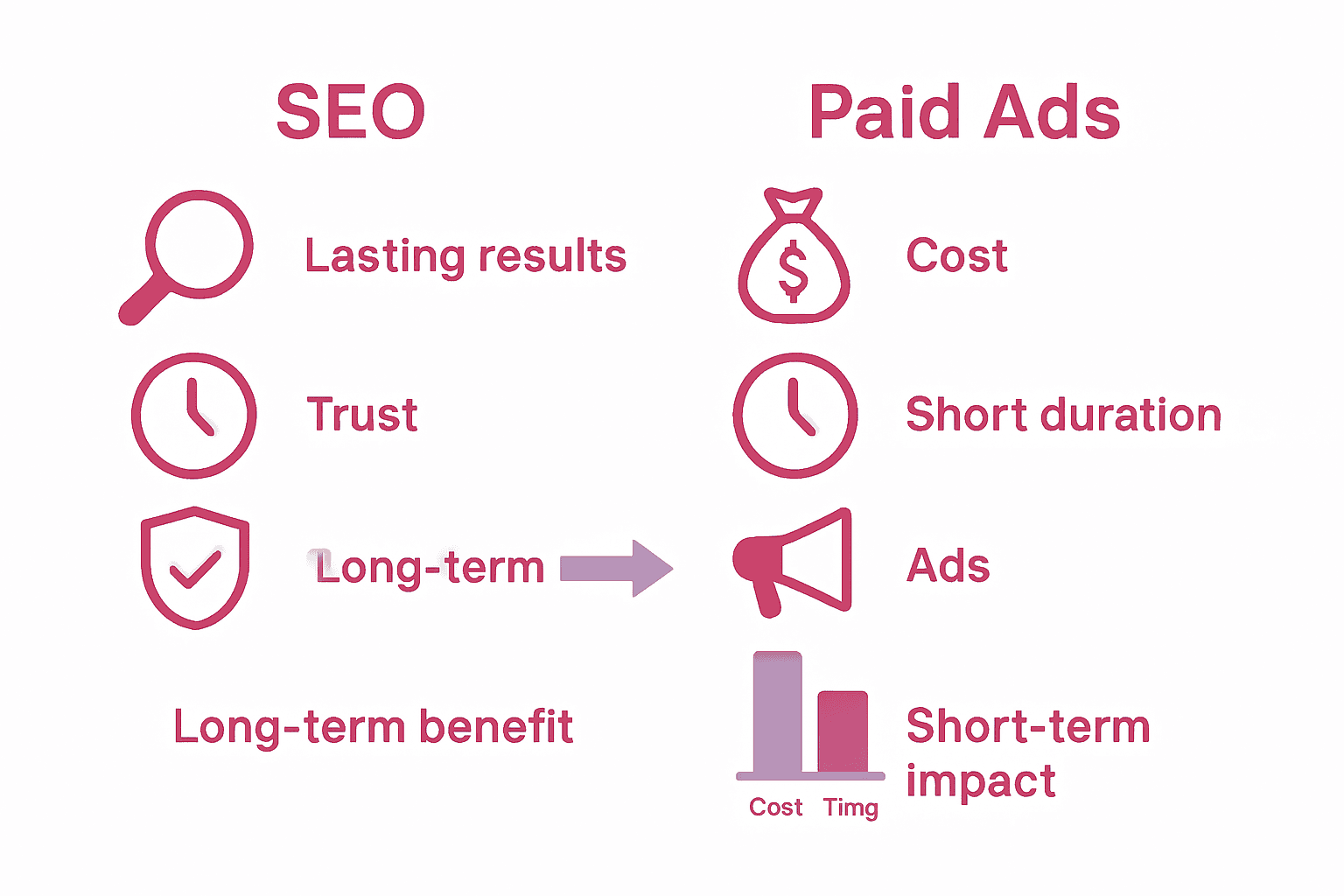
Cost Structure:
SEO: Upfront investment with compounding long-term returns
Paid Advertising: Immediate visibility with ongoing per-click expenses
Visibility Duration:
SEO: Persistent rankings that improve over time
Paid Ads: Visibility ceases immediately when funding stops
Credibility:
SEO: Builds organic trust and perceived authority
Paid Ads: Perceived as commercial messaging
Click-Through Rates:
SEO: Higher organic trust from users
Paid Ads: Lower perceived authenticity
For a comprehensive exploration of digital advertising strategies tailored to e-commerce, explore our Ecommerce Advertising Guide: Boost Sales with Expert Strategy, which provides in-depth insights into maximising your online marketing effectiveness.
Common SEO Pitfalls and Maximising ROI
E-commerce brands must navigate a complex landscape of SEO challenges to maximise their digital marketing returns. Research from PubMed emphasises the critical importance of niche differentiation and creating valuable content as key strategies for enhancing online brand positioning and driving sustainable growth.
Understanding and avoiding common SEO pitfalls is crucial for maintaining a competitive digital presence. According to ScienceDirect, strategic keyword selection and maintaining high-quality web content are fundamental to building online authority and generating consistent organic clicks.
Common SEO pitfalls that can significantly impact your return on investment include:
Keyword Stuffing: Overloading content with keywords, which reduces readability and search ranking
Neglecting Mobile Optimisation: Failing to create responsive design for mobile users
Duplicate Content: Creating multiple pages with similar content that confuses search engines
Ignoring Technical SEO: Overlooking site speed, structure, and indexing issues
Poor Quality Backlinks: Acquiring low-quality or irrelevant external links
To gain deeper insights into conducting a comprehensive SEO evaluation for your online business, explore our What Is an SEO Audit? Complete Deep Dive Guide, which provides expert strategies for identifying and addressing potential SEO challenges.
Unlock Sustainable Growth with Expert SEO Solutions
Investing in SEO is no longer optional for eCommerce brands aiming to thrive in a competitive market. If you are struggling with challenges like ineffective keyword strategies, poor mobile optimisation or limited organic visibility, our proven SEO services can transform these obstacles into opportunities for growth. The article highlights the critical importance of building strong online authority and avoiding common pitfalls to maximise your return on investment. We understand the emotional pressure of wanting your eCommerce site to perform but feeling overwhelmed by technical hurdles and the complexity of SEO best practices.
Boost your confidence in digital marketing with targeted strategies that deliver measurable results. Discover how we leverage over 25 years of experience in scaling successful eCommerce brands to craft personalised SEO plans focused on increasing organic traffic, improving user experience and elevating your brand credibility.
Take the first step now with our Complete Guide to SEO for E-Commerce for expert insights combined with our tailored services at iwanttobeseen.online.

Ready to stop wasting budgets on short-term fixes and build lasting organic growth? Visit our homepage today to start your SEO journey and gain the competitive edge your eCommerce brand deserves.
Frequently Asked Questions
What are the main advantages of investing in SEO for eCommerce brands?
Investing in SEO enhances online visibility, increases organic traffic, provides cost-effective marketing, improves user experience, and boosts brand credibility.
How does SEO differ from paid advertising for eCommerce?
SEO focuses on building long-term organic traffic through content optimisation and website authority, while paid advertising requires continuous financial investment to maintain visibility.
What are some key types of SEO strategies I should implement for my eCommerce site?
Key SEO strategies include On-Page SEO, which optimises individual page content and structure, and Technical SEO, which addresses backend elements like site speed and mobile responsiveness.
What common mistakes should I avoid to maximise my SEO investment?
Common pitfalls include keyword stuffing, neglecting mobile optimisation, duplicating content, ignoring technical SEO issues, and acquiring poor-quality backlinks.
Recommended
Comments