.png)
What is product discovery? A guide for eCommerce growth
- Darren Burns
- Apr 1
- 8 min read


Most eCommerce owners assume product discovery is simply about sourcing new items to stock. It is not. Product discovery is the entire journey a customer takes when finding products inside your online shop, from the moment they land on your site to the point they add something to their basket. Get it right, and you create a shopping experience that feels intuitive, personalised, and compelling. Get it wrong, and customers leave empty-handed, often never returning. This guide breaks down what product discovery really means, why it has a direct impact on your revenue, and what practical steps you can take to improve it across your store.
Table of Contents
Key Takeaways
Point | Details |
Understand product discovery | Product discovery means helping customers effortlessly find the right products in your shop. |
Boost engagement and sales | Better discovery processes increase conversion rates and customer satisfaction. |
Leverage digital tools | Use search, recommendation, and marketing software to power discovery. |
Continuously optimise | Regularly review your discovery methods and adjust based on data and feedback. |
Defining product discovery for eCommerce
Product discovery refers to the process by which customers find new or relevant products within your online store. It is not about which products you choose to sell. It is about how those products are surfaced, presented, and connected to the right shopper at the right moment.
Think of it this way: a customer visits your store looking for a birthday gift. They are not sure exactly what they want. How your site guides them through that uncertainty, through search, filters, recommendations, and curated collections, is your product discovery experience. A clear understanding of product discovery is now considered essential for any serious digital marketing strategy.
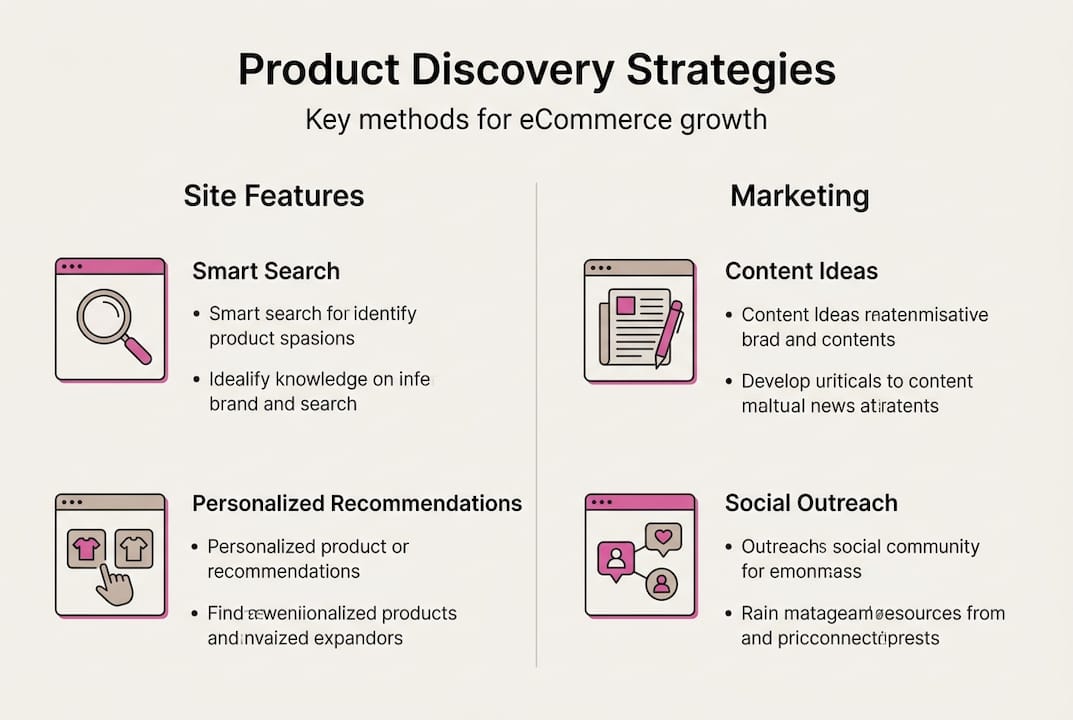
Product discovery covers several interconnected elements:
On-site search: How accurately and quickly your search bar returns relevant results
Navigation and filtering: Whether customers can narrow down options by size, price, colour, or category with ease
Personalisation algorithms: Systems that learn from browsing and purchase behaviour to suggest relevant items
Curated collections: Editorially selected groupings that guide customers toward products they might not have searched for directly
Visual discovery: Image-based search and shoppable content that lets customers find products from a photo or video
“Product discovery is not a single feature. It is the sum of every touchpoint that connects a customer to a product they want to buy.”
Many eCommerce owners invest heavily in driving traffic through paid ads or SEO, then neglect what happens once visitors arrive. That is a costly oversight. Effective product discovery anticipates customer intent and removes friction between curiosity and purchase. It is one of the most underutilised levers for growth available to UK and Irish online retailers today.
Why product discovery matters to your bottom line
With a clear definition in place, it is essential to understand why product discovery deserves your serious attention as an eCommerce owner.

The business case is straightforward. When customers can find what they want quickly and are shown products that genuinely interest them, they buy more and come back more often. Improving how products are discovered directly increases sales for eCommerce businesses, and the effect compounds over time as your personalisation data improves.
The numbers tell a clear story:
Personalised product recommendations can account for up to 31% of eCommerce revenue
Shoppers who use on-site search convert at rates up to 5 times higher than those who do not
Poor navigation is cited as a top reason for cart abandonment across UK online retailers
Customers who discover products through curated collections spend more per session on average
Beyond conversion rates, effective product discovery builds loyalty. When a customer feels that your store understands their tastes, they are far more likely to return and recommend you to others. Staying on top of digital marketing trends shows that personalisation and discovery are now the primary battlegrounds for customer retention in eCommerce.
Poor discovery, on the other hand, creates frustration. Customers who cannot find what they are looking for within a few clicks will bounce. High bounce rates signal to search engines that your site is not delivering value, which can hurt your organic rankings over time.
Pro Tip: Run a quick test on your own site. Ask someone unfamiliar with your catalogue to find a specific product using only your search bar. Their experience will reveal more about your discovery gaps than any analytics report.
Key strategies for effective product discovery
Knowing why product discovery matters, the next step is learning how to make it work better in your online shop.
Here are five proven strategies to implement:
Optimise your on-site search: Invest in a search tool that handles typos, synonyms, and natural language queries. Most default platform search functions are too basic for serious eCommerce stores.
Use personalised recommendations: Display “customers also bought” or “recommended for you” sections based on real browsing and purchase data. This is one of the highest-return investments in discovery.
Create dynamic collections: Build product groupings that update automatically based on seasonality, trends, or stock levels. Static category pages go stale quickly.
Write descriptions that work harder: Smart product descriptions improve both search visibility and on-page conversion by speaking directly to customer intent.
Leverage social proof: Customer reviews, ratings, and user-generated content help shoppers feel confident about products they discover, reducing hesitation at the point of decision.
Using content marketing ideas to surface the right products to the right people is increasingly how leading eCommerce brands differentiate themselves from competitors.
Strategy | Effort level | Impact on discovery |
On-site search optimisation | Medium | Very high |
Personalised recommendations | Medium | Very high |
Dynamic collections | Low to medium | High |
Product description quality | Medium | High |
Social proof integration | Low | Medium to high |
Pro Tip: Do not try to implement all five strategies at once. Start with on-site search, as it delivers the fastest measurable improvement, then layer in personalisation once your data foundation is solid.
Tools and technologies powering product discovery
Implementing strategies is far easier and more effective when you have the right technologies in place.
Modern marketing software solutions now automate recommendation engines and improve discoverability at a scale that would be impossible to manage manually. Whether you are on Shopify, WooCommerce, or a custom platform, there are tools built specifically to enhance every layer of product discovery.
Tool category | What it does | Best for |
Search and filter platforms | Delivers fast, relevant on-site search results | Stores with large catalogues |
Recommendation engines | Surfaces personalised product suggestions | Repeat customer retention |
Visual search tools | Allows image-based product finding | Fashion, home, and lifestyle brands |
PPC and retargeting platforms | Re-engages visitors with relevant product ads | Recovering abandoned sessions |
Social commerce tools | Integrates product discovery into social feeds | Reaching new audiences |
Key tools worth exploring for UK and Irish eCommerce stores include:
Searchanise or Boost Commerce for on-site search enhancement
Nosto or Klevu for AI-powered personalisation and recommendations
Pinterest and Instagram Shopping for social-led discovery
Google Shopping and Performance Max for paid discovery across search and display
Social media tools are now critical for boosting product discovery in a competitive market, particularly for reaching customers who are not yet actively searching for your products. Pairing these with eCommerce PPC tools creates a discovery funnel that captures intent at every stage, from passive browsing to active purchase.
When evaluating any tool, prioritise integration with your existing platform, quality of analytics reporting, and the ability to segment recommendations by customer behaviour rather than just demographics.
Evaluating and improving your product discovery process
With strategies and tools established, it is crucial to keep your discovery process sharp and aligned with customer needs.
Start with an honest audit of where you currently stand. Here is a simple framework:
Review your search data: What are customers searching for that returns no results? These gaps reveal products you should stock or content you should create.
Analyse navigation drop-off: Use heatmaps and session recordings to see where customers abandon their browsing journey. Friction points here are costing you sales.
Check recommendation performance: Are your suggested products generating clicks and conversions, or are they being ignored? Low engagement means your algorithm needs retraining.
Audit category page performance: Which collections have high bounce rates? These pages likely need better filtering, stronger imagery, or improved copy.
Gather direct feedback: Short exit surveys or post-purchase questions can surface discovery issues that analytics alone will not reveal.
Regularly reviewing marketing data helps eCommerce businesses stay ahead in product discovery and adapt quickly when customer behaviour shifts.
Metric | What it tells you | Target benchmark |
On-site search conversion rate | How well search drives purchases | 3x to 5x above site average |
Bounce rate on category pages | Whether discovery is engaging visitors | Below 45% |
Revenue per visitor | Overall discovery efficiency | Rising month on month |
Average session depth | How far customers explore your catalogue | 4 or more pages per session |
Tracking digital marketing trends alongside your own metrics ensures you are not just measuring performance in isolation but benchmarking against where the market is heading.
Our view: Product discovery’s strategic edge in 2026
Here is something most marketing agencies will not tell you: product discovery is where eCommerce battles are actually won or lost, not in ad spend.
We have spent over 25 years scaling eCommerce brands, and the pattern is consistent. Businesses that obsess over acquisition whilst neglecting what happens on-site are essentially pouring water into a leaky bucket. The brands that grow sustainably are the ones that treat discovery as a core business function, not an afterthought.
The uncomfortable truth is that most SMEs underinvest in discovery because it feels less tangible than a paid ad campaign. You cannot point to a single discovery improvement and say “that generated £X today.” But the compounding effect of better search, smarter recommendations, and richer content is enormous over six to twelve months.
Organisations that champion creative eCommerce marketing holistically, across technology, content, and user experience, consistently outperform competitors who treat these as separate workstreams. Discovery is not a technical problem. It is a strategic one. And in 2026, the brands that understand this will pull ahead decisively.
Ready to elevate your product discovery?
If this guide has highlighted gaps in how your store surfaces and connects products to customers, you are not alone. Most eCommerce businesses we work with have significant untapped potential in their discovery experience.

At I Want To Be Seen, we specialise in helping UK and Irish eCommerce brands build discovery strategies that drive real, measurable growth. From SEO and content to AI-powered personalisation and PPC, our team brings over 25 years of hands-on eCommerce experience to every project. Whether you need a full discovery audit or targeted digital marketing support, we are ready to help you turn browsers into buyers. Get in touch today to start the conversation.
Frequently asked questions
What is product discovery in eCommerce?
Product discovery in eCommerce is the process by which customers find relevant products in your online shop using search, navigation, personalisation, and marketing tools. It is a technology-driven process that connects shoppers with the products they are most likely to buy.
How can I improve product discovery for my online shop?
Enhance site search, use personalised recommendations, create clear product categories, and leverage content marketing for greater visibility. Clear product descriptions and innovative content marketing both help customers discover products more effectively.
Which tools help with product discovery in eCommerce?
Marketing software, recommendation engines, PPC platforms, and social media tools can all play a role in boosting product discovery. PPC tools in particular enhance product discoverability by re-engaging shoppers who have already shown interest.
How do I measure the effectiveness of product discovery?
Track metrics such as conversion rate, time on site, bounce rate, and revenue per visitor to gauge discovery effectiveness. Auditing key performance metrics regularly ensures your discovery strategy stays aligned with actual customer behaviour.
Recommended
Comments