.png)
Semantic Search: Transforming SEO For E-Commerce Success


Finding the right buyers often feels like a guessing game for many British and Irish e-commerce owners. Traditional keyword searches can leave your products hidden from the very customers you want to reach. With the shift to semantic search, new technology is enabling sites to interpret user intent and context rather than simply matching words. This article explains how modern semantic search strategies can help your business stand out, connect with customers more effectively, and improve SEO performance.
Table of Contents
Key Takeaways
Point | Details |
Evolution of Search | Semantic search shifts focus from keyword matching to understanding user intent and context, enhancing search relevance. |
Technological Integration | Utilisation of advanced technologies like machine learning and knowledge graphs allows for more accurate and tailored search results. |
E-commerce Advantage | Businesses can optimise for user intent rather than exact terms, leading to improved product discovery and customer satisfaction. |
Continuous Optimisation | Regular updates to metadata and search algorithms are essential to sustain effective semantic search strategies. |
Defining Semantic Search In Modern SEO
Semantic search represents a groundbreaking evolution in search technology, moving far beyond traditional keyword matching. At its core, semantic search aims to understand the contextual meaning and intent behind user queries, rather than simply scanning for literal word matches. Natural language processing techniques enable search engines to interpret complex human communication more intelligently.
This sophisticated approach involves multiple advanced technologies working in concert:
Knowledge graphs that map relationships between concepts
Machine learning algorithms analysing search patterns
Contextual understanding of user intent
Analysis of previous search history and user behaviour
The fundamental difference between traditional and semantic search lies in comprehension. Traditional search engines would match exact keywords, producing potentially irrelevant results. Semantic search, by contrast, understands nuance, context, and the underlying meaning of a query.

To better understand the evolution in search technology, here’s a comparison of traditional search versus semantic search in e-commerce:
Aspect | Traditional Search | Semantic Search |
Query Handling | Exact keyword match | Context and intent analysis |
Result Relevance | Often generic listing | Highly tailored recommendations |
User Experience | Mechanical result process | Conversational, intuitive discovery |
Ranking Ability | Cannot rank for related terms | Can rank for intent-driven queries |
For e-commerce businesses, this represents a transformative opportunity. Semantic search allows websites to rank for queries that aren’t literal keyword matches but capture the genuine user intent. A search for “comfortable work shoes” might previously have returned rigid results, but semantic search understands the underlying desire for professional yet ergonomic footwear.
Semantic search transforms search from a mechanical matching process into an intelligent, context-aware interaction.
Pro tip: Optimise your e-commerce content to reflect natural language and user intent, not just isolated keywords.
Types Of Semantic Search Technologies
Semantic search technologies represent a sophisticated array of computational approaches designed to understand and interpret human language with remarkable precision. Machine learning algorithms have evolved to create increasingly nuanced methods of comprehending search intent beyond simple keyword matching.
Key semantic search technologies include:
BM25 Algorithm: A ranking function measuring relevance between search query and documents
Word Embeddings: Techniques converting words into numerical vector representations
Universal Sentence Encoder: Advanced model translating entire sentences into semantic vectors
Sentence-BERT: Machine learning model specialising in understanding contextual sentence meanings
Each technology offers unique capabilities for interpreting language. Vector embeddings enable search engines to encode semantic relationships mathematically, allowing complex language understanding that mimics human comprehension.
The computational sophistication of these technologies means e-commerce platforms can now deliver extraordinarily precise search results. Instead of returning generic matches, semantic search technologies can interpret nuanced user intentions, connecting shoppers with precisely the products they seek.
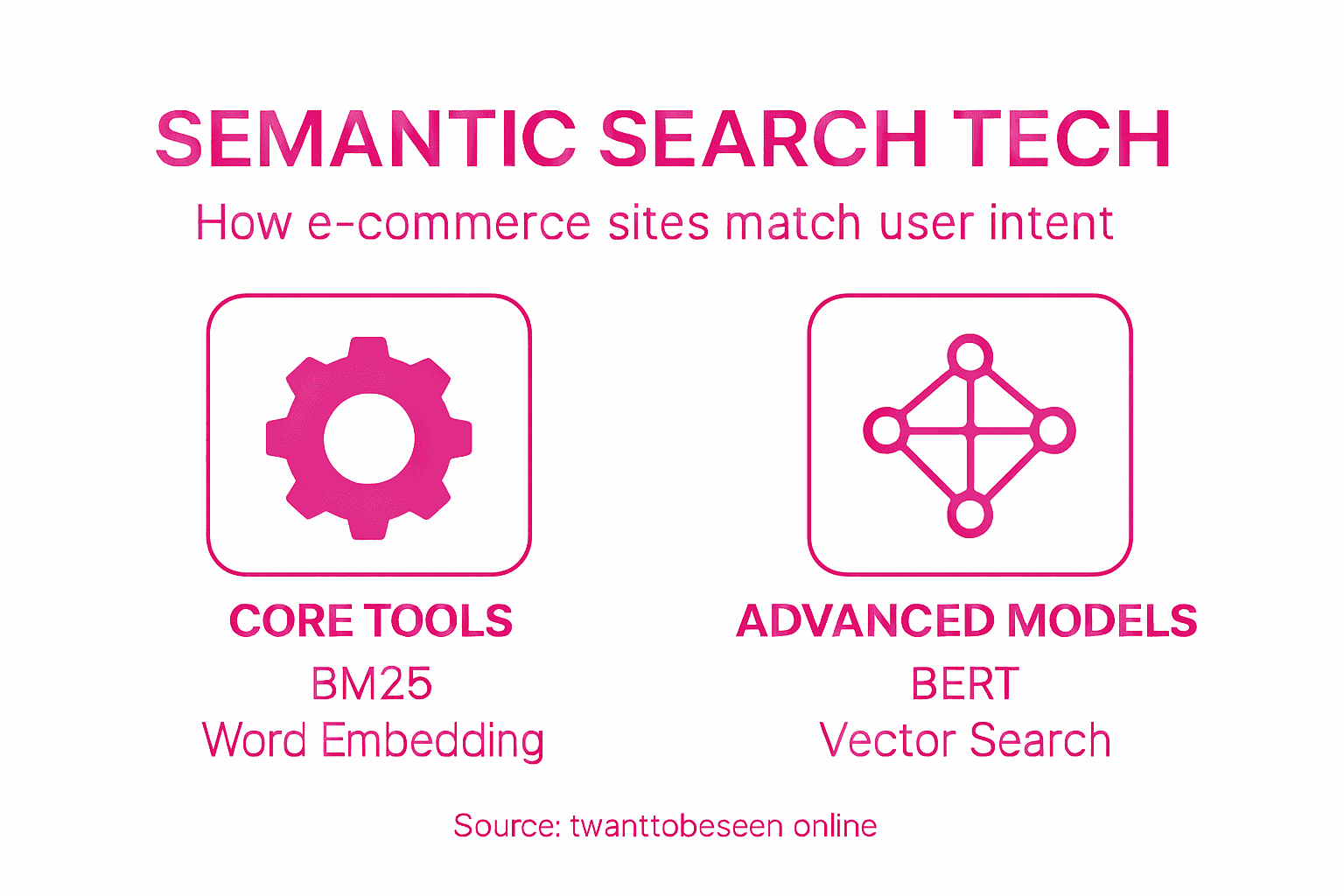
Below is a summary of leading semantic search technologies and their distinct advantages in e-commerce:
Technology | Core Function | Business Impact |
BM25 | Relevance scoring | Improved ranking precision |
Word Embeddings | Semantic encoding | Greater understanding of synonyms |
Universal Sentence Encoder | Sentence comprehension | Accurate intent mapping |
Sentence-BERT | Contextual analysis | Enhanced personalisation of results |
Semantic search technologies transform raw data into meaningful, context-aware insights.
Pro tip: Experiment with multiple semantic search technologies to find the optimal approach for your specific e-commerce platform’s search functionality.
How Semantic Search Works For E-Commerce
Semantic search transforms e-commerce search functionality by understanding user intent far beyond simple keyword matching. E-commerce SEO strategies now leverage advanced computational techniques to interpret the nuanced meaning behind customer searches, delivering more relevant and precise product recommendations.
The operational mechanics of semantic search in e-commerce involve several sophisticated processes:
Query interpretation: Analysing the deeper context of search terms
Intent recognition: Understanding the underlying customer motivation
Contextual mapping: Connecting search terms with relevant product attributes
Personalised ranking: Prioritising results based on individual user behaviour
When a customer searches for “comfortable summer work shoes”, semantic search doesn’t just match literal keywords. Instead, it comprehends the complex requirements: professional footwear, comfort-focused design, seasonal appropriateness, and potential style preferences.
This intelligent approach enables e-commerce platforms to bridge the communication gap between customer language and product catalogues. By understanding semantic relationships, online stores can present more accurate, contextually relevant search results that significantly enhance user experience and potentially increase conversion rates.
Semantic search transforms product discovery from a mechanical matching process into an intuitive, intelligent shopping experience.
Pro tip: Continuously refine your product descriptions to use natural, conversational language that aligns with how customers actually search for items.
Real-World E-Commerce Applications And Benefits
Semantic search technologies are revolutionising online shopping experiences by delivering unprecedented levels of product discovery and user satisfaction. These advanced computational approaches transform how customers interact with e-commerce platforms, moving beyond traditional keyword-based search limitations.
Key real-world applications of semantic search include:
Intelligent product recommendations: Suggesting items based on nuanced user preferences
Multi-modal search experiences: Enabling image and text-based product discovery
Personalised search results: Customising outcomes based on individual user behaviour
Enhanced customer intent interpretation: Understanding complex search queries
For instance, when a customer searches for “comfortable workwear for summer office”, semantic search comprehends the intricate requirements. It doesn’t just match keywords but interprets the underlying needs: professional attire, comfort, seasonal appropriateness, and style preferences.
By leveraging artificial intelligence and natural language processing, e-commerce platforms can create more intuitive, responsive search experiences. These technologies analyse contextual cues, previous search history, and user interactions to deliver increasingly precise and satisfying product recommendations.
Semantic search transforms online shopping from a transactional process into an intelligent, conversational experience.
Pro tip: Invest in rich, descriptive product metadata that captures natural language and multiple attribute variations to improve semantic search performance.
Challenges, Risks, And Optimisation Strategies
Semantic search optimisation faces multiple complex challenges that require sophisticated technological approaches and strategic planning. E-commerce businesses must navigate intricate computational landscapes to implement effective semantic search technologies.
Key challenges in semantic search implementation include:
Computational resource demands: High processing requirements for complex queries
Data quality management: Ensuring accurate and comprehensive metadata
Query ambiguity: Interpreting nuanced and potentially unclear user searches
Scalability limitations: Maintaining performance across diverse product catalogues
The primary risks involve potential performance degradation, increased infrastructure costs, and potential misinterpretation of user intent. Advanced machine learning algorithms and natural language processing techniques can help mitigate these challenges by continuously refining search interpretation capabilities.
Successful optimisation strategies require a multifaceted approach. E-commerce platforms must invest in robust infrastructure, develop sophisticated metadata taxonomies, and implement adaptive learning systems that can understand evolving user search behaviours.
Semantic search optimisation is not a destination, but a continuous journey of technological refinement.
Pro tip: Regularly audit and update your product metadata to improve semantic search accuracy and user experience.
Elevate Your E-Commerce Success with Advanced Semantic Search Solutions
Struggling to capture your customers true intent and deliver tailored, context-aware search experiences can limit your online store’s growth. This article emphasises the critical need to move beyond basic keyword matching and embrace semantic search technologies such as BM25, Word Embeddings, and Sentence-BERT for transformational SEO results. If you are navigating challenges like computational resource demands or data quality management, you are not alone in wanting to offer an intelligent, personalised shopping journey that drives higher conversions.
At iwanttobeseen.online we combine over 25 years of e-commerce expertise with cutting-edge digital marketing strategies including SEO and AI integration tailored specifically for e-commerce platforms. Our services focus on optimising semantic search to increase relevance, improve user engagement, and boost organic rankings by crafting product content that mirrors natural human language and intent.

Take the first step towards transforming your e-commerce SEO. Discover how our specialised solutions at iwanttobeseen.online can help you overcome search complexity, refine metadata, and deliver personalised user experiences that convert. Start unlocking intelligent product discovery today and watch your sales soar. Visit us now to learn more and get your tailored SEO strategy started.
Frequently Asked Questions
What is semantic search in SEO?
Semantic search is an advanced approach in search technology that aims to understand the contextual meaning and intent behind user queries, rather than just matching exact keywords. It leverages natural language processing and machine learning to interpret complex user communication.
How can semantic search improve e-commerce product discoverability?
Semantic search enhances product discoverability by analysing user intent, understanding context, and mapping queries to relevant product attributes. This leads to more tailored recommendations based on what users genuinely seek, rather than just matching keywords.
What are some key technologies behind semantic search?
Key technologies include the BM25 algorithm for relevance scoring, word embeddings for understanding synonyms, the Universal Sentence Encoder for sentence comprehension, and Sentence-BERT for contextual analysis. These technologies help create more nuanced search experiences in e-commerce.
What challenges do e-commerce businesses face with semantic search optimization?
E-commerce businesses may encounter challenges such as high computational resource demands, managing data quality, handling query ambiguity, and scaling performance across diverse product catalogues. Continuous improvement in search interpretation capabilities is essential to address these issues.
Recommended
Comments