.png)
What Is Amazon SEO? Complete Guide for eCommerce


More than 60 percent of product searches now begin directly on Amazon, making visibility in this marketplace critical for sellers. For many businesses, competing goes far beyond listing products. Understanding how Amazon’s A9 algorithm works can be the difference between steady sales and getting lost in the crowd. This guide unpacks the ranking secrets and proven strategies that can help your listings rise above the rest.
Table of Contents
Key Takeaways
Point | Details |
Amazon SEO Focus | Amazon SEO is aimed at improving product visibility and ranking specifically within the Amazon marketplace, differing from traditional SEO. |
A9 Algorithm Factors | Key factors influencing the A9 algorithm include product relevance, sales history, customer reviews, pricing, and availability. |
Holistic Optimization | Successful sellers must adopt a holistic approach to optimize listings consistently by addressing all ranking factors. |
Common Mistakes | Avoid critical errors such as irrelevant keyword usage, poor listing quality, and neglecting customer engagement to enhance SEO performance. |
Defining Amazon SEO and Core Concepts
Amazon SEO represents a specialised digital strategy designed to enhance product visibility and ranking within Amazon’s search ecosystem. Unlike traditional search engine optimisation, Amazon SEO focuses exclusively on improving product placement within the world’s largest ecommerce marketplace.
According to research from Bilpubgroup Journals, the Amazon A9 algorithm determines product search rankings by evaluating multiple critical factors. These key ranking components include:
Product Relevancy: How closely your product matches customer search terms
Sales History: Total volume and velocity of product sales
Customer Reviews: Quality and quantity of positive customer feedback
Price Competitiveness: How your pricing compares to similar products
Product Availability: Current stock levels and consistent inventory
Research from IOSR Journals further reveals that Amazon’s algorithm prioritises conversion rates and customer satisfaction. This means products that generate more sales and receive positive customer interactions will naturally rank higher in search results.
To succeed in Amazon SEO, sellers must strategically optimise product listings by understanding these algorithmic nuances. This involves crafting compelling product titles, utilising relevant keywords, maintaining competitive pricing, and consistently delivering high-quality customer experiences. By aligning your product strategy with these core ranking principles, you can significantly improve your visibility and potential sales performance on the Amazon marketplace.

How Amazon’s A9 Algorithm Determines Rankings
Amazon’s A9 algorithm is a sophisticated ranking system that goes far beyond simple keyword matching. It’s a complex machine learning mechanism designed to predict and reward product listings that are most likely to generate sales and satisfy customer needs. While many sellers focus solely on keywords, the algorithm evaluates a nuanced set of performance metrics.
According to research from Bilpubgroup Journals, the A9 algorithm comprehensively evaluates multiple interconnected factors to determine product rankings. These critical ranking signals include:
Performance Metrics
Conversion rate
Sales velocity
Total sales volume
Customer Engagement
Review quality and quantity
Customer interaction rates
Product page click-through rates
Listing Optimization
Keyword relevance
Title and description quality
Product image clarity
Research from IOSR Journals further emphasizes that the algorithm utilizes both predicted and real conversion rates when ranking products. This means Amazon doesn’t just look at current performance but also anticipates future sales potential based on complex predictive modeling.
To excel in Amazon’s competitive marketplace, sellers must adopt a holistic approach that addresses each algorithmic ranking factor. This involves continuously optimising product listings, maintaining competitive pricing, generating authentic positive reviews, and ensuring consistent product availability. By understanding these intricate ranking dynamics, sellers can strategically position their products to achieve higher visibility and drive more sales.
For more insights into SEO strategies, check out our SEO Basics guide that can help you navigate the complex world of online product visibility.
Key Ranking Factors for Amazon Listings
Successful Amazon product listings are not created by chance but through strategic optimization that aligns with the platform’s complex ranking algorithm. Understanding the nuanced ranking factors can mean the difference between visibility and obscurity in a marketplace with millions of competing products.
According to research from Bilpubgroup Journals, Amazon’s ranking algorithm considers multiple interconnected factors when determining product visibility. The key ranking signals include:
Conversion-Driven Metrics
Sales volume
Purchase frequency
Conversion rate
Historical sales performance
Product Listing Quality
Keyword relevance
Title optimization
Detailed product descriptions
High-quality product images
Competitive pricing
Customer Engagement Indicators
Review quantity and quality
Customer ratings
Product page click-through rates
Customer questions and answers
Research from IOSR Journals further emphasizes that the algorithm prioritizes customer satisfaction and retention alongside conversion rates. This means Amazon rewards products that not only sell but also consistently meet customer expectations.
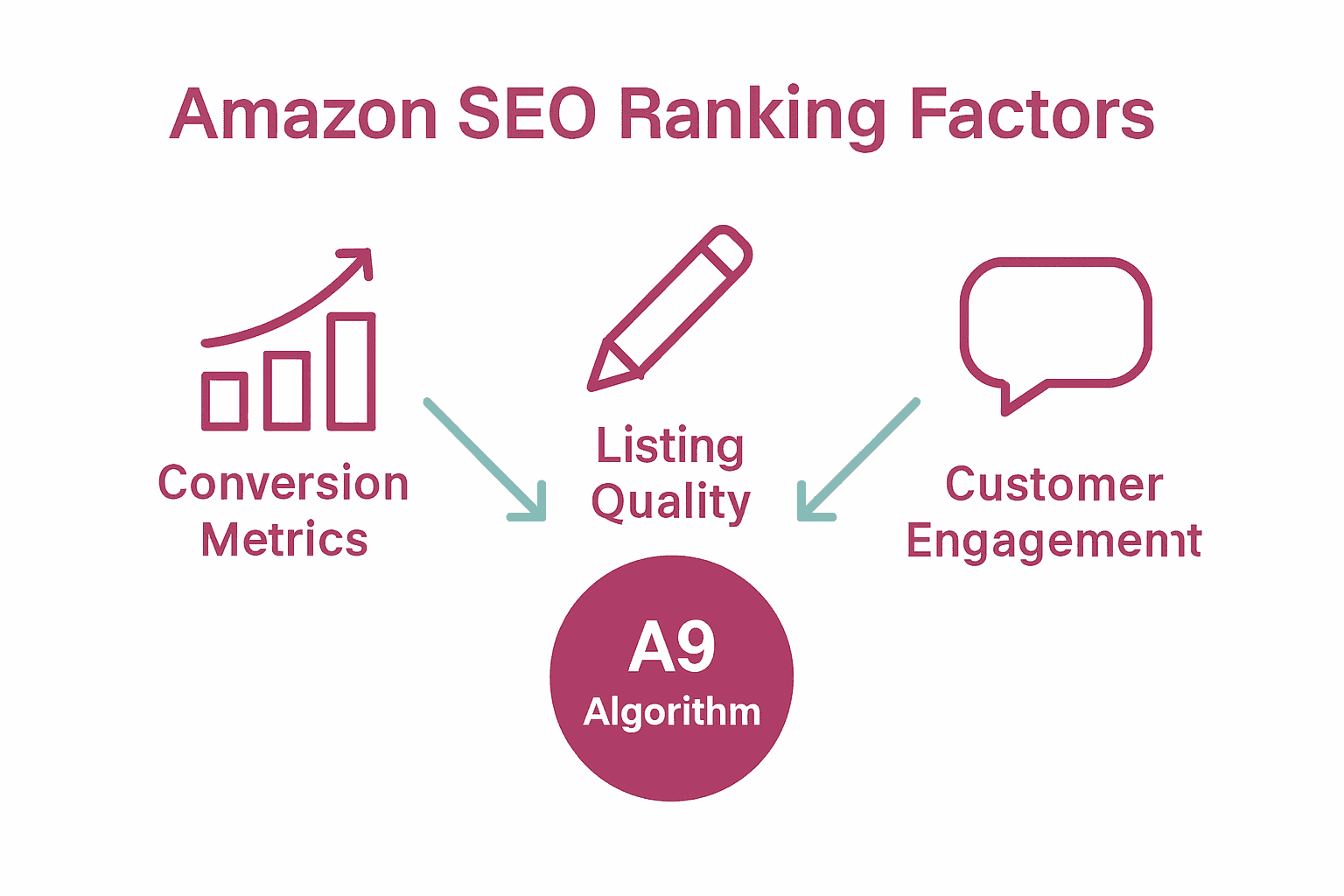
To truly excel in Amazon’s competitive landscape, sellers must adopt a holistic approach that addresses each ranking factor systematically. This involves continuous optimization of product listings, maintaining competitive pricing, generating authentic positive reviews, and ensuring product availability. For sellers looking to dive deeper into marketplace strategies, our Marketplace SEO guide provides comprehensive insights into navigating these complex ranking dynamics.
Essential Amazon SEO Optimization Strategies
Mastering Amazon SEO is not about quick fixes, but implementing a comprehensive strategy that systematically improves product visibility and conversion potential. The most successful sellers approach optimization as an ongoing process of refinement and strategic enhancement.
According to research from Bilpubgroup Journals, optimizing product listings requires a multifaceted approach targeting several critical areas:
Keyword Optimization Techniques
Comprehensive Keyword Research
Identify long-tail and high-volume search terms
Analyse competitor keyword strategies
Use Amazon’s own search suggestions
Strategic Keyword Placement
Integrate keywords naturally in product titles
Optimize backend search terms
Include keywords in product descriptions
Performance Enhancement Strategies
Conversion Rate Optimization
Create compelling product images
Write clear, benefit-driven descriptions
Highlight unique product features
Pricing and Availability
Maintain competitive pricing
Ensure consistent product stock
Use dynamic pricing strategies
Research from IOSR Journals emphasizes that customer satisfaction and retention are paramount. This means your optimization efforts must go beyond algorithmic manipulation and genuinely improve the customer experience.
For sellers seeking a comprehensive approach to digital marketing strategies, our Complete Guide to SEO for E-Commerce offers in-depth insights into scaling your online presence effectively. Remember, Amazon SEO is an ongoing journey of continuous learning and adaptation.
Common Amazon SEO Mistakes to Avoid
Successful Amazon sellers understand that avoiding critical SEO mistakes can mean the difference between thriving and struggling in this competitive marketplace. Each misstep can potentially cost valuable visibility, conversions, and ultimately, revenue.
According to research from Bilpubgroup Journals, sellers frequently make mistakes across several key optimization areas:
Keyword and Listing Errors
Keyword Mismanagement
Stuffing irrelevant keywords
Ignoring long-tail search terms
Failing to update keyword strategies
Listing Quality Problems
Generic, unclear product titles
Low-quality product images
Incomplete product descriptions
Inconsistent product information
Performance and Strategy Mistakes
Conversion Rate Killers
Neglecting customer reviews
Inconsistent pricing strategies
Poor product availability management
Algorithmic Oversights
Ignoring sales velocity
Failing to track performance metrics
Not understanding ranking factors
Research from IOSR Journals emphasizes that customer satisfaction and retention are paramount. Mistakes that compromise these elements can quickly derail your Amazon SEO efforts.
For sellers seeking deeper insights into marketplace strategies and avoiding potential pitfalls, our Marketplace SEO guide offers comprehensive strategies to navigate the complex Amazon ecosystem effectively. Remember, Amazon SEO is about consistent, strategic improvement rather than quick fixes.
Elevate Your Amazon SEO Strategy with Expert Support
Struggling to master Amazon’s complex A9 algorithm and stand out amidst fierce competition is a challenge many sellers face. This article emphasises how critical factors like product relevancy, conversion rates, and customer satisfaction must be finely tuned to unlock higher visibility and sales. If you feel overwhelmed by keyword optimisation, pricing strategies, or generating authentic reviews, you are not alone.

Take control of your Amazon SEO success by partnering with a team that truly understands the marketplace dynamics. At iWantToBeSeen, with over 25 years of experience scaling eCommerce brands, we specialise in tailored digital marketing solutions including SEO, AI, Social Media, and PPC designed specifically for eCommerce sellers. Discover how our Complete Guide to SEO for E-Commerce and Marketplace SEO guide can support your journey to higher rankings and more consistent sales.
Do not let the nuances of Amazon SEO hold you back. Visit our homepage today to explore bespoke strategies that transform your product listings and put your store ahead of the competition. Your next growth breakthrough starts here.
Frequently Asked Questions
What is Amazon SEO?
Amazon SEO is a specialized digital marketing strategy aimed at improving the visibility and ranking of products within Amazon’s search results, focusing on factors such as keyword relevance, sales history, customer reviews, pricing, and stock availability.
How does Amazon’s A9 algorithm determine product rankings?
The A9 algorithm considers various factors including conversion rates, sales velocity, product listing quality, review quality, and customer engagement to predict which products are most likely to generate sales and satisfy customer needs.
What are the key factors for optimizing Amazon product listings?
Key factors for optimizing Amazon listings include effective keyword usage, high-quality product images, competitive pricing, detailed and accurate product descriptions, and managing customer reviews and engagement effectively.
What are common mistakes to avoid in Amazon SEO?
Common mistakes include mismanaging keywords, using low-quality product images, neglecting customer reviews, inconsistent pricing strategies, and failing to monitor performance metrics. These errors can negatively impact product visibility and conversions.
Recommended
Comments