.png)
What Is AI in Ecommerce? Key Benefits for Retailers


Over half of British consumers have interacted with Artificial Intelligence while shopping online, often without even realising it. As digital retail changes at a rapid pace, understanding how AI shapes everything from product suggestions to customer service matters more than ever. This overview reveals how British retailers use AI to deliver personalised shopping, improve efficiency, and stay ahead in the crowded ecommerce world.
Table of Contents
Key Takeaways
Point | Details |
AI Enhances Customer Experience | AI technologies enable personalised shopping experiences by analysing customer behaviour and preferences. |
Diverse AI Applications | Key applications include intelligent recommendation systems and dynamic pricing algorithms, improving operational efficiency. |
Data-Driven Decision Making | Real-time data processing empowers retailers to make informed decisions and optimise marketing strategies. |
Ethical Considerations | Retailers must address data privacy and algorithmic transparency to maintain customer trust during AI implementation. |
Defining AI in Ecommerce Today
Artificial Intelligence (AI) in ecommerce represents a transformative technological approach that enables online businesses to leverage advanced computational methods for enhancing customer experiences and operational efficiency. At its core, AI technology uses sophisticated algorithms and machine learning techniques to analyse vast amounts of data, predict consumer behaviour, and automate complex decision-making processes.
The contemporary understanding of AI in ecommerce goes far beyond simple automation. Recent academic research highlights how AI and machine learning are fundamentally reshaping online retail strategies. These technologies enable businesses to create highly personalised shopping experiences by understanding individual customer preferences, predicting purchasing patterns, and delivering targeted recommendations with unprecedented accuracy.
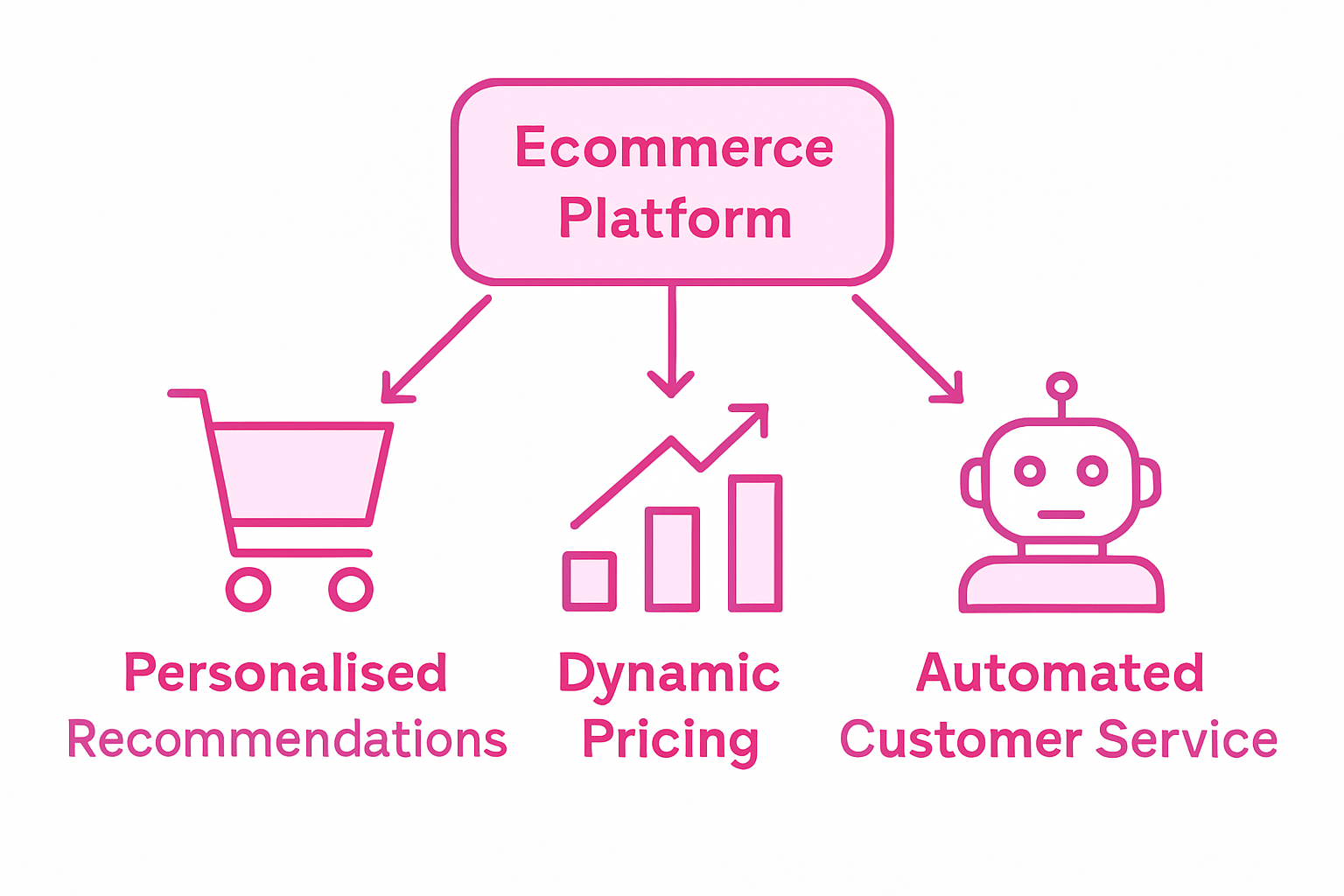
Key AI applications in modern ecommerce include intelligent product recommendation systems, dynamic pricing algorithms, chatbot customer support, and predictive inventory management. Retailers can now utilise AI marketing strategies to segment audiences more precisely, optimise marketing spend, and create more engaging customer interaction models. By processing complex datasets in real-time, AI helps businesses make data-driven decisions that were previously impossible, transforming how online retailers understand and serve their customers.
Understanding AI’s role in ecommerce is not just about technological implementation but recognising its potential to create more intuitive, responsive, and personalised shopping experiences. As machine learning algorithms become increasingly sophisticated, they will continue to blur the lines between digital and physical retail, offering consumers increasingly seamless and intelligent purchasing journeys.
Leading Types of AI Used by Retailers
AI technologies have revolutionised retail operations through a diverse range of sophisticated applications that transform how businesses interact with customers and manage internal processes. Advanced research reveals several critical AI implementations that are reshaping the ecommerce landscape.
Key AI types used by retailers include intelligent recommendation engines, which analyse customer browsing and purchasing history to suggest personalised product offerings. These systems use machine learning algorithms to understand individual preferences, significantly increasing conversion rates and customer engagement. Another powerful AI application is chatbot technology, which provides instant customer support, handles inquiries, and guides shoppers through purchasing decisions with remarkable accuracy and efficiency.

Ecommerce analytics play a crucial role in AI implementation, with advanced systems enabling retailers to leverage predictive technologies for critical business functions. These include dynamic pricing algorithms that adjust product prices in real-time based on market demand, inventory levels, and competitive landscape. Warehouse automation and intelligent logistics represent another transformative AI domain, where machine learning optimises inventory management, predicts stock requirements, and streamlines distribution processes.
Visual search technologies are emerging as a particularly innovative AI application, allowing customers to find products by uploading images rather than typing descriptions. This technology uses complex neural networks to analyse visual characteristics, match similar items, and provide seamless shopping experiences. As AI continues to evolve, retailers can expect increasingly sophisticated tools that not only enhance operational efficiency but also create more personalised, intuitive customer interactions across digital platforms.
How Ecommerce AI Technology Works
Artificial Intelligence in ecommerce operates through complex computational systems that transform raw data into intelligent, actionable insights. At its fundamental level, AI technology employs sophisticated machine learning algorithms that continuously analyse and interpret vast amounts of digital information, enabling retailers to make more precise, data-driven decisions.
Innovative research demonstrates how AI can revolutionise product design and marketing strategies. For instance, advanced systems now enable merchants to generate photorealistic product images based on textual descriptions, implementing a ‘sell it before you make it’ approach that dramatically reduces production risks and inventory costs. These machine learning models process multiple data points simultaneously, identifying patterns and predicting consumer behaviour with remarkable accuracy.
Ecommerce SEO strategies are increasingly powered by AI sentiment analysis technologies that decode complex customer interactions. The underlying mechanism involves deep learning neural networks that can interpret nuanced customer feedback, analyse purchasing patterns, and generate personalised recommendations. These systems leverage multiple data sources - including browsing history, previous purchases, demographic information, and real-time engagement metrics - to create increasingly sophisticated predictive models.
The technological architecture of ecommerce AI involves intricate layers of data processing, including neural networks, natural language processing, and predictive analytics. By continuously learning from each interaction, these systems become progressively more intelligent, adapting to changing consumer preferences and market dynamics. As AI technologies evolve, they promise to create increasingly personalised, intuitive shopping experiences that seamlessly bridge digital convenience with individual customer expectations.
Key Real-World Applications for Online Shops
Artificial Intelligence is transforming online retail through a range of sophisticated applications that address critical business challenges and enhance customer experiences. From inventory management to personalised marketing, AI technologies are providing online shops with unprecedented capabilities to optimise operations and drive growth.
Advanced research demonstrates how AI can revolutionise inventory management through intelligent replenishment systems. These smart inventory technologies leverage complex algorithms to forecast demand, optimise supplier selections, and continuously learn from market dynamics. By implementing multi-agent negotiation strategies, online retailers can significantly reduce stockouts, minimise inventory holding costs, and improve overall product mix turnover.
Social commerce strategies increasingly rely on AI-powered analytics to decode intricate customer behaviour patterns. These systems analyse multiple data points, including browsing history, purchase records, and engagement metrics, to generate highly personalised product recommendations and targeted promotional campaigns. Retailers can now create dynamic pricing models, predict customer preferences, and design marketing interventions with remarkable precision.
The most transformative AI applications in online shops extend beyond traditional analytics. Intelligent chatbots provide instant customer support, visual search technologies enable image-based product discovery, and predictive algorithms help businesses anticipate market trends before they emerge. As these technologies continue to evolve, online shops can expect increasingly sophisticated tools that not only streamline operations but also create more intuitive, personalised shopping experiences that adapt in real-time to individual customer needs.
Risks, Costs and Mistakes to Avoid
Artificial Intelligence implementation in ecommerce presents both transformative opportunities and significant potential pitfalls that retailers must carefully navigate. Understanding these challenges is crucial for successful technological integration and mitigating potential financial and reputational risks.
Ethical research highlights substantial concerns surrounding consumer data privacy and algorithmic transparency. Online retailers must be acutely aware that AI systems collect enormous quantities of personal information, which can quickly erode customer trust if not managed responsibly. The most common mistakes include inadequate data protection mechanisms, opaque data usage policies, and failing to obtain explicit customer consent for sophisticated tracking technologies.
Digital marketing strategies require careful consideration of AI implementation costs. Initial investments can be substantial, often requiring significant technological infrastructure, specialised personnel, and ongoing maintenance. Businesses frequently underestimate the complexity of AI integration, leading to unexpected expenses and potential system inefficiencies. Common financial risks include over-investing in complex AI solutions that do not align with specific business needs, neglecting essential staff training, and failing to establish clear performance metrics.
Technological risks extend beyond financial considerations. Retailers must be vigilant about potential algorithmic biases that could inadvertently discriminate against certain customer groups, create inappropriate product recommendations, or generate misleading analytics. Successful AI adoption demands a comprehensive approach that balances technological innovation with ethical considerations, robust data protection protocols, and a deep understanding of both the capabilities and limitations of artificial intelligence systems.
Unlock The Full Potential of AI in Your Ecommerce Business
The challenges of implementing effective AI technology like intelligent recommendation engines and dynamic pricing algorithms can feel overwhelming. Pain points such as managing vast data responsibly, overcoming costly integration, and achieving truly personalised customer engagement are all critical hurdles. Our proven expertise in AI marketing strategies and ecommerce SEO means we understand these issues and can help you transform complex AI insights into actionable growth.

Don’t let costly mistakes or data privacy concerns hold you back from capturing the immense benefits of AI in ecommerce. Partner with us at https://iwanttobeseen.online to elevate your online store with customised AI-driven digital marketing solutions built from over 25 years of e-commerce success. Take control today and start delivering seamless, personalised shopping experiences your customers expect.
Frequently Asked Questions
What is the role of AI in ecommerce?
AI in ecommerce enhances customer experiences and operational efficiency through advanced data analysis, predicting consumer behaviour and automating decision-making processes.
How do intelligent recommendation systems work in retail?
Intelligent recommendation systems analyse customer browsing and purchase history to suggest personalised product offerings, helping to increase conversion rates and customer engagement.
What are some benefits of using AI for inventory management?
AI improves inventory management by forecasting demand, optimising supplier selection, and learning from market dynamics, which can reduce stockouts and minimise inventory holding costs.
How can retailers mitigate risks associated with AI implementation?
Retailers can mitigate AI implementation risks by ensuring robust data protection, being transparent about data usage, obtaining customer consent, and continuously training staff to align technology with business needs.
Recommended
Comments