.png)
Segment your email lists for higher engagement: step-by-step


TL;DR:
Segmentation improves email open and click-through rates and boosts revenue in e-commerce.
Reliable, GDPR-compliant data is essential for creating effective segments based on purchase, location, engagement, and browsing behavior.
Focusing on a few well-defined segments aligned with customer journey moments is more effective than complex, micro-segmentation.
Sending the same email to your entire list and hoping for the best is one of the most common and costly mistakes in e-commerce marketing. If your open rates are flat, your click-throughs are disappointing, and your unsubscribes are creeping up, the problem is almost certainly relevance. Segmentation, which means dividing your email list into smaller groups based on shared characteristics, is the single most effective fix available to you. This guide walks you through exactly how to do it, from the data you need to collect, through to building segments, testing them, and measuring what works.
Table of Contents
Key Takeaways
Point | Details |
Segmentation boosts engagement | Personalised, segmented emails result in notably higher open and conversion rates. |
Solid groundwork is essential | Effective segmentation requires clean data, the right tools, and ongoing maintenance. |
Focus and simplicity win | Clear, purposeful segments outperform overly complex approaches. |
Review and adjust regularly | Consistent measurement and iteration transform segmentation from a one-off task to a revenue driver. |
Why segmentation matters for e-commerce email marketing
Think about the last promotional email you deleted without opening. Chances are it felt generic, irrelevant, or just badly timed. Your customers feel the same way about untargeted campaigns. Segmentation fixes this by ensuring the right message reaches the right person at the right moment.
The commercial case is clear. Segmentation increases email open and click-through rates for e-commerce businesses, and the gap between segmented and unsegmented campaigns is significant. Marketers who segment their lists consistently report higher revenue per email sent, lower unsubscribe rates, and stronger customer lifetime value.
Here is what segmentation actually delivers for e-commerce teams:
Higher open rates because subject lines can speak directly to a specific group’s interests or needs
Better click-through rates because the content inside the email matches what that group actually wants
Fewer unsubscribes because customers receive fewer irrelevant messages
Improved deliverability because engaged subscribers signal to inbox providers that your emails are worth showing
More accurate attribution because you can track which segments drive the most revenue
The email marketing benefits extend beyond open rates too. Segmentation supports your wider e-commerce strategy by feeding better data back into your customer profiles, informing your paid media targeting, and sharpening your understanding of which products resonate with which audiences.
In crowded inboxes, relevance is your competitive edge. A customer who bought running shoes last month does not want an email about winter coats. But they might respond brilliantly to a follow-up about running socks, nutrition gels, or a loyalty reward. That kind of precision is only possible with segmentation. The Mailchimp segmentation guide outlines how even basic segmentation criteria can dramatically shift campaign performance. Pair this with solid email marketing tips and you have a foundation that compounds over time.
Stat to note: Segmented email campaigns can generate up to 760% more revenue than non-segmented ones, according to industry benchmarks. Even modest segmentation efforts produce measurable lifts.
What you need before segmenting your email lists
Segmentation only works if your data is reliable. Before you build a single segment, you need to know what data you have, whether it is accurate, and whether you are allowed to use it.
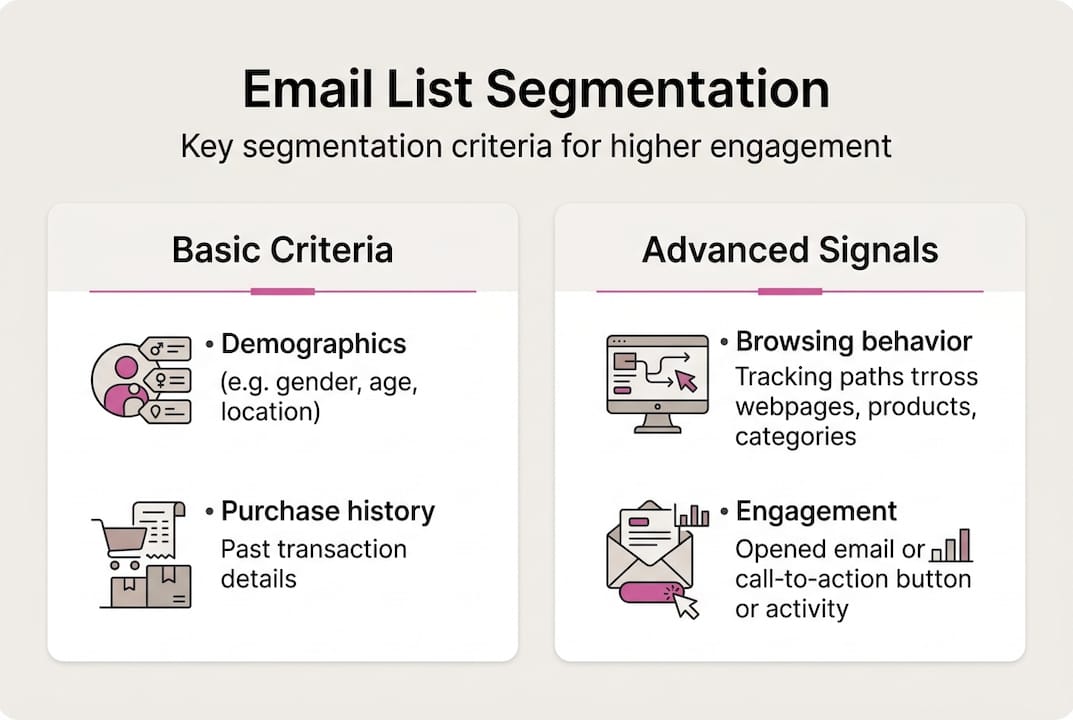
Customer data and behavioural signals are essential for building effective segments. The most useful data types for UK and Irish e-commerce businesses include:
Purchase history: what customers bought, how often, and how recently
Location: country, region, or city, which matters for delivery offers and localised promotions
Demographics: age, gender, or household type where collected with consent
Engagement data: who opens your emails, who clicks, and who has gone quiet
Browsing behaviour: pages visited, products viewed, and abandoned carts
GDPR compliance is non-negotiable for UK and Irish businesses. You must have a lawful basis for processing personal data, and your subscribers must have genuinely opted in. Audit your sign-up forms and data collection processes before you start segmenting. If you are unsure, consult the ICO guidelines for the UK or the DPC for Ireland.
Data type | Source | Segmentation use |
Purchase history | Your e-commerce platform | Frequency, recency, value segments |
Email engagement | Your ESP | Active vs. lapsed subscribers |
Location | Checkout data | Regional campaigns, delivery offers |
Browsing behaviour | Website analytics | Interest-based and retargeting segments |
Demographics | Sign-up forms | Age or gender-specific promotions |
Choosing the right Email Service Provider (ESP) matters enormously. Platforms like Klaviyo, Dotdigital, and Mailchimp all support rules-based segmentation. Review your current tools for email marketing and check whether your ESP can pull data directly from your e-commerce platform. Native integrations with Shopify or WooCommerce make this significantly easier. The list segmentation best practices from Campaign Monitor are a useful reference when evaluating your setup.

Pro Tip: Run a data audit before you build any segments. Remove duplicate records, correct obvious errors, and flag any contacts where consent is unclear. Clean data produces clean segments.
Step-by-step process: how to segment your email lists effectively
With your data in order and your ESP ready, here is a repeatable process for building segments that actually perform.
Define your objective first. Are you trying to re-engage lapsed customers, upsell to high-value buyers, or convert first-time purchasers into repeat ones? Your goal shapes everything else.
Choose your segmentation criteria. Marketers typically use demographics, purchase behaviour, and customer activity as their primary criteria. Start with two or three variables rather than ten.
Build your segments inside your ESP. Use filters and rules to define each group. For example: customers who purchased in the last 90 days, spent over £75, and opened at least one email in the past month.
Create targeted content for each segment. A segment is only as good as the email you send to it. Tailor subject lines, offers, and imagery to match each group’s profile.
Run a small test campaign first. Before rolling out to your full segment, send to a subset. Check open rates, click-throughs, and any unusual bounce or unsubscribe spikes.
Review and refine. Use the results to adjust your criteria, your content, or both.
Segment type | Criteria example | Typical goal |
High-value customers | Spent £200+ in last 6 months | Loyalty rewards, early access |
Lapsed customers | No purchase in 120+ days | Win-back campaigns |
New subscribers | Joined in last 30 days | Welcome series, first purchase offer |
Engaged non-buyers | Opens emails but never purchased | Conversion-focused campaigns |
Behavioural targeting adds another layer of precision. Combining purchase data with browsing signals lets you anticipate what a customer wants before they tell you. Pair this with personalised email marketing and you will see results that generic campaigns simply cannot match. The HubSpot segmentation tips are worth reviewing for additional criteria ideas. Also consider exploring the full range of types of e-commerce email campaigns to match each segment with the right campaign format.
Pro Tip: Resist the urge to create dozens of segments immediately. Three to five well-defined groups will outperform twenty poorly defined ones every time.
Troubleshooting and common segmentation mistakes
Even experienced marketers make errors with segmentation. Knowing what to watch for saves you time, money, and deliverability damage.
The most frequent mistakes include:
Over-segmenting your list. When segments become too small, you lose statistical significance and your results become unreliable. A segment of 40 people tells you very little.
Using stale data. Over-segmentation and stale data can undermine campaign effectiveness. A customer who bought baby products two years ago may no longer be in that life stage.
Ignoring engagement data. Relying only on demographics misses the most predictive signal: whether someone actually interacts with your emails.
Failing to check GDPR permissions. Segmenting by data you do not have explicit consent to use is not just ineffective, it is a compliance risk.
Not monitoring for audience fatigue. If a segment receives too many emails, engagement drops and unsubscribes rise. Watch frequency carefully.
“The biggest segmentation failures we see are not technical. They are strategic. Marketers build complex segment structures without asking what problem they are actually trying to solve.”
The common segmentation mistakes outlined by Smart Insights reinforce this point. Complexity is not the same as sophistication. Review your email growth strategies to ensure segmentation is serving your commercial goals, not just adding operational overhead. And revisit your email mistakes to avoid checklist regularly.
Pro Tip: Set a calendar reminder every quarter to audit your active segments. Remove any that have fewer than 100 subscribers or have not been used in six months.
Measuring results: tracking and improving your segmentation
Building segments is only half the job. Knowing whether they are working, and what to do when they are not, is where most of the long-term value comes from.
The key metrics to track for each segment are:
Open rate: Are people actually reading your emails?
Click-through rate (CTR): Are they engaging with your content?
Conversion rate: Are they completing the desired action, whether that is a purchase, a sign-up, or a download?
Revenue per email: What is each send actually worth in commercial terms?
Unsubscribe rate: Are you losing subscribers faster than you are engaging them?
Ongoing review of open, click, and conversion rates is critical to improving segmentation over time. Without this discipline, even well-built segments decay as customer behaviour shifts.
A/B testing is your most powerful tool here. Test one variable at a time: the segment criteria, the subject line, the send time, or the offer. Changing multiple things at once makes it impossible to know what drove the result. The improve segmentation results guidance from Sendinblue covers practical A/B frameworks worth adopting.
Stat to note: Marketers who A/B test their segmented campaigns regularly report conversion rate improvements of 20 to 30% within three to six months.
Set a formal review schedule. Monthly check-ins for active segments, quarterly reviews for your overall segmentation strategy. Automating email segmentation through your ESP can flag performance drops automatically, so you are not relying on manual monitoring alone.
A smarter, simpler way: rethinking email list segmentation in e-commerce
Here is something we have learnt from over 25 years of scaling e-commerce brands: the marketers who obsess over building more segments rarely outperform those who build fewer, better ones.
There is a widespread assumption that hyper-segmentation, breaking your list into dozens of micro-groups, is the gold standard. In practice, it often creates operational chaos without proportional results. Segments become too small to test meaningfully. Content production becomes a bottleneck. And the original goal, sending more relevant emails, gets buried under process.
What actually works is clarity. Know your customer journey. Identify the two or three moments where a well-timed, relevant email genuinely changes behaviour. Build segments around those moments. That is it.
Personalised marketing does not require a hundred segments. It requires honest thinking about what your customers need and when they need it. Segmentation is a means to an end. The end is a customer who feels understood. Keep that in focus and your strategy will stay sharp.
Take your email marketing to the next level
Putting segmentation into practice takes time, the right tools, and a clear strategy. If you are managing a growing e-commerce operation in the UK or Ireland, the gap between knowing what to do and actually doing it well can cost you significant revenue.

At iwanttobeseen.online, we specialise in helping e-commerce businesses build and scale email marketing strategies that deliver measurable results. From auditing your current setup to building automated, segmented campaigns, our team brings over 25 years of hands-on experience to every project. If you are ready to turn your email list into a genuine revenue channel, explore our e-commerce email marketing support and find out how we can help you get there faster.
Frequently asked questions
What are the best criteria for segmenting my e-commerce email list?
Start with demographics, purchase behaviour, and engagement as your primary criteria, as these have the strongest and most consistent impact on campaign results.
How often should I update my email list segments?
Review and update your segments at least quarterly. Regular segment reviews ensure your groups stay relevant as customer behaviour evolves.
Can I automate my email segmentation process?
Yes. Most ESPs support automated, rules-based segmentation that updates in real time as customer data changes, removing the need for manual list management.
Is segmentation necessary for small e-commerce lists?
Segmentation boosts engagement regardless of list size. Even a list of a few hundred subscribers benefits from basic groupings by purchase behaviour or engagement level.
What is the most common mistake managers make with segmentation?
Over-segmenting and allowing data to go stale are the most frequent pitfalls. Keep your approach focused and your data current, as stale data undermines even well-designed campaigns.
Recommended
Comments