.png)
Complete Guide to Marketing Funnels for E-Commerce

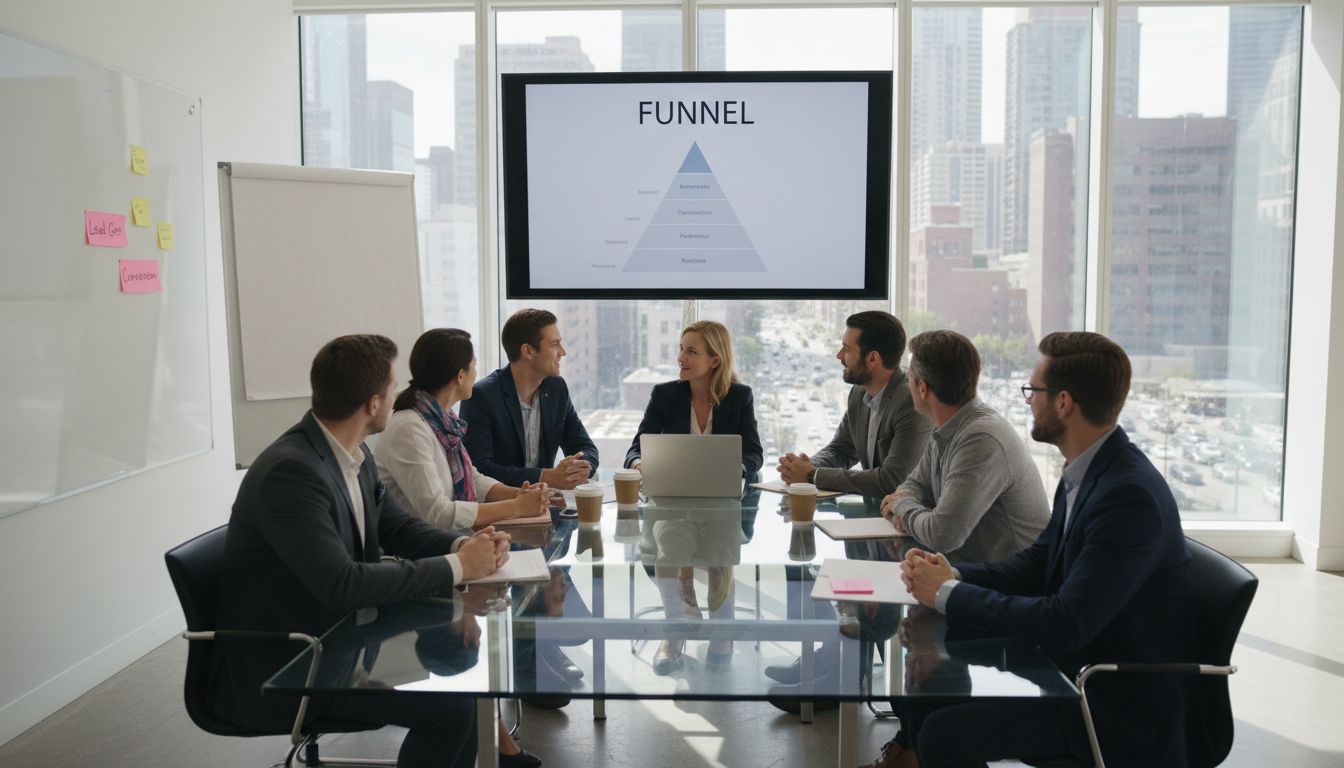
Most businesses underestimate just how vital a clear marketing funnel is for driving consistent e-commerce growth. Studies show that companies with well-defined funnel strategies enjoy conversion rates up to three times higher than their competitors. For british entrepreneurs and marketers, understanding every stage of the funnel offers a practical path to guiding customers from curiosity to loyal fans. This guide breaks down the funnel’s core concepts and reveals how smart businesses shape real buyer behaviour.
Table of Contents
Key Takeaways
Point | Details |
Understanding the Marketing Funnel | The marketing funnel is a strategic framework illustrating the customer journey from awareness to purchase, enabling tailored marketing strategies at each stage. |
Stages of Consumer Progression | Recognising distinct phases such as awareness, consideration, and conversion helps businesses create targeted communications that resonate with customers’ needs. |
Impact of Content Type | Different types of content influence buyer behaviour at various funnel stages, necessitating a nuanced approach to content strategy. |
Avoiding Common Mistakes | Implementing a one-size-fits-all strategy can hinder effectiveness; businesses should adopt a multi-channel, customer-centric approach for better engagement. |
Defining the Marketing Funnel Concept
The marketing funnel represents a strategic framework for understanding how potential customers progress from initial awareness to final purchase. It is fundamentally a visual representation of the customer journey that breaks down complex purchasing behaviours into distinct, manageable stages.
Traditionally illustrated as an inverted pyramid, the marketing funnel captures how consumer interest narrows as they move closer to making a purchase. Each stage within the funnel serves a specific purpose in guiding potential customers through their decision-making process. The funnel typically encompasses several key stages: awareness, interest, consideration, evaluation, and ultimately, conversion.
At the awareness stage, businesses aim to capture potential customers’ attention through various marketing channels such as social media, content marketing, and advertising. This initial phase is critical for generating initial interest and introducing your brand or product to a wider audience. As potential customers progress through subsequent stages, marketing strategies become more targeted and personalised, focusing on addressing specific customer needs and pain points.
The marketing funnel is not a linear progression but a dynamic model that recognises the complexity of consumer behaviour. Different customers may move through stages at varying speeds, and some might require multiple touchpoints before making a purchase. Understanding this nuanced approach allows e-commerce businesses to develop more sophisticated, responsive marketing strategies that effectively guide potential customers towards conversion.
Stages and Models of the Marketing Funnel
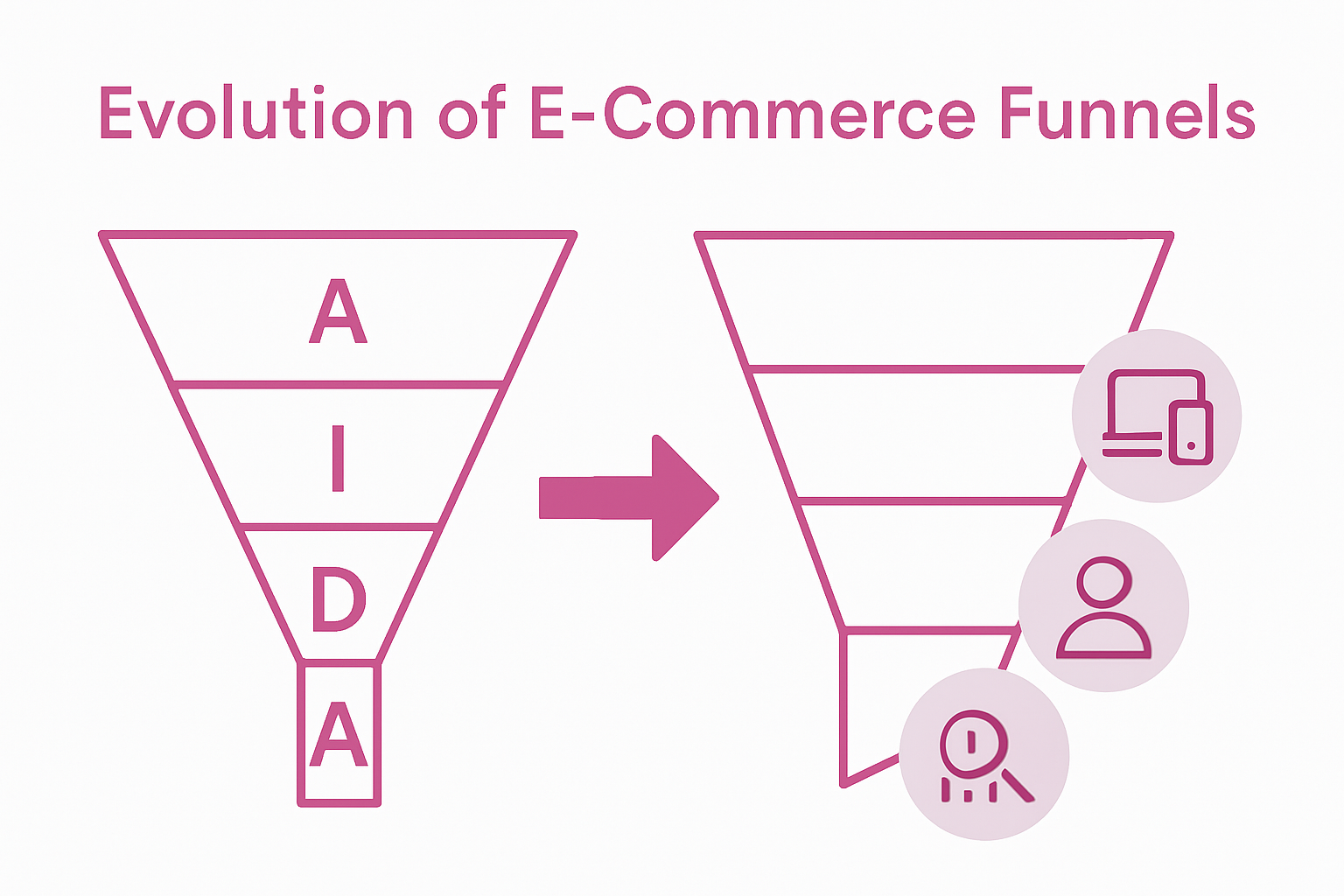
Marketing funnels offer multiple models for understanding customer progression, with the AIDA model serving as a foundational framework. This classic approach breaks down consumer engagement into four critical stages: Attention, Interest, Desire, and Action. Each stage represents a psychological milestone in the customer’s decision-making journey, providing marketers with a structured approach to understanding and influencing purchasing behaviours.
Beyond the traditional AIDA model, more sophisticated frameworks have emerged to capture the nuanced complexity of modern consumer interactions. The AISDALSLove model represents a more comprehensive approach, expanding the classic stages to include additional elements such as Search, Like/Dislike, Share, and Love/Hate. This advanced model recognises that contemporary consumer journeys are rarely linear and often involve multiple emotional and interactive touchpoints.
Typical marketing funnel stages generally include awareness, interest, consideration, intent, evaluation, and purchase. However, progressive models now extend beyond the point of sale, incorporating post-purchase stages like retention, advocacy, and brand loyalty. E-commerce businesses must understand that each stage requires distinct marketing strategies, tailored communication approaches, and specific performance metrics.

The evolution of marketing funnel models reflects the increasing complexity of digital consumer behaviour. Modern funnel approaches are less about pushing customers through a rigid progression and more about creating responsive, personalised experiences that adapt to individual customer preferences and interactions. Successful e-commerce strategies now focus on creating seamless, engaging journeys that anticipate and meet customer needs across multiple digital and physical touchpoints.
How Marketing Funnels Drive Buyer Behaviour
Marketing funnels provide a sophisticated framework for understanding and predictive modeling of consumer decision-making processes. By mapping the psychological journey from initial awareness to final purchase, these models reveal critical insights into how buyers interact with brands and make purchasing decisions. The funnel approach allows businesses to strategically influence consumer behaviour by understanding the specific psychological triggers at each stage of the buying process.
Research demonstrates that different types of content significantly impact buyer behaviour across marketing funnel stages. At the awareness stage, broad-reach content generates initial interest, while deeper, more detailed content becomes crucial during consideration and evaluation stages. This nuanced approach recognises that consumers require different types of information and emotional engagement as they progress through their purchasing journey.
The psychological mechanisms driving buyer behaviour are complex and multifaceted. Cognitive triggers play a crucial role in moving potential customers through the funnel, with factors like social proof, scarcity, authority, and reciprocity influencing decision-making. E-commerce businesses can strategically design their marketing communications to address specific psychological needs at each funnel stage, creating a more personalised and compelling customer experience.
Ultimately, effective marketing funnels transform linear purchasing paths into dynamic, responsive journeys. By understanding how marketing strategies can be tailored to different consumer segments, businesses can create more targeted, engaging experiences that anticipate and meet individual customer needs. The most successful e-commerce brands recognise that driving buyer behaviour is less about pushing sales and more about building meaningful connections that guide customers naturally towards making informed purchasing decisions.
Integrating Funnels with E-Commerce Strategies
Successful e-commerce strategies demand sophisticated integration of marketing funnels through context-enhanced learning techniques that optimise intervention strategies. By developing a comprehensive approach that tracks customer interactions across multiple touchpoints, businesses can create more responsive and personalised marketing approaches that effectively guide potential customers through their purchasing journey.
Advanced e-commerce organisations are now implementing model-free approximate learning approaches to maximise conversion funnel optimisation. These sophisticated strategies involve creating dynamic, data-driven frameworks that adapt in real-time to individual customer behaviours, allowing for highly personalised interventions that increase the probability of successful conversions. Sequential personalisation becomes a critical strategy, enabling businesses to design targeted marketing communications that resonate with specific customer segments.
Technological advancements have transformed traditional marketing funnel integration, enabling e-commerce businesses to leverage sophisticated data analysis and machine learning techniques. Content marketing strategies play a crucial role in supporting these integrated approaches, allowing companies to create targeted, contextually relevant messaging that moves customers seamlessly through different funnel stages. This approach requires a holistic understanding of customer psychology, technological capabilities, and strategic communication.
Ultimately, integrating marketing funnels with e-commerce strategies is not about implementing a one-size-fits-all approach, but developing flexible, intelligent systems that can adapt to complex customer journeys. By combining advanced technological tools with deep customer insights, businesses can create marketing ecosystems that anticipate customer needs, personalise interactions, and ultimately drive more effective and efficient conversion processes.
Common Mistakes and Best Practices
E-commerce businesses frequently encounter significant barriers when implementing marketing funnels, with research highlighting critical challenges in consumer progression through different funnel stages. Common mistakes often stem from a lack of understanding about the nuanced requirements of each stage, leading to disconnected and ineffective marketing strategies that fail to engage potential customers effectively.
One of the most prevalent errors is adopting a one-size-fits-all approach to media selection and communication. Empirical studies demonstrate the critical importance of strategic media choice in effectively guiding consumers through marketing funnels. Businesses must develop sophisticated, stage-specific communication strategies that adapt to the unique psychological needs of potential customers at each funnel stage, rather than relying on generic messaging that fails to resonate.
Best practices for marketing funnel implementation involve developing a multi-channel, data-driven approach. Digital marketing strategies require comprehensive, integrated communication methods that create seamless experiences across different touchpoints. This means carefully tracking customer interactions, personalising content, and creating responsive marketing ecosystems that can adapt to individual customer behaviours and preferences.
Ultimately, successful marketing funnel implementation is about understanding and anticipating customer needs rather than pushing aggressive sales tactics. The most effective strategies focus on building trust, providing value, and creating meaningful connections that naturally guide potential customers towards conversion. By avoiding common pitfalls and embracing a more nuanced, customer-centric approach, e-commerce businesses can develop marketing funnels that are not just conversion tools, but powerful mechanisms for building long-term customer relationships.
Unlock the Full Potential of Your E-Commerce Marketing Funnel Today
Navigating the complex stages of a marketing funnel can be overwhelming. From capturing awareness to nurturing consideration and driving conversion, each step demands precise, data-driven strategies that resonate with your customers’ needs. This article highlights common challenges like ineffective media selection and the lack of personalised communication, which often leave e-commerce businesses struggling to guide buyers smoothly through every stage. If you want to avoid these pitfalls and create a dynamic funnel that adapts to your customer’s behaviour, expert guidance is essential.

Take your e-commerce marketing to the next level with our specialised digital marketing services that focus on SEO, AI, social media and PPC to drive growth at every funnel stage. With over 25 years of experience scaling successful e-commerce brands, we know how to build responsive, customer-centric funnels that turn shoppers into loyal advocates. Visit our homepage now to discover how tailored, multi-channel strategies can overcome buyer hesitation and deliver measurable results. Don’t wait to transform your marketing approach — the right strategy awaits you at iwanttobeseen.online.
Frequently Asked Questions
What are the key stages of a marketing funnel for e-commerce?
The key stages of a marketing funnel typically include awareness, interest, consideration, evaluation, and conversion. Some models also incorporate post-purchase stages like retention and advocacy.
How can content marketing influence buyer behaviour in the marketing funnel?
Content marketing plays a crucial role by providing tailored information at different funnel stages. At the awareness stage, broad content generates interest, while detailed content becomes essential during consideration and evaluation.
What mistakes should e-commerce businesses avoid when implementing marketing funnels?
Common mistakes include adopting a one-size-fits-all approach to communication and failing to develop stage-specific strategies. It’s essential to personalise marketing efforts to meet the unique needs of potential customers at each stage of the funnel.
How can e-commerce businesses integrate marketing funnels into their overall strategy?
E-commerce businesses can integrate marketing funnels by using data-driven techniques to track customer interactions, personalising content, and creating responsive marketing ecosystems that adapt to customer behaviour.
Recommended
Comments