.png)
Email Marketing: Driving eCommerce Growth Effectively


Over 80 percent of successful British eCommerce brands rank email marketing among their most profitable digital tactics. With shoppers expecting personalised offers and relevant updates, the right strategy can turn a single message into long-term customer loyalty. This guide empowers British businesses to master powerful email marketing techniques proven to boost engagement, drive repeat sales, and meet evolving privacy standards.
Table of Contents
Key Takeaways
Point | Details |
Effective Email Marketing | Utilise personalised, targeted messaging to enhance customer engagement and conversion rates in eCommerce. |
Segmented Campaigns | Implement segmented email campaigns such as welcome emails and abandoned cart reminders to cater to specific customer needs. |
Automation and Compliance | Leverage email automation while ensuring compliance with GDPR by obtaining explicit consent and maintaining transparent data practices. |
Avoid Common Mistakes | Focus on creating compelling subject lines and optimising content for mobile to improve the overall effectiveness of email communications. |
Email Marketing Defined For eCommerce Success
Email marketing represents a strategic digital communication approach designed to connect businesses directly with their potential and existing customers through targeted electronic messaging. At its core, email marketing enables personalised consumer communication that empowers customers by providing interactive and tailored experiences.
For eCommerce businesses, email marketing serves multiple critical functions beyond simple promotion. It functions as a sophisticated relationship-building tool that nurtures customer connections through segmented, data-driven communication strategies. By analysing consumer behaviour, preferences, and engagement patterns, businesses can craft highly targeted email campaigns that speak directly to individual customer needs and interests.

The mechanics of effective email marketing involve sophisticated tactics observed in leading UK retailers. Research examining promotional emails from top e-retailers reveals critical strategies including dynamic subject lines, interactive content formats, and personalisation techniques that dramatically enhance customer engagement and conversion rates. Successful email marketing goes far beyond generic mass messaging, instead focusing on creating meaningful, relevant interactions that provide genuine value to recipients.
Pro Tip: Segmentation Strategy: Create at least three distinct customer segments based on purchasing history, browsing behaviour, and engagement levels to deliver hyper-targeted email content that resonates with each group’s specific preferences and needs.
Types Of Email Campaigns And Their Purposes
Email marketing encompasses several strategic campaign types designed to achieve specific business objectives within the eCommerce ecosystem. Research on permission-based email marketing reveals that successful campaigns rely on carefully crafted executional elements that attract and retain customer interest through targeted messaging.
Key email campaign types include:
Welcome Emails: Introduce new subscribers to the brand, setting initial expectations and offering first-purchase incentives
Abandoned Cart Campaigns: Remind customers about products left in their online shopping cart, often including personalised discounts
Product Recommendation Emails: Leverage customer purchase history and browsing behaviour to suggest relevant merchandise
Re-engagement Campaigns: Target inactive customers with special offers to reignite their interest
Seasonal Promotional Campaigns: Align with holidays, events, or specific shopping periods to drive time-sensitive sales
Cultural context research demonstrates that email campaign effectiveness depends significantly on nuanced elements like text length, scarcity messaging, and personalisation strategies. Successful campaigns carefully balance informative content with compelling call-to-action techniques that motivate customer interaction.
To better understand the diverse purposes of email campaigns in eCommerce, see the comparative summary below:
Campaign Type | Primary Objective | Typical Timing | Unique Benefit |
Welcome Emails | Build early brand trust | After sign-up | Accelerates first purchase |
Abandoned Cart Campaigns | Recover lost sales | Minutes to hours post-abandon | Boosts conversion rate |
Product Recommendation Emails | Increase basket size | Post-purchase or browse | Drives repeat purchases |
Re-engagement Campaigns | Win back inactive users | After extended inactivity | Revives lapsed customer interest |
Seasonal Promotions | Capitalise on festive sales | Pre-holiday or event | Maximises timely revenue |
Pro Tip: Dynamic Content Strategy: Implement a robust email personalisation approach by segmenting your audience and creating dynamically generated content that adapts to individual customer preferences, purchase history, and engagement levels.
How Email Automation And Segmentation Work
Email automation and segmentation represent sophisticated strategies that transform generic mass communication into precision-targeted marketing approaches. Advanced research on personalised product recommendations demonstrates how leveraging user purchase history can create highly tailored email experiences that dramatically improve customer engagement and conversion rates.
The core mechanisms of email automation involve several critical components:
Data Collection: Gathering comprehensive customer interaction data
Behavioural Tracking: Monitoring individual customer browsing and purchasing patterns
Trigger-Based Messaging: Designing automated emails based on specific customer actions
Dynamic Content Generation: Creating personalised email content that adapts to individual preferences
Predictive Analysis: Anticipating customer needs through machine learning algorithms
Cutting-edge research exploring automated email content generation reveals how sophisticated language models can now craft thematic email titles that resonate with specific customer segments. This technological advancement enables businesses to create more engaging, contextually relevant email communications that feel personalised and timely, rather than generic and impersonal.
Pro Tip: Automation Precision: Implement a multi-layered segmentation approach that combines demographic data, purchasing behaviour, and engagement history to create granular customer segments, allowing for hyper-targeted automated email campaigns that feel individually crafted.
Legal Obligations: GDPR And Email Compliance
GDPR represents a comprehensive legal framework that fundamentally transforms how businesses approach digital communication and customer data management. Research analysing email marketing practices post-GDPR reveals significant challenges in maintaining compliance, particularly around promotional email practices and consumer opt-out preferences.
Key legal requirements for email marketing under GDPR include:
Explicit Consent: Obtaining clear, unambiguous permission before sending marketing communications
Transparent Data Usage: Providing detailed information about how customer data will be used
Right to Withdraw: Enabling simple, straightforward opt-out mechanisms
Data Minimisation: Collecting only essential information required for marketing purposes
Secure Data Storage: Implementing robust protection measures for customer information
Permission-based marketing research emphasises the critical importance of empowering consumers through transparent, consent-driven communication strategies. This approach not only ensures legal compliance but also builds trust by respecting individual privacy preferences and providing customers genuine control over their personal data.
For clarity, here is a summary of how key GDPR requirements impact eCommerce email practices:
GDPR Principle | Requirement for eCommerce Emails | Business Benefit |
Explicit Consent | Obtain clear, opt-in permission | Reduces risk of legal penalties |
Transparent Use | Explain data handling practices | Builds long-term customer trust |
Easy Withdrawal | Offer direct unsubscribe options | Enhances brand reputation |
Data Minimisation | Request only needed information | Prevents excessive data retention |
Secure Storage | Protect customer information | Minimises breach risks |
Pro Tip: Compliance Documentation: Maintain a comprehensive audit trail of customer consent, including timestamp, method of consent, and specific permissions granted, to demonstrate regulatory compliance and protect your business from potential legal challenges.
Common Email Marketing Mistakes To Avoid
Research on email marketing effectiveness highlights critical mistakes that can significantly undermine the performance of digital marketing campaigns. Understanding these pitfalls is crucial for eCommerce businesses seeking to maximise their email communication strategies.
Common email marketing mistakes include:
Generic Subject Lines: Failing to create compelling, personalised headline text that sparks immediate interest
Overcrowded Content: Overwhelming recipients with dense, lengthy email compositions
Inconsistent Sending Frequency: Bombarding subscribers or disappearing for extended periods
Neglecting Mobile Optimisation: Designing emails that don’t render correctly on smartphone devices
Lack of Personalisation: Sending identical messages to entire subscriber lists without segmentation
Weak Call-to-Action: Using vague or uninspiring action prompts that fail to drive engagement
Scientific analysis of email communication strategies reveals that text length and engagement elements dramatically impact click-through rates. Successful email campaigns require a delicate balance between concise messaging and compelling content that motivates recipients to take action.
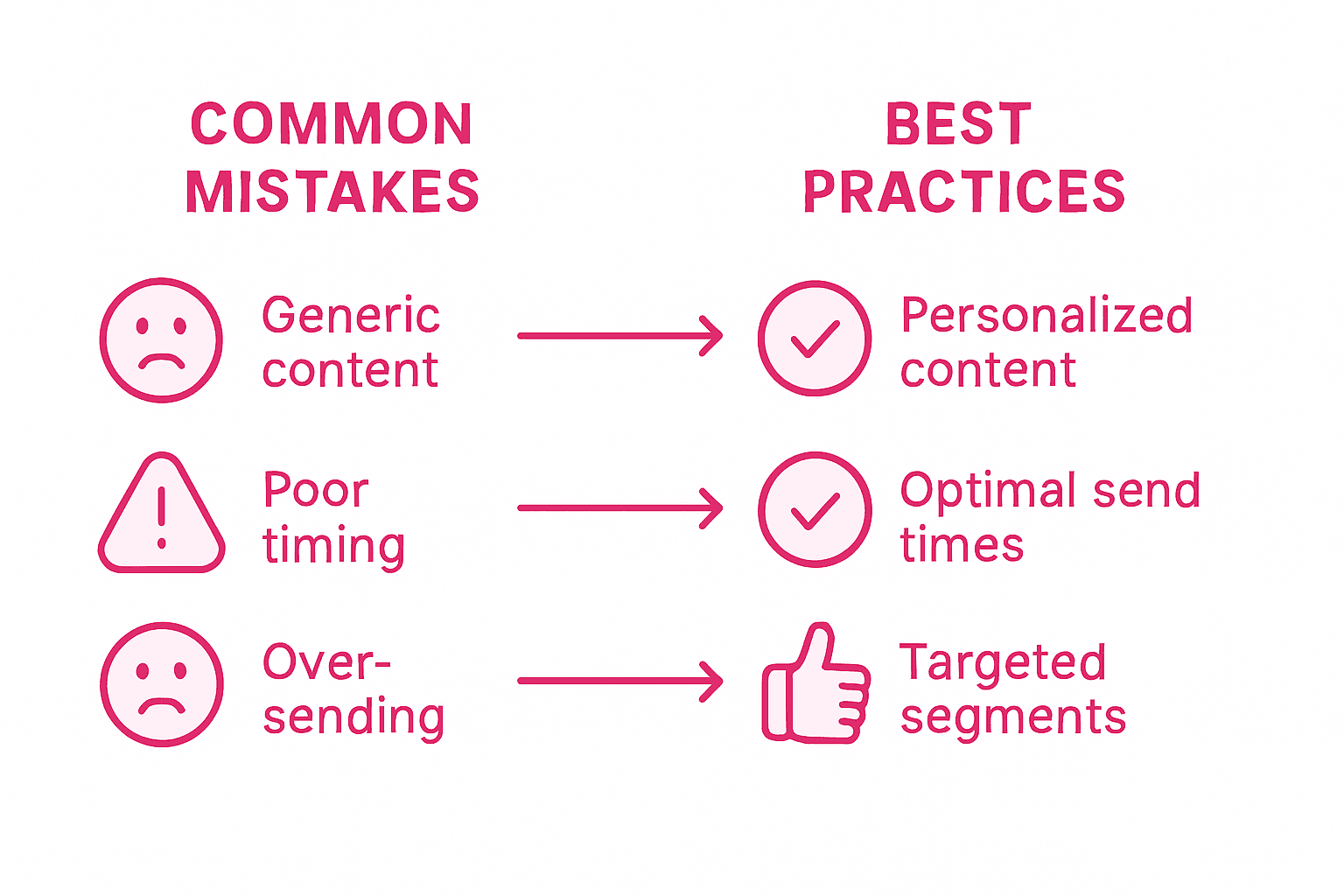
Pro Tip: Content Refinement: Develop a rigorous email review process that includes A/B testing subject lines, trimming unnecessary text, and ensuring every communication provides clear, immediate value to the recipient.
Elevate Your eCommerce Growth With Expert Email Marketing Support
Struggling to turn your email campaigns into powerful revenue drivers? The article highlights common challenges such as generic messaging, poor segmentation, and compliance complexities like GDPR. These hurdles can leave your marketing efforts feeling ineffective and disconnected from your customers. With decades of experience in scaling successful eCommerce brands, we understand the critical need for personalised, data-driven email marketing that captivates and converts.
Unlock the potential of targeted email automation, dynamic content, and compliance confidence with our specialised digital marketing services. Discover how combining SEO, AI, social media, and PPC strategies can create a seamless customer journey that transforms email into your strongest growth channel. Learn more about our expertise and tailored solutions at https://iwanttobeseen.online.
Ready to harness the power of precision email marketing and elevate your eCommerce business today?

Partner with us now for a customised marketing strategy that respects your customers and accelerates your sales. Visit our website and start transforming your email campaigns into lasting growth opportunities.
Frequently Asked Questions
What are the benefits of email marketing for eCommerce?
Email marketing allows for direct communication with potential and existing customers, fostering relationships through personalised and targeted messaging. It helps in driving sales, improving customer engagement, and enhancing brand loyalty.
How can segmentation improve my email marketing campaigns?
Segmentation allows businesses to divide their subscriber list into distinct groups based on factors like behaviour, purchasing history, and engagement levels. This results in hyper-targeted emails that resonate more with specific customer needs, ultimately improving engagement and conversion rates.
What types of email campaigns should eCommerce businesses focus on?
ECommerce businesses should focus on various types of email campaigns, including welcome emails, abandoned cart reminders, product recommendations, re-engagement emails, and seasonal promotions to effectively connect with their audience and drive sales.
How do I ensure my email marketing complies with GDPR?
To comply with GDPR, ensure you obtain explicit consent from customers before sending marketing emails, provide clear information on how their data will be used, offer straightforward options to opt-out, and securely store customer data.
Recommended
Comments